wayground logo

Free Printable Worksheets

NEW

Font size

S
M
L
XL
Worksheets

Biology II Evolution Unit

Total questions: 67

Worksheet time: 49mins

Name
Class
Date
1.
What does the variable q represent?
a)
Frequency of the heterozygote genotype
b)
Frequency of the homozygous recessive genotype
c)
The frequency of the recessive allele
d)
The frequency of the dominant allele 
2.
In a population of humans, the frequency of no dimples is 0.36. If having no dimples is the recessive phenotype, what is the frequency of the recessive allele?
a)
0.6
b)
0.36
c)
0.64
d)
0.18
3.
Which is a mechanism for change in allele frequency?
a)
gene flow
b)
genetic drift
c)
natural selection
d)
all answers are correct
4.
Which of the following is NOT a condition for Hardy-Weinberg Equilibrium?
a)
No mutations
b)
Random Mating
c)
No natural selection
d)
No offspring
5.
The Hardy-Weinberg Model is?
a)
Available at local hobby stores and retailers throughout the Greater Cleveland area.
b)
A mathematical tool that biologists can use to predict allele frequencies and determine whether or not evolution is occurring within a population.
c)
Always occurring within populations of organisms in nature.
d)
Only useful in the lab and cannot be practically applied to real-world populations of organisms.  
6.
When a population is in Hardy-Weinberg Equilibrium.  What is not happening to the species?
a)
Survival
b)
Reproduction
c)
Death
d)
Evolution
7.
A group of Kent squirrels, they are black, accidentally get put on a truck to Cleveland.  After the squirrels are dropped off in Cleveland they begin to mate with all the squirrels there.  Which of Hardy-Weinberg conditions are being broken in this scenario?
a)
No Death or Reproduction
b)
No Gene Flow
c)
No Natural Selection
d)
No Genetic Drift
8.
What does the Hardy-Weinberg equilibrium measure?
a)
changes in allele frequencies
b)
numbers of mutations
c)
goodness of fit
d)
genetic diversity
9.
A population of 150 individuals has an allele frequency of 0.3 for the dominant allele (B) and a frequency of 0.7 for the recessive allele (b). Use the Hardy-Weinberg equation to determine freq.(bb).
a)
0.09
b)
0.42
c)
0.49
d)
0.21
10.
If the frequencies are as follows in a population with a total size of 150: f(BB)=0.16, f(Bb)=0.48, and f(bb)=0.36, determine the expected numbers of organisms with genotype Bb.
a)
24
b)
72
c)
54
d)
150
11.
If the frequencies are as follows in a population with a total size of 150: f(BB)=0.16, f(Bb)=0.48, and f(bb)=0.36, determine the expected numbers of organisms with genotype bb.
a)
24
b)
72
c)
54
d)
150
12.
Gene flow involves
a)
Natural disasters killing most of the members of a population
b)
Individuals moving into and out of the population
c)
Selective mating
d)
Small changes because of the environment
13.
Yellow toucan birds seek out one another to make babies together and tend to avoid the green toucan birds.
a)
Genetic Drift
b)
Non-random mating
c)
Gene flow
d)
Mutation
14.
T5. What does the image represent?
a)
Founder effect
b)
Bottleneck effect
c)
Mutation
d)
Natural Selection
15.
Which of the following is an example of the bottle neck effect?
a)
Bald Eagles are hunted until near extinction, population recovers.
b)
Small group of iguanas floats to an island, starts a new population.
c)
Red fox pups are more likely to survive in a snowy environment if they are born white.
d)
Farmer chooses seeds from largest apples to plant next year.  This results in larger apples from year to year.
16.
Which of the following is an example of the founder effect?
a)
Bald Eagles are hunted until near extinction, population recovers.
b)
Small group of iguanas floats to an island, starts a new population.
c)
Red fox pups are more likely to survive in a snowy environment if they are born white.
d)
Farmer chooses seeds from largest apples to plant next year.  This results in larger apples from year to year.
17.

Which of the following is an example of natural selection?

a)

Bald Eagles are hunted until near extinction, population recovers.

b)

Small group of iguanas floats to an island, starts a new population.

c)

Red fox pups are more likely to survive in a snowy environment if they are born white.

d)

Farmer chooses seeds from largest apples to plant next year. This results in larger apples from year to year.

18.

In the Hardy-Weinberg Equation, q2 is the frequency of what?

a)

The recessive allele

b)

the dominant allele

c)

the recessive genotype

d)

the dominant genotype

19.
Mutations are important because they bring about
a)
death of the organism in which they develop
b)
genetic variation needed for a population to evolve
c)
benefits for the individual, not for the population
d)
Hardey-Weinberg equilibrium within a population
20.
Which Hardy-Weinberg equation represents the genotype frequencies in a population?
a)
p + q = 1
b)
p2 + 2pq + q2 = 1
c)
p2 + pq2 + q2 = 1
d)
p + 2pq + q3 = 1
21.

What is an example of sexual selection?

a)

One sex of an organism is preferred over the other

b)

A small subgroup of a population leaves and forms a new population

c)

Female birds prefer male birds with red feathers

d)

Individuals move between two populations, exchanging genes

22.
What is an organism that has similar characteristics and can reproduce?
a)
species
b)
organism
c)
embryology
d)
vestigial 
23.
Which layer is the oldest?
a)
1
b)
2
c)
3
d)
4
24.
A remnant or trace of an organism from the past is called a _______.
a)
Ancestor
b)
Skeleton
c)
Fossil
d)
Imprints
25.
Which of the following is an example of a vestigial structure?
a)
the wings of a red-tailed hawk
b)
the hind limbs of a house cat
c)
the fins of sharks
d)
the tailbone of a human
26.
You look at two species and see very similar DNA. What does this likely tell you?
a)
These are the same animal.
b)
These animals have a common ancestor.
c)
These animals are not likely related.
d)
These animals are likely becoming one species.
27.
If an organism has a vestigial structure, that structure likely once had a function in a(n)
a)
close relative
b)
early ancestor
c)
unrelated organism
d)
embryological stage
28.

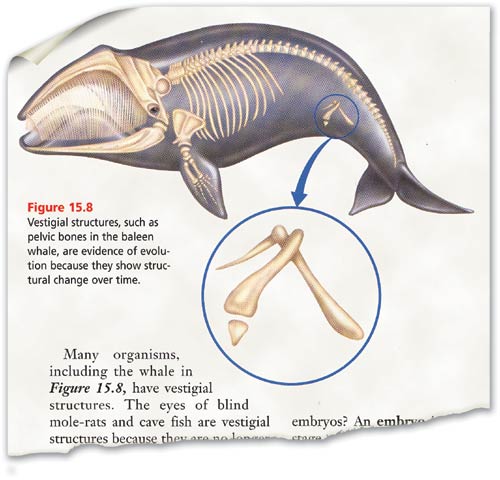
Whales are aquatic mammals, but fossil evidence shows that they have a leg bone. Even though it does not aid in its movement, the function must have been used by a common ancestor of the whale. Thus, the leg bone is referred to as a(n)

a)

Vestigial structure

b)

Homologous structure

c)

Analogous structure

d)

Embryonic structure

29.
What is speciation?
a)
  The process by which populations become geographically isolated
b)
The process in which reproductively isolated populations evolve to become distinct species
c)
The process in which reproductively isolated populations do not evole
d)
None of these
30.
What is geographic isolation?
a)
Members of a population live together within an geographic boundary
b)
Members of a population may become isolated from one another by geographic boundaries
c)
An isolation that is geographic
d)
None of these
31.
What is reproductive isolation?
a)
When two populations can no longer produce offspring
b)
When two populations can no longer produce viable offspring
c)
When two populations can produce viable, fertile offspring
d)
When the two populations can no longer produce viable, fertile offspring
32.

Species of birds with different mating times

a)

temporal

b)

behavioral

c)

geographic

d)

other

33.
If the environment suddenly changed, how could a species go extinct?
a)
The environmental change means fewer predators are around
b)
There are more homes available in the newly changed environment
c)
New resources are available with less competition
d)
There aren't enough members of the species with a trait necessary to survive in the new environment
34.
In convergent evolution, organisms share physical similarities because they 
a)
have a common ancestor
b)
live in the same enviornment
c)
develop homologous structures
d)
are closely related 
35.
a)
The image shows convergent evolution.
b)
The image shows divergent evolution.
c)
The image shows adaptive radiation.
d)
The image shows homologous structures.
36.
a)
The image shows convergent evolution. 
b)
The image shows divergent evolution. 
c)
The image shows adaptive radiation.
d)
The image shows analogous structures.
37.
Which answer best describes macroevolution?
a)
Largest-scale evolutionary changes that occur over time
b)
A scientist who classifies organisms into groups and makes a hypothesis on whether they are a different species based on the evidence
c)
Identification of species by differences in their appearances
d)
AP biological trait evolves in two unrelated species as a result of exposure to similar environments
38.
Define a taxonomist
a)
Species that look almost identical but are very different in other traits, such as habitat or courtship behaviors
b)
Identification of species by differences in their appearances
c)
A scientist who classifies organisms into groups and makes a hypothesis on whether they are a different species based on the evidence
d)
The formation of a new distinct species in the course of evolution
39.
What is Morphology?
a)
When traits that increase prezygotic isolation are favored by natural selection
b)
When species are distinguished from each other by one or more distinct physical characteristics called diagnostic
c)
Species that look almost identical but are very different in other traits, such as habitat or courtship behaviors
d)
Identification of species by differences in their appearances
40.
What is Morphological species concept?
a)
Identification of species by differences in their appearances
b)
Species that look almost identical but are very different in other traits, such as habitat or courtship behaviors
c)
When species are distinguished from each other by one or more distinct physical characteristics called diagnostic
d)
Using a family tree to identify species based on a common ancestor
41.
What is Phylogenetic species concept?
a)
Relies on identification of certain morphological traits to distinguish one species from another
b)
Distinct physical characteristic used to  distinguish morphological species
c)
Species that look almost identical but are very different in other traits, such as habitat or courtship behaviors
d)
Using a family tree to identify species based on a common ancestor
42.
What is a Zygote?
a)
A branch that contains all the descendants of a common ancestor in a phylogeny
b)
A diploid cell resulting from the fusion of two haploid gametes
c)
They prevent reproductive attempts and make it unlikely that fertilization will be successful if mating occurs.
d)
A barrier that prevents species from mating because they breed at different times
43.
What are prezygotic isolating mechanisms?
a)
They prevent reproductive attempts and make it unlikely that fertilization will be successful if mating occurs.
b)
When animal genitalia or plant floral structures are incompatible, reproduction can not occur
c)
Courtship patterns used to allow male and female to recognize one another
d)
A biological trait evolves in two unrelated species as a result of exposure to similar environments
44.
What is Hybridization?
a)
A branch that contains all the descendants of a common ancestor in a phylogeny
b)
A hybrid zygote may develop into a sterile adult
c)
The formation of a new distinct species in the course of evolution
d)
The mating between two species
45.
What best defines Behavioral isolation?
a)
Courtship patterns used to allow male and female to recognize one another
b)
Even if the two gametes of two different species meet, they can not fuse to become a zygote
c)
When animal genitalia or plant floral structures are incompatible, reproduction can not occur
d)
Even if the two gametes of two different species meet, they can not fuse to become a zygote
46.
What choice answer best defines mechanic isolation?
a)
A biological trait evolves in two unrelated species as a result of exposure to similar environments
b)
Barriers that prevent the formation of a fertile offspring
c)
When animal genitalia or plant floral structures are incompatible, reproduction can not occur
d)
The mating between two species
47.
What choice answer best defines Gamete isolation?
a)
A biological trait evolves in two unrelated species as a result of exposure to similar environments
b)
Even if the two gametes of two different species meet, they can not fuse to become a zygote
c)
Barriers that prevent the formation of a fertile offspring
d)
The mating between two species
48.
What are Postzygotic isolating mechanisms?
a)
A diploid cell resulting from the fusion of two haploid gametes
b)
Barriers that prevent the formation of a fertile offspring
c)
They prevent reproductive attempts and make it unlikely that fertilization will be successful if mating occurs
d)
The mating between two species
49.
What is Hybrid inviability?
a)
A hybrid zygote that may develop into a sterile adult
b)
Speciation on an organism separated by geographic or physical barrier
c)
Speciation that occurs in the absence of a geographic barrier.
d)
The demise of a hybrid zygote due to inviability
50.
What is Hybrid Sterility?
a)
The demise of a hybrid zygote due to inviability
b)
A hybrid zygote may develop into a sterile adult
c)
A diploid gamete produced by a diploid plant due to nondisjunction during meiosis
d)
Barriers that prevent species from producing a fertile offspring or producing an offspring at all
51.
What is Allopatric Speciation?
a)
Speciation that occurs in the absence of a geographic barrier.
b)
A biological trait evolves in two unrelated species as a result of exposure to similar environments
c)
Speciation on an organism separated by geographic or physical barrier
d)
Largest-scale evolutionary changes that occur over time
52.
What is Polypoidy?
a)
The reduction of a competition that leads to expansion of resource use within a habitat
b)
When single ancestral species rapidly give rise to a variety of new species as each adapts to a specific environment
c)
The hybridization of two different but related species of plants
d)
Condition in which a cell has more than two complete sets of chromosomes
53.
What is Autoploidy?
a)
Barriers that prevent species from producing a fertile offspring or producing an offspring at all
b)
A diploid gamete produced by a diploid plant due to nondisjunction during meiosis
c)
The hybridization of two different but related species of plants
d)
When single ancestral species rapidly give rise to a variety of new species as each adapts to a specific environment
54.
What is Allopoidy?
a)
The hybridization of two different but related species of plants
b)
When single ancestral species rapidly give rise to a variety of new species as each adapts to a specific environment
c)
The reduction of a competition that leads to expansion of resource use within a habitat
d)
A biological trait evolves in two unrelated species as a result of exposure to similar environments
55.
What is Adaptive radiation?
a)
A biological trait evolves in two unrelated species as a result of exposure to similar environments
b)
Largest-scale evolutionary changes that occur over time
c)
Traits that evolve convergently in two unrelated lineages because of a response to a similar lifestyle or habitat
d)
When single ancestral species rapidly give rise to a variety of new species as each adapts to a specific environment
56.
What is Analogous?
a)
Traits that evolve convergently in two unrelated lineages because of a response to a similar lifestyle or habitat
b)
Traits that are similar because they evolved from the same ancestor
c)
When single ancestral species rapidly give rise to a variety of new species as each adapts to a specific environment
d)
Largest-scale evolutionary changes that occur over time
57.
What is Convergent Evolution?
a)
Traits that evolve convergently in two unrelated lineages because of a response to a similar lifestyle or habitat
b)
A biological trait evolves in two unrelated species as a result of exposure to similar environments
c)
Traits that are similar because they evolved from the same ancestor
d)
The gradual evolution of new species
58.
What is Homologous?
a)
When single ancestral species rapidly give rise to a variety of new species as each adapts to a specific environment
b)
The assembly of species in the fossil record can be explained by periods of equilibrium.
c)
Traits that are similar because they evolved from the same ancestor
d)
Traits that evolve convergently in two unrelated lineages because of a response to a similar lifestyle or habitat
59.
What is Gradualistic model?
a)
Traits that are similar because they evolved from the same ancestor
b)
The gradual evolution of new species
c)
Traits that evolve convergently in two unrelated lineages because of a response to a similar lifestyle or habitat
d)
The assembly of species in the fossil record can be explained by periods of equilibrium.
60.
What is a Punctuated equilibrium model?
a)
Traits that are similar because they evolved from the same ancestor
b)
The assembly of species in the fossil record can be explained by periods of equilibrium.
c)
The gradual evolution of new species
d)
Traits that evolve convergently in two unrelated lineages because of a response to a similar lifestyle or habitat
61.
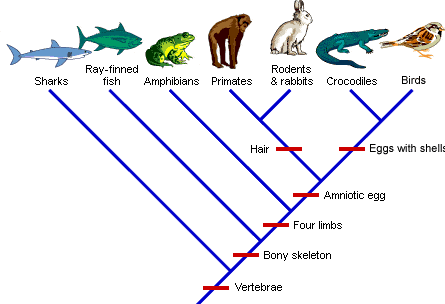
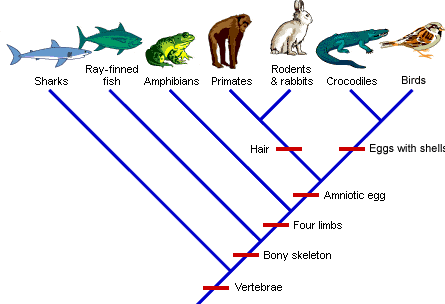
According to this cladogram, primates are most closely related to -
a)
Amphibians
b)
Rodents and rabbits
c)
Crocodiles
d)
Birds
62.
Which trait do only humans have, according to the cladogram?
a)
jaws
b)
mammary glands & hair
c)
terrestrial during all life stages
d)
opposable thumbs
63.
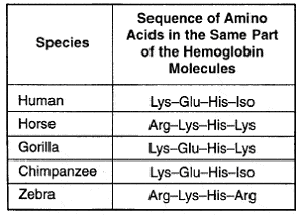
You look at two species and see very similar amino acid sequences. What does this likely tell you?
a)
These are the same animal.
b)
These animals have a common ancestor.
c)
These animals are not likely related.
d)
These animals are likely becoming one species.
64.
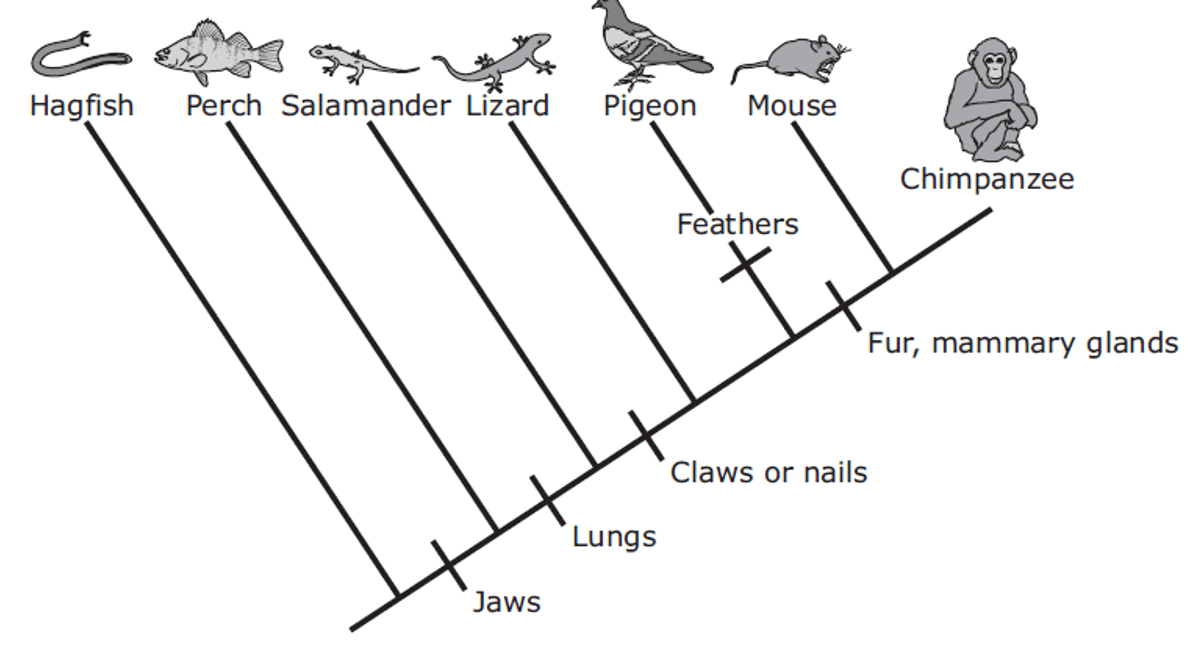
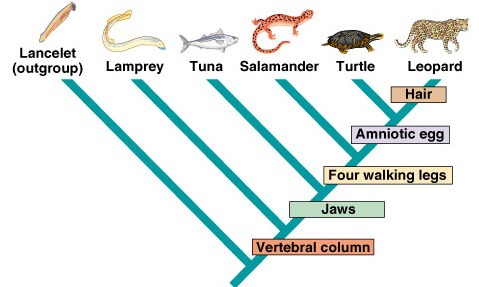
All the animals to the right of the hagfish would have the common characteristic of -
a)
Fur
b)
Claws or nails
c)
Lungs
d)
Jaws
65.

Which is the newest trait?

a)

Amniotic egg

b)

Walking legs

c)

Jaws

d)

Hair

66.

According to this cladogram, sharks are MOST closely related to which organism?

a)

Amphibians

b)

Ray finned fish

c)

Crocodiles

d)

Birds

67.

What distinguishes zebras from from giraffes?

a)

un-branching horns (in males)

b)

even number of toes

c)

fur

d)

carnivorous teeth