
 Worksheets
Astronomy : Solar System Exam
Total questions: 71
Worksheet time: 1hrs 19mins
A person would weigh less on the moon than on the Earth because...
the moon has less mass, and therefore less gravity
the moon has more mass, and therefore less gravity
the moon has less mass, and therefore more gravity
the moon has more mass, and therefore more gravity
If a person weighs 100 pounds on Earth, calculate how much that person would weigh on Jupiter. Jupiter has 3 times the amount of gravity than Earth does.
100 pounds
300 pounds
33.3 pounds
Not enough information is given
Gravity on Mar's surface is much lower than it is here on Earth. This is because the mass of Mars is __________ that of Earth.
less than
more than
the same as
Two factors effecting the magnitude of the force of gravity between 2 objects are...
mass. density and distance
mass and matter
distance, density and weight
weight and mass
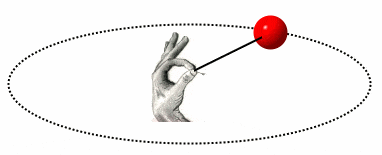
How does changing the distance of the string in the model represent the orbits of the planets?
the longer the string means the larger the planet
the longer the string, the longer the orbit time of a planet
the shorter the string, the longer the orbit time of the planet
the shorter the string, the smaller the planet
What best describes the mass and weight of a person as they move around the universe?
mass and weight changes
mass and weight stays constant
weight remains constant, mass changes
mass stays constant, weight changes
All objects in the universe that have mass exert a gravitational pull on other objects that have mass.
True
False

The spinning of an object on its axis is called______
orbit
rotation
revolution
tide
Day and night is caused by the _____________ of earth on its axis.
revolution
orbit
rotation
How long does it take the Earth to make one REVOLUTION around the Sun?
365 hours
365.5 days
365.25 days
29.5 days
Which of the following statements is correct?
Pluto was once classified as a dwarf planet, but is now classified as a main planet
Pluto was never classified as a planet
Pluto has always been considered a planet
Pluto was once considered a main planet, but is now a dwarf planet


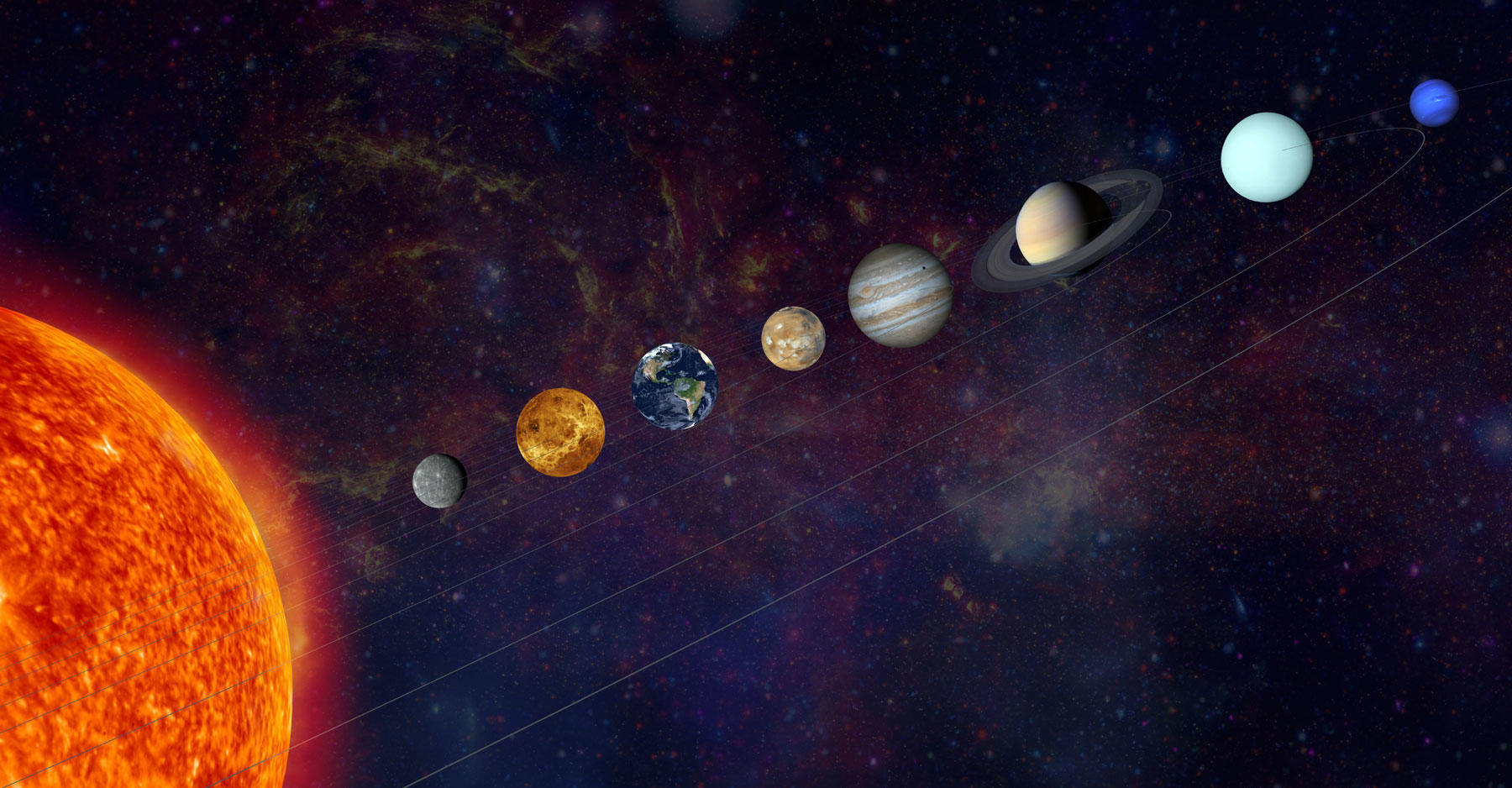
The planets are all equally distanced from each other.

What is between the inner planets and the outer planets?

What force(s) keeps the planets orbiting the sun? ( You may select more than one.)
Gravity
Magnetism
Electricity
Friction
inertia
gas and ice
rocky
A dwarf planet. It is farther from the sun than Neptune
Earth
Pluto
Uranus
Neptune
Kuiper
The spherical outer shell of objects that surrounds everything else in the solar system is called the ______.
Kuiper Belt
Oort Cloud
Scattered Disk
Plutinos
All the known dwarf planets (except Ceres) orbit in the:
asteroid belt
Kuiper belt
Oort cloud
What object is at the center of a heliocentric model?
Earth
Sun
the Moon

The first concept of the solar system had the earth at the center, this was called
a heliocentric system
a geocentric system
the Milky Way
Copernicus' model

The planets of the solar system
are evenly spaced out.
are closer together inside the asteroid belt and then spread further apart after the asteroid belt.
are far apart inside the asteroid belt then closer together outside the asteroid belt.
have not set spacing between them.

This model of the "universe" was first proposed by ancient Greeks
heliocentric
geocentric
lunarcentric
Ptolomy's system
According to Kepler's 2nd law
Planets move faster when they have moons
Planets all move at the same speed around the sun
Planets move faster farther away from the sun and slower when closer to the sun
Planets move faster closer to the sun and slower when farther away.
According to Kepler's first law
Orbits are dependent on the mass of the planet and the sun
Orbits are perfectly circular with the sun at the focus
Orbits of planets are ellipses with the earth at one focus
Orbits of planets are ellipses with sun at one focus
Which planet is the only planet with water in 3 states
Earth
Venus
Mars
Mercury
Which planet is covered in clouds of CO2 and sulfuric acid
Earth
Mercury
Venus
Mars
Which planet has polar “ice caps” of CO2
Earth
Mercury
Venus
Mars
On which planet is Olympus Mons: largest volcano known found?
Earth
Mercury
Venus
Mars
Which planet has no atmosphere due low gravitational force
Earth
Mercury
Venus
Mars
This planet has many craters
Earth
Mercury
Venus
Mars
This planet has high atmospheric pressure and temperature
Earth
Mercury
Venus
Mars
The four outer "Jovian Planets" are mostly made up of
gasses: nitrogen, oxygen, carbon dioxide, and water vapor
gasses and/or ices: Hydrogen, helium, methane, ammonia, and water
solid: Hydrogen, helium, methane, ammonia, and water
rocky minerals
Which planet has 4 largest moons that were seen by Galileo
Jupiter
Saturn
Uranus
Neptune
Which planet is almost enough mass to be a brown dwarf star
Jupiter
Saturn
Neptune
Uranus
Which planet is rolling through space?
Jupiter
Saturn
Uranus
Neptune
Which planet is famous for its blue color?
Jupiter
Saturn
Uranus
Neptune
Which planet has large, easily visible rings made of rocks and ice with 82 moons?
Jupiter
Saturn
Uranus
Neptune
Which planet has the giant red spot storm?
Jupiter
Saturn
Uranus
Neptune
Which gas giant has seasons?
Jupiter
Saturn
Uranus
Neptune
The distance of each planet from the sun makes a big difference in
its climate and weather
its moons and whether it can support life.
if it has rings
its climate and whether it can support life.
What is one reason Earth can support life?
water
atmosphere
moon
seasons
Models that are to scale are most useful for showing
the relationships between the sizes of things and the distances between them.
the number of items in the solar system
the order of the planets
what color each planet is
Why is it diffiicult to make a model the solar system with both the sizes and the distances being accurate and to scale?
Because we do not know what is in the solar system
Because the sun is so large and the distances so great
Because of the immense distances and the fact that things are so small in comparison
Because we do not know the actual distances

What force does the string represent? What would happen if the string was suddenly let go? What force does this represent?
The string represents the pull of gravity between the hand and the ball. If released the ball would be pulled into the center.
The string represents the push of gravity. Nothing would happen to the the ball, it would just continue in its orbit due to the pull of inertia.
The string represents the pull of inertia. If released the ball at the end would fly off due to the pull of gravity.
The string represents pull gravity. If released the ball at the end would fly off due to inertia.
What is the difference between the Asteroid belt and the Kuiper belt?
Asteroid belt contains rocky material and Kuiper belt contains icy material.
Asteroid belt contains large rocky material , Kuper belt contains dwarf planets and other rocky material and is found outside of the gas giants.
Asteroid belt contains comets, meteoroids and asteroids while the Kuiper belt contains meteoroids and comets.
Asteroid belt contains dwarf planets and Kuiper belt contains small rocky material.
How does the tail of a comet behave?
it points towards the sun
it only exists out in deep space
it points away from the sun
it is part of the nucleus
Where is the home of billions of comets?
Kuiper belt
asteroid belt
Oort cloud
between area between Neptune and the Kuiper Belt
What type of orbit do comets have?
circular
slightly elliptical
very elliptical
square
What is Halley's comet?
Comet that appears every 76 years and was predicted by Hailey in 1705
Comet that appears every 76 years and reappearred in 1905
Comet that appears every 1705 years and reappearred in 1758
Comet that appears every 1758 years and reappearred in 1705
What do scientist think occurred 65 million years ago?
The Earth was formed
the moon was formed from a collision between Earth and a large rocky object
An asteroid hit Earth and exploded leaving a thin layer of Irdium
An asteroid hit Earth and made the oceans
When the eccentricity of an orbit increases what is ocurring?
the more circular the shape of the orbit is becoming
the number of moons and rings the planet has is increasing
the faster the planet is moving around the sun
the more oval the shape of the orbit is becoming
Why do scientist think dinosaurs went extinct?
Humans hunted them to death
Mammals ate all their eggs
Earth was hit by a large asteroid
Earth was hit by a dwarf planet
Why do meteors burn up in the Earth's atmosphere?
they don't, they all hit the ground
friction creates thermal heat
they don't instead they warm up and melt
they are on fire out in space
What is the relationship between mass and weight?
Mass is the amount of matter in an object and weight is the measure of how gravity pulls that mass
Weight is the amount of matter in an object and mass is the measure of how gravity pulls that mass
weight and mass are the same thing
mass is how large something is and weight is how gravity pulls on the object
Which of these statements describes our solar system? (choose more than 1)
The inner planets are small, dense, and close together
The innner planets are small and very far apart
the outer planets are large gas giants with low density and spread far apart
the outer planets are large dense rocky planets that are far apart
Select the statement that best reflects the relationship between planet size and gravity .
Smaller planets always have less gravitational pull than large planets
Small rocky planets and larger giants with low density can have similar gravities
Giant planets always have larger gravitational pull than small planets
Giant planets have the same gravitational pull as Earth.
Which description best fits our solar system
1 Sun, 8 planets, many moons, and small items that can be rocky or icy
1 Sun, 8planets all with moons, and small rocky and icy items
1 Sun, 13 planets, 10 moons, and small rocks
1 Sun, 8 planets with moons
Which general statement best describes the arrangement of our solar system
all planets are spaced equally from the sun
Inner planets and giants are spaced equally far apart
Inner planets are spaced far apart and giants are spread further apart the farther you get from the sun
Inner planets are closer together and the giants are spread further apart the farther you get from the suny
Which statement best describes our solar system?
Inner planets are smaller gas planets and outer planets are solid ice or gas giants
All planets are alike
Inner planets are smaller solid planets and outer planets are gas or ice giants
there is not a relationship between size of planet and distance from sun

