wayground logo

Free Printable Worksheets

NEW

Font size

S
M
L
XL
Worksheets

Semester 2 State Test Review

Total questions: 67

Worksheet time: 39mins
Name
Class
Date
1.
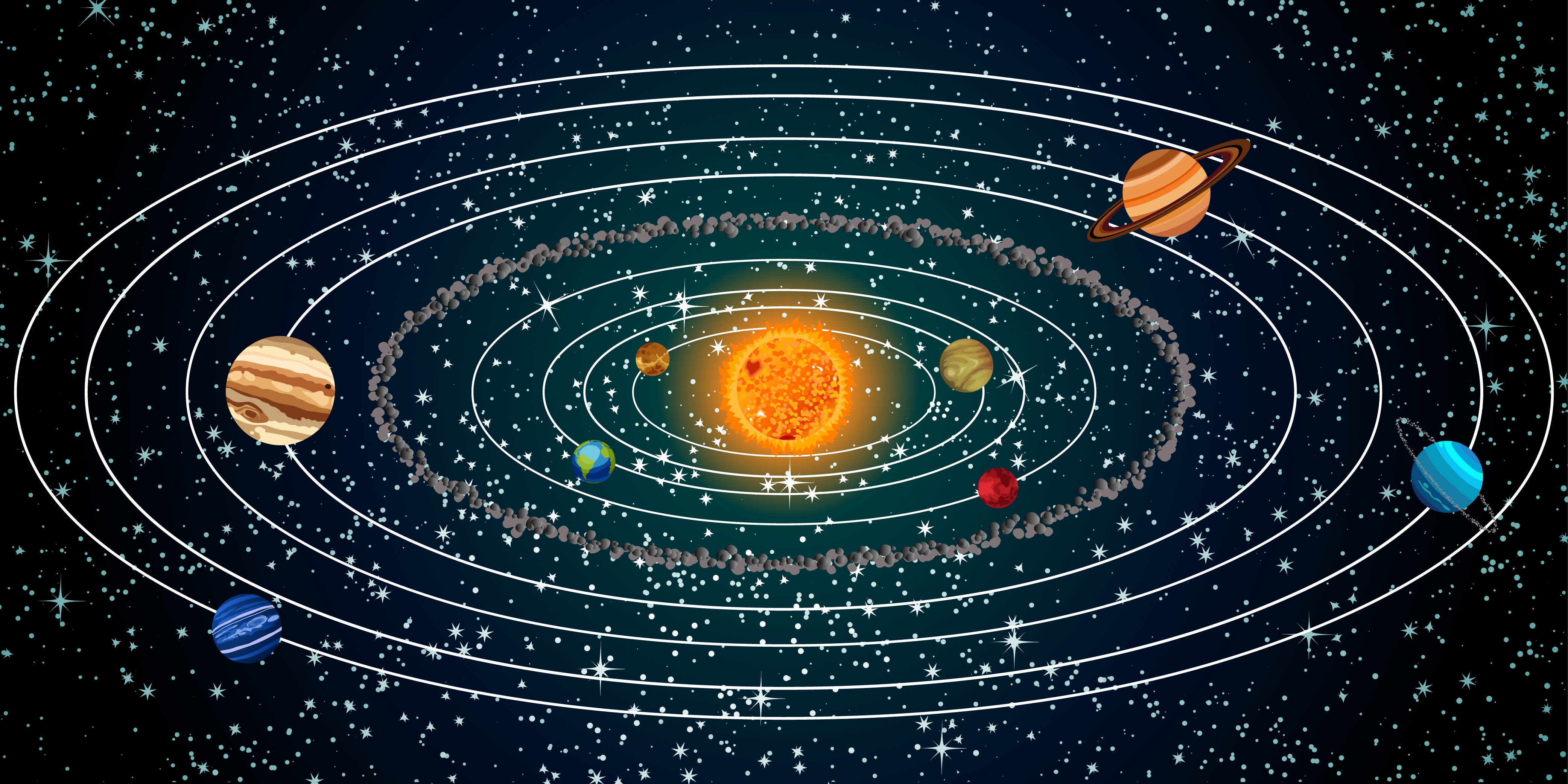
Why do planets orbit the sun (and not float around in space)?
a)
the moons are keeping them in place
b)
They were hit by an asteroid
c)
they were hit by a comet
d)
the sun's gravity keeps them in place
2.
Dividing each object in the solar system by the same amount so that it fits on a poster is...
a)
Scale
b)
Size difference
c)
Distance difference
d)
All choices
3.
We scaled down the objects in the solar system.  To do this we had to divide each object (Sun and each planet) by...
a)
the same amount
b)
a different amount
4.
The two objects are representing what in the solar system?
a)
Sun is the basketball.  Earth is the pea.
b)
Jupiter is the basketball.  Earth is the pea.
c)
Earth is the basketball.  Moon is the pea.
d)
Sun is the basketball.  Jupiter is the pea.
5.
This shows 
a)
Size difference between the planets accurately
b)
Distance between the planets accurately
c)
All choices
6.
The sun looks small in the sky because...
a)
It is small compared to Earth
b)
It is really far away
c)
It is not very bright
d)
The moon redirects the light
7.
Is this a correct scale model of the Sun and Earth?
a)
Yes
b)
No
8.
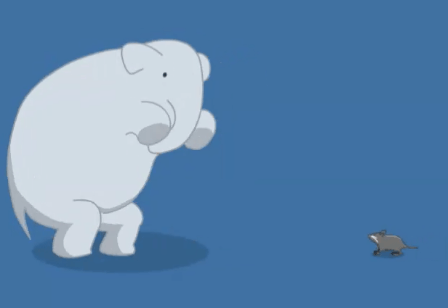
Which objects have a STRONG force of gravity?
a)
Objects with GREATER mass, like elephants
b)
Objects with LESS mass, like mice
9.
What is the SI unit used to measure force? 
a)
pounds 
b)
grams 
c)
newtons 
d)
friction
10.
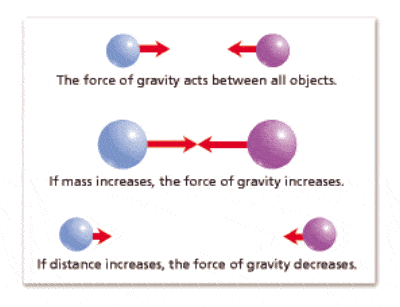
As distance between two objects increase the pull of gravity 
a)
Increases
b)
Decreases
c)
Stays the same
11.
The amount of matter in an object is 
a)
pressure
b)
weight
c)
mass
d)
force
12.
A person would weigh less on on the Moon than on the Earth because . . .
a)
Moon has more mass, and therefore more gravity
b)
Moon has less mass, and therefore more gravity
c)
Moon has more mass, and therefore less gravity
d)
Moon has less mass and therefore less gravity
13.
Two factors effecting the magnitude of the force of gravity between 2 objects are...
a)
mass and distance 
b)
mass and matter
c)
distance and weight 
d)
weight and mass
14.
If Earth's mass was cut in half, what would happen to your mass?
a)
increase because gravitational force increases
b)
decrease because gravitational force decreases
c)
decrease because gravitational force increases
d)
nothing, mass is not affected by gravitational force
15.
As mass increases, what happens to gravitational force?
a)
increases
b)
decreases
c)
stays the same
d)
i don't know
16.
Which model has greater gravitational attraction (if any)
a)
Model A
b)
Model B
c)
Both Model A and Model B (same gravity)
17.
As distance between two objects increase the pull of gravity 
a)
Increases
b)
Decreases
c)
Stays the same
18.
The force of gravity acting on an object is the object's ______.
a)
mass
b)
matter
c)
weight 
d)
friction 
19.
Two factors effecting the magnitude of the force of gravity between 2 objects are...
a)
mass and distance 
b)
mass and matter
c)
distance and weight 
d)
weight and mass
20.
In winter, the axis of the earth is pointed away or toward the sun?
a)
towards
b)
up
c)
down
d)
away
21.
Why is the Equator warmest?
a)
Because it is closest to the sun.
b)
Because it receives the most direct sunlight
c)
Because no clouds form here.
d)
Because it is far from the sun
22.
Which season is taking place in the Northern Hemisphere in Position 1?
a)
Winter
b)
Spring
c)
Summer
d)
Fall
23.
Which season is taking place in the Northern Hemisphere in Position 3?
a)
Winter
b)
Spring
c)
Summer
d)
Fall
24.
If its ____ in the Northern hemisphere, then its summer in the Southern hemisphere. 
a)
spring
b)
summer
c)
fall
d)
winter
25.
If its ____ in the Northern hemisphere, then its fall in the Southern hemisphere. 
a)
spring
b)
summer
c)
fall
d)
winter
26.
What is the longest day of the year?
a)
winter solstice
b)
summer solstice
c)
fall equinox
d)
spring equinox
27.

In the diagram below, the Northern hemisphere would be in what season at position A?

a)

Fall or Autumn

b)

Spring

c)

Winter

d)

Summer

28.

During a summer solstice the America, the southern hemisphere experiences

a)

a vernal equinox

b)

the autmunal equinox

c)

a summer solstice

d)

a winter solstice

29.
What does the rotation of the earth cause us to experience?
a)
seasons
b)
year
c)
day & night
d)
eclipse
30.

Which diagram models a hypothetical situation in which every location on Earth would have 12 hours of daylight and 12 hours of darkness per day?

a)
b)
c)
d)
31.

The beginning of autumn in North American is in September, but the beginning of autumn in South America is in March. The diagram shows a picture of the Earth, the sun, and the moon on one day in September and another in March. Why does autumn start in different months of the year in North America and South America?

a)

Earth's orbit around the sun is not a perfect circle.

b)

North America has a larger landmass than South America.

c)

The moon has a greater pull on South America than North America.

d)

Earth's axis has a 23.5 degree tilt.

32.

Students in a science class in Marfa, Texas, made a poster with a diagram to represent seasonal change in the Northern hemisphere. Which statement best describes conditions for Earth at position 1 in the diagram?

a)

There are an equal number of hours of daylight and nighttime in the Northern hemisphere, and the north pole is tilted away from the Sun.

b)

The Northern hemisphere has the fewest hours of daylight, and the Earth's axis does not tilt at this position.

c)

There are an equal number of daylight and nighttime hours in this position because the Earth is not tilted in this position.

d)

The Northern hemisphere has the fewest hours of daylight, and the north pole is tilted away from the Sun.

33.
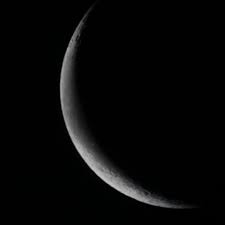
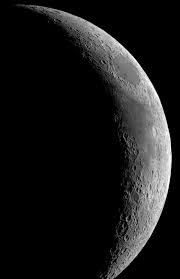
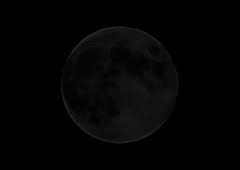
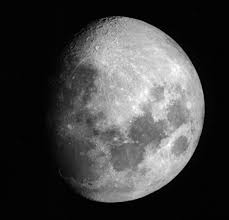
Name the moon phase
a)
waning crescent
b)
waxing crescent
c)
waning gibbous
d)
waxing gibbous
34.
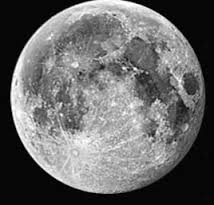
Name the moon phase
a)
waning crescent
b)
waxing crescent
c)
waning gibbous
d)
waxing gibbous
35.
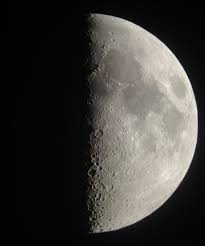
Name the moon phase
a)
waning crescent
b)
waxing crescent
c)
waning gibbous
d)
waxing gibbous
36.
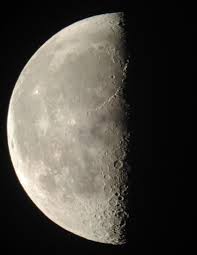
Name the moon phase
a)
waning crescent
b)
waxing crescent
c)
waning gibbous
d)
waxing gibbous
37.

Name the moon phase

a)

First Quarter

b)

Third Quarter

c)

New Moon

d)

Full Moon

38.

Name the moon phase

a)

First Quarter

b)

Third Quarter

c)

New Moon

d)

Full Moon

39.

Name the moon phase

a)

First Quarter

b)

Third Quarter

c)

New Moon

d)

Full Moon

40.

Name the moon phase

a)

First Quarter

b)

Third Quarter

c)

New Moon

d)

Full Moon

41.
Name the moon phase that would come AFTER this moon.
a)
waning crescent
b)
waxing crescent
c)
waning gibbous
d)
waxing gibbous
42.
When the moon is in between the earth and the sun it is a
a)
New Moon
b)
Full Moon
c)
First Quarter
d)
Third Quarter
43.
Waxing means...
a)
Growing
b)
Dying
c)
Losing light
d)
Moving
44.
What is illuminating the Moon?
a)
Nuclear Fusion
b)
Sunlight
c)
Mirrors
d)
Flood Lights
45.

Two identical alleles for a trait is known as

a)

homozygous

b)

heterozygous

c)

mutation

d)

codominance

46.

A physical appearance is

a)

genotype

b)

heterozygous

c)

phenotype

d)

codominance

47.

A mutation is harmful to an organism if it

a)

changes the phenotype of an organism

b)

changes the DNA segment

c)

reduces the organism's chance of survival

d)

makes the organism better able to avoid predators

48.

What does Pp mean?

a)

two dominant alleles

b)

heterozygous alleles

c)

one dominant allele

d)

two dominant and recessive alleles

49.

Who studied different characteristics of pea plants by cross-pollinating plants?

a)

Gregor Mendel

b)

Albert Punnett

c)

Sir Isaac Newton

d)

David Kuster

50.

A purebred horse with white hair is crossed with a purebred horse with brown hair. Each of their offspring has both white and brown hair. Why does this occur?

a)

several alleles work together to determine a trait

b)

two alleles for hair are dominant

c)

two alleles for hair are recessive

d)

the alleles for fur color are neither dominant or recessive

51.

The term that relates to physical characteristics that are studied in genetics.

a)

traits

b)

offspring

c)

generations

d)

hybrids

52.

Factors that control traits are

a)

purebreds

b)

genes

c)

recessives

d)

parents

53.

A mutation is

a)

any change that is harmful

b)

any change in a gene or chromosome

c)

any change that is helpful

d)

any change in the phenotype

54.

An organisms's allele combination is known as

a)

phenotype

b)

mutation

c)

hybrid

d)

genotype

55.

If a homozygous black cat (BB) is crossed with a homozygous white cat (bb), what is the probability of having a cat with white fur?

a)

100%

b)

0%

c)

75%

d)

25%

56.

Why are advantageous traits more likely to be passed onto offspring?

a)

Because they are more likely to survive and reproduce.

b)

Because they come from dominant alleles.

c)

Because they come from recessive alleles.

d)

Because the organism knew it needed that trait, survives, and passes it on.

57.

Mutations are a change in what?

a)

DNA

b)

tRNA

c)

protein

d)

rRNA

58.
The differences among a species, like different bird beaks, are called
a)
genes.
b)
variations.
c)
traits.
d)
theories.
59.
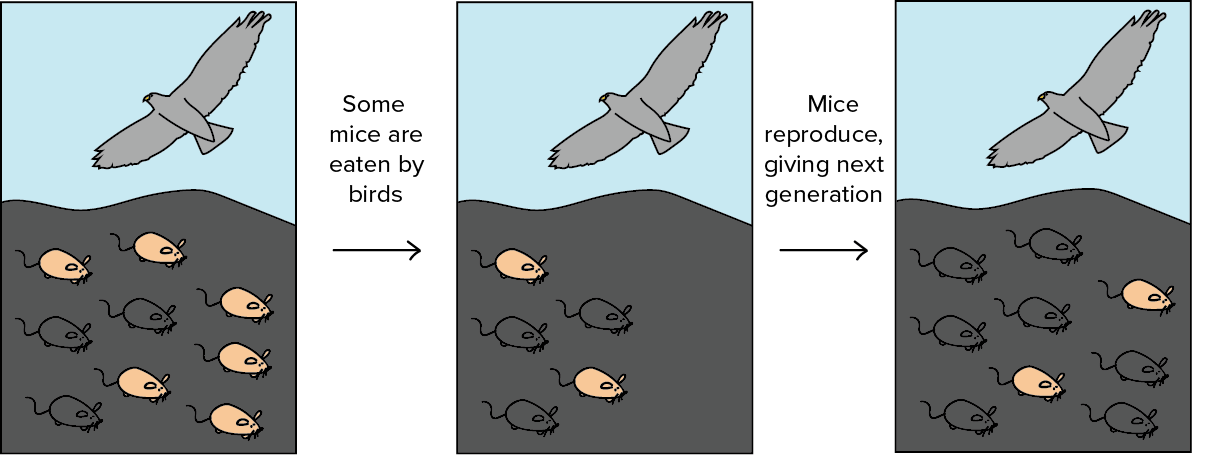
Why is the mouse population changing over time?
a)
The light mice can reproduce more successfully than the dark mice
b)
The hawks eat more dark mice than light mice because the dark mice taste better
c)
The hawks eat more light mice than dark mice because they can see the light mice more easily
d)
The hawks eat more dark mice than light mice because they can see the dark mice more easily
60.
What process is being shown in this image?
a)
Variation
b)
Natural Selection
c)
Selective Breeding
d)
Homeostasis
61.

Where do adaptations come from?

a)

The individual organism decides to adapt

b)

Mutations that give an organism an advantage in its environment

c)

Genetic recombination during meiosis

d)

Both mutations and genetic recombination are sources of adaptation

62.

Which best describes the role of mutations in natural selection?

a)

Mutations help an organism to better survive in their environment

b)

An organism may acquire a helpful mutation by interacting with the environment

c)

A mutation may result in a beneficial trait that makes an organism more likely to survive and reproduce

d)

Organisms with certain traits are more likely to win competitions for mutations

63.
Why do frogs and other organism reproduce so many eggs or offspring?
a)
so that their babies can have friends to play with
b)
the more offspring the more likely the offspring will survive
c)
the more offspring the less likely offspring will survive 
d)
the more offspring the less competition
64.
Which organisms are most likely to survive?
a)
the best adapted
b)
the fastest
c)
the strongest
d)
the most domesticated (tamed)
65.
The long and sharp beak of a woodpecker is an example of:
a)
Natural Selection
b)
Selective Breeding
66.
Domesticated dogs are an example of:
a)
Natural Selection
b)
Selective Breeding
67.

Why is competition important for natural selection?

a)

It shows which variations are more successful, allowing the organisms with those variations to survive.

b)

It causes organisms, regardless of which traits they have, to die out, reducing the population size.

c)

It causes organisms to get stronger due to having to outcompete other species.

d)

Competition is not important for natural selection.