wayground logo

Free Printable Worksheets

NEW

Font size

S
M
L
XL
Worksheets

Biology: Genetics - Pre Test

Total questions: 54

Worksheet time: 1hrs 4mins

Name
Class
Date
1.
The cells produced via meiosis are called:
a)
sex cells
b)
somatic cells
c)
body cells
d)
skin cells
2.
If a body cell in a butterfly contains 24 chromosomes, a butterfly egg would contain
a)
3
b)
6
c)
12
d)
24
3.
Why do we need meiosis?
a)
To double the number of chromosomes going into sex cells
b)
To halve the number of chromosomes going into sex cells
c)
To triple the number of chromosomes going into sex cells
d)
To not change the number of chromosomes going into sex cells
4.
When a starfish grows a new body off a broken arm, what kind of reproduction is this?
a)
Sexual
b)
Differentiation
c)
Asexual 
d)
Specialization
5.
Sexual reproduction requires _____ parents and asexual reproduction requires ___ parents
a)
1,1
b)
2,2
c)
2,1
d)
1,2 
6.
What is an advantage of sexual reproduction?
a)
Allows genetic variation
b)
Only needs one parent
c)
Happens very quickly
d)
Offspring are exact copies of parent
7.
What are some of the facts about sexual reproduction?
a)
Takes two mates to reproduce and takes a longer time to reproduce
b)
Takes one mate to reproduce and takes a shorter amount of time to reproduce
c)
Takes two mates to reproduce and takes a shorter amount of time to reproduce
d)
Takes one mate to reproduce and takes a shorter amount of time to reproduce
8.
What are some of the facts about asexual reproduction?
a)
Takes only one mate to reproduce and takes a longer time to reproduce
b)
Takes a shorter amount of time to reproduce and it takes two mates to reproduce
c)
Reproduces diverse offspring and takes a longer time to reproduce
d)
Takes only one mate to reproduce and takes a shorter time to reproduce
9.
Which of the following genotypes is homozygous recessive?
a)
RR
b)
Rr
c)
rr
d)
None of the Above
10.
Brown (B) is dominant over white (b). Which genotype is a purebred for brown fur?
a)
BB
b)
Bb
c)
bb
d)
All of the above
11.
If something is heterozygous, it is also...
a)
purebred
b)
hybrid
c)
dominant
d)
recessive
12.
This image shows a...
a)
Punnett Square
b)
Phenotype
c)
Genotype
d)
Dominant allele
13.
A phenotype is the...
a)
letter combination
b)
dominant gene
c)
recessive gene
d)
physical appearance
14.
 Dominant alleles are-
a)
capital
b)
lowercase
c)
both
d)
neither
15.
Purple is dominant to white. A heterozygous purple flower is crossed with a white flower. What are the genotypes and phenotypes of the offspring?
a)
100% Pp (purple)
b)
50% Pp (purple); 50% pp (white)
c)
75% Pp (purple); 25% pp (white)
d)
25% PP, 50% Pp, 25% pp
75% purple, 25% white
16.
Which is the correct phenotype for this organism?
a)
BB
b)
blue
c)
green
d)
bb
17.
A cross of a red cow with a white bull produces all road offspring. This type of inheritance is known as
a)
codominance
b)
incomplete dominance
c)
multiple alleles
d)
"breed time:
18.
the blending of two traits 
a)
blending
b)
recessive trait
c)
incomplete dominance
d)
homozygous
19.
This is an example of ___________?
a)
Incomplete dominance
b)
Co-Dominance
20.
What are the nucleotides made of?
a)
Sugar, Phosphate, nitrogen base
b)
Phosphate, Adenine, nitrogen base
c)
Thymine, Adenine, Cytomine
d)
Phosphate, Nitrogen, Adenine
21.
Which of the following best describes a DNA molecule?
a)
double helix
b)
contains ribose
c)
made of amino acids
d)
contains Uracil
22.
Why is DNA important?
a)
it is very small and very complicated
b)
it's in everything
c)
it serves as the blueprint for traits of all living things
d)
because we eat it every day for energy
23.
Which sequence of DNA bases would pair with this partial strand
ATG TGA CAG
a)
ATG TGA CAG
b)
TAC ACT GTC
c)
GTA AGT GAC
d)
CAT TCA CTG
24.
In a molecule of double-stranded DNA, the amount of Adenine present is always equal to the amount of
a)
cytosine
b)
guanine
c)
thymine
d)
uracil
25.
A process in which DNA has the unique ability to make an exact copy of itself.
a)
Replication
b)
Translation
c)
Transcription
26.
Which organelle is DNA usually found in?
a)
cell membrane
b)
vacuole
c)
chloroplast
d)
nucleus
27.
In RNA, Uracil pairs with ______. 
a)
cytosine
b)
adenine
c)
guanine
d)
thymine
28.
The process to go from DNA to mRNA is _______
a)
translation
b)
transcription
c)
replication
29.
The process to go from mRNA to a protein is called ____
a)
transcription
b)
rRNA
c)
replication
d)
translation
30.
DNA holds the code for
a)
lipids
b)
carbohydrates
c)
protein
d)
sugar
31.
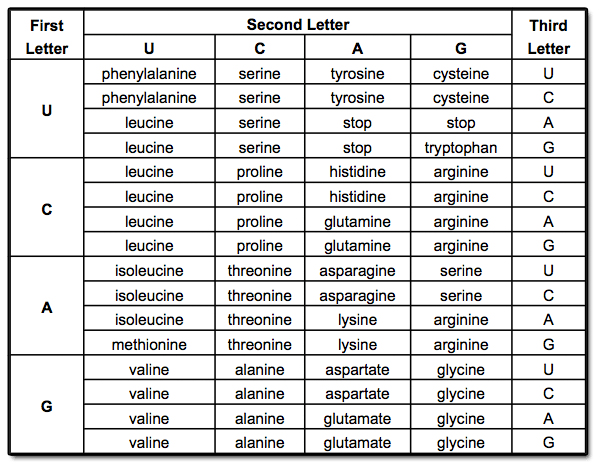
What amino acid is represented by the codon UUA?
a)
Phenylalanine
b)
Tyrosine
c)
Leucine
d)
Stop codon
32.
What is the location in the cell for translation?
a)
nucleus
b)
mitochondria
c)
ribosome
d)
chloroplast
33.

During transcription, this type of ribonucleic acid is responsible for copying the DNA and brining it out of the nucleus.

a)

tRNA

b)

mRNA

c)

rRNA

d)

dRNA

34.
Translation takes place in the 
a)
ribosome
b)
chloroplast
c)
nucleus
d)
mitochondria
35.
SB2: Who is considered the "father of genetics"?
a)
Gregor Mendel
b)
Reginald Punnett
c)
James Watson
d)
Justin Bieber
36.
SB2: Which of the following shows how information is transformed to make a protein?
a)
gene → chromosome → protein
b)
DNA → RNA → protein
c)
cell respiration → ATP → protein
d)
ATP → amino acid → protein
37.
How many individuals are there in the 3rd generation?
a)
2
b)
3
c)
4
d)
6
38.
What does the prefix homo- in homozygous mean?
a)
same
b)
different
c)
dating
d)
humans
39.
What does the prefix hetero- in heterozygous mean?
a)
same
b)
different
c)
dating
d)
human
40.
Traits that show up more and mask or cover up the other trait are called
a)
homozygous
b)
heterozygous
c)
dominant
d)
recessive
41.
Traits that are often covered up and show only in the homozygous state are called
a)
homozygous
b)
heterozygous
c)
dominant
d)
recessive
42.
Traits shown by capital letters
a)
dominant
b)
recessive
c)
sex-linked
d)
codominant
43.
trait shown by lower case letters
a)
dominant
b)
recessive
c)
sex-linked
d)
codominant
44.
If 2 black guinea pigs have a white guinea pig and black is dominant to white, the parents must have been...
a)
Bb x Bb
b)
BB x bb
c)
BB x BB
d)
bb x bb
45.
In order to determine the phenotype of an organism, you must
a)
take blood
b)
look at it
c)
work a punnet square
d)
take urine
46.
Which of the following is an example of a GENOTYPE?
a)
25%
b)
Blue
c)
1:2:1
d)
Bb
47.
Which of Mendel's laws states that alleles are separated during meiosis?
a)
Law of Dominance
b)
Law of Segregation
c)
Law of Independent Assortment
d)
Law of Meiosis
48.

Which of Mendel's laws explains why a sibling will look different than another sibling but both will have a combination of the parents' various traits?

a)

Law of Dominance

b)

Law of Segregation

c)

Law of Independent Assortmen

d)

Theory of Evolution

49.
Different forms a gene may have for a trait.
a)
chromosome
b)
gene
c)
mutation
d)
allele
50.

Which of the following laws claims that alleles will separate during meiosis, one going to half the sex cells, the other allele going to the other half.

a)

Law of Domination

b)

Law of Segregation

c)

Law of Speciation

d)

Law of Genetics

51.

Which of the following laws claims that alleles will come together independently of each other in the offspring?

a)

Law of Independent Assortment

b)

Law of Probable Expression

c)

Law of Typical Collection

d)

Law of Assorted Assignment

52.

Long hair is a dominant trait. Choose the BEST statement.

a)

This guinea pig definitely received two dominant traits. (HH)

b)

This guinea pig cannot have a recessive allele. (h)

c)

This guinea pig could be homozygous dominant (HH) or heterozygous (Hh)

d)

This guinea pig is homozygous recessive (hh)

53.

In each case where Mendel crossed true breeding plants as parents, the offspring displayed only one of the two traits seen in the parents. This observation supports Mendel's principle of _________.

a)

segregation

b)

independent assortment

c)

dominance

d)

inheritance

54.

The idea that for any particular trait, the pair of alleles of each parent separate and only one allele from each parent passes to an offspring is Mendel's principle of:

a)

Independent Assortment

b)

Dominance

c)

Segregation

d)

Genetics