wayground logo

Free Printable Worksheets

Font size

S
M
L
XL
Worksheets

Unit 5 and 6 GIANT REVIEW!

Total questions: 103

Worksheet time: 2hrs 8mins

Name
Class
Date
1.
The purpose of selective breeding is to 
a)
Get bigger animals
b)
get smaller animals
c)
create animals with desirable traits
d)
create animals with bad traits
2.
All of the following statements are reasons for selective breeding except:
a)
To produce offspring with desirable characteristics
b)
Farmers increase their profit by improving crops
c)
To improve the quality of food products
d)
To increase migration patterns
3.
A farmer has bred his pineapple plants from the sweetest pineapples from his last harvest to get even sweeter pineapple plants. What is this an example of?
a)
Selective breeding
b)
Natural selection
c)
Extinction
d)
Mutagenesis
4.
Which term refers to a farmer choosing the best corn from this year to plant next year?
a)
natural selection
b)
selective breeding
c)
genetic engineering
d)
genetic transformation
5.
Organisms within a population have genetic differences in their traits called.
a)
Genotypes
b)
Variation
c)
Natural Selection
d)
Heterozygous
6.
Use the following table to answer the next question. A farmer wants to grow extra-large, sweet oranges.  Which plants should the farmer select to cross to get the desired set of characteristics?
a)
1 and 2
b)
2 and 4
c)
1 and 3 
d)
4 and 5
7.
Use the following table to answer the next question. A family wanted a cat but, due to allergies, they wanted a cat that shed the least amount of hair.  They also wanted a cat with a calm personality.  Which cats should the breeder select to be the parents of the requested cat?
a)
2 and 4
b)
2 and 3
c)
1 and 4
d)
1 and 3
8.
Use the following table to answer the next question. A farmer wants to create a watermelon that is sweet tasting but has a low quantity of seeds.  Which plants should the farmer select to cross to get the desired set of characteristics?
a)
1 and 2
b)
2 and 4
c)
1 and 4
d)
2 and 4
9.
Use the following table to answer the next question. A family visited a dog breeder and requested a puppy that had short fur and was friendly and lovable.  Which dogs should the breeder select to be the parents of the requested puppy?
a)
1 and 2
b)
2 and 3
c)
1 and 4
d)
2 and 4
10.
Use the following table to answer the next question.A farmer wants to grow a crop that is resistant to disease while producing more fruit per plant.  Which plants should the farmer select to cross to get the desired combination of traits?
a)
1 and 2
b)
2 and 4
c)
1 and 3
d)
3 and 4
11.
Behavioral changes of individuals of a species that allow for better survival. (Acquired traits)
a)
Variation
b)
Adaptation
c)
Behavior
d)
Environment
12.
Survival of the Fittest and Evolution were proposed by what scientist?
a)
Charles Darwin
b)
Albert Einstein
c)
Steven Hawking
d)
Isaac Newton
13.
Where the better adapted organisms survive to pass traits along to offspring.
a)
Evolution
b)
Natural Selection
c)
Extinction
d)
Artifical Selection
14.
What is the advantage of having different shaped beaks?
a)
To look different from other species.
b)
To be able to eat the food readily available in the environment.
c)
To protect itself against predators.
d)
To protect itself against prey.
15.
The theory of evolution by natural selection means that what is changing over time?
a)
The inherited traits of a population.
b)
The acquired traits of a population.
c)
Hair color and eye color
d)
Attractive features.
16.
Why are advantageous traits more likely to be passed onto offspring?
a)
Because they are more likely to survive and reproduce.
b)
Because they come from dominant alleles.
c)
Because they come from recessive alleles.
d)
Because the trait is an acquired phenotype.
17.
Mutations are a change in what?
a)
DNA
b)
tRNA
c)
genotype
d)
phenotype
18.

What word describes a trait that helps an organism survive in its environment?

a)

natural selection

b)

mutation

c)

camouflage

d)

adaptation

19.
Which organisms are most likely to survive?
a)
the best adapted
b)
the fastest
c)
the strongest
d)
the most domesticated (tamed)
20.
Do organisms "decide" to evolve and change?
a)
Yes, they know they need to change to survive 
b)
No, they change because of natural selection
21.
The differences among a species, like different bird beaks, are called
a)
genes.
b)
variations.
c)
traits.
d)
theories.
22.
When every organism of a given species has died
a)
Natural Selection
b)
Homeostasis
c)
Extinction
d)
Selective Breeding
23.
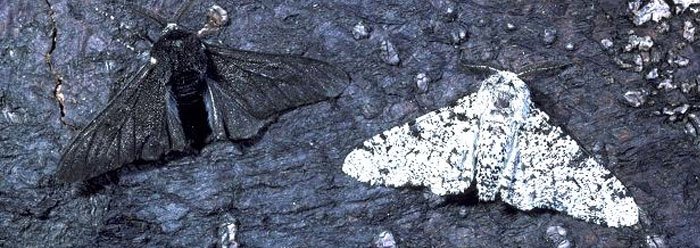
The trees these moths used to live on were white, but have been covered in soot from coal factories. Which moth will be more successful in this environment?
a)
Dark moth
b)
Light moth
c)
Both will be equally successful
d)
Neither will be successful
24.
Since the 1800s humans have stopped burning coal, and the trees have returned to their original color. Which moth will be more successful in this environment?
a)
Dark moth
b)
Light moth
c)
Both will be equally successful
d)
Neither will be successful
25.
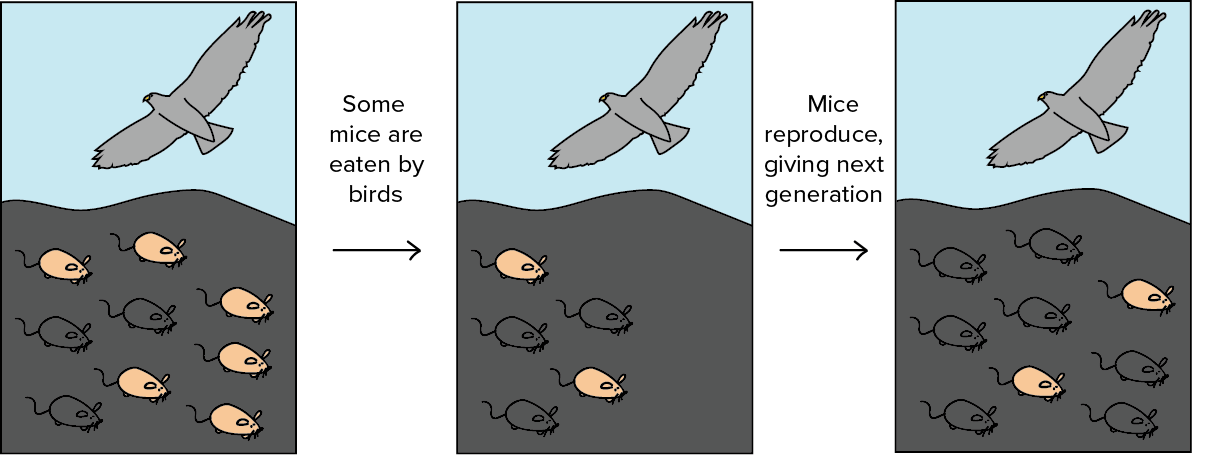
What process is being shown in this image?
a)
Variation
b)
Natural Selection
c)
Selective Breeding
d)
Homeostasis
26.
Why is the mouse population changing over time?
a)
The light mice can reproduce more successfully than the dark mice
b)
The hawks eat more dark mice than light mice because the dark mice taste better
c)
The hawks eat more light mice than dark mice because they can see the light mice more easily
d)
The hawks eat more dark mice than light mice because they can see the dark mice more easily
27.
Which of these statements best describes what Darwin observed on the Galapagos Islands?
a)
The finch population on each island was unique
b)
The finches on the islands ate seeds and nuts, but no insects
c)
The finches on the islands were the same as the finches in Ecuador
d)
The finches could produce offspring only with finches from other islands
28.
Where do adaptations come from?
a)
The individual organism decides to adapt
b)
Mutations that give an organism an advantage in its environment
29.
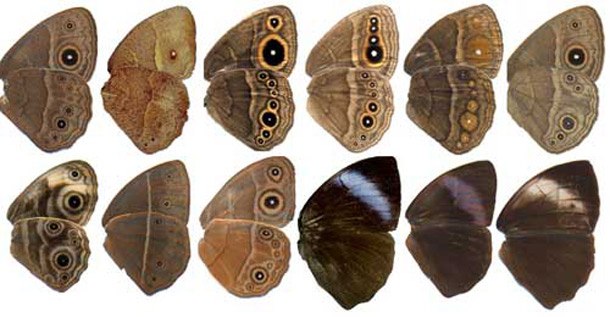
These moths are all the same species. The differences between their wings is an example of ________________
a)
Natural Selection
b)
Variation
c)
Homeostasis
d)
Extinction
30.
Organisms that are better adapted to the environment survive to pass traits to their offspring
a)
Natural Selection
b)
Homeostasis
c)
Selective Breeding
d)
Extinction
31.
Which best describes the role of mutations in natural selection?
a)
Mutations help an organism to better survive in their environment
b)
An organism may acquire a helpful mutation by interacting with the environment
c)
A mutation may result in an adaptive trait that makes an organism more likely to survive and reproduce
d)
Organisms with certain traits are more likely to win competitions for mutations
32.
Selective breeding is where ___________ decides which traits should be passed on
a)
Nature
b)
 A human
c)
Mr. Holt
d)
The illuminati
33.
Natural selection is where ___________ decides which traits should be passed on
a)
Nature
b)
A human
c)
Mr. Holt
d)
The illuminati
34.
All rabbits living in a particular area would be an example of a(n)
a)
population
b)
species
c)
fossil
d)
individual organism
35.
a bird that can easily outcompete other birds for food and that can produce many eggs has a high
a)
life expectancy
b)
mutation rate
c)
fitness
d)
adaptability
36.
a measure of how commonly a particular allele occurs in a population is known as the 
a)
gene pool
b)
allele frequency
c)
mutation rate
d)
phenotype
37.

The more genetic variation a population has,

the more likely it is for some individuals to

a)

evolve

b)

migrate

c)

survive

d)

mutate

38.
Mutations are important because they bring about
a)
death of the organism in which they develop
b)
genetic variation needed for a population to evolve
c)
benefits for the individual, not for the population
d)
Hardey-Weinberg equilibrium within a population
39.
An organism's appearance or other observable characteristics:
a)
phenotype
b)
recessive
c)
genotype
d)
dominant
40.
An organism's genetic make-up:
a)
phenotype
b)
recessive
c)
genotype
d)
dominant
41.
The efficiency of energy transfer from a lower trophic level to the next highest level is roughly
a)
1%
b)
10%
c)
100%
d)
1000%
42.
Trophic levels are represented by 
a)
squares
b)
circles
c)
pyramids
d)
lines
43.
Which animal is the apex predator?
a)
hawk
b)
lizard
c)
snake
d)
grass
44.
Which animal is not the apex predator but, a predator to a mouse?
a)
hawk
b)
rabbit
c)
snake
d)
grass
45.
Why is a shark a carnivore.
a)
because it eats seaweed
b)
because it eats dead animals
c)
because it eats sand 
d)
because it eats other animals
46.
The unique position that a species has in the physical use of its habitat and in its function (job) within an ecosystem  
a)
producer
b)
biotic factors
c)
ecosystem
d)
niche
47.
In the energy pyramid here, how much of the energy in each level gets lost as heat or used by the organism for survival?
a)
80%
b)
90%
c)
10%
d)
20%
48.
The arrows in a food chain or web represents what?
a)
They point to the organism that is being eaten.
b)
It shows how sunlight flows within an ecosystem.
c)
They show what direction the energy is flowing between organisms. 
d)
They represent how water is transferred within a habitat.
49.
Which of the following is a herbivore?
a)
cricket
b)
frog
c)
hawk
d)
shrew
50.
Organisms that create their own energy from sunlight or chemicals
a)
Herbivore
b)
Omnivore
c)
Autotroph
d)
Heterotroph 
51.
Biomass refers to
a)
Chemical Energy
b)
Light Energy
c)
Rank in the feeding heirarchy
d)
Amount of living tissue in an ecosystem
52.
Why do we sometimes use a food pyramid to illustrate feeding relationships?
a)
To change things up a bit
b)
Pyramids show you need a lot more producers than consumers
c)
To show you need more consumers than decomposers
d)
Pyramids are neat
53.
All of the living and nonliving things in an area that interact with each other are called a/an ______.
a)
community
b)
habitat
c)
population
d)
ecosystem
54.
Organisms that look similar, interbreed and can produce fertile offspring
a)
Species
b)
Fish
c)
Community
d)
Trees
55.
A group of a particular species living and interacting in the same area
a)
Community
b)
Population
c)
Organisms
d)
Biosphere
56.
Different populations living and interacting with each other in the same area
a)
Biome
b)
Ecosystem
c)
Community
d)
Niche
57.
What does a food web represent?
a)
All connections of energy flow throughout all organisms in a habitat.
b)
The specific ways that mutualism is carried out.
c)
A single pathway or energy flow between organisms. 
d)
How carnivores get their food. 
58.
The image provided is an example of a(n):
a)
Producer
b)
Autotroph
c)
Consumer
d)
Insect
59.
Which of the following would be the definition of a scavenger/detritivore?
a)
Animals that eat insects.
b)
Organisms that feed on rocks, recycling the nutrients back into the ground.
c)
Organisms that eat only pants
d)
Things that feed on dead, rotting organisms (roadkill)
60.
A place where an organism lives.
a)
Terrain
b)
Habitat
c)
Community
d)
Population
61.
The image provided is an example of a(n):
a)
Carnivore
b)
Herbivore
c)
Producer
d)
Autotroph
62.
Which of the following would provide the most energy in an ecosystem?
a)
Producers
b)
Herbivore
c)
Omnivore
d)
Carnivore
63.
A wolf eats a rabbit, that just ate some berries.  What would you call the rabbit?
a)
Producer
b)
Omnivore
c)
Primary Consumer
d)
2nd order Heterotrph
64.
Why are decomposers located to the side of the pyramid?
a)
They recycle dead material from all levels
b)
The eat living things from all levels
c)
They are not a living organisms
d)
They are too large to fit on the pyramid
65.
This is a period of deep sleep that occurs in some animals when outside temperatures are cold: ______
a)
hibernation
b)
migration
66.
An example of a physical adaptation is...
a)
a turtle hiding inside its shell
b)
The spikes on a porcupine fish
c)
a rabbit burrowing underground
d)
a viper biting when threatened
67.
Which adaptation would NOT help a hawk catch a mouse?
a)
Hollow Bones 
b)
Good eye sight
c)
Talons
d)
Camouflage
68.
Cactus has spines instead of leaves. The spines reduces water loss through the stomata.
a)
Structural
b)
Behavioural
69.
Which feature of a rose helps it grow without being eaten by large animals?
a)
flowers with bright colors
b)
sharp thorns
c)
small seeds
d)
deep roots
70.
Which feature helps an animal hide from other animals?
a)
looking like a dangerous animal
b)
being the same color as the place it lives (camoflauge)
c)
having sharp claws or a strong shel
d)
having only a few young and caring for them
71.
Some plants have small leaves that help them do which of these?
a)
grow tall
b)
save water
c)
make seeds
make seeds
d)
fall off in winter
72.
How are hardwood trees adapted to live in cold winters?
a)
They have long stems buried in mud.
b)
They live on tree islands.
c)
They lose their leaves in winter.
d)
They grow low to the ground.
73.
A nice smell is an adaptation that __________________.
a)
helps the plant keep water inside the leaves.
b)
pokes animals that try to eat the plant.
c)
attracts pollinators to the plant.
74.
What does it mean to survive?
a)
To stay alive
b)
To grow
c)
To have energy
d)
To be born
75.
What does it mean to reproduce?
a)
to eat things
b)
to make things pretty
c)
to produce energy
d)
to produce new living things
76.
What is a trait?
a)
plant
b)
an adaptation
c)
a characteristic or feature
77.
The Prickly Pear Cactus can grow in a dry environment because.....
a)
it is able to story water
b)
it has spiny leaves
c)
is carnivorous
d)
collects salt
78.
What is the scientific term for an animal that is eaten by another animal?
a)
predator
b)
dinner
c)
prey
d)
stupid
79.
The Bald Eagle has __________.
a)
keen eyesight
b)
sharp talons
c)
sharp beak
d)
all of the above
80.
A trait that helps a living thing survive.
a)
instinct
b)
mimicry
c)
camouflage
d)
adaptation
81.
Which adaptation (for the underlined animal) serves the function of defense?
a)
A walking stick looks like the twig on which it rests.
b)
A porcupine’s quills cause a predator to seek another meal.
c)
A whale filters plankton and krill from the water in which it swims.
d)
A penguin is dark on top and white below to blend in with the water.
82.
Plants with spines and waxy leaves are well suited for life in which environment?
a)
Desert
b)
Temperate forest
c)
Grassland
d)
Tropical Rainfroest
83.
Dandelions have light furry seeds that allow them to spread easily. 
a)
True
b)
False
84.
Why do animals use camouflage?
a)
To look pretty
b)
To stay safe
c)
To play Hide and Go Seek
d)
To eat food
85.

Which best describes an internal adaptation?

a)

An animals characteristics

b)

A plants physical features.

c)

Structure inside an organism that helps it survive.

d)

Anything that allows an animal to live like water and shelter.

86.

What internal adaptation do plants have that allow the transportation of water?

a)

Leaves

b)

Petals

c)

Root

d)

Xylem

87.

What proof or investigation proves that water is transported up to different parts of the plant?

a)

Plant parts absorb the color of the water and is shown in different parts of the plant

b)

The plant wilts and dies.

c)

The plant doesn't do anything and continues to survive.

d)

None of the above

88.

What can we hypothesize if a plant had no xylem?

a)

It would move to another place for water.

b)

It could not survive.

c)

It would live stronger cause the vacuole would have all the water it needs.

d)

Nothing would happen, the xylem is not important to survival of plant.

89.

What type of bones do birds have?

a)

Short and filled with heavy material

b)

Strong unbreakable bones

c)

Hollow bones that help flight.

d)

Bones that are heavy for speed

90.

Hollow bones in birds is a perfect example of?

a)

Hollow birds help with the mating dance.

b)

How birds find food

c)

A feature that most other animals also have.

d)

An internal adaptation that allows bird to survive.

91.

Why would different organisms have different types of bones?

a)

That is the way organisms are made to help reproduce.

b)

There is no real reason why organisms have different types of bones.

c)

All birds have the same types of bones.

d)

The different internal structures allows the organism to survive in its environment.

92.

Which internal structure is important to fish in order to survive?

a)

Gills

b)

Fins

c)

Eyes

d)

Scales

93.

Why are the gills of the fish an internal adaptation?

a)

The gills don't help the fish eat so they are considered an external adaptation.

b)

Gills allow the fish to swim faster and stronger

c)

The gills are within the fish and allows the fish to survive as they capture oxygen from the water.

d)

Gills are not considered an adaptation

94.

What can we hypothesize about organisms that live in the water that do not have gills?

a)

They will die due to drowning.

b)

They have another adaptation that allows them to breathe and therefore survive in the water.

c)

Those organisms don't exist.

d)

All of the above

95.
Which organism do the owl and the weasel compete for in the food web?
a)
Hawk
b)
Spider
c)
Grasshopper
d)
Shrew
96.
Which of the following is a herbivore?
a)
cricket
b)
frog
c)
hawk
d)
shrew
97.
What might happen if you remove a primary consumer from the ecosystem?
a)
There would be more food for secondary consumers.
b)
The number of primary consumers would increase.
c)
The number of plants would increase.
d)
The number of secondary consumers would increase.
98.
Which of the following would be the most likely effect, if there were a sudden increase in the cricket population?
a)
There would be a decrease in the small bird population.
b)
There would be a decrease in the grass/flowers population.
c)
There would be a decrease in the mice population.
d)
There would be an increase in the grass/flowers population.
99.
A consumer that hunts is called:
a)
a producer.
b)
an omnivore.
c)
a predator.
d)
a herbivore.
100.
Which of the following best describes the small bird in the food web above?
a)
primary and secondary consumer
b)
secondary and tertiary consumer
c)
primary consumer only
d)
secondary consumer only
101.
A frog eats a fly. The frog and fly are demonstrating ________.
a)
mutualism
b)
competition
c)
predator/prey
d)
parasitism
102.
How many herbivores are in this web?
a)
1
b)
2
c)
3
d)
4
103.
How many primary consumers are there in this food web?
a)
1
b)
2
c)
3
d)
4