wayground logo

Free Printable Worksheets

NEW

Font size

S
M
L
XL
Worksheets

Midterm Spring 2019 Review

Total questions: 75

Worksheet time: 1hrs 18mins

Name
Class
Date
1.
A homozygous dominant dog with brown fur is crossed with a heterozygous dog with brown fur. What are the percentages of the possible genotypes?
a)
100% BB
b)
75% BB and 25%Bb
c)
50 % BB and 50% Bb
d)
50% Bb and 50% bb
2.
The man who studied genetics and came up with genetics is
a)
Watson
b)
Crick
c)
Mendel
d)
Darwin
3.
Genotype refers to the ...
a)
physical expression of the genes
b)
the possible combination of alleles in a gene
c)
whether an allele is dominant or recessive
d)
how an organism will appear
4.
Which of the following is a phenotype?
a)
BB
b)
Bb
c)
bb
d)
Blue eyes
5.
the passing of genetic traits from parent to offspring.
a)
heredity
b)
trait
c)
gene
d)
allele
6.
having two different genes for a trait (sometimes called hybrid).
a)
protein
b)
homozygous
c)
heterozygous
d)
genotype
7.
having two of the same genes for the trait (sometimes called purebred).
a)
homozygous
b)
hetrozygous
c)
protein
d)
chromosome
8.
G = green, g = yellow
The genotype for a yellow plant is...
a)
GG
b)
Gg
c)
gg
d)
all of the choices result in yellow
9.
An allele whose trait only shows up when no dominant allele is present.
a)
hidden allele
b)
dominant allele
c)
recessive allele
d)
present allele
10.
Two heterozygous (Tt) tall pea plants are crossed. Which describes their offspring?
a)
50% tall and 50% short
b)
75%tall and 25% short
c)
100%short
11.
What is the definition of phenotype?
a)
The physical expression of a trait
b)
The genetic combination of alleles
c)
A gene on the DNA strand
12.
One form of a gene is called_______________
a)
a DNA
b)
a Phenotype
c)
a trait
d)
an allele
13.
Where, in the eukaryotic cell, is DNA located?
a)
ribosomes
b)
nucleus
c)
E.R.
d)
cytoplasm
14.
the condensed form of DNA is called________________
a)
an allele
b)
a gene
c)
a chromosome
d)
a phenotype
15.

In fruit flies, eye color is a sex linked trait. Red (R) is dominant to white (r). What is the sex and eye color of flies with the following genotype: X R X r ?

a)

male with white eyes

b)

female with red eyes

c)

male with red eyes

d)

female with white eyes

16.

In fruit flies, eye color is a sex linked trait. Red (R) is dominant to white (r). What is the sex and eye color of flies with the following genotype: X R Y ?

a)

male with white eyes

b)

female with white eyes

c)

male with red eyes

d)

female with red eyes

17.

XB=Normal Allele

Xb=Colorblind Allele


Cross an XBXb mother with an XbY father.

What proportion/percent of the male children are colorblind?

a)

100%

b)

75%

c)

50%

d)

25%

18.

H= normal blood clotting

h=hemophilia


XHXh x XHY


What is the probability that any of their offspring will have hemophilia?

a)

4/4

b)

3/4

c)

2/4

d)

1/4

19.
Males are more likely to suffer from a sex-linked disease or disorder because
a)
males are the weaker sex
b)
males have less DNA
c)
males have 1 X chromosome, so the disorder is more likely to be expressed
20.
When we say that a woman is a carrier for a genetic disease or disorder it means that
a)
she has 1 gene, but not the disorder
b)
she has 2 genes for the disorder
c)
she can pass the gene only to male children
d)
she can pass the gene only to female children
21.
If a gene is found only on the X chromosome and not the Y chromosome, it is said to be 
a)
sex-linked trait
b)
polygenic trait
c)
codominant trait
d)
incomplete dominance trait
22.
Hemophilia is a recessive x-linked disorder.
Which genotype represents a female who is a carrier for hemophilia?
a)
XHXh
b)
XhXh
c)
XHXH
d)
XhY
23.
Looking at this pedigree, how many family members have the disease?
a)
4
b)
7
c)
All
d)
None
24.
Looking at this pedigree, how many female family members are carriers?
a)
1
b)
3
c)
10
d)
7
25.
I have 1 X chromosome and 1 Y chromosome. What am I?
a)
Male
b)
Female
26.
I have 2 X chromosomes. What am I?
a)
Male
b)
Female
27.

What is a genetic disorder?

a)

An inherited case of the flu in the DNA

b)

An inherited medical condition in the DNA

28.

Define Nondisjunction

a)

When homologous chromosomes separate

b)

When homologous chromosomes FAIL to separate

29.

Which of the following is a result of a nondisjunction?

a)

Klinefleter syndrome

b)

Sickle cell anemia

c)

Cystic fibrosis

d)

Hemophilia

30.
A normal human has ___ pairs of autosomes and ___ pair(s) of sex chromosomes.
a)
23,1
b)
22,1
c)
1, 22
d)
1, 23
31.
____ are chromosomes that contain genes for characteristics unrelated to sex.
a)
autosomes
b)
microsomes
c)
cosmos
d)
inheritance 
32.
A person with extra 21st chromosome exhibits what genetic disorder?
a)
hemophilia
b)
heterogeneity 
c)
down syndrome
d)
dwarfism
33.
What must occur for a girl to be colorblind?
a)
each parent must be colorblind
b)
each parent must have the dominant allele for colorblindness
c)
each parent must have the recessive allele for colorblindness
d)
each parent must have two codominant alleles for colorblindness
34.

When a nucleotide is added to DNA

a)

Insertion

b)

Removal

c)

Substitution

d)

Silent

35.

When a nucleotide is lost or removed from DNA

a)

Insertion

b)

Removal

c)

Substitution

d)

Deletion

36.

A change in the DNA sequence that doesn't change protein made.

a)

Nonsense

b)

Silent

c)

Missense

d)

Substitution

37.

When a nucleotide is replaced by a different nucleotide

a)

Insertion

b)

Removal

c)

Substitution

d)

Deletion

38.

Sickle cell anemia is an example of a _____________________ mutation

a)

Cell

b)

Chromosome

c)

Point

d)

Somatic Cell

39.
Which change below would result in a different Amino Acid? 
3'-GCT-5'
a)
GTT
b)
TCT
c)
TCC
d)
GCA
40.
In a point mutation, this would have the worst effect on the function of the protein 
a)
an insertion or deletion near the end of a gene
b)
an insertion or deletion at the beginning of the gene
c)
an insertion at the middle of the gene
d)
a base substitution
41.
What mutation has occurred here? 
T-G-A-C-C-A
T-G-A-G-C-A
a)
Substitution
b)
Deletion
c)
Insertion
d)
Frameshift 
42.
Any change in the sequence of DNA is...
a)
transgenic shift
b)
Single Genotype
c)
Monohybrid Trait
d)
Mutation
43.

ATTTGAGCC- Original

ATTGAGCC - Mutated

The example above is an example of a

a)

Insertion- Frameshift

b)

Substitution

c)

Deletion -Frameshift

d)

All of the above

44.
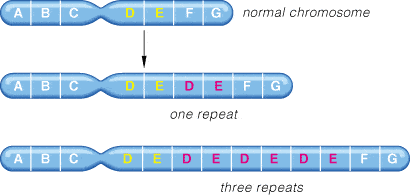
Identify the mutation in the picture.
a)
Inversion
b)
Deletion
c)
Duplication
d)
Translocation
45.
Identify the mutation in the picture.
a)
Inversion
b)
Duplication
c)
Deletion
d)
Translocation
46.
Identify the mutation in the picture.
a)
Deletion
b)
Inversion
c)
Duplication
d)
Translocation
47.
When can a mutation be passed on to offspring?
a)
only when the mutation is present during or occurs during mitosis
b)
only when the mutation is present during or occurs during meiosis
c)
when the mutation occurs during mitosis or meiosis
d)
when the mutation occurs in somatic cells
48.
This is an example of ___________?
a)
Incomplete dominance
b)
Co-Dominance
49.
A tall plant (TT) is crossed with a short plant (SS) and a medium plant (TS) results. This is what type of inheritance pattern?
a)
Incomplete Dominance
b)
Codominance
50.
This is an example of ___________.
a)
 Incomplete Dominance
b)
 Codominance
51.
A calico cat shows both the traits for orange fur and black fur. What kind of allele expression is this?
a)
Incomplete Dominance
b)
Co dominance
52.
Where the better adapted organisms survive to pass traits along to offspring.
a)
Evolution
b)
Natural Selection
c)
Extinction
d)
Artifical Selection
53.
Why are advantageous traits more likely to be passed onto offspring?
a)
Because they are more likely to survive and reproduce.
b)
Because they come from dominant alleles.
c)
Because they come from recessive alleles.
d)
Because the trait is an acquired phenotype.
54.
The differences among a species, like different bird beaks, are called
a)
genes.
b)
variations.
c)
traits.
d)
theories.
55.
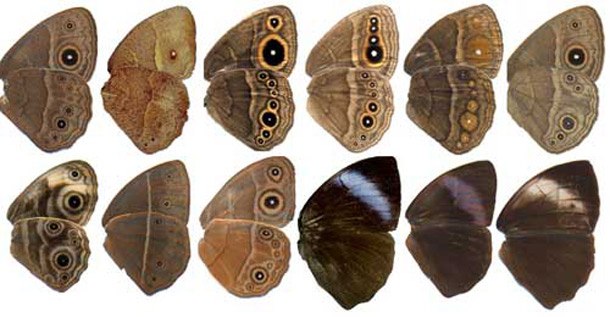
These moths are all the same species. The differences between their wings is an example of ________________
a)
Natural Selection
b)
Variation
c)
Homeostasis
d)
Extinction
56.
a bird that can easily outcompete other birds for food and that can produce many eggs has a high
a)
life expectancy
b)
mutation rate
c)
fitness
d)
adaptability
57.
The Aztecs and Maya Tribes of Mexico where some of the first humans to slowly change wild corn to the corn we know today. What process did these tribes use?
a)
Natural Selection
b)
Artificial Selection "Selective Breeding"
c)
Mitosis
d)
Cell Membrane
58.

Farmers breed cows to produce high amounts of milk. This is an example of...

a)

Natural Selection

b)

Variations in a species

c)

Artificial Selection

59.

When you have an infection, the multiplying pathogenic bacteria inside of you are not all identical. Most of them are the same, but every now and again one of of them will be slightly different genetically. Because of these slight genetic differences, harmful conditions, like the presence of an antibiotic, might kill most of the pathogenic bacteria but some may be better able to survive and then thrive. These characteristics are favored in this environment so these bacteria can continue to thrive, and make you ill. Does this scenario represent natural or artificial selection?

a)

Natural Selection

b)

Artificial Selection

c)

Selective Breeding

d)

Pathogenic Breeding Pattern

60.
Change that occurs over time:
a)
Analogous
b)
Homologous
c)
Evolution
d)
Biogeography
61.
When organisms, whether living or extinct, are descended from a common ancestor---this is known as: 
a)
Struggle for Existence
b)
Survival of the Fittest
c)
Descent with Modification
d)
Adaptation
62.
Which of Darwin's ideas had the strongest connection to Darwin having read Malthus's essay on human population growth? 
a)
A) descent with modification 
b)
B) variation among individuals in a population 
c)
C) struggle for existence 
d)
D) the ability of related species to be conceptualized in "tree thinking" 
e)
E) that the ancestors of the Galápagos finches had come from the South American mainland
63.

____________________ is the theory that more recent species of organisms are changed descendants of earlier species.

a)

Descent with modification

b)

Natural selection

c)

Hypothesis

d)

Adaptive advantage

e)

Vestigial structure

64.
Lamarck thought that the differences in traits of organisms are a result of
a)
increases in population size.
b)
the actions of organisms as they change a body structure. 
c)
an unchanging local environment.
d)
the natural variations already present within the population of organisms.
65.
This salamander did not use its eyes so it lost its vision. Whose theory said if you don't use it, you lose it? 
a)
Darwin
b)
Lamarck
66.
What is the process in which organism with variations most suited to their local environment survive and leave more offspring?
a)
Natural Selection
b)
Acquired Traits
c)
Phenotype 
67.
A set of principles that explains and predicts a phenomena is called a _____. 
a)
scientific law
b)
scientific method
c)
scientific theory
d)
scientific instructor
68.

Which of the following was the most significant stop on Charles Darwin's voyage?

a)

Australia

b)

Barbados

c)

Galapagos

d)

Trinidad

69.

Darwin noticed that many organisms seemed well suited to

a)

providing humans with food

b)

surviving in the environments in which they lived

c)

being preserved as a fossil

d)

swimming from one island to another

70.

Which scientist theorized that we can explain past geological events through erosion, volcanoes, etc.?

a)

Lyell

b)

Lamarck

c)

Malthus

d)

Darwin

71.
   James Hutton Was A _________
a)
Astronomer
b)
Geologist
c)
Meme
d)
Philosopher
72.
Thomas Malthus concluded that
a)
population increased arithmetically while food production increased geometrically.
b)
the world's rate of population increase was higher than the development of food supplies.
c)
moral restraint was producing lower crude birth rates.
d)
population growth was outpacing available resources in every country.
73.

Various structures in different species that have the same function but have evolved separately are called ____________.

[no common ancestor]

a)

Convergent Evolution

b)

Homologous Structures

c)

Analogous Structures

d)

Vestigial Structures

74.
what are vestigial organs
a)
leftover organs that aren't used
b)
very useful organs that are needed for life
75.
Structures with the same parts have different functions; suggests that organisms share a common ancestry
a)
vestigial structures
b)
homologous structures
c)
adaptive radiation
d)
fossil