
NEW
Font size
S
M
L
XL
 Worksheets
The cell
Total questions: 73
Worksheet time: 50mins
Name
Class
Date
1.
All living things are made of...
a)
atoms
b)
cells
c)
bacteria
d)
plants
2.
Where is the DNA found in a prokaryotic cell?
a)
floating around in the cytoplasm
b)
in the nucleus
c)
in the ribosomes
d)
in the cell membrane
3.
What type of cell has a nucleus?
a)
eukaryotic
b)
prokaryotic
4.
Controls what enters/leaves a cell
a)
cell membrane
b)
Nuclear membrane
c)
cell wall
d)
cytoplasm
5.
stiff, protective outer layer of plant cells
a)
cell membrane
b)
nuclear membrane
c)
cell wall
d)
cytoplasm
6.
releases energy for cells to use, most common in animal cells
a)
mitochondria
b)
ribosomes
c)
lysosomes
d)
nucleolus
7.
packages proteins for delivery
a)
Endoplasmic reticulum
b)
ribosomes
c)
golgi apparatus
d)
lysosomes
8.

Amino acids link together to form proteins. In which organelle would this process occur?
a)
Lysosome
b)
Ribosome
c)
Centriole
d)
Mitochondria
9.
collect sunlight which it converts to sugars
a)
chloroplasts
b)
cytoplasm
c)
cell wall
d)
mitochondria
10.
hold/store water, mainly found in plant cells
a)
nuclolus
b)
ribosomes
c)
golgi bodies
d)
vacuoles
11.
break down (digest) worn out cell parts, mostly in animal cells
a)
cytoplasm
b)
lysosomes
c)
mitochondria
d)
vacuoles
12.
jello-like material, fills the space between cell organelles, is where many chemical reactions occur
a)
cytoplasm
b)
chromatin
c)
chloroplast
d)
cell membrane
13.

What am I?
a)
cell wall
b)
mitochondria
c)
cytoplasm
d)
chloroplast
14.

What am I?
a)
vacuole
b)
ribosome
c)
endoplasmic reticulum
d)
golgi apparatus
15.

What am I?
a)
Nucleus
b)
Golgi Body
c)
Mitochondrion
d)
Plasma Membrane
16.
What can only be found in plant cells?
a)
Cell membrane
b)
Vacuole
c)
Chloroplast
d)
Mitochondrion
17.
The powerhouse of the cell is the...
a)
Mitochondrion
b)
Golgi body
c)
Nucleus
d)
Ribosomes
18.
Where are proteins made?
a)
Golgi body
b)
Mitoichondrion
c)
Chromosomes
d)
Ribosomes
19.
What form are chromosomes in during most of the life of the cell?
a)
DNA
b)
Chromatin
c)
Mitosis
d)
Nucleus
20.
What makes the endoplasmic reticulum rough?
a)
Vessicles
b)
Vacuoles
c)
Ribosomes
d)
Chromosomes
21.
What is found in both plant and animal cells but is much larger in plant cells?
a)
Nucleus
b)
Mitochondrion
c)
Chloroplast
d)
Vacuole
22.
Cell membranes are found in
a)
Only animal cells
b)
Only plant cells
c)
Some plant and animal cells
d)
All plant and animal cells
23.
The ______________ is the brain of the cell.
a)
Vacuole
b)
Nucleus
c)
Chromosomes
d)
60 W light bulb
24.
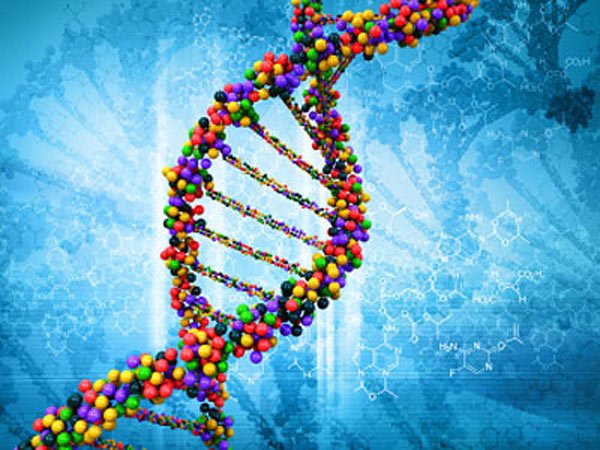
What is the name of the genetic material that is inside the nucleus?
a)
ER
b)
ATP
c)
YOLO
d)
DNA
25.
The site of photosynthesis
a)
ribosome
b)
mitochondria
c)
chloroplast
d)
nucleus
26.
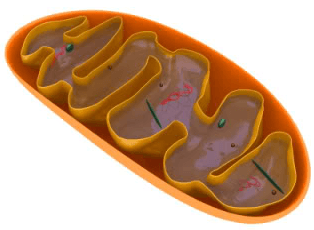
What are tiny organelles that convert glucose into ATP?
a)
Ribosomes
b)
Vesicles
c)
Cytoskeleton
d)
Mitochondria
27.
Main producer of ATP in all eukaryotes
a)
chloroplast
b)
mitochondria
c)
lysosome
d)
smooth er
28.
A group of tissues that work together to perform a similar function is called_____. (Examples include the heart, lungs or stomach)
a)
cells
b)
tissues
c)
organs
d)
organ system
29.
Organs that work together to perform a related function is called _____________?
a)
cells
b)
tissues
c)
organ system
d)
organs
30.
The diffusion of WATER across a semi-permeable membrane is
a)
osmosis
b)
diffusion
c)
endocytosis
d)
exocytosis
31.
The movement of molecules from higher concentration to lower concentration is
a)
diffusion
b)
cell division
active transport
active transport
c)
active transport
d)
tonicity
32.
Active transport requires
a)
energy
b)
the nucleus
c)
chloroplasts
d)
lysosomes
33.
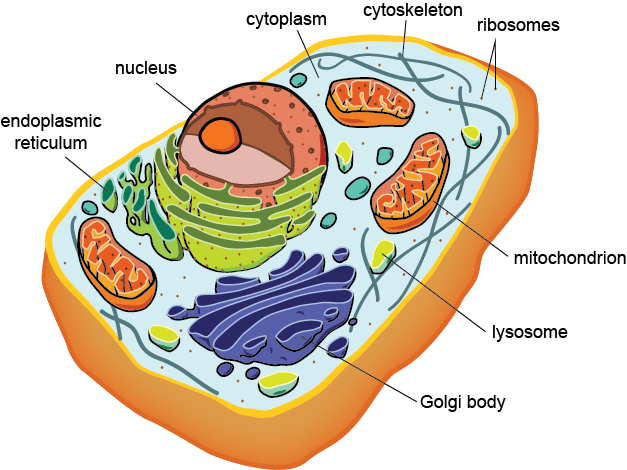
Which of the following statements is not part of the cell theory?
a)
Cells are the basic unit of structure and function in all living things.
b)
All cells are produced from other cells.
c)
Only animal cells are composed of cells.
d)
All living things are composed of cells.
34.

a)
Cytokinesis
b)
Interphase
c)
Anaphase
d)
Metaphase
35.

a)
Prophase
b)
Interphase
c)
Anaphase
d)
Telophase
36.

a)
Anaphase
b)
Cytokinesis
c)
Telophase
d)
Metaphase
37.

a)
Anaphase
b)
Cytonkinesis
c)
Interphase
d)
Prophase
38.

a)
Cytokinesis
b)
Anaphase
c)
Telophase
d)
Prophase
39.
The phase in mitosis where chromosomes move away and are pulled apart by spindles to opposite sides of the cell.
a)
prophase
b)
anaphase
c)
metaphase
d)
telephase
40.
Chromosomes condense from long stands into rod like structures.
a)
Prophase
b)
Interphase
c)
Metaphase
d)
Anaphase
41.

In mitosis, the two resulting cells are
a)
different from the starting cell and identical to each other.
b)
different from the starting cell and different from each other.
c)
identical to the starting cell and different from each other.
d)
identical to the starting cell and identical to each other.
42.
The time between cell divisions in the life cycle of the cell is called
a)
anaphase
b)
interphase
c)
prophase
d)
metaphase
43.
Where does a cell contain it's genetic material?
a)
nucleus
b)
nucleolus
c)
cytoskeleton
d)
golgi
44.
Which organelle performs PHOTOSYNTHESIS?
a)
Chloroplast
b)
Mitochondria
c)
Nucleus
d)
Ribosome
45.
Which of the following is the correct equation for PHOTOSYNTHESIS?
a)
CO2 + light + H2O --> O2 + Sugar
b)
CO2 + sugar + H2O --> O2 + light
c)
O2 + light + H2O --> CO2 + Sugar
d)
CO2 + O2 + H2O --> Light+ Sugar
46.
What is the ultimate ORIGINAL source of energy for living things
a)
Sugar
b)
Sun
c)
Moon
d)
Carbon Dioxide
47.
What is the pigment in chloroplasts that performs photosynthesis?
a)
Chlorosynthesis
b)
Chlorophyll
c)
enzymes
d)
borophyll
48.
Which gas is removed from the atmosphere during photosynthesis?
a)
hydrogen
b)
oxygen
c)
nitrogen
d)
carbon dioxide
49.
What are the products of photosynthesis?
a)
water and carbon dioxide
b)
oxygen and glucose
c)
oxygen and carbon dioxide
d)
oxygen and water
50.
Plants need ________ for photosynthesis
a)
oxygen
b)
soil
c)
carbon dioxide
d)
sugar
51.
What is photosynthesis?
a)
The process in which humans eat their food
b)
When a photographer takes a photo.
c)
To get your pictures from the photo lab.
d)
The process in which plants make their food.
52.
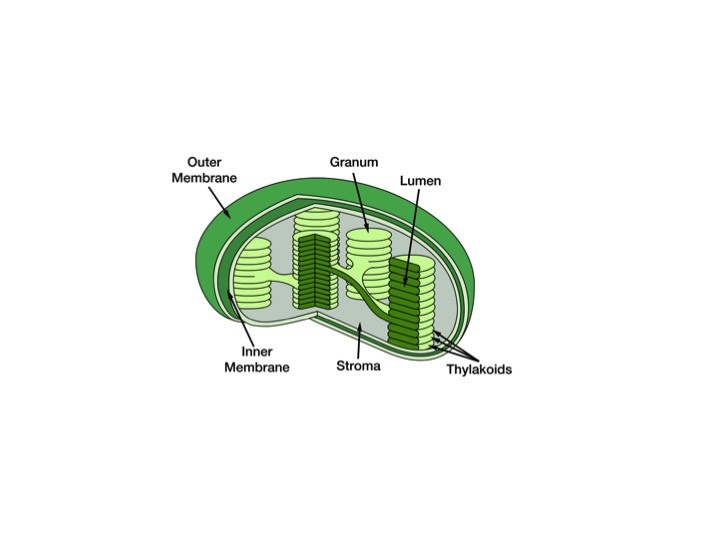
Chloroplasts are...
a)
Structures of animal cells to produce ATP
b)
Organelles where lipids are elaborated
c)
Specialized structures of plants where food is made
d)
Waste organelle of plants
53.

Which organelle from the plant cell is primarily responsible for converting sunlight to energy?
a)
Mitochonria
b)
Nucleus
c)
Vacuole
d)
Chloroplast
54.

What is produced as a result of photosynthesis?
a)
Glucose and Chlorophyll
b)
Glucose and Oxygen
c)
Water and Light energy
d)
Carbon dioxide and Water
55.
All living things do which of the following?
a)
Chemosynthesis
b)
Respiration
c)
photosynthesis
d)
all of the answers
56.
What is one of the reactants of cellular respiration?
a)
energy
b)
glucose
c)
carbon dioxide
d)
water
57.
In which way are photosynthesis and cellular respiration different?
a)
Cellular respiration stores ATP, while photosynthesis releases ATP.
b)
Cellular respiration produces oxygen, while photosynthesis uses oxygen.
c)
Photosynthesis releases energy, while cellular respiration stores energy.
d)
Photosynthesis used carbon dioxide, while cellular respiration produces carbon dioxide.
58.
What is the correct equation for cellular respiration?
a)
6O2 + C6H12O6 -> 6CO2 + 6H2O + Energy
b)
6O2 + C6H12O6 + Energy -> 6CO2 + 6H2O
c)
6CO2 + 6H2O -> 6O2 + C6H12O6 + Energy
d)
6CO2 + 6H2O + Energy -> 6O2 + C6H12O6
59.
Cellular Respiration's goal is to
a)
make water
b)
make ATP
c)
make glucose
d)
make oxygen
60.
What is cellular respiration?
a)
the breakdown of glucose to release ATP
b)
the breakdown of glucose to release NADH
c)
the breakdown of glucose to release FADH
d)
the breakdown of glucose to release carbon
61.
Where does cellular respiration occur?
a)
glucose molecule
b)
mitochondria
c)
cytoplasm
d)
chloroplast
62.
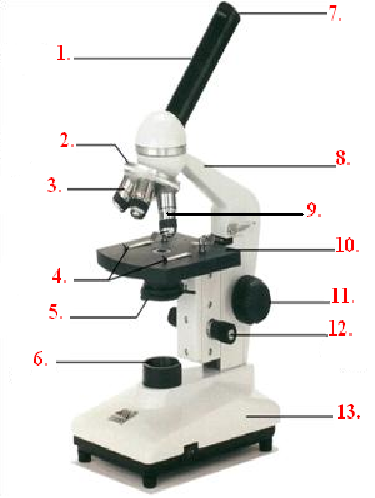
Number 12
a)
arm
b)
Fine Adjustment
63.
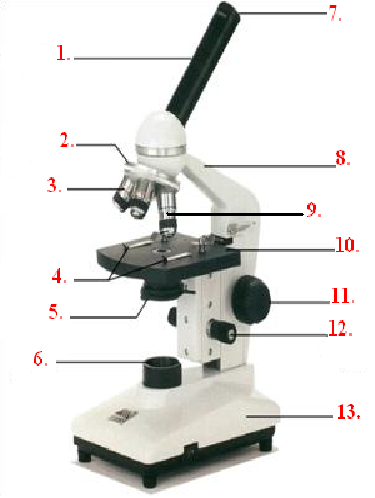
Piece 7
a)
eyepiece
b)
Objective Lens
c)
Base
d)
Arm
64.

Number 3
a)
Ocular Lens
b)
Objective Lens
c)
Diaphragm
d)
Base
65.

Number 8
a)
Base
b)
Stage
c)
Tube
d)
Arm
66.

Number 4
a)
Stages
b)
Arms
c)
Stage Clips
d)
Ocular Lens
67.
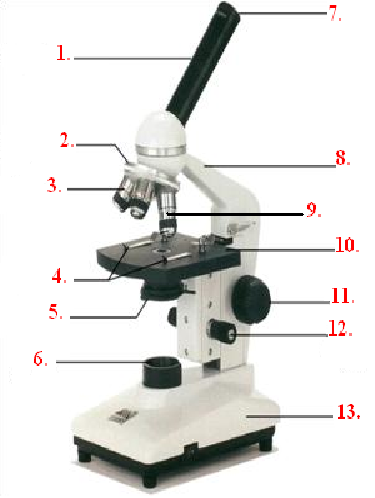
Number 10
a)
Stage
b)
Stage Clips
c)
Diaphragm
d)
Base
68.
Number 12
a)
Course Adjustment
b)
Fine Adjustment
c)
Small Adjuster
d)
Large Adjuster
69.

Number 11
a)
Course Adjustment
b)
Fine Adjustment
c)
Small Adjuster
d)
Large Adjuster
70.

Number 5
a)
Knob
b)
Ocular Lens
c)
Diaphragm
d)
Objective Lens
71.

Number 6
a)
Insulator
b)
Objective Lens
c)
eyepiece
d)
Light
72.

Number 13
a)
Arm
b)
Light
c)
Base
d)
Stand
73.
Cells are the base unit and function of living things.
a)
True
b)
False
Reset

