wayground logo

Free Printable Worksheets

Font size

S
M
L
XL
Worksheets

Final Exam Review - Evolution, DNA, Cell Division, Genetics

Total questions: 72

Worksheet time: 1hrs 7mins

Name
Class
Date
1.

two of the same allele

a)

homozygous

b)

heterozygous

c)

recessive

d)

dominant

2.

phenotype

a)

the genetic make up of an organism

b)

the physical expression of a trait

c)

the change in the DNA

d)

the result of plastic surgery

3.

genotype

a)

the genetic make up of an organism

b)

the physical expression of a trait

c)

the change in the DNA

d)

the result of plastic surgery

4.
variations of a gene
a)
trait
b)
monohybrid cross
c)
dihybrid cross
d)
alelle
5.

What is the genotype of a heterozygous rabbit with long ears if short is recessive to long?

a)

Ll

b)

LL

c)

ll

d)

you cannot tell

6.
What percentage of plants will have yellow seeds if you cross a heterozygous green seed with a homozygous recessive yellow seed?  Use a Punnet square!
a)
25
b)
50
c)
75
d)
100
7.

blue and red flowers produce purple flowers

a)

incomplete dominance

b)

codominance

c)

polygenic inheritance

d)

multiple alleles

8.

a breed of dog has black fur, brown fur, or black and brown mottled fur

a)

incomplete dominance

b)

codominance

c)

polygenic inheritance

d)

multiple alleles

9.

blue and red flowers produce blue flowers with red edges

a)

incomplete dominance

b)

codominance

c)

polygenic inheritance

d)

multiple alleles

10.
the genotype of a female who exhibits a recessive X-linked trait
a)
XGXg
b)
XXg
c)
XgXg
d)
XGY
11.
What genotype do I have if I have type B blood?
a)
B
b)
BO
c)
BB
d)
BB or BO
12.
Which blood type is universal donor?
a)
A
b)
B
c)
AB
d)
O
13.
Which blood type is universal recipient?
a)
A
b)
B
c)
AB
d)
O
14.
What is the chance of a couple who are both AB having a baby with type B?  (do a Punnett square)
a)
25
b)
50
c)
75
d)
0
15.
 A person with type O marries a person with type AB.  Can their kids have type A blood?  type B blood?
a)
yes to A, no to B
b)
yes to B, no to A
c)
yes, either A or B
d)
no, all will be AB
16.
A woman is heterozygous dominant for curly hair and homozygous dominant for brown hair.  Her genotype is
a)
CCBB
b)
CcBB
c)
Ccbb
d)
ccBb
17.
Which of the following is an example of a homozygous recessive genotype?
a)
RR
b)
Rr
c)
rr
18.
Refer to the illustration. The child in box 1 in the Punnett square would
a)
be homozygous for freckles
b)
have an extra freckles chromosome
c)
be heterozygous for freckles
d)
not have freckles
19.
G = green, g = yellow
The genotype for a yellow plant is...
a)
GG
b)
Gg
c)
gg
d)
all of the choices result in yellow
20.

A person with type AB blood needs a transfusion. Which blood type can they safely receive? (don't worry about them being Rh + or -)

a)

A

b)

B

c)

O

d)

Any type will be safe.

21.

A person with type B blood needs a transfusion. Which blood type can they safely receive? (don't worry about them being Rh + or -)

a)

AB

b)

B

c)

O

d)

B or O

22.

the genotype of a male who exhibits a recessive X-linked trait

a)

XGXg

b)

XgY

c)

XgXg

d)

XGY

23.

Blonde hair is a recessive trait. If a blonde woman marries a man who is homozygous dominant for dark hair, what percentage of their children will be blonde?

a)

0%

b)

25%

c)

75%

d)

100%

24.

A flower has incomplete dominance in its petal colors. Petals can be yellow (YY), orange (OO), or peach (YO). Cross a peach flower with a yellow flower. What percentage of the offspring will be yellow?

a)

25%

b)

50%

c)

75%

d)

0%

25.

Dimples are dominant to not having dimples. A couple are both heterozygous for dimples. What is the genotype ratio (DD:Dd:dd) of their offpring? (do a Punnett square!)

a)

2:2:0

b)

1:2:1

c)

0:2:2

d)

1:1:2

26.
Which of the following bases is found only in RNA?
a)
Adenine
b)
Guanine
c)
Thymine
d)
Uracil
27.
Which form of RNA carries amino acids from the cytoplasm to the ribosome?
a)
amino RNA
b)
ribosomal RNA
c)
transfer RNA
d)
messenger RNA
28.
Transcribe the following sequence of DNA into RNA:
AAG   CTT   TGC
a)
TTC  GAA  ACG
b)
UUC  GAA ACG
c)
TTC  GUU  UCG
d)
UUC  GUU  UCG
29.
What is the monomer of DNA and RNA?
a)
amino acids
b)
nucleotides
c)
fatty acids
d)
monosaccharide
30.
Which of the following would be a DNA nucleotide?
a)
phosphate, deoxyribose, uracil
b)
phosphate, deoxyribose, thymine
c)
phosphate, ribose, uracil
d)
phosphate, ribose, thymine
31.
What would be the complementary DNA strand for the following nucleotide sequence?
TCG ATA CGA
a)
AGC ATA GCT
b)
AGC TAT GCT
c)
AGC UAU GCU
d)
UGC TUT GCT
32.

What process is shown in the picture?

a)

commensalism

b)

deletion

c)

passive transport

d)

DNA replication

33.
Which 2 molecules form the sides (backbone) of the DNA ladder?
a)
deoxyribose sugar and adenine
b)
deoxyribose sugar and a hydrogen bond
c)
deoxyribose sugar and the nucleus
d)
deoxyribose sugar and phosphate
34.
Which phase of which process does this picture show?
a)
Transcription
b)
Translation
c)
Replication
35.

These building blocks consist of a sugar, phosphate, and nitrogen base.

a)

Ribose

b)

Nucleotide

c)

Gene

d)

Protein

36.
How does RNA differ from DNA?
a)
RNA contains uracil and deoxyribose
b)
RNA contains ribose and thymine
c)
RNA contains uracil and ribose
d)
RNA contains adenine and ribose
37.
In humans, where does DNA replication take place?
a)
cytoplasm
b)
ribosome
c)
nucleus
d)
vacuole
38.
During transcription, what does messenger RNA do?
a)
It delivers DNA's instructions for making proteins.
b)
It constructs proteins out of random amino acids.
c)
It strings together two complementary DNA strands.
d)
It strings together two complementary RNA strands.
39.
How many amino acids are coded for in the following sequence of mRNA nucleotides? 
CGAUACAGUAGC
a)
3
b)
4
c)
6
d)
12
40.
Which of the following is the site of translation?
a)
vacuole
b)
lysosome
c)
nucleus
d)
ribosome
41.

Every ​ (a)   nitrogen bases on a DNA strand represents ​ (b)   codon. A single codon will add a ​ (c)   ​ amino acid(s) to the protein.

Choose from the below words
three
one
single
two
pair of
42.

What is the end product of meiosis?

a)

4 haploid cells.

b)

2 diploid cells.

c)

2 haploid cells.

d)

4 diploid cells.

43.

What process results in the division of 1 cell into 2 identical daughter cells?

a)

Mitosis

b)

Meiosis

c)

G1

d)

Cross-Over

44.

What is the end product of meiosis?

a)

4 haploid cells.

b)

2 diploid cells.

c)

2 haploid cells.

d)

4 diploid cells.

45.

The end of meiosis results in _______ to each other.

a)

2 cells that are genetically identical

b)

4 cells that are genetically identical

c)

2 cells that are genetically unique

d)

4 cells that are genetically unique

46.

In mitosis the two resulting cells are

a)

Different from the starting cell and identical to each other

b)

Identical to the starting cell and different from each other

c)

Different from the starting cell and different from each other

d)

Identical to the starting cell and identical to each other

47.

A human germ cell has 46 chromosomes, after meiosis how many chromosomes will it have?

a)

11.5

b)

23

c)

46

d)

92

48.
The difference in the physical traits of an individual from those of other individuals in a group is called a(n)
a)
change
b)
adaption
c)
species
d)
variation
49.

A trait that makes an organism more likely to survive its environment is called a(n)

a)

natural selection

b)

adaptation

c)

fitness

d)

variation

50.
Darwin called the ability of an organism to survive and reproduce in its environment
a)

natural selection

b)

adaption

c)

fitness

d)

variation

51.
The process in which organisms that are best suited to the environment survive and reporduce at a higher rate is called
a)
natural selection
b)
adaption
c)
fitness
d)
variation
52.
An earthquake causes an ocean channel to open and separate an island into two smaller islands.  The species on each section are now in
a)
geographic isoliation
b)
behavioral isolation
c)
disruptive selection
d)
temporal isolation
53.
What is the process in which humans breed organisms for certain traits?
a)
natural selection
b)
inheritance
c)
artificial selection
d)
descent withOUT modification
54.

Favors the middle of the population. For example, turtles with medium-length necks can reach food sources on a bush while still hiding from predators inside their shells.

a)
b)
c)
55.
Which of the following explains how natural selection causes a trait to become predominant in a population?
a)
Individuals with traits that are favorable to the environment reproduce more.
b)
Traits of an individual change in order to adapt to changes in enviornment.
c)
organisms select which traits they wish to inherit
d)
all of these answers
56.
Structures that have different mature forms but develop from the same embryonic tissue and have similar bones are called 
a)
analagous
b)
adaptations
c)
homologous
d)
fossils
57.

Whales are aquatic mammals that contain a pelvis bone.  Even though it does not aid in its movement, the function must have been used by a common ancestor of the whale who probably had four legs and lived on land.  Thus, the pelvis is referred to as a(n)

a)

vestigial structure

b)

analogous structure

c)

homologous structure

58.
A farmer's use of the best livestock for breeding is an example of
a)
natural selection
b)
artificial selection
c)
extinction
d)
adaptation
59.
Any change in the relative frequency of alleles in the gene pool of a population over time is known as
a)
variation
b)
evolution
c)
stabilizing selection
d)
Founder effect
60.

The characteristics of an organism that make it better suited for survival in an environment. 

a)

Adaptation

b)

Behavior

c)

Fossil

d)

Nutrient

61.
Modern whales developed their traits through natural selection.  What occurs during the process of natural selection?
a)
Organisms choose mates from other species to create new species
b)
Breeders selectively cross organisms with desired traits
c)
Only the fittest organisms can survive and reproduce
d)
Organisms remain exactly the same over time.
62.
Modern whales developed their traits through natural selection.  The vestigial pelvic bones of a whale indicate that
a)
whales came close to becoming extinct
b)
whales are developing into land animals
c)
whales evolved from a four-legged species
d)
whale legs are hidden by their fatty layers
63.
Natural selection can also be referred to as:
a)
Survival of the weakest
b)
Survival
c)
Survival of the fittest
d)
Artificial selection
64.
Which of the following is a term for a group of similar organisms that can reproduce fertile offspring?
a)
individual
b)
population
c)
species
d)
fossil
65.
If a law is passed that only deer over a certain size may be hunted during deer season in Michigan, what would the most likely effect be on the deer population over several decades?
a)
The average body size would increase
b)
The average body size would decrease
c)
male body size increased, females stayed the same
d)
none of the above
66.
Which is an example of behavioral or reproductive isolation?
a)
lava flow separates two groups of lizards living on Maui
b)
finches develop different mating calls due to differing beak structure
c)
zebras travel in herds for protection
d)
peacocks display bright feathers to attract mates
67.
According to the cladogram, which share the MOST RECENT common ancestor?
a)
swordfish and frog
b)
swordfish and t. rex
c)
t. rex and alligator
d)
frog and alligator
68.
According to the cladogram, B represents a commmon ancestor between
a)
swordfish and frog
b)
frog and t. rex
c)
frog, t. rex and alligator
d)
frog and alligator
69.
According to the cladogram, swordfish and alligator have a common ancestor at ?
a)
A
b)
B
c)
C
d)
A, B, and C all represent common ancestors
70.
According the the cladogram, which have the most RECENT common ancestor?
a)
birds and reptiles
b)
birds and sharks
c)
amphibians and reptiles
d)
reptiles and mammals
71.

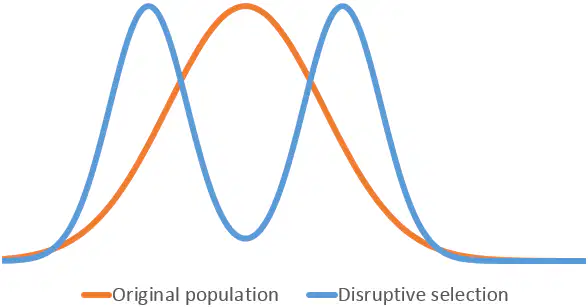
Middle is wiped out, extremes survive. For example, due to a loss of a certain food source, only finches with beaks small enough to reach inside tree crevices or long enough to reach deep into the ground surviveRed is previous, blue represents the change.

a)
b)
c)
72.

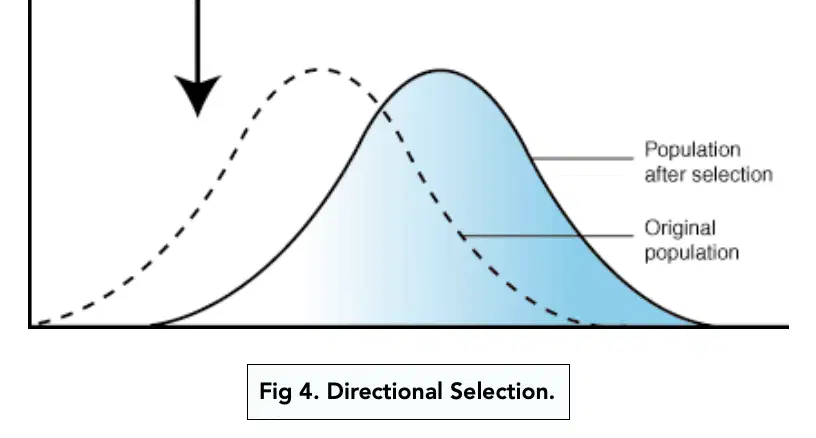
The entire curve moves in one direction or the other.  For example, only giraffes with the longest necks can reach leaves after a drought wipes out smaller trees.

a)
b)
c)