wayground logo

Free Printable Worksheets

Font size

S
M
L
XL
Worksheets

Quiz on DNA history, structure and replication

Total questions: 73

Worksheet time: 2hrs 54mins
Name
Class
Date
1.
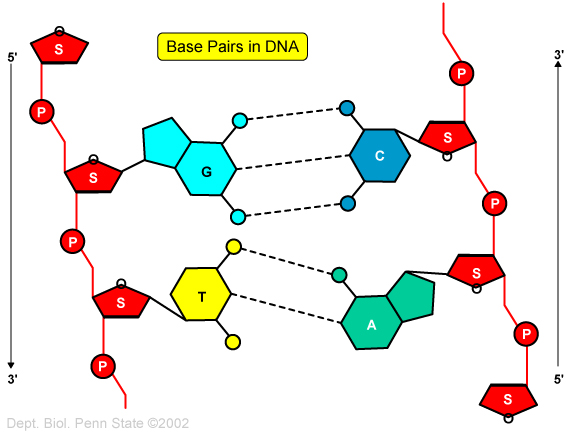
Adenine bonds with ______________.
a)
Guanine
b)
Thymine
c)
Cytosine
d)
Adenine
2.
Guanine bonds with ______________.
a)
Adenine
b)
Guanine
c)
Cytosine
d)
Thymine
3.
Which 2 molecules form the sides (backbone) of the DNA ladder?
a)
deoxyribose sugar and adenine
b)
deoxyribose sugar and a hydrogen bond
c)
deoxyribose sugar and the nucleus
d)
deoxyribose sugar and phosphate
4.
Nitrogenous bases are joined by which type of bond?
a)
polar bonds
b)
ionic bonds
c)
covalent bonds
d)
hydrogen bonds
5.
The enzyme that unzips the DNA to prepare for replication
a)
helicase
b)
replicase
c)
polymerase
d)
synthase
6.
A process in which DNA has the unique ability to make an exact copy of itself.
a)
Replication
b)
Translation
c)
Transcription
7.
Which of the following units are repeatedly joined together to form a strand of DNA?
a)
amino acids
b)
nucleotides
c)
fatty acids
d)
polysaccharides
8.
What are the nucleotides made of?
a)
Sugar, Phosphate, nitrogen base
b)
Phosphate, Adenine, nitrogen base
c)
Thymine, Adenine, Cytomine
d)
Phosphate, Nitrogen, Adenine
9.
If a strand reads:
3' A A A T T T C 5'
The matching strand would read...
a)
5' T T T A A A G 3'
b)
3' T T T A A A G 5'
c)
5' A A A T T T C 3'
d)
3' U U U A A A G 5'
10.
Polymerase is able to replicate the new DNA ______ along the leading strand.
a)
continuously
b)
only in short fragments
c)
very slowly
d)
prokaryotically
11.
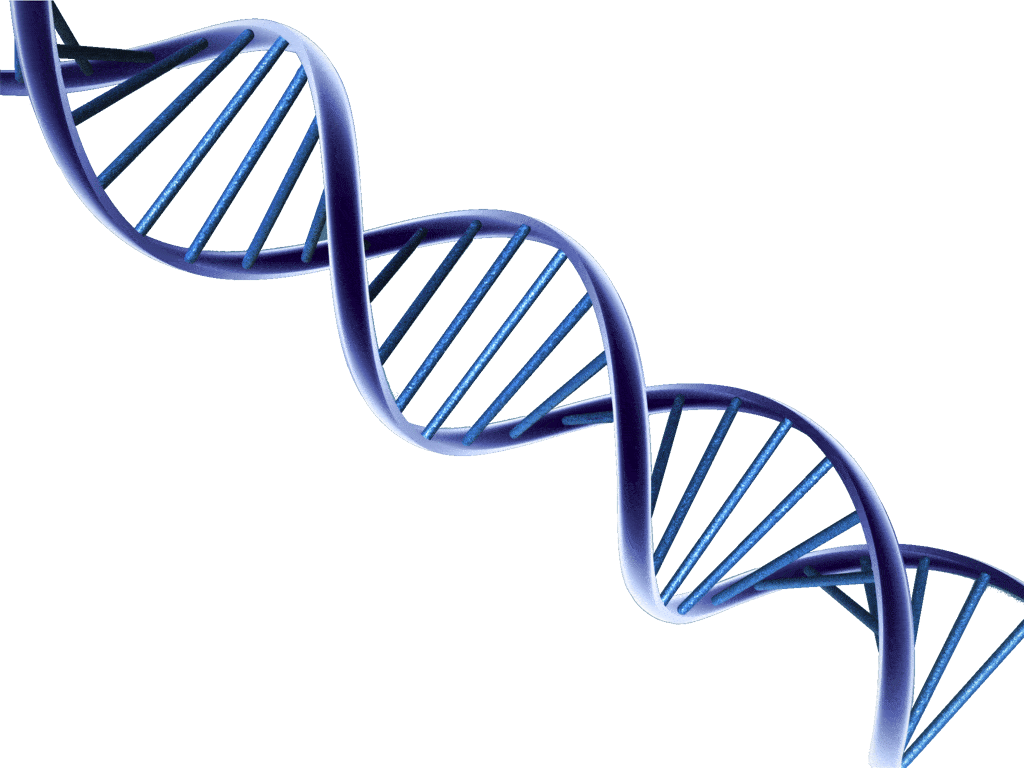
What is the shape of DNA?
a)
Double helix
b)
Triple helix
c)
Flat, bilayer
d)
Three-pronged rigid ladder
12.
If the percentage of DNA is made of 30% Thymine, what is the correct percentage of Guanine?
a)
30
b)
15
c)
20
d)
60
13.
These are the "smaller", single ringed bases such as thymine and cytosine
a)
complementary
b)
 cytosine
c)
purine
d)
pyrimidine
14.
These are the "larger", double-ringed bases such as adenine and guanine.
a)
complementary
b)
 cytosine
c)
purine
d)
pyrimidine
15.
In Chargaff's Rule, adenine pairs with ________, and cytosine pairs with _________.
a)
thymine, guanine
b)
guanine, thymine
c)
uracil, guanine
d)
thymine, uracil
16.
What is the sugar in the DNA molecule?
a)
deoxyribose
b)
ribose
c)
glucose
d)
fructose
17.
Which enzyme is responsible for adding nucleotides?
a)
Topoisomerase
b)
DNA Polymerase
c)
Ligase
d)
Primase
18.
Which sequence of DNA bases would pair with this partial strand
ATG TGA CAG
a)
ATG TGA CAG
b)
TAC ACT GTC
c)
GTA AGT GAC
d)
CAT TCA CTG
19.
Which of the following best describes a DNA molecule?
a)
double helix
b)
contains ribose
c)
made of amino acids
d)
contains Uracil
20.
Which of the following units are repeatedly joined together to form a strand of DNA?
a)
amino acids
b)
nucleotides
c)
fatty acids
d)
polysaccharides
21.
In a molecule of double-stranded DNA, the amount of Adenine present is always equal to the amount of
a)
cytosine
b)
guanine
c)
thymine
d)
uracil
22.
Guanine bonds with ______________.
a)
Adenine
b)
Guanine
c)
Cytosine
d)
Thymine
23.
Why is DNA important?
a)
it is very small and very complicated
b)
it's in everything
c)
it serves as the blueprint for traits of all living things
d)
because we eat it every day for energy
24.
Which organelle is DNA usually found in?
a)
cell membrane
b)
vacuole
c)
chloroplast
d)
nucleus
25.
Replicate the following strand of DNA: 
AATCATGGA
a)
AATCATGGA
b)
TTAGTACCT
c)
UUAGUACCU
d)
GGATAUCUA
26.
DNA replication results in two DNA molecules,
a)
each one with two original strands
b)
each one with two new strands
c)
each one with one new strand and one original strand
d)
one with two new strands and the other with two original strands
27.
The drawing shows the structure of what molecule?
a)
A DNA molecule
b)
A lipid molecule
c)
A carbohydrate molecule
d)
A protein molecule
28.
In what phase of the cell cycle does DNA replication take place?
a)
G1
b)
S
c)
G2
d)
M
29.
Who is responsible for producing this image?
a)
Francis Crick
b)
James Watson
c)
Rosalind Franklin
d)
Watson and Crick
30.
What does this image show?
a)
Double helical structure of DNA
b)
Triple Helical Structure of DNA
c)
Double helical structure of RNA
d)
Triple Helical Structure of RNA
31.
How did Rosalind Franklin's photo 51 affect the work of Watson and Crick?
a)
It was used to determine the physical structure of DNA
b)
It was used to identify the four bases that make up DNA
c)
It was used to determine the theory of independent assortment
d)
It was used to show DNA was the molecule of inheritance
32.
What did Erwin Chargaff conclude from his experiments?
a)
Nitrogen bases are held together by peptide bonds
b)
A and T, C and G always occur in equal amounts
c)
Proteins are the carriers of genetic information
d)
C and G rarely occur in eukaryotic organisms
33.
What was Watson and Crick's main scientific accomplishment?
a)
Building the first accurate model of DNA
b)
Isolating strains of pneumonia causing bacteria
c)
Determining base pairing rules
d)
Discovering the process of genetic transformation
34.
From his work with mice and pneumonia-causing bacteria, Frederick Griffith discovered what?
a)
Replication
b)
Transcription
c)
Transformation
d)
Translation
35.
By using radioactive isotopes, Hershey and Chase were able to conclude that _____ is the carrier of genetic information.
a)
DNA
b)
Protein
c)
Carbohydrate
d)
Lipid
36.
The work of Erwin Chargaff allowed Watson and Crick to determine the rules of.......
a)
protein synthesis
b)
transcription
c)
hydrogen bonding
d)
nitrogen base pairing
37.
Rosalind Franklin's "Photo 51" allowed Watson and Crick to determine the _______ of DNA.
a)
Shape
b)
Backbone
c)
Nitrogen bases
d)
Hydrogen bonds
38.
The work of scientists including Griffin, Avery, Hershey & Chase, and Franklin helped us to determine that _______ are responsible for carrying genetic material.
a)
Amino Acids
b)
Proteins
c)
Nucleic Acids
d)
Carbohydrates
39.
Who was responsible for the model shown?
a)
Oswald Avery
b)
Watson and Crick
c)
Erwin Chargaff
d)
Rosalind Franklin
40.
What are the 4 nitrogen bases?
a)
adenine, thymine, cytoplasm, and guanine
b)
adenine, thymine cytosine, and guanine
c)
adenine, thymine, cytosine, and gylcerol
d)
adenine, thymine, cytosine, and glucose
41.
What does DNA stand for?
a)
Deoxyribonucleic acid
b)
Denitrogenous acid
c)
Deribonucleic acid
d)
Diribonucleic acid
42.

How many chromosomes do human cells have?

a)

46

b)

23

c)

2

d)

44

43.
Which enzyme is responsible for adding nucleotides?
a)
Topoisomerase
b)
DNA Polymerase
c)
Ligase
d)
Primase
44.
RNA contains the sugar
a)
ribose
b)
deoxyribose
c)
glucose
d)
lactose
45.
The correct spelling of DNA is....
a)
deoxiribonucleic acid
b)
deoxyribosenucleic acid
c)
deoxyribonucleic acid
d)
deoxyribonucliec acid
46.
Which of the following statements is true?
a)
DNA is single-stranded
b)
RNA is single-stranded
c)
DNA contains uracil
d)
RNA contains deoxyribose
47.
What is the difference between DNA and RNA in terms of bases?
a)
RNA contains uracil in place of thymine
b)
RNA contains uracil in place of adenine
c)
RNA contains uracil in place of guanine
d)
RNA contains uracil in place of  cytosine
48.
Which type of RNA takes the instructions from the nucleus to the cytoplasm?
a)
mRNA
b)
tRNA
c)
rRNA
d)
RNA polymerase
49.
What is the template for mRNA?
a)
DNA
b)
tRNA
c)
rRNA
d)
proteins
50.
How does RNA differ from DNA?
a)
RNA contains uracil and deoxyribose
b)
RNA contains ribose and thymine
c)
RNA contains uracil and ribose
d)
RNA contains adenine and ribose
51.

What type of biomolecule are DNA and RNA?

a)

Nucleotides

b)

Nucleic Acids

c)

Amino Acids

d)

Proteins

52.

What is the monomer for DNA and RNA?

a)

Nucleotides

b)

Nucleic Acids

c)

Amino Acids

d)

Fatty Acids

53.

SELECT ALL the nucleotides found in DNA..........

a)

Adenine

b)

Thymine

c)

Uracil

d)

Cytosine

e)

Guanine

54.

SELECT ALL the nucleotides found in RNA..........

a)

Adenine

b)

Thymine

c)

Uracil

d)

Cytosine

e)

Guanine

55.

What is the main function of DNA?

a)

Store energy

b)

Store and carry genetic information

c)

Store lipids

d)

Store different nucleotides

56.

SELECT ALL THAT APPLY. What are the three parts of a nucleotide?

a)

Sugar

b)

Nitrogenous base

c)

Neon center

d)

Phosphate

57.

What sugar makes up DNA?

a)

Ribose sugar

b)

Deoxyribose sugar

c)

Deoxy sugar

d)

Oxygen sugar

58.

What sugar makes up RNA?

a)

Ribose sugar

b)

Deoxyribose sugar

c)

Deoxy sugar

d)

Oxygen sugar

59.

What is the job of the ribosome?

a)

Stores and carries genetic information

b)

Creates protein

c)

Creates fats

d)

Creates problems

60.

SELECT ALL the types of RNA......

a)

mRNA

b)

tRNA

c)

dRNA

d)

rRNA

61.

Why is RNA so so SO important?

a)

It has three different types

b)

It's made of ribose sugar

c)

It doesn't have thymine

d)

It transports the genetic code out of the nucleus

62.

Why can't DNA leave the nucleus?

a)

It's too darn small

b)

It's too dang big

c)

It can leave the nucleus....silly Ms. Grula

d)

It's too important to leave the nucleus

63.
What does this picture represent?
a)
amino acid
b)
base pairing
c)
nucleotide
d)
the DNA molecule
64.
The following picture must be
a)
DNA because it's double stranded
b)
RNA because it's single stranded
c)
DNA because it's single stranded
d)
RNA because it's double stranded
65.
I include the bases Guanine, Cytosine, Adenine and Uracil .
a)
DNA
b)
RNA
66.
I have the sugar ribose.
a)
DNA
b)
RNA
67.
I travel outside of the nucleus.
a)
DNA
b)
RNA
68.
In RNA, adenine goes with __________.
a)
adnine
b)
cytosine
c)
thymine
d)
uracil
69.
In RNA, uracil takes the place of the DNA nitrogen base called
a)
guanine
b)
cytosine
c)
thymine
d)
adenine
70.

Who proposed that DNA was not a protein?

a)

Oswald Avery

b)

James Watson

c)

Martha Chase

d)

Harry Styles

71.

Which scientist(s) determined that DNA is the transforming principle of cells?

a)

Avery

b)

Griffith

c)

Hershey and Chase

d)

Chargaff

72.

Which scientist coined the term "transformation" based on his work in which bacteria can change in the presence of external DNA?

a)

Avery

b)

Crick

c)

Griffith

d)

Wilkins

73.

Which phrase describes the base pairings that occur in DNA?

a)

purine + purine

b)

pyrimidine + pyrimidine

c)

purine + pyrimidine