wayground logo

Free Printable Worksheets

Font size

S
M
L
XL
Worksheets

Unit 3 Review

Total questions: 75

Worksheet time: 50mins

Name
Class
Date
1.
What word describes when water is attracted to other substances?
a)
cohesion
b)
adhesion
c)
capillary action
d)
surface tension
2.
Why does ice float?
a)
As water freezes, it expands and its density decreases.
b)
As water freezes, it takes up more hydrogen from the atmosphere, causing it to have a greater buoyancy.
c)
As water freezes, air becomes trapped between the hydrogen bonds of water molecules.
d)
As water freezes, it takes up more oxygen from the atmosphere, causing it to have a greater buoyancy.
3.
Which end of the water molecule has a slightly positive charge?
a)
the oxygen end
b)
the hydrogen end
c)
both ends are slightly positive
d)
neither end is positive
4.
Water is a universal solvent because it...
a)
It can be found anywhere
b)
It freezes when it gets cold
c)
floats when frozen
d)
Dissolves most substances
5.
 Small insects can walk across the surface of calm water. Their feet push the surface of the water down slightly, somewhat like a person walking across a trampoline, but they do not break the surface. What is the best explanation for why this happens?
a)
The insects are light enough so that they do not break the hydrogen bonds holding the water molecules together
b)
The insects actually use their wings to hover slightly above the water's surface and they only skim it with their feet
c)
The insects' feet are non-polar, so they are repelled by the polar water molecules and are pushed away from the water's surface
d)
The insects are small enough to see the individual water molecules, so they are able to step carefully from one molecule to the next
6.
Which statement explains why water molecules stick together?
a)
both sides are negative
b)
one side has a positive charge and the other side has a negative charge
c)
one side has a negative charge adn the other side has a neutral charge
d)
both sides are positive
7.
When a molecule has an opposite electrical charge on each end, it is known as what?
a)
cohesion
b)
polar molecule
c)
hydrogen bond
d)
solution
8.

What property of water allows for water to act as a temperature regulator for the world?

a)

Cohesive Behavior

b)

Expansion Upon Freezing

c)

High Specific Heat

d)

Universal Solvent

9.

What property of water causes these Alka-Seltzer tablets to dissolve?

a)

Universal Solvent

b)

Expansion Upon Freezing

c)

Cohesive Behavior

d)

High Specific Heat

10.

Subatomic particles with a negative charge

a)

Electrons

b)

Neutrons

c)

Protons

d)

Quarks

11.
Subatomic particles with a positive charge
a)
neutrons
b)
atomic mass
c)
protons
d)
isotopes
12.
Measure mainly of the nuclear particles: protons + neutrons
a)
Subatomic Particles
b)
Atomic Number
c)
Atomic Mass
d)
Gluons
13.
Subatomic particles that are neutral in charge
a)
Neutrons
b)
Protons
c)
Nucleus 
d)
Electrons
14.
A tiny but very dense, positively charged portion of the atom that holds most of the atomic mass
a)
Electron Shells
b)
Orbitals
c)
Electron Cloud
d)
Nucleus
15.

The smallest particle of an element.

a)

Element

b)

Molecule

c)

Atom

16.
Where are the Electrons found in the structure of an atom?
a)
In the nucleus
b)
In spaces around the nucleus
17.

A monosaccharide is....

a)

carbohydrate

b)

lipids

c)

protein

d)

nucleic acid

18.

This macromolecule provides the major energy source used by mitochondria (and all living things)

a)

carbohydrate

b)

lipids

c)

protein

d)

nucleic acid

19.

This macromolecule make up cell membranes, store energy, and provide insulation

a)

carbohydrate

b)

lipids

c)

protein

d)

nucleic acid

20.

This macromolecule carries hereditary information and instructions for building molecules

a)

carbohydrate

b)

lipids

c)

protein

d)

nucleic acid

21.

This macromolecule provides structural support and act as enzymes to catalyze metabolic reactions

a)

carbohydrate

b)

lipids

c)

protein

d)

nucleic acid

22.

A macromolecule with C, H, O, and N only, is a.....

a)

carbohydrate

b)

lipid

c)

protein

d)

nucleic acid

23.

Which statement is true?

a)

Simple sugars are made of polysaccharides.

b)

Glycerol is made of fatty acids.

c)

RNA molecules are made of nucleotides.

d)

Amino acids are made of proteins.

24.

Plants build cellulose (a polysaccharide) to makeup their parts like leaves, roots, stems, etc. What monomer do plants use to build cellulose?

a)

monosaccharides

b)

disaccharides

c)

amino acids

d)

nucleotides

25.

This group includes steroids like estrogen and testosterone

a)

carbohydrate

b)

lipid

c)

protein

d)

nucleic acid

26.

One of the characteristics of life is that organisms must have genetic material. This genetic material is a ________.

a)

carbohydrate

b)

lipid

c)

protein

d)

nucleic acid

27.

What is the term used to describe the energy needed to get a reaction started?

a)

activation energy

b)

adhesion energy

c)

cohesion energy

d)

chemical energy

28.

Which of the following statements is true about catalysts (enzymes)?

a)

Catalysts slow down the rate of chemical reactions.

b)

Enzymes help regulate pH.

c)

Catalysts are used up during a chemical reaction.

d)

Catalysts lower the activation energy of a chemical reaction.

29.

An enzyme and substrate can be compared to

a)

lock and key

b)

a faucet

c)

a door hinge

d)

light switch

30.

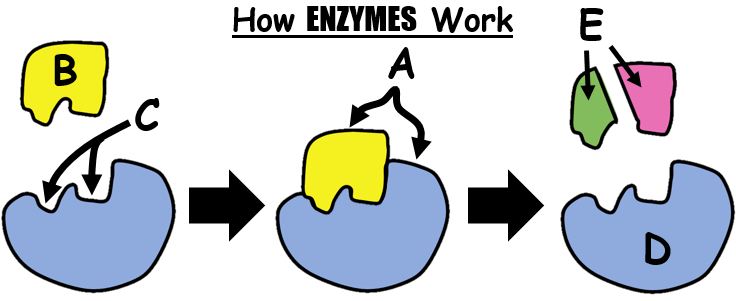
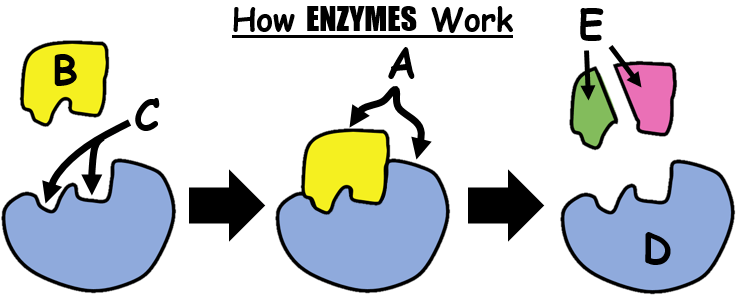
The picture below shows an enzyme acting on a substrate to form products during a chemical reaction. Using the figure, what letters represents the enzyme?

a)

A and B

b)

B and D

c)

A and E

d)

D and E

31.

Which of the following elements are found in all macromolecules? (Select all that apply).

a)
b)
c)
d)
32.

Which macromolecule is used as our main source of energy?

a)

Lipids/Fats

b)

Nucleic Acids

c)

Proteins

d)

Carbohydrates

33.

Which of the following are examples of carbohydrates? (Select all that apply).

a)

Bread

b)

Pasta

c)

Olive Oil

d)

Cheese

34.

Which macromolecule stores energy?

a)

Carbohydrates

b)

Proteins

c)

Lipids/Fats

d)

Nucleic Acids

35.

Nucleic acids make up which of the two molecules listed below?

a)

FDA

b)

RNA

c)

DNA

d)

FDR

36.

What COLOR is the "Enzyme" in this picture?

a)

Green

b)

Blue

c)

Black

37.

Match the following

a)
1.

carbohydrate

b)
2.

lipid

c)
3.

protein

38.

Match the MACROMOLECULES and their MONOMERS.

Hint: Monomer = a single unit

a)

carbohydrate

1.

monosaccharide

b)

lipid

2.

fatty acid & glycerol

c)

protein

3.

amino acid

d)

nucleic acid

4.

nucleotide

39.

What is this?

a)

water

b)

DNA

c)

a snake

40.

Match the following MONOMERS and MACROMOLECULES

a)
1.

Nucleic Acid

b)
2.

Protein

c)
3.

Lipid

d)
4.

Carbohydrate

41.
Proteins are made of monomers called ___________
a)
Nucleotides
b)
Monosaccharides
c)
Amino Acids
d)
Glycerol and fatty acids
42.
DNA and RNA are examples of 
a)
Carbohydrates
b)
Lipids
c)
Proteins
d)
Nucleic Acids
43.
In the diagram, what is letter A? 
a)
product
b)
substrate
c)
enzyme-substrate complex
d)
active site
44.
Letter D...
a)
active site
b)
enzyme
c)
substrate
d)
products
45.
The element _______is found in all of the organic compounds.
a)
Iron
b)
Nitrogen
c)
Carbon
d)
Oxygen
46.
Glycerol and fatty acids are the monomers of
a)
Carbohydrates
b)
Lipids
c)
Proteins
d)
Nucleic Acids
47.
Carbohydrates are made of... 
a)
C H O
b)
C H O N
c)
C H O N P
d)
C H O N S
48.
Lipids are made of... 
a)
C H O
b)
C H O N
c)
C H O N P
d)
C H O N S
49.
Which macromolecule stores energy, insulates us, and makes up the cell membrane?
a)
lipids
b)
proteins
c)
carbohydrates
d)
nucleic acids
50.
What are the four macromolecules?
a)
proteins, nucleic acids, carbohydrates, and lipids
b)
monosaccharides, lipids, polysaccaharides, and proteins
c)
RNA, DNA, proteins, and carbohydrates
d)
proteins, DNA, RNA, and steroids
51.

When reading the ingredients on a nutrition facts label carbohydrates are written as a type of

a)

Food Additive

b)

Sugar

c)

Ingredient

d)

Fat

52.

A lipid is a macromolecule that is used to...

a)

give cells/systems energy

b)

give cells/systems long term energy storage

c)

help cells with chemical processes.

53.

Starch is...

a)

a protein

b)

a lipid

c)

a carbohydrate

54.

What macromolecule is shown?

a)

Protein

b)

Nucleic Acid

c)

Carbohydrate

d)

Lipid

55.

What macromolecule is shown?

a)

Protein

b)

Nucleic Acid

c)

Lipid

d)

Carbohydrate

56.

What is the monomer of a lipid?

a)

Amino Acid

b)

Fatty Acid

c)

Monosaccharides

d)

Glucose

57.

What macromolecule is shown?

a)

Nucleic Acids

b)

Lipids

c)

Proteins

d)

Carbohydrates

58.

What macromolecule is shown?

a)

Carbohydrate

b)

Nucleic Acid

c)

Protein

d)

Lipid

59.

What macromolecule is shown?

a)

Carbohydrates

b)

Lipids

c)

Nucleic Acids

d)

Proteins

60.

What macromolecule is shown?

a)

Lipids

b)

Proteins

c)

Carbohydrates

d)

Nucleic Acids

61.

What macromolecule is shown?

a)

Proteins

b)

Nucleic Acids

c)

Lipids

d)

Carbohydrates

62.
Triglycerides are composed of glycerol and ___ fatty acid chains.
a)
two
b)
three
c)
four
d)
no
63.

A stick of butter is solid at room temperature, therefore it mostly contains....

a)

Saturated Fat

b)

Polyunsaturated Fat

c)

Monounsaturated Fat

64.

What molecule is this?

a)

Triglyceride

b)

Saturated Fatty Acid

c)

Biodiesel

d)

Glycerol

e)

Unsaturated Fatty Acid

65.

What molecule is this?

a)

Triglyceride

b)

Saturated Fatty Acid

c)

Biodiesel

d)

Glycerol

e)

Unsaturated Fatty Acid

66.

Which is more likely to be a solid at room temperature?

a)

Saturated Fat

b)

Unsaturated Fat

67.

Which is more likely to be a liquid at room temperature?

a)

Saturated Fat

b)

Unsaturated Fat

68.
What are the 2 functions of a Carbohydrate?
a)
Stores and transmits genetic informatiom
b)
Energy Storage
c)
Builds bones and muscles
d)
Major source of energy and structure in plants
69.
What is the monomer for a Nucleic Acid?
a)
Grapes
b)
Glucose
c)
Amino Acid
d)
Nucleotide
70.
Which of the following is a function of a protein?
a)
Stores Energy
b)
Transmits genetic information
c)
Regulates chemical reactions
d)
Provides structure in plants
71.

What is the following molecule?

a)

triglyceride

b)

phospholipid

c)

steroid

d)

protein

72.

Which of these form a triglycerides?

a)

two fatty acids + one glycerol + nitrogen group

b)

three fatty acids + one glycerol

c)

four carbon rings

73.

What does hydrophobic means?

a)

Fear of water

b)

"Love to water"

c)

That mixes with water

d)

That doesn't mix with water

74.

A fat is considered healthy or unhealthy based on its?

a)

Size

b)

Shape

c)

Color

d)

Texture

75.
Triglycerides are composed of glycerol and ___ fatty acid chains.
a)
two
b)
three
c)
four
d)
no