
 Worksheets
Year 9 PASS - Body Systems
Total questions: 27
Worksheet time: 16mins
Name
Class
Date
1.
___________ are the building blocks of life.
a)
cells
b)
legos
c)
blocks
d)
blood
2.
Which of the following body systems work together for support, protection, and movement?
a)
respiratory and cardiovascular
b)
skeletal and muscular
c)
skeletal and integumentary
d)
digestive and respiratory
3.
Which system enables the body to move, moves food through the digestive system, and keeps the heart beating?
a)
skeletal
b)
muscular
c)
digestive
d)
nervous
4.
Which system includes bones, cartilage, and ligaments?
a)
nervous
b)
muscular
c)
skeletal
d)
excretory
5.

What bone is highlighted?
a)
Skull (Cranium)
b)
Mandible
c)
Clavicle
d)
Scapula
6.

What bone is highlighted?
a)
Skull (Cranium)
b)
Mandible
c)
Scapula
d)
Clavicle
7.
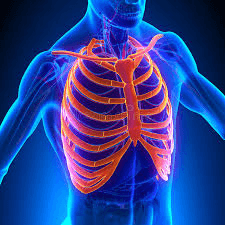
What bone is highlighted?
a)
Ribs
b)
Vertebrae
c)
Clavicle
d)
Femur
8.

What bone is highlighted?
a)
Radius
b)
Ulna
c)
Humerus
d)
Carpals
9.
From wrist to fingertip, what is the order of bones?
a)
Carpals, metacarpals, phalanges
b)
Phalanges, metacarpals, carpals
c)
Carpals, phalanges, metacarpals
d)
Metacarpals, carpals, phalanges
10.

What is the place where two bones meet?
a)
hinge
b)
bone
c)
spot
d)
joint
11.

What is the name for the connector that attaches muscle to bone?
a)
ligament
b)
tendon
c)
patella
d)
string
12.

What is the name for the connector that attaches bone to bone?
a)
ligament
b)
tendon
c)
patella
d)
string
13.
The adult skeletal system is composed of how many bones?
a)
216
b)
371
c)
206
d)
199
14.
The joints in your knees and elbows are most similar to:
a)
a clock
b)
a screw
c)
a wheel
d)
a door hinge
15.
Bending your head back until it hurts is an example of ________.
a)
A) flexion
b)
B) extension
c)
C) hyperextension
d)
D) circumduction
16.

Name this joint
a)
pivot
b)
saddle
c)
gliding
d)
hinge
17.
Which joint allows for the widest range of movement?
a)
Gliding
b)
Saddle
c)
Ball and socket
d)
Hinge
18.
carpals and tarsals are examples of this type of joint
a)
condyloid
b)
gliding
c)
hinge
d)
saddle
19.

Name the joint.
a)
Saddle
b)
Ball and Socket
c)
Ellipsoid
d)
Hinge
20.
Carpals and tarsals (flat bones) are examples of this type of joint
a)
condyloid
b)
gliding
c)
hinge
d)
saddle
21.

What are joints
a)
A place where one bone meets
b)
A place where two bones meet
c)
Bones don't meet
d)
A place where three bones meet
22.

The skull is an example of what type of joint?
a)
Cartilaginous
b)
Synovial
c)
Fibrous
23.
Fibrous joints are?
a)
freely moveable
b)
partially moveable
c)
immovable
24.
Skeletal muscles are attached to the _________.
a)
Stomach
b)
Lungs
c)
Bones
d)
Involuntary Muscles
25.
What is a body system?
a)
A group of cells that work together and perform a specific job in the body
b)
A group of organs that work together and perform a specific job in the body
c)
A group of tissues that work together and perform a specific job in the body
d)
A group of body parts that that work together and perform a specific job in the body
26.
Your skeletal system is made up of _______
a)
all your muscles
b)
The spinal cord, brain and nerves
c)
Your heart, veins and arteries
d)
all of your bones
27.
True or False: While each body system has a special job of its own ... many body systems work together and rely on one another
a)
True
b)
False
100 %

