
 Worksheets
Earth 1 Review
Total questions: 45
Worksheet time: 32mins
Name
Class
Date
1.
Which type of rock results from melting and cooling of magma?
a)
Igneous
b)
Metamorphic
c)
Sedimentary
d)
Extrusive
2.
Which type of rock forms from extreme heat and pressure?
a)
Igneous
b)
Sedimentary
c)
Organic
d)
Metamorphic
3.
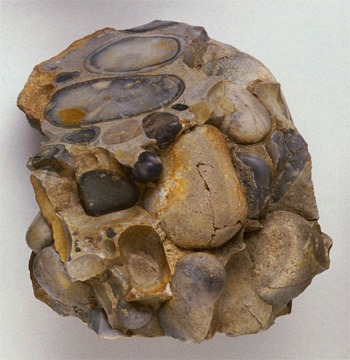
This rock was formed by smaller pieces of rock that settled at the bottom of a lake millions of years ago. What type of rock is this?
a)
Sedimentary
b)
Igneous
c)
Metamorphic
4.

This rock started as lava that cooled and then was heated and put under pressure over time. What type of rock is this?
a)
Sedimentar
b)
Igneous
c)
Metamorphic
5.

This rock cooled on the outside of a volcano and contained air bubbles when it was forming. What type of rock is this?
a)
Sedimentary
b)
Igneous
c)
Metamorphic
6.
Which type of igneous rock forms above ground?
a)
Intrusive
b)
Organic
c)
Extrusive
d)
Foliated
7.
Wind, water, and ice breaking down rock is called
a)
Erosion
b)
Deposition
c)
Compaction
d)
Weathering
8.
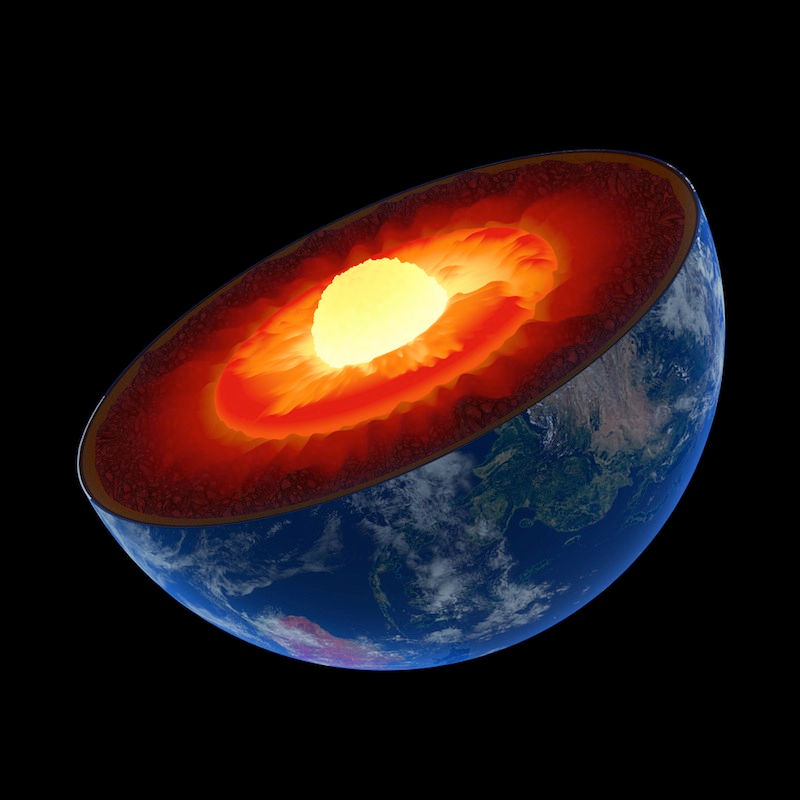
This layer contains the upper mantle and the crust.
a)
Mesosphere
b)
Asthenosphere
c)
Lithosphere
d)
Core
9.
This layer contains most of Earth's mass.
a)
Inner Core
b)
Mantle
c)
Outer Core
d)
Crust
10.
This layer is divided into pieces called tectonic plates.
a)
Mesosphere
b)
Asthenosphere
c)
Mantle
d)
Lithosphere
11.
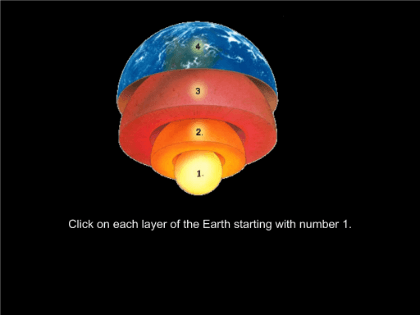
Which layer is the OUTER CORE?
a)
1
b)
2
c)
3
d)
4
12.

Which layer is the MANTLE?
a)
1
b)
2
c)
3
d)
4
13.

Identify layer #20.
a)
mantle
b)
asthenosphere
c)
inner core
d)
outer core
14.
What is the correct order (starting from the surface) of Earth's layers?
a)
crust, outer core, inner core, mantle
b)
mantle, outer core, inner core, crust
c)
crust, mantle, outer core, inner core
d)
outer core, inner core, crust, mantle
15.
Heat transfer within a fluid takes place by...
a)
convection currents
b)
radiation
c)
conduction
d)
density
16.

This arch was created by pieces of rock being washed away by the waves. This is an example of
a)
weathering
b)
erosion
c)
deposition
17.
Deforestation causes....
a)
soil erosion
b)
new plants
c)
reduces pollution
d)
gives new homes to animals
18.

What process causes hot rock to rise in the mantle?
a)
condensation
b)
convection
c)
conduction
d)
radiation
19.
Hot rises and Cold sinks
a)
condensation
b)
conduction
c)
convection
d)
radiation
20.
deposition
a)
move
b)
break down
c)
rest
21.
weathering
a)
move
b)
break down
c)
rest
22.
Erosion
a)
move
b)
break down
c)
rest
23.

Where is the sediment deposited?
a)
B. in the snow
b)
D. Far in the ocean
c)
C. at the mouth of the river
d)
A. In the mountains
24.

Which rock layer in the diagram seems to be the oldest?
a)
F
b)
E
c)
B
d)
A
25.

Name the boundary
a)
convergent boundary
b)
divergent boundary
c)
transform boundary
d)
sergent boundary
26.
Which of the following occurs because of convection currents?
a)
Tectonic plates on the crust move.
b)
The mantle increases in size.
c)
Pressure in the crust increases.
d)
Pressure in the crust decreases.
27.

Name the boundary
a)
convergent boundary
b)
divergent boundary
c)
transform boundary
d)
sergent boundary
28.

Name the boundary
a)
convergent boundary
b)
divergent boundary
c)
transform boundary
d)
sergent boundary
29.
This arch was created by pieces of rock being washed away by the waves. This is an example of
a)
weathering
b)
erosion
c)
deposition
30.

Limestone reacting with an acid (such as vinegar) is an example of
a)
mechanical weathering
b)
chemical weathering
c)
erosion
d)
deposition
31.

This is part of the....
a)
Geosphere
b)
Biosphere
c)
Cryosphere
d)
Atmosphere
32.

A thunderstorm is a connection between:
a)
Biosphere-Atmosphere
b)
Atmosphere-Hydrosphere
c)
Hydrosphere-Geosphere
d)
Hydrosphere-Biosphere
33.

This picture shows
a)
Atmosphere
b)
Biosphere
c)
Hydrosphere
d)
Geosphere
34.
Animals, forests, grasslands, and trees all belong to which sphere?
a)
Atmosphere
b)
Biosphere
c)
Lithosphere
d)
Hydrosphere
35.
Humidity is the...
a)
Amount of Water Vapor in the Air
b)
Amount of Wind in the Air
c)
Amount of Precipitation in the Air
d)
Amount of Pressure in the Air
36.
Climate is
a)
the further you get from the equator
b)
the higher you go, the colder it gets
c)
the conditions of the atmosphere at a certain place and time.
d)
the average weather conditions of an area over a long period of time.
37.

What is A?
a)
Evaporation
b)
Condensation
c)
Precipitation
d)
Runoff
38.
When clouds form - what process is occurring?
a)
Meteorology
b)
Condensation
c)
Collection
d)
Runoff
39.
What are the yearly conditions of temperature, precipitation and humidity?
a)
weather
b)
climate
40.
What part of the water cycle includes rain, sleet and snow?
a)
condensation
b)
precipitation
41.
The short-term state of the atmosphere, including temperature, humidity, precipitation, wind and visibility.
a)
Weather
b)
Climate
c)
Greenhouse Effect
d)
Jet Stream
42.
Wind occurs because of?
a)
conduction
b)
radiation
c)
constants
d)
convection
43.
WInd is air moving from areas of what pressure to what pressure?
a)
high to low
b)
low to low
c)
high to high
d)
low to high
44.
What could an earthquake create if a region of ocean floor is displaced?
a)
low tide
b)
change in the weather
c)
tsunami
d)
sand dune
45.

What will eventually happen to the hole in this sea arch?
a)
it will stay the same
b)
it will fill with dirt
c)
it will get bigger
d)
it will fill up with water
100 %

