wayground logo

Free Printable Worksheets

NEW

Font size

S
M
L
XL
Worksheets

THS Chemistry of Llife

Total questions: 70

Worksheet time: 59mins

Name
Class
Date
1.
What elements make up carbohydrates?
a)
Carbon, hydrogen, nitrogen, oxygen
b)
sulfur, carbon, hydrogen
c)
glucose and fructose
d)
carbon, hydrogen, oxygen
2.
The 3 categories of carbohydrates are:
a)
Monosaccharide, disaccharide, polysaccharide
b)
glucose, fructose, galatose
c)
starch, cellulose, chitin
d)
There are no categories of carbohydrates
3.
All carbohydrate names end with which ending:
a)
ise
b)
ase
c)
ese
d)
ose
4.
C6H12O6 is the molecular formula for what carbohydrate?
a)
Sucrose
b)
Glucose
c)
Fructose
d)
Both glucose and fructose
5.
What molecule is this
a)
sucrose
b)
protein
c)
glucose
d)
cellulose
6.
What type of carbohydrate is this?
a)
polysaccharide
b)
disaccharide
c)
monosaccharide
d)
it isn't a carbohydrate
7.
What type of carbohydrate is this?
a)
polysaccharide
b)
disaccharide
c)
monosaccharide
d)
it isn't a carbohydrate
8.

All the following are monosaccharides EXCEPT:

a)

Starch

b)

Glucose

c)

Fructose

d)

flour

9.

Carbohydrates are our-

a)

Quaternary source of energy

b)

tertiary source of energy

c)

secondary source of energy

d)

primary source of energy

10.

Cellulose is a structural carbohydrate found in-

a)

plants

b)

fungi

c)

insects

d)

polyvinyl

11.
Why are carbohydrates so important in our diet? 
a)
They help make us sleepy
b)
They make it hard to concentrate
c)
They give us energy
12.

Name a monosaccharide:

a)

glucose: grape juice

b)

starches: potato

c)

sucrose: beets

13.

Name a disaccharide:

a)

Glucose: grape juice

b)

Sucrose: beets

c)

Starches: potato

14.

Name a polysaccharide:

a)

Starches: potato

b)

Glucose: Grape juice

c)

Sucrose: beets

15.
Which elements are present in carbohydrates?
a)
C,N,O
b)
C,H,O
c)
H2O
d)
CO2
16.
What is the function of a carbohydrate?
a)
Stores energy
b)
Movement
c)
Stores genetic information
d)
Speeds up reactions
17.
What suffix is used in the names of most carbohydrates?
a)
-ase
b)
-nic
c)
-ose
d)
-yme
18.
Lactose is found in....
a)
Milk
b)
Milk products
c)
All of the above
19.
How many sugar units make up monosaccharides?
a)
one
b)
two
c)
three
d)
zero
20.
How many sugar units make up disaccharides?
a)
one
b)
two
c)
three
d)
zero
21.
How many sugar units make up polysaccharides?
a)
one
b)
two
c)
more than two
d)
zero
22.
Which of these are examples of carbohydrates?
a)
DNA, RNA
b)
Fats, hormones
c)
amino acids
d)
starches, glucose, chitin
23.

Building blocks of protein are made up of _______________.

a)

foods

b)

energy

c)

amino acids

d)

complementary

24.

Proteins can assist with

a)

movement

b)

transport

c)

making lipids

d)

A+B

e)

A,B+C

25.
What is a protein: 
a)
A polymer composed of many sugars.
b)
A polymer composed of many amino acids. 
c)
A polymer composed of fatty acids. 
d)
A polymer composed of nucleotides. 
26.
What is a peptide bond?
a)
Bond that holds two amino acids together.
b)
A bond that holds hydrogen and oxygen molecules together.
c)
A bond that holds the phosphate group of one nucleotide and a sugar of a neighboring nucleotide.
d)
A bond that is formed by the sharing of electrons.
27.
How many different amino acids are there?
a)
15
b)
20
c)
25
d)
30
28.
Enyzmes are a very important type of protein used to
a)
Build bones in skeleton
b)
Send hormonal signals throughout body
c)
Speed up chemical reactions
d)
Photosynthesize glucose in plants
29.
Where do substrates bind on an enzyme?
a)
voltage-gated channels
b)
surface receptor
c)
calcium channels
d)
active site
30.
What is a peptide bond?
a)
Bond that holds two amino acids together.
b)
A bond that holds hydrogen and oxygen molecules together.
c)
A bond that holds the phosphate group of one nucleotide and a sugar of a neighboring nucleotide.
d)
A bond that is formed by the sharing of electrons.
31.
Enzymes are capable of increasing the rate of a chemical reaction within a living cell.  Enzymes accomplish this through which of the following means?
a)
reducing the number of products   
b)
reducing the activation energy
c)
increasing the temperature of the cell
d)
increasing the concentration of reactants 
32.
Given the graph below, which statement best describes the role of enzymes?
a)
More energy is released without the presence of enzymes
b)
Less energy is needed to start a reaction when enzymes are present.
c)
A reaction is catalyzed by the lack of enzymes
d)
The presence of enzymes causes reactions to occur at a slower rate.
33.
The structure of proteins can be changed by environmental factors such as temperature or pH.
a)
True
b)
False
34.
When a protein unfolds, it is
a)
Denatured
b)
Building
c)
Adding amino acids
d)
Making food
35.
Which of the following conclusions can be drawn from this graph?
a)
The optimum pH of the enzyme is 6.6.
b)
The optimum pH of the enzyme is 5.8
c)
The enzyme’s activity increases as pH increases 5.0 to 9.0
d)
The enzyme’s activity is greater around pH of 8.0 .
36.
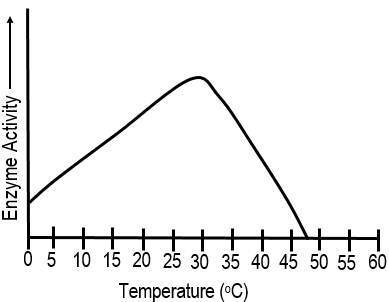
Based on the graph, what temperature does this enzyme work best? 
a)
15 C
b)
40 C
c)
30 C
37.

What happens when enzymes are heated to a high temperature?

a)

The enzymes die.

b)

The shapes of the enzyme are altered or denatured

c)

The enzymes' amino acid sequence changes.

d)

The enzymes remain the same

38.
Cells must produce many different enzymes because
a)
enzymes are quickly used up
b)
most cellular reactions require a specific, unique enzyme
c)
They have to have some way to use up the protein that they consume
d)
enzymes are not very effective at speeding up reactions
39.
Which macromolecule is this?
a)
carbohydrate
b)
lipid
c)
protein
d)
nucleic acid
40.
What are different examples of lipids?
a)
monosaccahrides, disaccharides, starch, cellulose
b)
dipetide, polypeptide, amino acids
c)
DNA, RNA, ATP
d)
triglycerides, waxes, steroids, phospholipds
41.
This molecule is a
a)
carbohydrate
b)
nucleic acid
c)
protein
d)
lipid
42.
The characteristic that all lipids have in common is----
a)
made of lots of double bonds
b)
acidic when mixed with water
c)
no high energy content
d)
do not dissolve in water
43.
Which of the following is NOT a function of lipids?
a)
long term energy
b)
provides flavor in food
c)
used to make hormones
d)
building of muscles
44.
What does hydrophobic mean?
a)
the fear of water
b)
the fear of hydrogen
c)
the love of water
d)
the love of hydrogen
45.
This picture shows what type of lipid?
a)
unsaturated fat
b)
wax
c)
saturated fat
d)
steroid
46.
A "kinky structure" due to the double bonds between carbon atoms creates a lipid known as what?
a)
saturated fat
b)
wax
c)
steroid
d)
unsaturated fat
47.
The brown paper test for lipids is positive for lipids when the test spot is
a)
dry
b)
brick red
c)
black-blue
d)
translucent
48.
DNA and RNA are examples of...
a)
proteins
b)
nucleic acids
c)
carbohydrates
d)
lipids
49.
What is the function of nucleic acids?
a)
Stores energy
b)
Stores genetic information
c)
Movement
d)
Physical structure
50.
What are the components of a nucleotide?
a)
nitrogen base, phosphate group, and pentose sugar
b)
pentose sugar, purine, and pyrimidine
c)
nitrogen base and a phosphate group
d)
DNA, phosphate group, monosaccharide
51.
RNA contains the sugar...
a)
Deoxyribose
b)
Glucose
c)
Ribose
d)
Lipids
52.
All organic compounds contain the element
a)
carbon
b)
nitrogen
c)
phosphorus
d)
sulfur
53.
Which macromolecule is shown?
a)
lipid
b)
protein
c)
nucleic acid
d)
carbohydrate
54.
Which base is not found in RNA?
a)
adenine
b)
cytosine
c)
thymine
d)
uracil
55.
From the nucleotide on the right, which part is labeled 2?
a)
Sugar
b)
Phosphate
c)
Nitrogenous Base
d)
Phosphorous
56.
What pentose sugar does DNA use?
a)
Ribose
b)
Sucrose
c)
Amylose
d)
Deoxyribose
57.
Which of these is true about RNA?
a)
Has a double helix
b)
Has a single helix
c)
Contains thymine
58.
What kind of bond holds the two strands of DNA together?
a)
Hydrogen bonds
b)
Ionic bonds
c)
Polar bonds
d)
Covalent bonds
59.
What is structure D?
a)
Substrate
b)
Active site
c)
Enzyme
d)
Products
60.
What is structure C?
a)
Substrate
b)
Active site
c)
Enzyme
d)
Products
61.
What is structure E, F, G?
a)
Substrate
b)
Active site
c)
Enzyme
d)
Products
62.
What is a substance called if it speeds up a chemical reaction?
a)
reusable
b)
catalyst
c)
specific
d)
fragile
63.

Each enzyme only has 1 substrate that will fit its active site. What is this called?

a)

reusable

b)

catalyst

c)

specificity

d)

fragile

64.
What 3 letters do enzymes typically end in?
a)
-ose
b)
-ase
c)
-ese
d)
-tic
65.
The "lock and key hypothesis" attempts to explain the mechanism of?
a)
Vacuole formation
b)
Pinocytosis
c)
Sharing of electrons
d)
Enzyme specificity 
66.
An enzyme speeds up a chemical reaction in the cell but can only be used once.  True or False? 
a)
true
b)
false
67.
Which of these is most likely an enzyme?  
a)
Sucrose
b)
Galactose
c)
Fructose
d)
Amylase
68.
Babies do not have well developed digestive systems for breaking down proteins; therefore baby food is prepared after treatment with which enzyme? 
a)
protease
b)
lipase
c)
carbohydrase
d)
synthase
69.
Catabolic is when....
a)
An enzyme builds up
b)
An enzyme breaks down
70.
Anabolic reactions are when an enzyme
a)
Breaks down
b)
Builds up
c)
Ties together and form a substance that ends with "ase"