wayground logo

Free Printable Worksheets

NEW

Font size

S
M
L
XL
Worksheets

Energy: KE, PE and transfer of energy

Total questions: 40

Worksheet time: 2hrs 25mins

Name
Class
Date
1.
What kind of energy is in a moving skateboard?
a)
Potential
b)
Kinetic
2.
What kind of energy is in a rock at the edge of a cliff?
a)
Potential
b)
Kinetic
3.
At which point is potential energy greatest?
a)
W
b)
X
c)
Y
d)
Z
4.
A roller coaster has a mass of 250 kg, and is 50 meters above the ground, what is the potential energy?
a)
122,625 Joules
b)
5,600 Joules
c)
234,799 Joules
5.
Conservation of energy states that energy cannot be ________ or ________, but can be altered from one form to another.
a)
created, destryoed
b)
gravity, force
c)
heat, created
6.
A baby carriage that is carrying twins is sitting at the top of a knoll that is 21 m high. The carriage
with the babies are 48kg. What is the Potential Energy of the twins and the carriage?
a)
5,524 Joules
b)
45,125 Joules
c)
9,888 Joules
7.
A weight lifter lifts a set of 1250kg weights a vertical distance of 2m in a weight lifting contest. What Potential Energy do the weights now possess?
a)
12,789 Joules
b)
24,525 Joules
c)
4,500 Joules
8.
Japan’s fasted high speed “bullet” trains, also known as the Shinkansen, travel at a speed of 88.9 m/s. It has an estimated mass of 480,000 kg. What is the maximum KE of this train?
a)
259,000 Joules
b)
1,896,770,400 Joules
c)
10,444,678 Joules
9.
What is the KE of a 1.00 kg hammer swinging at 20.0 m/s?
a)
200 Joules
b)
1500 Joules
c)
950 Joules
10.
A cheetah can run briefly with a speed of 31.0 m/s. Suppose a cheetah with a mass of 47.0 kg runs at this speed. What is the cheetah’s kinetic energy?
a)
15,500 Joules
b)
22,583 Joules
c)
15 Joules
d)
45,543 Joules
11.

What are the two factors that affect kinetic energy?

a)

time and energy

b)

power and mass

c)

mass and velocity

d)

time and work

12.
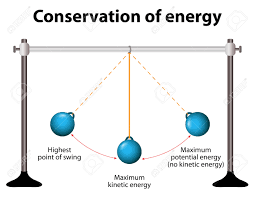
When a pendulum swings, at which point is potential energy at its greatest
a)
1
b)
2
c)
3
d)
4
13.
How fast is a 0.50 kg ball moving if its kinetic energy is 400 J?
a)
150 m/s
b)
30 m/s
c)
200 m/s
d)
40 m/s
14.
A ball is released from rest at position 1.  The diagram shows the ball in four positions as it rolls along a track from left to right. In which position does the ball have its minimum gravitational potential energy and maximum kinetic energy?
a)
1
b)
2
c)
3
d)
4
15.
The faster an object moves, the ________ kinetic energy it has. 
a)
more
b)
less
c)
none of the above
d)
all of the above 
16.
A pitcher throws a 0.145 kg baseball at a velocity of 30.0m/s. How much kinetic energy does the ball have?
a)
65.35 J
b)
87.25 J
c)
23.45 J
d)
65.25 J
17.

Which of the following expressions defines power?

a)

force x distance moved in the direction of the force

b)

force x velocity

c)

work done ÷ time taken

d)

work done x time taken

18.

Refer to the diagram, what is the work done to load a barrel of mass 50 kg onto a lorry?

a)

80 J

b)

170 J

c)

780 J

d)

1700 J

19.

The K.E. of a particle is increased by a factor of 4. By what factor does its speed increase?

a)

2

b)

4

c)

8

d)

16

20.

A railway engine accelerates a train of total mass 800 tonnes (1 tonne = 1000 kg) from rest to speed of 50 ms-1.

How much useful work must be done on the train to reach this speed?

a)

1.0 x 10⁶ J

b)

2.0 x 10⁶ J

c)

1.0 x 10⁹ J

d)

2.0 x 10⁹ J

21.

Mike and Ian move 50 m on a snow lift which uses 750 N of force to move them in 75 seconds. Calculate the power of the lift.

a)

750 W

b)

500 W

c)

7500 W

d)

2812500 W

22.
What is the process used in nuclear reactors today to generate energy called?
a)
Nuclear Fusion
b)
Nuclear Fission
c)
Nuclear Generation
d)
Nuclear Chemical Synthesis
23.
How does biomass reduce our carbon footprint by producing less CO2 than fossil fuels?
a)
Plants absorb the same amount of CO2 that is released when it is burned.
b)
Plants remove CO2 from the atmosphere and put it permanently into the ground.
c)
Biomass filters CO2 to make it more environmentally stable.
d)
Biomass doesn't release any CO2 when burned.
24.
Which energy source has the least negative environmental impact?
a)
Biomass
b)
Nuclear
c)
Natural Gas
d)
Solar
25.
A disadvantage of solar panels is that: 
a)
They do not use an abundant energy source
b)
They are expensive
c)
They have little availability
d)
They have few advantages
26.
Solar energy does what to create energy?
a)
turbines inside of the panels create power
b)
carbon dioxide is absorbed from the air
c)
photons generate a flow of electricity
d)
renewable energy from living things is transferred to the panels
27.
What is a renewable resource?
a)
A natural resource that is replenished at a rate comparable to its rate of consumption
b)
A natural resource that is replenished at a rate less than its rate of consumption.
28.
What form of renewable energy requires a dam?
a)
solar
b)
nuclear
c)
biomass
d)
hydroelectric
29.
__________uses heat from the interior of the Earth.
a)
Solar
b)
Geothermal
c)
Nucler
d)
Wind
30.
There are 3 Main Fossil Fuels. We Know Them As --
a)
Carbon Dioxide, Oxygen, Nitrogen
b)
Cookies, Nutella, Granola
c)
Coal, Oil, Natural Gas
d)
Canyons, Oceans, Nymph
31.
The kind of heat transfer that travels through space in electromagnetic waves is ______________________.
a)
insulation.
b)
Radiation
c)
Conduction
d)
Convection
32.
The type of heat transfer that happens through direct contact of molecules or particles with each other is ___________________.
a)
Convection
b)
Conduction
c)
Radiation
d)
insulation.
33.
___________________ is the type of heat transfer that occurs in fluids, such as warm air rising and cold air sinking; creating wind.
a)
Convection
b)
Conduction
c)
Radiation
d)
insulation.
34.
Which statement is true?
a)
The quicker a molecule moves, the colder it is.
b)
The slower a molecule moves, the warmer it is.
c)
The quicker a molecule moves, the warmer it is
d)
The movement on molecule don�t affect its temperature
35.
Two objects at different temperatures are in contact. Which of the following happens to their thermal energy?
a)
Their thermal energies remain the same.
b)
Thermal energy passes from the cooler object to the warmer object
c)
Thermal energy passes from the warmer object to the cooler object.
d)
Thermal energy passes back and forth equally between the two objects.
36.
When you use a microwave, what is the main way that heat is transferred?
a)
Convection
b)
Conduction
c)
Radiation
d)
insulation.
37.
A large house being heated by heater warms a house when the air is circulating.
a)
Convection
b)
Conduction
c)
Radiation
d)
insulation.
38.
The Gulf Stream is a current that brings warm ocean water from the south to the north. What type of heat transfer is this?
a)
conduction
b)
convection
c)
radiation
d)
Insolation 
39.
Johnny accidentally grabbed the handle of the hot pot.
a)
conduction
b)
convection
c)
radiation
40.
A group of friends gather around a fire to stay warm.
a)
conduction
b)
convection
c)
radiation