Wayground logo

Free Printable Worksheets

Font size

S
M
L
XL
Worksheets

Evolution and Ecology Review

Total questions: 70

Worksheet time: 1hrs 1mins
Name
Class
Date
1.
When all of the organisms of a species have died it is called
a)
evolution
b)
extinction
c)
adaptation
d)
natural selection
2.
What is a change in an organism that allows for it to survive in its environment?
a)
homologous
b)
vestigial
c)
variation
d)
adaptation
3.
What is an organism that has similar characteristics and can reproduce?
a)
species
b)
organism
c)
embryology
d)
vestigial 
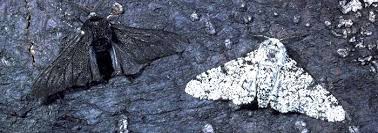
4.
Predict which moth would increase in population
a)
light 
b)
dark
5.
Which of the following is a fossil?
a)
a plant that has recently died
b)
a group of organisms that can reproduce
c)
a structure or organ that no longer functions
d)
a trace of an organisms that existed in the past
6.
Which term refers to the process by which individuals that are better suited to the environment survive and reproduce therefore passing down their genes to their offspring? 
a)
Evolution 
b)
Variation 
c)
Adaptation
d)
Natural Selection 
7.
The struggle for existence against other members of an organisms species is
a)
Competition
b)
Natural Selection
c)
gene flow
d)
genetic drift
8.
Who was the naturalist that traveled the world to study plants and animals?
a)
Albert Einstein
b)
Charles Darwin
c)
Charles Barkley
d)
Isaac Newton
9.
The gradual change in species over time is...
a)
Evolution
b)
Nucleotide 
c)
Adaptation
d)
Natural Selection
10.
The white feathers of a snowy owl allow it to blend in with its environment during the winter months (snow). This is an example of ________________
a)
Species
b)
Environmental Change
c)
Adaptation
d)
Variation
11.
Where the better adapted organisms survive to pass traits along to offspring.
a)
Evolution
b)
Natural Selection
c)
Extinction
d)
Artifical Selection
12.
Genetic differences between organisms of the same species
a)
Variation
b)
Adaptation
c)
Behavior
d)
Environment
13.
The theory of evolution by natural selection means that what is changing over time?
a)
The inherited traits of a population.
b)
The acquired traits of a population.
c)
Hair color and eye color
d)
Attractive features.
14.
Why are advantageous traits more likely to be passed onto offspring?
a)
Because they are more likely to survive and reproduce.
b)
Because they come from dominant alleles.
c)
Because they come from recessive alleles.
d)
Because the trait is an acquired phenotype.
15.
Which organisms are most likely to survive?
a)
the best adapted
b)
the fastest
c)
the strongest
d)
the most domesticated (tamed)
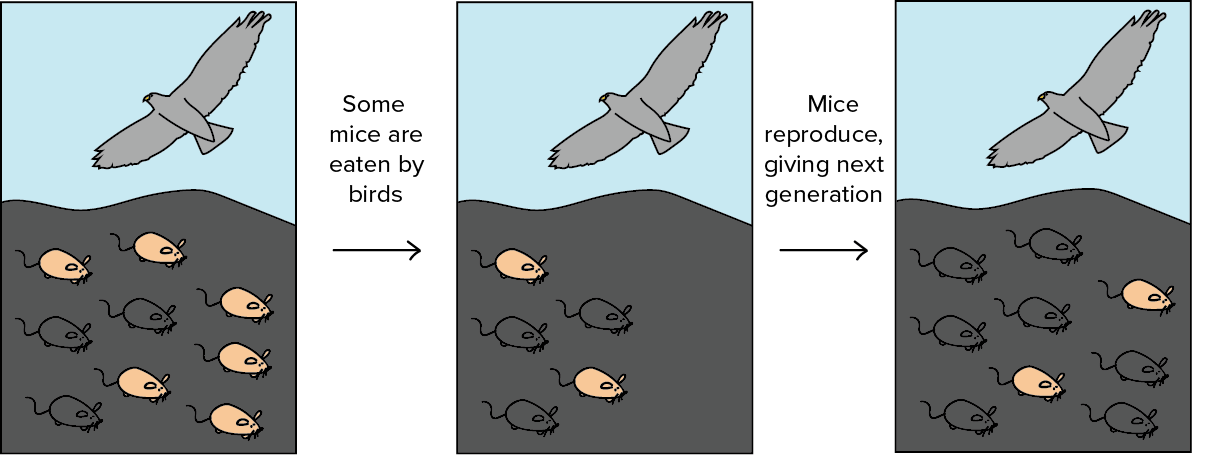
16.
Why is the mouse population changing over time?
a)
The light mice can reproduce more successfully than the dark mice
b)
The hawks eat more dark mice than light mice because the dark mice taste better
c)
The hawks eat more light mice than dark mice because they can see the light mice more easily
d)
The hawks eat more dark mice than light mice because they can see the dark mice more easily
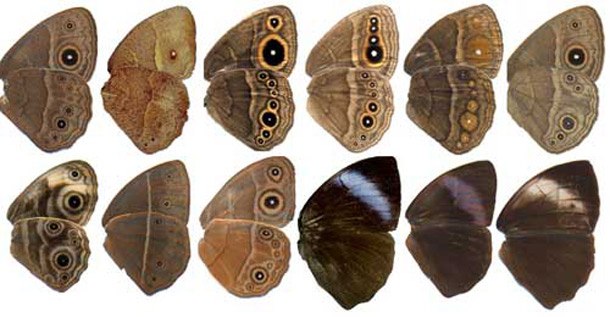
17.
These moths are all the same species. The differences between their wings is an example of ________________
a)
Natural Selection
b)
Variation
c)
Homeostasis
d)
Extinction
18.

a bird that can easily outcompete other birds for food and that can produce many eggs has a high

a)

life expectancy

b)

mutation rate

c)

fitness

d)

adaptability

19.
Which layer formed first?
a)
Rock Layer W
b)
Rock Layer X
c)
Rock Layer Y
d)
Rock Layer Z
20.
Where can the oldest layer be found?
a)
The top layer
b)
The middle layer
c)
They are all the same age
d)
The bottom layer
21.

Which is the most accurate method scientists can use to estimate the age of fossils?

a)

relativism

b)

superposition

c)

relative dating

d)

radioactive dating

22.

Which factor will MOST likely increase the survival chances of an organism living in an environment that is undergoing rapid changes?

a)

encountering strong competition

b)

having a long life span

c)

producing identical offspring

d)

having a diverse gene pool

23.

In the past, African elephants have been hunted for their tusks. Over time, the number of tuskless elephants has increased while the number of elephants with tusks has decreased. What is the most likely explanation for the increase in the number of tuskless elephants?

a)

fewer elephants with tusks survived to reproduce

b)

the gene pool for tusks has become recessive over time

c)

the hunting of elephants resulted in genetic mutation of the tusk gene

d)

Elephants began to lose their tusks because of climate changes

24.

Scientists theorize that the ancient animal on the left is related to the modern animal on the right and has gone through many changes over time. How did the scientists conclude that the animal changed over time?

a)

by examining fossil records

b)

by learning about natural selection

c)

by studying deposition of sediments

d)

by observing different types of rock formations

25.
Justin blows his nose, but mucus seems to leak through the tissue.  He decides to test which tissue holds up the best while sneezing.  What is the independent variable?
a)
sneezing
b)
Justin
c)
amount of tissue
d)
type of tissue
26.
Mr. McNeice wanted to know if different types of music affected people's heart rates, so he played different music and checked their pulses.  What is the dependent variable?
a)
type of music
b)
heart rate
c)
how long they listend to music
d)
Mr. McNeice
27.
Why should an experiment be repeated?
a)
to form a hypothesis
b)
to reduce the chance of error
c)
to change controls
d)
to identify the problem
28.
This is the outcome of the experiment. We get data and results from this.
a)
Independent Variable
b)
Dependent Variable
c)
Control
d)
Constant
29.
How many independent variables should be tested at a time in a scientific investigation?
a)
none
b)
one
c)
two
d)
three
30.
The variable that is changed on purpose is: 
a)
Control
b)
Dependent
c)
Independent
d)
Outcome
31.
The variable in the experiment that is the outcome that you measure is called:
a)
Control
b)
Dependent
c)
Independent
d)
Hypothesis
32.
When experimenting with the growth of a plant, a scientist uses three plants, two different fertilizers, equal light, and equal water. What type of variable is the water?
a)
Dependent
b)
Independent
c)
Control
d)
Outcome
33.
In the paper airplane experiment, changing the size of the airplane would be which variable?
a)
Dependent
b)
Independent
c)
Control
d)
Conclusion
34.
I want to see how the amount of water affects plant growth.  What is the independent variable?
a)
amount of water
b)
plant growth
c)
type of plant
d)
soil type
35.
The variable being tested.  The one thing you change.
a)
independent
b)
dependent
c)
control
36.
A testable idea or explanation that leads to a scientific investigation is called (can be stated as an if/ then statement)
a)
conclusion
b)
experiment
c)
hypothesis
37.
The variable that is your result.  Usually measured.
a)
independent
b)
dependent
c)
control
38.
What is a hypothesis?
a)
an educated guess stating what you believe will be the result of your experiement
b)
a random guess
c)
a statement of the outcome of your experiment
d)
step by step directions for your experiment
39.
A series of steps used by scientists to solve a problem or answer a question. 
a)
scientific method
b)
recipe
c)
data collection
d)
metric system
40.
If plants are exposed to sunlight, then they will grow taller.
What part of the scientific method is this an example of?
a)
Procedure
b)
Hypothesis
c)
Question
d)
Results
41.
A student is planning an experiment to find out how the height from which he drops a ball affects how high the ball bounces. The dependent variable is the _____.
a)
Diameter of the ball
b)
Force acting on the ball
c)
Height that the ball bounces
d)
Height from which the ball is dropped
42.
An investigation was designed to determine the effect of ultraviolet light on mold spore growth. Two groups of mold spores were grown under identical conditions, except one group was exposed only to ultraviolet light, while the other group was grown in total darkness. In this investigation, the group of mold spores grown without receiving any ultraviolet light is known as the
a)
experimental group
b)
control group
c)
independent variable
d)
dependent variable
43.
A scientist set up an experiment to see how vinegar affects plant growth. Five seed pots received a small amount of vinegar in the soil and were placed in the sunlight. Another five pots received no vinegar and were placed in the shade. The scientist grew the seedlings for two months. Which explains why her experiment was not set up properly?
a)
More than one variable was changed.
b)
She did not have a control.
c)
She did not grow the plants long enough.
d)
Vinegar should not be used on plants.
44.
A well-substantiated explanation of some aspect of the natural world that can incorporate facts, laws, inferences, and tested hypotheses.
a)
Fact
b)
Theory
c)
Law
d)
Conclusion
45.
Evolution is one example of a theory. From what you know about the scientific method, what can you conclude about this biological theory?
a)
a. It's been tested many times. 
b)
b. Scientists don't need to test it anymore
c)
c. No one is allowed to test whether it's true or not. 
d)
d. There is very little evidence to support it. 
46.

These are the best explanation for a phenomenon with all of the available evidence

a)

law

b)

theory

47.

These describe a natural phenomenon or relationship that always occurs under specific conditions

a)

theory

b)

law

48.

Atomic theory, which describes the atoms that make up matter, has been explored for centuries. Scientists in Ancient Greece first proposed that matter was made of units called atoms. For many years, scientists thought atoms were solid and could not be divided. Then, in the nineteenth century, scientists began to discover the particles that make up atoms. Modern techniques have allowed scientists to split atoms into increasingly smaller particles. Which of the following statements about theories is supported by the history of the atomic theory?

a)

If new evidence contradicts earlier theories, it is a result of an experimental error

b)

Experiments with modern equipment can not be used to support earlier theories

c)

Theories can change in response to new evidence.

d)

A theory is discarded when new evidence contradicts a part of the theory.

49.

Scientists create both scientific theories and scientific laws as they make observations and conduct experiments about the natural world. Which of the following statements most accurately compares the difference between scientific theories and scientific laws

a)

sci laws are based on evidence while sci theories are not

b)

sci theories involve only biology, while laws involve all types of science

c)

sci theories involve mathematical equations, while sci laws are based on observations

d)

sci theories are ideas that explain natural events, while sci laws more reliably predict natural events

50.
relationship in which two species live closely together
a)
resource
b)
mutualism
c)
succession
d)
symbiosis
51.
The rabbit in this food web would be considered a:
a)
Decomposer
b)
Producer
c)
Secondary Consumer
d)
Primary Consumer
52.
The amount of energy that usually transfers from one trophic level to the next...
a)
10%
b)
20%
c)
80%
d)
50%
53.
As you move upward, from level to level, in an energy pyramid, energy _____.
a)
increases
b)
decreases
c)
stays the same
d)
increases exponentially
54.

WHy are fast occurring environmental changes more likely to cause extinctions than slow changes

a)

slow changes allow time for adaptations

b)

rapid changes require little adaptation

c)

slow changes affect only small regions

d)

rapid changes have a global effect

55.

In which scenario below would natural selection most likely occur

a)

catastrophic destruction of habitat

b)

rapid and profound climate change

c)

centuries of gradual climate change

d)

immediate loss of primary food source

56.

Which is the explanation of why certain animals are able to adapt to changing environments?

a)

some species have greater variation in their genetic makeup

b)

some species have mostly dominant genes

c)

some species have unlimited habitats

d)

some species react by mutating

57.

Organisms from which niche contain the greatest amount of energy?

a)

the secondary consumers

b)

the decomposers

c)

the primary consumers

d)

the rpoducers

58.
An organism at the second trophic level would be considered a...
a)
Top carnivore
b)
Producer
c)
Herbivore
d)
Carnivore
59.
A collection of organisms that make up a community as well as all of the nonliving aspects of the environment.
a)
Population
b)
Community
c)
Habitat
d)
Ecosystem
60.
If there is 1000 Kcal available in the producers in trophic level 1, how much energy is available in the herbivores in trophic level 2?
a)
10 Kcal
b)
1 Kcal
c)
100 Kcal
d)
1000 Kcal
61.
The arrows in a food chain or web represents what?
a)
They point to the organism that is being eaten.
b)
It shows how sunlight flows within an ecosystem.
c)
They show what direction the energy is flowing between organisms. 
d)
They represent how water is transferred within a habitat.
62.
Which type of consumer could be a first or second consumer?
a)
Herbivore
b)
Omnivore
c)
Carnivore
d)
Producer
63.
What is the role of decomposers in a food chain?
a)
Use sunlight to make food
b)
Eat other organisms to gain energy
c)
Make the food for the whole food chain
d)
Break down dead organisms and add nutrients to the soil
64.
Reaches a climax community quicker because soil is already present
a)
primary succession 
b)
secondary succession
c)
both types of succession
65.
Succession that occurs in an area with NO SOIL
a)
ecological succession 
b)
primary succession 
c)
secondary succession
d)
pioneer speciles
66.
What is the most important function of pioneer species?
a)
To create rocks
b)
To create soil and add nutrients to the environment 
c)
To look nice
d)
Food for animals 
67.
A feeder fish usually follows behind sharks to pick up food scraps that they leave behind. The fish gets food and the shark is unaffected. This is an example of:
a)
Mutualism
b)
Commensalism
c)
Parasitism
d)
Decomposition
68.
A clownfish uses a sea anenome as a safe place to live. While living there, the clownfish lures in food for the anenome. This is an example of what type of relationship?
a)
Predator-Prey
b)
Commensalism
c)
Mutualism
d)
Parasitism
69.
A feeding relationship where one organism hunts and one is hunted.
a)
Commensalism
b)
Decomposistion
c)
Mutualism
d)
Predator-Prey
70.
A mosquito feeds off of the blood of different organisms. This usually causes discomfort to the organism and sometimes disease and death. This is an example of:
a)
Parasitism
b)
Decomposition
c)
Commensalism
d)
Mutualism