
 Worksheets
Waves - General and Sound
Total questions: 72
Worksheet time: 1hrs 19mins


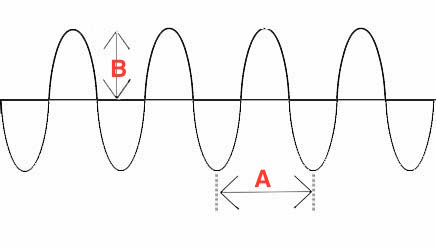
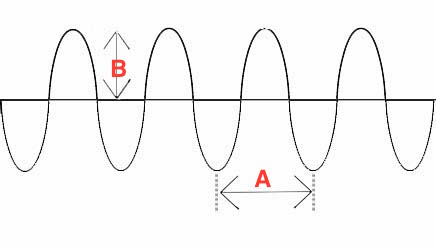
What property of this wave is represented by the letter "A"
amplitude
crest
trough
wavelength

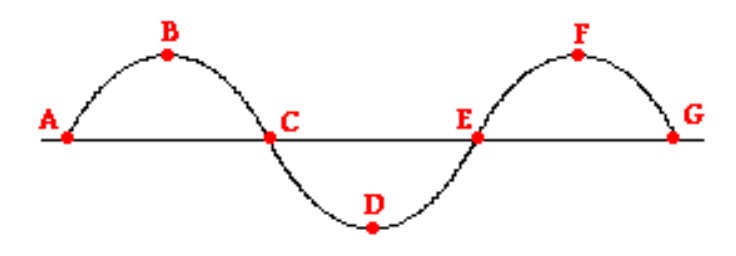
A 680 Hz sound wave travels at 340 m/s in air, with a wavelength of...
50 m
0.5 m
2.0 m
5 m
A wave oscillates up and down 5 complete times within 1 second. The wave's wavelength is 4 meters long. What is the wave's speed?
20 m/s
0.8 m/s
.05 m/s
1.25 m/s

What is the approximate wavelength of this wave?
100 cm
120 cm
35 cm
110 cm

What is the approximate amplitude of the wave shown?
35 cm
30 cm
70 cm
75 cm
An echo is heard exactly 2.0 seconds after you and a group of friends make a loud holler. How far away is the wall that the sound wave made a reflection off of?
340 meters
170 meters
85 meters
680 meters
If the speed of sound at 0 degrees Celcius is 330 m/s, how fast will it travel at 5 degrees Celcius?
203 m/s
342 m/s
340 m/s
333 m/s

This graph represents the relationship between...
Frequency and wavelength
Wavelength and energy
Frequency and energy
sound and speed
What is the speed of a sound wave that is travelling through air that has a temperature of 35 degrees celcius?
239 m/s
351 m/s
364 m/s
343 m/s
What is the speed of sound at room temperature?
330 m/s
340 m/s
300 m/s
360 m/s
The speed of sound depends on
Its source
the force of its compressions
The number of waves per second
the medium through which it travels
Select the correct order of waves on the EMS going from largest to shortest wavelength
Radio, Micro, Infra, Visible, Ultra, X-ray, Gamma
Gamma, X-ray, Ultra, Vis, Infra, Micro, Radio
Vis, Micro, Infra, Ultra, X-ray, Gamma, Radio
Micro, Radio, Vis, Infra, Ultra, X-ray, Gamma
Mechanical waves, like sound waves, require a medium through which to travel?
true
false
Electromagnetic radiation (i.e. light) requires a medium through which to travel?
true
false
The height measured from the rest position/equilibrium position line to the top of a wave's crest(or the bottom of a trough) is called the __________.
amplitude of the wave
wavelength of the wave
frequency of the wave
speed of the wave
Light travels at about _______________.
300,000 m/s
300,000,000 km/s
300,000,000 km/h
300,000,000m/s

Standing waves are created by
Two identical waves reflecting off each other
Two identical waves being diffracted together
Two identical waves move through each other in opposite directions
Two identical waves are diffracted from two identical sources


Wavelength= 2.0m
Frequency= _________
Wavelength= __________
Frequency= 600 hertz

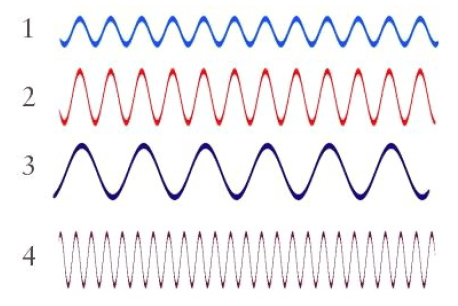
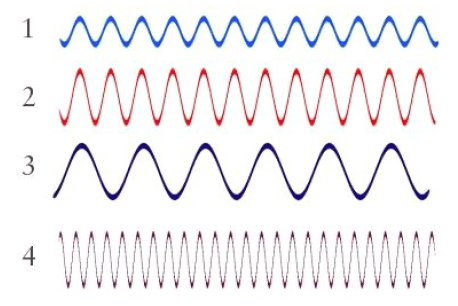
Which wave has a greater frequency?
A
B

Which shows the EM spectrum in order from longest to shortest wavelength?
Gamma, X-Ray, UV, Visible, IR, Microwaves, Radio
Radio, Microwaves, IR, Visible, UV, X-Ray, Gamma
Visible, UV, X-Ray, Gamma, Radio, Microwaves, IR
Visible, Radio, Microwaves, IR, UV, X-Ray, Gamma
How are frequency and wavelength related?
As frequency increases, wavelength gets shorter
As frequency increases, wavelength gets longer
As frequency increases, wavelength gets lower
As frequency increases, wavelength gets higher
A wave has wavelength of 10 m and a speed of 340 m/s. What is the frequency of the wave?
34 m/s
34 hz
3400 m/s
3400 Hz
A wave has frequency of 5 Hz and a speed of 25 m/s. What is the wavelength of the wave?
5 m
5 Hz
125 m
125 Hz
20 waves go past a fixed point in 10 seconds. What is the frequency of the wave?
20 seconds
20 Hz
2 Hz
2
Six waves go past a fixed point in two seconds. What is the frequency of the wave?
3
6 Hz
3 Hz
2
A wave has a frequency of 6 Hz. What is the period of the wave?
0.167 s
6 m
0.167
6 Hz
A wave has a frequency of 50 Hz. What is the period of the wave?
2 m
0.02
25 m
0.02 s
Compared to a low pitch wave, a high pitch wave will have a
higher frequency and shorter wavelength
higher frequency and longer wavelength
larger amplitude and shorter wavelength
smaller amplitude and shorter wavelength
The speed of sound varies when the medium it passes through changes. For example, the speed of sound through air is 343 m/s. A boat mapping the seafloor near Greenland determines after a 12-second ping, the depth is 8100 meters. What is the speed of sound in this cold, icy water?
Distance (Depth) = Velocity x (Total time/2)
1875m/s
48,600m/s
675m/s
1350m/s
If the depth of the ocean floor is 7500 meters, how long does it take sound waves to reach the bottom of the ocean?
Distance (Depth) = Velocity x (Total time/2)
Velocity of sound in water = 1500 m/s
10sec
5sec
11,250,000sec
0.2sec
The time for sound waves to return to a ship from just the bottom of the ocean was 1.25 seconds. What is the depth in meters?
Distance (Depth) = Velocity x (Total time/2)
Velocity of sound in water = 1500 m/s
937.5m
1875m
10050m
1200m
If the depth of the ocean floor is 12000 meters, how long, in total time, does it take sound waves to return to the SONAR detector?
Distance (Depth) = Velocity x (Total time/2)
Velocity of sound in water = 1500 m/s
16sec
8sec
18,000,000sec
36,000,000sec
If the depth of the ocean floor is 9000 meters, how long, in total time, does it take sound waves to return to the SONAR detector?
Distance (Depth) = Velocity x (Total time/2)
Velocity of sound in water = 1500 m/s
13,500,000sec
12sec
0.17sec
3sec
The total time for sound waves to return to a ship was 4.5 seconds after being released. What is the depth in meters?
Distance (Depth) = Velocity x (Total time/2)
Velocity of sound in water = 1500 m/s
6750m
333.33m
667m
3375m
The total time for sound waves to return to a ship was 8 seconds after being released. What is the depth in meters?
Distance (Depth) = Velocity x (Total time/2)
Velocity of sound in water = 1500 m/s
12,000m
6000m
375m
187.5m
Compared to the speed of light, sound travels
faster
slower
same speed
The speed of a sound wave depends on the...
wavelength
frequency
medium through which it travels through
all of the above
A wave has a frequency of 0.07 hertz and a wavelength of 10 meters. What is the wave's speed?
.07 m/s
0.7 m/s
2.0 m/s
Dan and his friends are in a canyon and his echo is heard 1.0 seconds after making the holler. What is the distance to the canyon wall? (assume the speed is 340 m/s)
170 m
680 m
165 m
340 m

What is the best estimate of the frequency?
0.4 Hz
0.8 Hz
2.5 Hz
1.25 Hz

What is the amplitude of this transverse wave?
About 38 cm
about 160 cm
about 20 cm

