

wayground logo

Free Printable Worksheets

Font size

S
M
L
XL
Worksheets

9 Week Exam 3rd Block

Total questions: 60

Worksheet time: 2hrs 51mins
Name
Class
Date
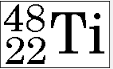
1.
How many protons does this isotope of titanium have?
a)
48
b)
22
c)
26
d)
70
2.

How many neutrons in Carbon-14?

a)

6

b)

7

c)

14

d)

8

3.
What element is this?  What is the mass number of this atom?
a)
sodium, 23
b)
magnesium, 23
c)
magnesium, 12
d)
sodium, 11
4.

Ions having positive charges are

a)

Cations

b)

atoms

c)

Anions

d)

molecules

5.

The nonmetals in Groups 6A and 7A ____.

a)

gain electrons when they form ions

b)

lose electrons when they form ions

c)

all have ions with a 1 charge

d)

end in -ate

6.
What charge does an atom have if it LOSES an electron? 
a)
Positive (+)
b)
Negative (-)
7.

Is potassium a cation or an anion?

a)

cation

b)

anion

8.
An atoms overall charge is 
a)
positive 
b)
depends on its mood 
c)
neutral 
d)
negative 
9.
The positive particles of an atom are 
a)
electrons 
b)
positrons 
c)
neutrons 
d)
protons 
10.
If an atom has 3 electrons, how many protons does it have?
a)
1
b)
2
c)
4
d)
3
11.
What is the atomic number?
a)
the number of protons
b)
the number of protons and neutrons
c)
the number of neutrons
d)
the number of protons and electrons
12.
How many electron shells/levels does this atom have?
a)
1
b)
2
c)
3
d)
4
13.
What are the maximum number of electrons that go on the first 3 energy levels?
a)
2,4,16
b)
2,8,18
c)
4,8,12
d)
3,4,6
14.
What are valence electrons?
a)
electrons on the first orbital always
b)
nucleus
c)
the outermost shell
d)
the number of electrons on the outermost orbital
15.
An element with a mass number of 10 and an atomic number of 6 has how many protons?
a)
5
b)
8
c)
6
d)
10
16.
What atom matches this electron configuration?
1s22s22p63s2
a)
Neon
b)
Magnesium
c)
Aluminum
d)
Potassium
17.
What atom matches this electron configuration?
1s22s22p63s23p64s23d10
a)
Zinc
b)
Copper
c)
Nickel
d)
Germanium
18.
Which electron configuration belongs to Chlorine (Cl)?
a)
1s2s2p3s3p5
b)
1s2s2p3s3p6
c)
1s2s2p3s3p7
19.
Electrons occupy orbitals of lowest energy first is part of what electron configuration rule?
a)
Hund’s Rule
b)
Aufbau Principle
c)
Pauli Exclusion Principle
20.
Electron arrangement that uses arrows
a)
Electron configuration
b)
Shorthand configuration
c)
Lewis dot structure
d)
Orbital diagram
21.
What is the shorthand electron configuration for Sulfur atom?
a)
[Ar] 3p4
b)
[He] 3s23p4
c)
[Ne] 3s23p4
d)
[Na] 3s23p3
22.

How many electrons can the p orbitals hold?

a)

6

b)

10

c)

8

d)

14

23.

An orbital can hold 2 electrons and they must have opposite spin.

a)

Pauli's Exclusion Principle

b)

Hund's Rule

c)

Aufbau's Principle

d)

Mendeleev's Rule

24.

Each orbital can hold how many electrons?

a)

5

b)

4

c)

8

d)

2

25.
How many electrons can the d sublevel hold?
a)
8
b)
10
c)
2
d)
4
26.
What is this element? 
1s22s22p63s23p6
4s23d104p6
a)
Argon
b)
Krypton
c)
Selenium
d)
Bromide
27.
What atom matches this electron configuration?
[Xe] 6s2 4f14 5d9
a)
Mercury
b)
Gold
c)
Platinum
d)
Thallium
28.
What is the shorthand electron configuration for Sulfur atom?
a)
[Ar] 3p4
b)
[He] 3s23p4
c)
[Ne] 3s23p4
d)
[Na] 3s23p3
29.
How many valence electrons does Chlorine have?
a)
5
b)
2
c)
7
d)
5
30.
Which element is pictured?
a)
neon
b)
fluorine
c)
magnesium
d)
argon
31.
What noble gas should be used to write the shorthand configuration for Te?
a)
Ar
b)
Kr
c)
Xe
d)
Sb
32.
Which of the following is a p block element?
a)
Ca
b)
Ar
c)
Re
d)
Au
33.

This person first proposed the idea of "atomos"

a)

Democritus

b)

Rutherford

c)

Dalton

34.
How did Rutherford discover the proton?
a)
Cathode tube ray experiment
b)
Gold Foil Experiment
c)
Planetary Model
d)
Plum Pudding Model
35.
What scientist is best known for his "Plum Pudding" model of the atom?
a)
J.J. Tomson
b)
Ernest Rutherford
c)
John Dalton
d)
Democritus
36.

Place the following discoveries in order, from earliest to latest:

A) proton

B) neutron

C) electron

D) quarks

a)

D,B,C,A

b)

C,A,B,D

c)

A,C,D,B

d)

C,B,A,D

37.

Rutherford's gold foil experiment provided evidence that...

a)

negative and positive charges are spread evenly throughout the atom.

b)

alpha particles have a positive charge.

c)

gold is not a dense as previously thought.

d)

there is a dense positively charged nucleus at the center of an atom.

38.

This model belongs to which scientist?

a)

Rutherford

b)

Chadwick

c)

JJ Thomson

39.

This model belongs to which scientist?

a)

Democritus

b)

Dalton

c)

Bohr

40.
Different versions of an element, with differing numbers of neutrons, are called _____
a)
isosceles
b)
isomers
c)
isotopes
d)
isicless
41.

Name the lab equipment.

a)

ring stand

b)

iron ring

c)

Bunsen burner

d)

wire gauze

42.
Name the lab equipment.
a)
Ring Stand
b)
Flask
c)
Beaker
d)
Bunsen Burner
43.
You are heating a piece of glass and now want to pick it up. You should 
a)
pour cold water on it
b)
use tongs
c)
pick up the end that looks cooler
d)
use a rag or paper towels
44.
A crucible and lid are used 
a)
to hold small amounts of dry chemicals for observation
b)
 to heat wet solids at high temperature in order to dry them out 
c)
to evaporate liquids at low temperature  in order to recover  dissolved solids
d)
to grind solids into powder in order to increase surface area
45.

Which pieces of lab equipment are used to support a beaker when heating above a Bunsen burner? Select all correct

a)

Iron ring

b)

Clay Triangle

c)

Ring Stand

d)

Wire Gauze

46.
air is a 
a)
compound
b)
element
c)
heterogeneous mixture
d)
solution
47.
Kool-Aid - Powder, sugar, and water
Identify the solvent 
a)
water
b)
powder
c)
sugar
d)
powder and sugar
48.
Lemonade - Water, lemon juice, and sugar
Identify the solute
a)
water
b)
lemon juice
c)
sugar and lemon juice 
49.
This type of mixture contains two or more substances that are visibly distinguishable. 
a)
homogeneous
b)
heterogeneous
c)
solution
d)
colloid
50.
melting is an example of
a)
chemical change
b)
physical change
51.
a change in which one kind of matter changes into a different kind of matter with different properties
a)
chemical change
b)
physical change
52.
mixing sugar and lemon juice to make lemonade
a)
chemical change
b)
physical change
53.
change produces light and/or heat
a)
chemical change
b)
physical change
54.
When the temperature of matter increases the particles...
a)
speed up and move closer
b)
speed up and move farther apart
c)
slow down and move closer together
d)
slow down and move farther apart
55.
Phase change from a liquid to a gas that only happens at the surface.
a)
evaporation
b)
boiling
c)
sublimation
d)
melting
56.

5. What is it called when a solid turns directly into a gas?

a)

Sublimation

b)

Condensation

c)

Melting

d)

Evaporation

57.
What can be determined by measuring the speed of molecules?
a)
volume
b)
density
c)
pressure
d)
temperature
58.
Can have various sizes and are designated s, p, d or f
a)
sublevels
b)
principal energy level
c)
quanta
d)
photons
59.

Which of the following shows a violation of Hund's rule

a)
b)
c)
60.

Which of the following shows a violation of Aufbau's Principle?

a)
b)
c)
