
 Worksheets
Matter and Gas Laws Review
Total questions: 59
Worksheet time: 2hrs 56mins
What is the formula for Boyle's Law?
P1V1=P2V2
P1V1/P2V2
P1V2=P2V1
P1/V1=P2/V2
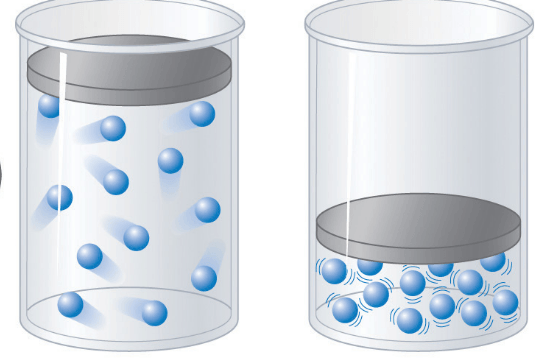
Which best explains why increasing the pressure on a gas decreases the volume of the gas sample?
Increasing the pressure causes the gas particles to hit the container walls more often.
Increasing the pressure on a gas sample moves the gas particles closer together.
Increasing the pressure on a gas sample causes the kinetic energy to increase.
(Charles Law) There are 65 liters of helium in a balloon at 35 K. If the temperature of the balloon is increased to 40 K, what will the new volume of the balloon be?
40 L
70 L
74.3 L
75.9 L
(Charles Law) There are 40 liters of helium in a balloon at 100 K. If the temperature of the balloon is increased to 200 K, what will the new volume of the balloon be?
80 L
45 L
54 L
45.33 L
(Don’t forget about what must be done to temperatures!)

If a hairspray can is heated, what can be expected of the pressure of the gas inside the can?
The pressure will increase
The pressure will decrease
The pressure will remain constant
The pressure will equalize
Pressure is
defined as the mass that an object exerts when at rest.
not a measurable in gases.
defined as the number of moles of substance divided by the mass of the substance.
created by the force of the gas particles impacting the walls of the container.
A student inflates a balloon with helium then places it in the freezer. The student should expect
the balloon's volume to increase
the balloon's volume to decrease
the balloon's moles to increase
the balloon's moles to decrease


what relationship does this graph show?
temperature and pressure- direct
temperature and pressure- inverse
pressure and volume- direct
pressure and volume- inverse

A sample of sulfur dioxide occupies a volume of 652 mL at 313 K and 150 kPa. What volume will the sulfur dioxide occupy at STP?
STP = 273 K, 101.3 kPa
1682.6 mL
20.7 mL
492.3 mL
842.1 mL

A quantity of gas has a volume of 250 L, at 290 K and 303.98 kPa of pressure. What volume must the gas be for the gas to be at 273 K and 101.33 kPa?
78.4 L
88.5 L
706 L
771 L

What volume of methane gas at 273 K and 101.33 kPa do you have when the volume is decreased to 0.50 L, with a temperature of 300 K and a pressure of 151.99 kPa.
0.68 L
0.82 L
0.50 L
0.37 L

If 3.0 L of helium at 293 K with a pressure of 200 kPa is allowed to expand to 4.4 L with the pressure staying constant. What is the new temperature?
702 K
430 K
157 K
0 K

A gas is heated from 263K to 298K. The volume is increased from 24.0L to 35.0L. If the original pressure was 101.33 kPa, what is the new pressure?
78.7 kPa
167.2 kPa
129.7 kPa
61.8 kPa

A weather balloon has a volume of 105 L at 98.3 kPa when the temperature is 318 K. What is the volume at 293 K and 106.4 kPa?
89.4 L
0.32 L
93.8 L
3.13 L
Phase change going from a Gas to a Liquid...
Sublimation
Deposition
Ionization
Condensation
Phase change going from a Liquid to a Gas...
Vaporization
Deposition
Condensation
Melting
Phase change going from a Solid to a Gas...
Deposition
Sublimation
Condensation
Recombination
Phase change going from a Solid to a Liquid...
Freezing
Condensation
Melting
Sublimation
Phase change going from a Gas to a Solid...
Deposition
Sublimation
Condensation
Vaporization
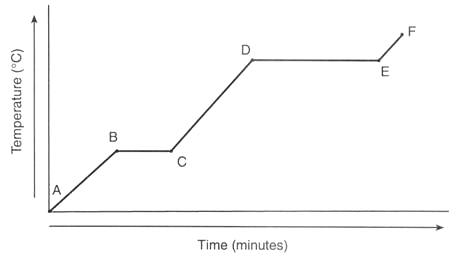
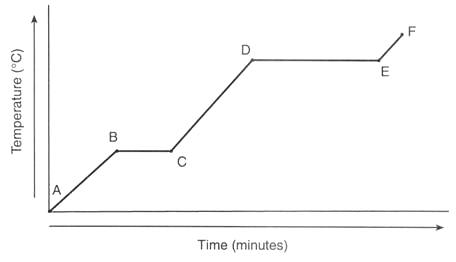
What state/phase is the object likely from points A to B?
Solid
Liquid
Gas
Plasma
What is happening to the particles in the substance between points D and E?
Melting
Freezing
Vaporizing
Sublimating
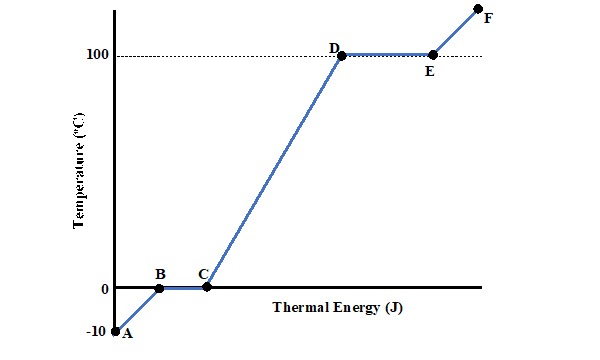
Between which two points is the gas heating up?
A ----> B
B <---- C
C ----> D
D ----> E
E ----> F


When ice sits out on a counter and melts, it is because the ice has...
gained mass
gained energy
lost mass
lost energy
When water sits in the freezer and freezes into ice, it is because the water has...
gained mass
gained energy
lost mass
lost energy
The TOTAL kinetic energy of particles in a substance is its...
Heat
Volume
Thermal Energy
Temperature
In an endothermic reaction, heat is ...
taken in
given out

