
 Worksheets
science revision
Total questions: 58
Worksheet time: 43mins
Name
Class
Date
1.
which of these are in group 1
a)
Li
b)
Be
c)
P
d)
Rh
e)
Co
2.
which of these are in group 7
a)
Cl
b)
Te
c)
Ta
d)
Sc
e)
Ti
3.
What is the family name for the Group 1 elements?
a)
alkaline earth metals
b)
transition metals
c)
alkali metals
d)
halogens
4.
resultant force of 10N up and 19N down
a)
9N down
b)
9N up
c)
29N up
d)
29N down
5.
what will effect braking distance
a)
wet brakes
b)
wether
c)
tiers tread
d)
load
e)
tiredness
6.
A living thing, such as a plant, that can make its own food
a)
Producer
b)
Consumer
c)
Herbivore
d)
Carnivore
7.
A living thing, such as a plant, that can make its own food
a)
Producer
b)
Consumer
c)
Herbivore
d)
Carnivore
8.
A living thing that can't make its own food and must eat other living things
a)
Carnivore
b)
Consumer
c)
Herbivore
d)
Producer
9.
A living thing that can't make its own food and must eat other living things
a)
Carnivore
b)
Consumer
c)
Herbivore
d)
Producer
10.
An animal that eats only plants or producers
a)
Carnivore
b)
Omnivore
c)
Herbivore
d)
Consumer
11.
An animal that eats only plants or producers
a)
Carnivore
b)
Omnivore
c)
Herbivore
d)
Consumer
12.
An animal that eats only other animals
a)
Carnivore
b)
Omnivore
c)
Consumer
d)
Producer
13.
An animal that eats only other animals
a)
Carnivore
b)
Omnivore
c)
Consumer
d)
Producer
14.
A living thing that feeds on the wastes and remains of plants and animals
a)
Decomposers
b)
Fungus
c)
Scavenger
d)
Microorganism
15.
A living thing that feeds on the wastes and remains of plants and animals
a)
Decomposers
b)
Fungus
c)
Scavenger
d)
Microorganism
16.
A living thing that feeds on large pieces of dead organism
a)
Decomposers
b)
Fungus
c)
Scavenger
d)
Microorganism
17.
A living thing that feeds on large pieces of dead organism
a)
Decomposers
b)
Fungus
c)
Scavenger
d)
Microorganism
18.
An organism that can't make food and can't move around
a)
Fungus
b)
Scavenger
c)
Decomposers
d)
Microorganism
19.
An organism that can't make food and can't move around
a)
Fungus
b)
Scavenger
c)
Decomposers
d)
Microorganism
20.
An organism that is too small to be seen without a microscope
a)
Decomposers
b)
Scavenger
c)
Microorganism
d)
Fungus
21.
An organism that is too small to be seen without a microscope
a)
Decomposers
b)
Scavenger
c)
Microorganism
d)
Fungus
22.
What is a mushroom an example of?
a)
Fungus
b)
Microorganism
c)
Scavenger
d)
Producer
23.
What is a mushroom an example of?
a)
Fungus
b)
Microorganism
c)
Scavenger
d)
Producer
24.
Which is not a consumer?
a)
Producer
b)
Herbivore
c)
Carnivore
d)
Omnivore
25.
Which is not a consumer?
a)
Producer
b)
Herbivore
c)
Carnivore
d)
Omnivore
26.
Which of the following is the smallest unit of life that can carry out all life functions?
a)
the mitochondria
b)
the vacuoles
c)
the nucleus
d)
the cell
27.
Which structures are found in every living cell?
a)
cell membrane and cytoplasm
b)
chloroplasts and mitochondria
c)
a cell wall and nucleus
d)
chloroplasts and cell wall
28.
Which cell structure is found in plant and animals cells and controls what can come into or leave a cell?
a)
cell membrane
b)
cytoplasm
c)
nucleus
d)
vacuole
29.
What is the function of the cell nucleus found in both plant and animal cells?
a)
to produce energy
b)
to control cell activity
c)
to remove waste products
d)
to allow molecules to enter the cell
30.
Cell organelles that are responsible for digesting food, worn out organelles and other cellular wastes are called ___________________.
a)
Mitochondria
b)
Vacuoles
c)
Lysosomes
d)
Chlororplasts
31.
What is one basic function of the vacuoles?
a)
circulating oxygen
b)
producing food
c)
controlling cell processes
d)
storing water
32.
Chloroplasts in plant cells allow the plant to perform a function that animal cells cannot do. What is the main function of the chloroplasts found in plant cells?
a)
to absorb light energy and manufacture food
b)
to remove waste materials by active transport
c)
to manufacture chemical energy from food
d)
to control the shape of the cell
33.
All cells need energy to function. Which cell organelle is responsible for producing energy in the cell?
a)
chloroplasts
b)
mitochondria
c)
nucleus
d)
vacuoles
34.
What is the function of a cell wall?
a)
to protect and support the cell
b)
to perform different functions in each cell
c)
to prevent water from passing through it
d)
to prevent oxygen from entering the cell
35.
In what part of the plant cell does the process of photosynthesis take place?
a)
nucleus
b)
mitochondria
c)
chloroplasts
d)
vacuoles
36.
Starch and water molecules in potato cells are stored in what organelle?
a)
mitochondria
b)
nucleus
c)
cell wall
d)
vacuole
37.
Cells with a nucleus and membrane-bound organelles are called ____________________.
a)
prokaryotes
b)
eukaryotes
c)
bacteria
d)
protists
38.
_ are organelles responsible for digesting certain materials within the cell.
a)
vacuoles
b)
chloroplasts
c)
lysosomes
d)
cell membrane
39.
Which of the following is not part of the cell theory?
a)
cells must contain DNA
b)
all living things are made from cells
c)
cells can only come from other cells
d)
cells are the basic unit of life
40.
He discovered that all plants are made of cells:
a)
Anton van Leeuwenhoek
b)
Theordor Schwann
c)
Robert Hooke
d)
Mattias Schleiden
41.
Who was the first person to see cells under the microscope and give them their name?
a)
Mattias Schleiden
b)
Robert Hooke
c)
Theordor Schwann
d)
Anton van Leeuwenhoek
42.
Chloroplasts are organelles that convert light energy to sugars. These organelles are found only in plants. Which organelles are found only in animals?
a)
Golgi apparatus
b)
lysosomes
c)
mitochondria
d)
ribosomes
43.
The basic unit of structure and function in a living things.
a)
chloroplast
b)
nucleus
c)
cell
d)
cell membrane
44.

What is the net force?
a)
40 N left
b)
0 N Balalnced
c)
400 N right
d)
40 N right
45.

How will this object move?
a)
It won't move.
b)
It will move to the right.
c)
It will move to the left.
d)
It will move in both directions.
46.
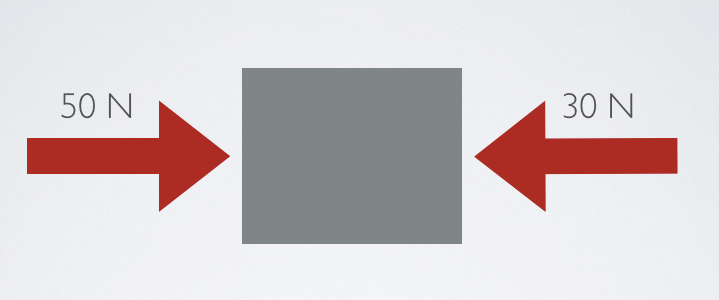
How will this object move?
a)
It won't move.
b)
It will move to the right.
c)
It will move to the left.
d)
It will move up.
47.

What is the net force?
a)
30 N left
b)
25 N right
c)
5 N left
d)
55 N right
48.
Which could be an example of an unbalanced force?
a)
A plate sitting on a dining table
b)
A ball at the top of a hill that is not moving
c)
Earth orbiting the Sun
d)
A baseball that has been thrown to home plate.
49.
You and your dad are moving the couch from one side to another. Your dad pushes with a force of 35 N to the right and you push with a force of 25 N right. What is the net force on the couch?
a)
60 N right
b)
10 N left
c)
60 n right
d)
50 N left
50.

What is the net force?
a)
400 N Up
b)
400 N Down
c)
- 400 N Down
d)
800 N Down
51.

Forces that have a net force of zero ( the object is still).
a)
Balanced force
b)
Unbalanced force
52.
The sum of all forces acting on an object and direction
a)
Contact Force
b)
Balanced Force
c)
Unbalanced Force
d)
Net Force
53.
8 N to the left , and 4 N to the right. Find the net force. Is this balanced
a)
12 N Right No
b)
4 N Left No
c)
12 N Right Yes
d)
4 N Left Yes
54.
(T or F?) A balanced force is only an object that is not moving.
a)
True
b)
False
55.

Balanced or Unbalanced?
a)
Balanced
b)
Unbalanced
56.

Are forces balanced or unbalanced when a car is moving at a constant speed in a straight line?
a)
Balanced
b)
Unbalanced
57.

Are forces balanced or unbalanced when a marble rolls down a ramp?
a)
Balanced
b)
Unbalanced
58.

Are forces balanced or unbalanced when skateboarding down a ramp?
a)
Balanced
b)
Unbalanced
100 %

