wayground logo

Free Printable Worksheets

Font size

S
M
L
XL
Worksheets

Mirrors (Conceptual Physics)

Total questions: 36

Worksheet time: 27mins
Name
Class
Date
1.
a mirror with a surface that curves inward like the inside of a bowl
a)
concave mirror
b)
convex mirror
c)
plane mirror
d)
flat mirror
2.
Convex Mirrors produce...
a)
only virtual images
b)
virtual or real images
c)
only real images
d)
inverted images
3.
Real images are :
a)
Always inverted
b)
Magnified or Diminished
c)
can be obtained on screen
d)
all the above
4.
Virtual Images are
a)
Always erect
b)
can be obtained on screen
c)
magnified or diminished
d)
all the above
5.

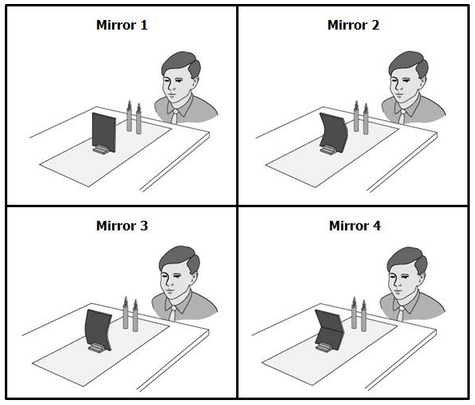
A student is conducting an experiment with four different types of mirrors. Which mirror in the experiment converges light and UP CLOSE, produces an upright, magnified image of the candles? (hint: no two mirrors are the same)

a)

mirror 1

b)

mirror 2

c)

mirror 3

d)

mirror 4

6.

A student is conducting an experiment with four different types of mirrors. Which mirror in the experiment is a convex mirror?

a)

mirror 1

b)

mirror 2

c)

mirror 3

d)

mirror 4

7.

A dentist uses a small dental mirror to help magnify teeth in your mouth. What type of mirror is this?

a)

a convex mirror

b)

a concave mirror

c)

a convex lens

d)

a concave lens

8.
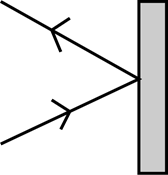
The illustration shows a light ray striking an object.
In the illustration, the light ray striking the object is-
a)
absorbed
b)
stopped
c)
reflected
d)
refracted
9.
A student is 2.50m away from a convex lens while her image is 1.80m from the lens, what is the focal length?
a)
1.05m 
b)
2.50m
c)
1.39m
d)
0.72m
10.
If a capital letter R is seen in an ordinary mirror, what does it look like?
a)
A
b)
B
c)
C
d)
D
11.
According to the laws of reflection, if i = angle of incidence and r = angle of reflection,
a)
A. i =  r
b)
B. i >  r
c)
C. r >  i
d)
D. i is not equal to r
12.
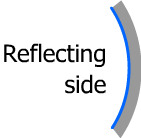
The following is a picture of what type of mirror? 
a)
Convex Mirror
b)
Concave Mirror
c)
Plane Mirror
d)
Flat Mirror
13.
The following is a picture of what type of mirror? 
a)
Convex Mirror
b)
Concave Mirror
c)
Plane Mirror
d)
Flat Mirror
14.
A real image having a size of 10 cm is formed by a concave mirror. The size of the object is 5 cm.The magnification of the object is
a)
-5
b)
5
c)
2
d)
-2
15.
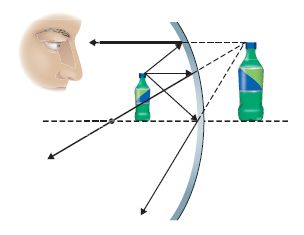
Which terms describe the reflection seen in this image?
a)
virtual, upright
b)
virtual, inverted
c)
real, upright
d)
real, inverted
16.
Convex mirrors can create real images.
a)
True
b)
False
17.
Concave mirrors can create virtual and real images.
a)
True
b)
False
18.
What does The law of reflection state?
a)
the angle the incident ray makes with a line drawn perpendicular to the surface of the mirror.
b)
shows how rays change direction when they strike mirrors and pass through lenses.
c)
The angle of reflection is equal to the angle of incidence.
19.
Which type of mirror is shown.
a)
Concave
b)
Convex
c)
Specular
d)
Plane
20.
Which type of mirror magnifies a close up image, like a make-up mirror.
a)
Concave
b)
Convex
c)
Specular
d)
Plane
21.

In the mirror equation above d0 represents:

a)

Distance of the object from the mirror

b)

Distance of the image from the mirror

c)

The focal length

d)

The plane of incidence

22.
a real image...
a)
is produced by virtual rays and can be projected on a screen
b)
is produced by real rays and cannot be projected on a screen
c)
is produced by virtual images and cannot be projected on a screen
d)
is produced by real rays and can be projected on a screen
23.
If the focal length is negative a _________ lens is being used
a)
concave (diverging)
b)
convex (converging)
24.
This shows the phenomenon known as....
a)
reflection
b)
refraction
c)
mirrors
d)
focal point
25.
What is the name of the perpendicular line that we use to measure angles?
a)
Incident ray
b)
Reflected ray
c)
Normal line
d)
Source ray
26.
Where is the angle of reflection located?
a)
Between the mirror and the incident ray
b)
Between the mirror and the reflected ray
c)
Between the normal line and incident ray
d)
Between the normal line and reflected ray
27.
What type of image is produced by a flat mirror?
a)
Real and upright
b)
Real and inverted
c)
Virtual and upright
d)
Virtual and inverted
28.
How much does a flat mirror magnify an image?
a)
1x
b)
2x
c)
3x
d)
4x
29.

As you walk away from a flat mirror:

a)

Your image gets smaller

b)

Your image gets larger

c)

Your image stays the same size

d)

Your image gets larger at first and then smaller

30.

If you are 6ft tall how large of a space on a mirror do you need to see yourself?

a)

6ft

b)

12ft

c)

3ft

d)

It depends on how close to the mirror you are

31.
An object is placed at a distance of 27.0 cm away from a thin convex lens with a focal length of 9.00 cm.  How far from the lens is the image located and what type of image is formed? 
a)
13.5 cm and real
b)
3.00 cm and real
c)
0.33 cm and virtual
d)
0.15 cm and virtual
32.

Material that allows all light through

a)

Translucent

b)

Transparent

c)

Opaque

33.

The distance from the center of a concave mirror to the focal point is called the

a)

optical axis

b)

focal length

c)

plane

d)

reflection

34.
What is the value of the unknown angle (theta) in the following diagram?
a)
A. 30 degrees
b)
B. 45 degrees
c)
C. 90 degrees
d)
D. 60 degrees
35.

An object is placed 20 cm from a concave mirror with a focal point of 15 cm. Where will the image be located.

a)

15 cm

b)

20 cm`

c)

60 cm

d)

-8.6 cm

36.

An object is located 5 cm from a convex mirror with a focal point of 15 cm. What is the location of the image?

a)

-7.5 cm

b)

-3.75 cm

c)

7.5 cm

d)

there is no image