
 Worksheets
Chemistry Unit 3 AOS1
Total questions: 60
Worksheet time: 52mins
1. The temperature increases when calcium chloride dissolves in water.
2. Steam condenses to liquid water
3. Water boils
4. Dry ice sublimates

How many moles of ammonium are produced when 3 moles of nitrogen react with hydrogen?
N2+ 2O2 -> 2NO2
ΔH = +67kJ


8.7: Combustion is when a __________ reacts with oxygen
petrol
fuel
fire triangle
carbon dioxide
List four factors that affects the rate of a reaction
temperature
concentration
surface area
volume
catalysts
List four factors that affects the rate of a reaction
temperature
concentration
surface area
volume
catalysts
A temperature increase causes the particles ......
to slow down
move faster
collide higher
in the right order
How does a catalyst work in speeding up a reaction?
By lowering the activation energy or reaction
by giving them more energy
by making them more available

In a Galvanic Cell, the anode is...
positive
negative
In a Galvanic Cell, the cathode is...
positive
negative
Oxidation occurs at the...
anode
cathode
Reduction occurs at the...
anode
cathode
In a Galvanic cell, the electrons flow from the...
anode to the cathode
cathode to the anode
Ecell =
Ered - Eox
Ered + Eox
Eox - Ered
Eox + Ered
In the list of standard electrode potentials, the strongest reducing agent is...
K
K+
F2
F-
In the list of standard electrode potentials, the strongest oxidising agent is...
K
K+
F2
F-
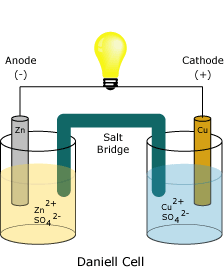
In the above Galvanic Cell, which half cell is undergoing reduction?
Cu | Cu2+
Zn | Zn2+
In any Galvanic Cell, which half cell will undergo reduction?
The half cell with the lower standard electrode potential
The half cell with the higher standard electrode potential
Consider the galvanic cell reaction Zn (s) + Cu2+ (aq) → Cu (s) + Zn2+ (aq) When the cell is running spontaneously, which is the only true statement?
The copper electrode loses mass and the zinc electrode is the cathode.
The copper electrode gains mass and the copper electrode is the cathode.
The zinc electrode gains mass and the zinc electrode is the anode.
The zinc electrode loses mass and the zinc electrode is the cathode.
A certain galvanic cell has for its spontaneous cell reaction: Zn + HgO → ZnO + Hg
Which is the half-reaction occurring at the cathode?
HgO + 2 e- → Hg + O2-
Hg → Hg2+ + 2 e-
Zn → Zn2+ + 2 e-
ZnO + 2 e- → Zn
What is the standard electrode which all other standard electrode potentials are measured against?
helium
hydrogen
magnesium
potassium
Select all the standard conditions used to measure the standard electrode potentials:
electrolyte solution 1 moldm-3
298K temperature
all chemicals in gaseous form
1atm pressure
standard hydrogen electrode as comparison
Why does the voltage from a chemical cell that is connected in a circuit with a lamp eventually reach zero?
The lamp breaks
One of the reactants is used up
The circuit becomes broken
What is produced by a hydrogen-oxygen fuel cell?
Water and Carbon Dioxide
Carbon Dioxide
Water
What happens to hydrogen molecules in a hydrogen-oxygen fuel cell?
They form hydrogen ions, H+ , and electrons, e-
They form hydrogen ions, H+ , and electrons, e+
They form hydrogen atoms, H
What happens to oxygen molecules in a hydrogen-oxygen fuel cell?
They react with electrons to form oxide ions, O2-
They react with hydrogen ions to form hydroxide ions, OH-
They react with hydrogen ions and electrons to form water
Which of these is a disadvantage of cars driven by hydrogen-oxygen fuel cells rather than by petrol engines?
They have fewer moving parts
There are fewer suitable filling stations
They emit little pollution
What is a strength of using hydrogen-oxygen fuel cells in manned spacecraft, compared to using chemical cells?
They produce electricity
They produce water that the astronauts can drink
They produce a voltage
What is a disadvantage of using solar photovoltaic cells to provide electricity in a spacecraft?
Photovoltaic cells have lots of moving parts
Photovoltaic cells release toxic byproducts
Photovoltaic cells only work when the spacecraft is in direct sunlight
An oxidising agent _______ electrons
Gains
Loses
An reducing agent _______ electrons
Gains
Loses

Above is a section of the electrochemical series. The strongest oxidising agent in this section is...
Ag+ (aq)
Ag (s)
Sn4+ (aq)
Sn2+ (aq)
Above is a section of the electrochemical series. The weakest oxidising agent in this section is...
Ag+ (aq)
Ag (s)
Sn4+ (aq)
Sn2+ (aq)
Above is a section of the electrochemical series. The weakest reducing agent in this section is...
Ag+ (aq)
Ag (s)
Sn4+ (aq)
Sn2+ (aq)
Which is the correct formula for determining the potential difference of the cell?
Eocell = Eooxidant - Eoreductant
Eocell = Eoreductant - Eooxidant
Eocell = Eooxidant + Eoreductant

