
 Worksheets
Physical Science Exam Review -- Chemistry Section
Total questions: 60
Worksheet time: 30mins
The scientist credited with forming the theory that all matter is made of tiny particles called atoms is
Dalton
J.J. Thomson
Rutherford
Bohr
The scientist credited with the discovery of the electron is
Dalton
J.J. Thomson
Rutherford
Bohr
The scientist who discovered the existence of a closely packed positive region of the atom that is now known at the nucleus is
Dalton
J.J. Thomson
Rutherford
Bohr
The famous "gold foil" experiment was performed by
Dalton
J.J. Thomson
Rutherford
Bohr
What kind of charge does the center of an atom have?
a positive charge
a negative charge
no charge at all
Which particles are found in the nucleus of an atom?
electrons and protons
protons and neutrons
electrons and neutrons
Which two subatomic particles have about the same mass?
electrons and protons
protons and neutrons
electrons and neutrons
The atomic number of an atom is the same as its number of
protons
neutrons
nucleons
If two atoms have different numbers of protons, what do you know about the atoms?
they are atoms of two different elements
they have different numbers of neutrons
they have different mass numbers
In a neutral atom, the number of protons is equal to the
number of neutrons
number of electrons
number of nucleons
How many protons does an atom of oxygen have?
2
4
6
8
How many electrons can be in the first energy level of an atom at one time?
2
8
10
18
How many electrons, protons and neutrons are found in a neutral atom of fluorine?
9 P, 9 N, 9 E
19 P, 10 N, 19 E
9 P, 10 N, 19 E
9 P, 10 N, 9 E
A material that is made of two or more substances that can be separated by a physical process is called
a substance
a mixture
an element
a compound
A characteristic of a material that can be observed without changing what the material is can be called a
chemical property
physical property
The density of copper is an example of
chemical change
physical change
chemical property
physical property
Which of the following is the correct formula for potassium chloride?
PC1
KCl
K₂Cl
KC1₂
Which of the following is the correct name of NaNO³?
natrium nitrogen oxide
sodium nitrogen oxide
sodium oxynitride
sodium nitrate
Which of the following is the correct formula for calcium sulfide?
CaSO4
Ca₂SO4
Ca₂S
Which of the following is the correct formula for aluminum chloride?
AICI
AIC1₂
AICI3
Al₂C13
How many neutrons are in the nucleus of an atom of aluminum?
0
13
14
27
How many electrons are in the outer energy level of all noble gasses except helium?
2
8
18
32
Which of the following elements is in the same family as chlorine?
iodine
argon
sulfur
neon
Which of the following is a metal?
sodium
sulfur
silicon
The type of bond that usually forms between two nonmetals is
ionic
covalent
metallic
Which element is the most chemically active nonmetal?
oxygen
chlorine
fluorine
bromine
Which nonmetal is a liquid at room temperature?
iodine
mercury
bromine
radon
The type of bond that usually forms between a metal and a nonmetal is
ionic
covalent
metallic
The elements in Groups 3-12 of the periodic table are the
actinides
alkaline earth metals
alkali metals
transition elements
A family of elements that has two electrons in its outer energy level is the
alkaline earth metals
alkali metals
halogens
transition elements
One element replaces another in a compound.
Synthesis
Decomposition
Single Replacement
Double Replacement
A substance breaks down into two or more simpler substances.
Synthesis
Decomposition
Single Replacement
Double Replacement
A precipitate, water or a gas forms when two ionic compounds are dissolved in a solution.
Synthesis
Decomposition
Single Replacement
Double Replacement
Two or more substances combine to form another substance.
Synthesis
Decomposition
Single Replacement
Double Replacement
C2H22O11 → 12C + 11H₂O
Synthesis
Decomposition
Single Replacement
Double Replacement
Zn + 2HCl → ZnCl + 2H
Synthesis
Decomposition
Single Replacement
Double Replacement
NiCl₂ → Ni + Cl₂
Synthesis
Decomposition
Single Replacement
Double Replacement
BaCl₂ + 2KIO3 → Ba(IO3)2 + 2KCl
Synthesis
Decomposition
Single Replacement
Double Replacement
4C + 6H₂ + O₂ → 2C₂H₂O
Synthesis
Decomposition
Single Replacement
Double Replacement
Each substance on the right side of the arrow in a chemical equation is a
reactant
product
coefficient
The formation of a precipitate when two solutions are mixed is an example of
a chemical change
a physical change
a chemical property
a physical property
What is an insoluble solid that forms as the result of a chemical reaction?
a precipitate
an inhibitor
an aqueous
a catalyst
Three indications that a chemical reaction has occurred are
a color change, the production of a gas, the particles of the substances are smaller
a solid melts to a liquid, the particles of a substance become smaller, and an odor is noted
a color change, the production of a gas and the production of an insoluble solid
a precipitate forms, sublimation occurs and the particles dissolve
In all chemical reactions, energy is
released
absorbed
either released or absorbed depending on the reaction
A substance that speeds up a chemical reaction but does not get changed by the reaction is a/an
inhibitor
catalyst
preservative
Substances that speed up chemical reactions in living things and make life reactions take place at faster speeds and lower temperatures are called
inhibitors
enzymes
preservatives
The hydronium ion has the formula
OH
H3O+
A substance has a slippery feel and conducts electricity. The substance is probably
an acid
a base
a salt
aqueous
The reaction of an acid and a base is called
titration
neutralization
saponification
pickling
What is the difference between a strong acid and a weak acid?
a strong acid eats through metal and a weak acid does not
a strong acid completely turns to ions in a water solution and a weak acid only partially turns to ions in a water solution
a strong acid is more concentrated than a weak acid
A solution with a pH of 7 is
acidic
basic
neutral
A solution with a pH of 9 is
acidic
basic
neutral
A solution with a pH of 5 is
acidic
basic
neutral
A solution with a pH of 3 will turn litmus paper
red
blue
white
A solution with a pH of 11 will turn litmus paper
red
blue
white
When an acid is reacted with a base, the products are
water and a salt
water and titration
Which of the following describes the motion of particles in a solid?
Particles vibrate in position
Particles flow over and around each other
Particles move in all directions
Particles are unable to move at all
What is the oxidation number of all the elements in group 15?
1+
2+
3-
2-
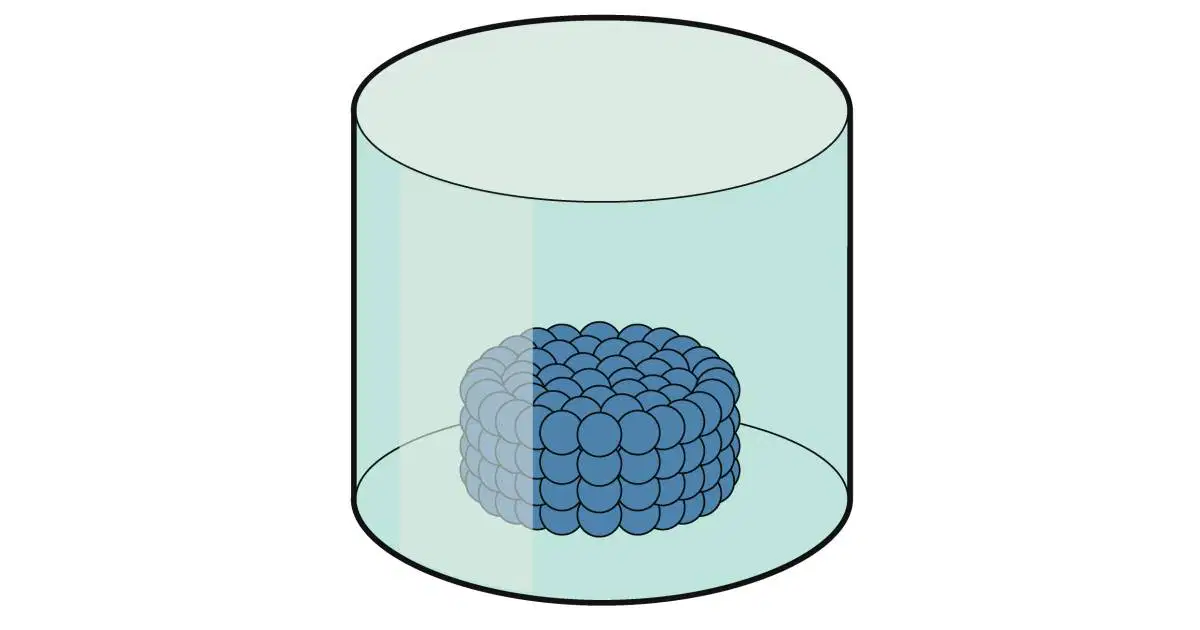
Which state of matter is represented in the image?
solid
liquid
gas
plasma

Which state of matter is represented in this image?
solid
liquid
gas
plasma

