wayground logo

Free Printable Worksheets

Font size

S
M
L
XL
Worksheets

Properties of Matter - Part 2

Total questions: 111

Worksheet time: 2hrs 56mins

Name
Class
Date
1.

This is testing ___________

a)

density

b)

solubility

c)

mass

d)

conductivity

2.
The water is ______ dense than the boat
a)
more
b)
less
3.

Mass, density, solubility, color, texture, state of matter, conductivity, etc.

a)

Physical state

b)

Insulators

c)

Physical Properties

d)

Inferences

4.

More dense than the corn oil, but less dense than the water... (Look at the picture)

a)

glycerin

b)

wood

c)

plastic

d)

copper wire

5.

Which property is this testing?

a)

density

b)

solubility

c)

mass

d)

conductivity

6.
If you poured 3 liquids that do not mix how could you tell which one is the most dense?
a)
The liquid on top
b)
The liquid in the middle
c)
The liquid at the bottom
7.
The ability of a substance to dissolve is called...
a)
malleability
b)
ductility
c)
solubility
8.
Anything that has mass and takes up space is called
a)
volume
volume
b)
matter
c)
magnetism
d)
electricity
9.
Color, flexibility, texture and shape are examples of 
a)
physical properties
b)
solids 
c)
gases
d)
mixtures 
10.
What part of matter can be observed with the senses like size, shape, color, and how it feels?
a)
physical property
b)
liquid
c)
solid
d)
gas
11.
What sense do we use to sort matter by color?
a)
smell
b)
sight
c)
hearing
d)
taste
12.
When we sort things by small, medium, or large, what property of matter are we using to sort?
a)
color
b)
texture
c)
size
d)
shape
13.
When we sort things by soft, hard, or rough, what property of matter are we using to sort?
a)
color
b)
texture
c)
size
d)
shape
14.
When we sort things by red, blue, green, or yellow, what property of matter are we using to sort?
a)
color
b)
texture
c)
size
d)
shape
15.
What is the texture of an object?
a)
What the surface looks and feels like
b)
how much mass it has
c)
The ability of an object to bend back and forth
d)
The color of an object
16.

If a mineral is scratched by talc, what must its hardness rating be? (Look at the picture)

a)

1

b)

3

c)

6

d)

10

17.

What is # 4 on the MOH's scale?

a)

Fluorite

b)

Feldspar

c)

Quartz

d)

Calcite

18.

What is # 8?

a)

Minerals

b)

Apatite

c)

Corundum

d)

Topaz

19.

Which mineral is HARDER than quartz?

a)

Topaz, Corundum, and Diamond

b)

Feldspar. Apatite, and Talc

c)

Talc, Gypsum, Topaz

d)

Diamond, Calcite, Fluorite

20.
Using this scale, which mineral can scratch fluorite?
a)
Talc 
b)
Gypsum 
c)
Apatite 
d)
Calcite 
21.
What can scratch Talc?
a)
Gypsum
b)
Diamond
c)
Quartz
d)
All of them
22.

Using this scale, which mineral can scratch a Drill bit?

a)

Talc

b)

Topaz

c)

Corundrum

d)

Quartz

23.

What is the #10 mineral?

a)

Gold

b)

Feldspar

c)

Diamond

d)

Fluorite

24.

Why did quartz scratch the glass easier than feldspar?

a)

Because it is softer.

b)

Because it has a lower scale.

c)

Because it is harder.

d)

None of the above

25.

What was mineral #6?

a)

Feldspar

b)

Diamond

c)

Gold

d)

Silver

26.

What was used to scratch the fluorite?

a)

feldspar

b)

gold

c)

a blade

d)

fluorite

27.

Which is harder fluorite or copper?

a)

Copper

b)

Fluorite

28.

What is the name of mineral #3?

a)

Feldspar

b)

Calcite

c)

Gold

d)

Fluorite

29.

An image that is produced by a mirror?

a)

Solubility

b)

Relectivity

c)

Hardness

30.

The bouncing back of light waves off of a surface is...

a)

Reflection

b)

Refraction

c)

Light

d)

Lens

31.

A mirror _________ light.

a)

absorbs

b)

reflects

c)

refracts

32.

Smooth and shiny surfaces can _____________ light.

a)

reflect

b)

refract

c)

absorb

33.

Light bounces when it is

a)

reflected

b)

absorbed

c)

refracted

34.
A magnet cannot not move which of the following objects?
a)
a paper clip
b)
a nail
c)
a toothpick
d)
a staple
35.
Iron, Nickel and cobalt are all __________________ materials
a)
Shiny
b)
poles
c)
magnetic
d)
cold
36.
What characteristics do magnetic substances have?
a)
They can give you a "shock" when you touch them
b)
They can push or pull objects without touching them
c)
They are always black and cold to touch
d)
They fall faster than other objects when you drop them
37.
Which object would a magnet attract?
a)
a glass bottle
b)
a piece of paper
c)
a metal paper clip
compass
d)
a rubber eraser
magnetic field
38.
A magnet will attract scissors if the scissors contain: 
a)
copper
b)
aluminum
c)
gold
d)
nickel
39.
Material that allows electric current or heat to flow through easily.
a)
electromagnetic field
b)
conductor
c)
open circuit
d)
electric current
40.
The pathway through which electrical current flows.
a)
conductor
b)
insulator
c)
electric circuit
d)
electromagnetic field 
41.
Energy produced by the movement of electrons.
a)
conductor
b)
electricity
c)
insulator
d)
open circuit
42.
Material that PREVENTS electric current or heat from flowing.
a)
electromagnetic field
b)
electric current
c)
insulator
43.

A material that allows heat or an electric current to flow through easily

a)

Conductor

b)

Insulator

c)

Thermal Energy

d)

Glass

44.

A material that prevents heat or an electric current from flowing

a)

insulator

b)

outsulator

c)

conductor

d)

electrical energy

45.
Max tested some objects with the circuit tester. Then, he recorded his results in the table below.

Based on his results, which of the following conclusions is the most likely to be true?
a)
A, B and C are flexible objects.
b)
B is a non-conductor of electricity.
c)
A is made of iron and B is made of copper.
d)
Conductors of electricity are also heat conductors.
46.

Which of the following objects, when placed in a closed circuit, will cause the bulb to light up?


A: Copper wire B: Plastic ruler


C: Wooden chopsticks D: Iron nail

a)

A and B only

b)

C and D only

c)

A and D only

d)

B and C only

47.
Which is NOT an insulator.
a)
Wool
b)
Plastic
c)
Copper
d)
Glass
48.
What is the difference between a conductor and an insulator?
a)
An insulator allows electricity to flow through it easily and a conductor does not
b)
A conductor allows electricity to flow through it easily and an insulator does not.
c)
An insulator is magnetic and a conductor is not
d)
A conductor is magnetic and an insulator is not
49.
A great conductor of energy is:
a)
wood
b)
plastic
c)
metal
d)
cloth
50.
All of the following are conductors except _______.
a)
metal spoon
b)
wire
c)
iron nail
d)
plastic spoon
51.
Olivia wanted to complete her circuit with a conductor.  What object is her best option?
a)
Wood stick
b)
Glass bead
c)
Aluminum foil
d)
Styrofoam
52.
Claire wants to complete her circuit with a conductor.  What object is her best option?
a)
rubber
b)
a penny
c)
card board
d)
plastic spoon
53.
A cold bathroom floor is an example of
a)
Conductor
b)
Thermal conductivity
c)
Cold weather
d)
Insulators
54.

Hot water heaters are...

a)

Conductors

b)

Insulators

c)

Machines

d)

conductors and insulators

55.
What is an insulator?
a)
A coat
b)
Something that. doesn't allow heat to pass through it
c)
Something to stop music
d)
Something that allows heat to pass through
56.
Thermal conductivity is....
a)
How fast heat passes through something
b)
How hot certain materials get
c)
Something that doesn'treadily allow heat to pass theough
d)
Metals
57.

Which is NOT an insulator.

a)

Wool

b)

Plastic

c)

iron

d)

Glass

58.
What is a example of a conductor?
a)
wood 
b)
metal
c)
rubber
d)
rock
59.
The handle of a frying pan is often coated in rubber because rubber provides...
a)
Heat insulation
b)
Heat conduction
c)
A low melting point
d)
A nonstick surface
60.
What is NOT an example of an insulator in the kitchen?
a)
An oven mitt
b)
Pots and pans
c)
A wooden spoon
d)
A plastic measuring cup
61.
Conductors are materials that...
a)
Allow heat to pass through
b)
Stop heat from passing through
c)
Allow cold to pass through
d)
Stop cold from passing through
62.
Gloves help keep your hands warm in winter because:
a)
They are conductors of heat.
b)
They are fuzzy.
c)
They are conductors of electrical energy.
d)
They are insulators.
63.
Thermal energy travels...
a)
Hot to cold
b)
Cold to hot
c)
Inside to outside
d)
Outside to inside
64.

Which of the examples are heat insulators?


Choose 2.

a)
b)
c)
d)
65.
Which box has a higher density?  
a)
Box A
b)
Box B
c)
cannot be determined
d)
they are the same
66.
An object with which of the following densities will float on water?
a)
0.7 g/cm3
b)
1.2 g/cm3
c)
3.5 g/cm3
d)
11.4 g/cm3
67.
A can of Coke will sink in a bowl of water.  A can of Diet Coke will float in a bowl of water.  What does this tell you about the density of the Diet Coke?
a)
it is bigger than 1
b)
it is smaller than 1
c)
it is equal to 1
d)
it is equal to -1
68.
What is the density of water?
a)
0 g/ml
b)
1 g/ml
c)
10 g/ml
d)
100 g/ml
69.
Why do some substances float on water?
a)
they are warmer than water
b)
they are cooler than water
c)
they are more dense than water
d)
they are less dense than water
70.
Helium balloons rise on earth because
a)
helium is less dense than air
b)
helium is more dense than air
c)
helium is cooler than air
d)
helium is warmer than air
71.
Put the liquids in order from most dense to least dense?
a)
4, 3, 2, 1
b)
1, 2, 3, 4
c)
3, 4, 2, 1, 
d)
4, 3, 1, 2
72.
Why does ice float?
a)
Liquid water is less dense than solid water.
b)
Solid water is less dense than liquid water.
c)
Gaseous water is less dense than solid water.
d)
Liquid water is less dense than gaseous water.
73.
What do we know about the density of lamp oil, rubbing alcohol, and vegetable oil?  
a)
The density is greater than 1.0 g/mL
b)
The density is less than 1.0 g/mL
c)
The density is equal to 1.0 g/mL
d)
The density can not be determined
74.
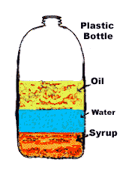
Which liquid is the least dense?
a)
oil
b)
water
c)
syrup 
d)
plastic bottle
75.
A scoop of ice cream, a ball of aluminum foil, a golf ball, and a ping pong ball, all have the same volume. Which of these has the greatest density?
a)
aluminum
b)
ping pong ball
c)
golf ball
d)
ice cream
76.
Water changes states when energy is added or taken away. What happens to liquid water when energy is added?
a)
It melts into a gas.
b)
It freezes into a solid.
c)
It evaporates into a gas.
d)
It condenses into a solid. 
77.
Water is found as a liquid, solid, or gas. What happens when water changes from a gas to a liquid? 
a)
It melts.
b)
It freezes.
c)
It condenses.
d)
It evaporates. 
78.
The three states of matter are solid, liquid, and gas. Which shows water a solid? 
a)
 a snowman 
b)
a pot of boiling water
c)
a lake
d)
clouds
79.
Isamar changed water from a liquid to a gas. What did Isamar do to the water? 
a)
She froze the water.
b)
She melted the water.
c)
She added energy to the water.
d)
She removed energy from the water.
80.
Water is found in all three states of matter. Which shows the change of state involved when water freezes? 
a)
changes from a solid into a gas
b)
changes from a gas into a liquid
c)
changes from a solid into a liquid
d)
changes from a liquid into a solid
81.
The table shows some properties of water in different states. Which property should be put into the second column? 
a)
feels dry
b)
tastes sour
c)
has strong odor
d)
fits the shape of its container 
82.
Jared conducts an experiment to compare densities. He places each of the following objects in a single graduated cylinder. Choose the order of the items as they would appear in the cylinder, from top to bottom.
a)
cord, olive oil, water, corn syrup, sandstone rock
b)
water, olive oil, corn syrup, sandstone rock, cork
c)
sandstone rock, cork, water, olive oil, corn syrup
d)
corn syrup, cork, water, olive oil, sandstone rock
83.
A liquid is
a)
a substance that does not have a definite shape or volume
b)
a substance with a definite volume, but no definite shape
c)
a substance with a definite shape and volume
d)
a substance whose particles vibrate
84.
A solid is
a)
a substance that does not have a definite shape or volume
b)
a substance with a definite volume, but no definite shape
c)
a substance with a definite shape and volume
d)
a substance whose particles glide past one another
85.
Which of the following is a characteristic of liquids?
a)
molecules are tightly packed
b)
takes the shape of its container
c)
constantly keeps its shape
d)
molecules are spread far apart
86.
Molecules in a solid are
a)
close together
b)
glide past each other
c)
far apart
87.
A gas is
a)
a substance that does not have a definite shape or volume
b)
a substance with a definite volume, but no definite shape
c)
a substance with a definite shape and volume
d)
a substance whose particles glide past one another
88.
Molecules spread out and move FAST!
a)
solid
b)
gas
c)
liquid
89.
Molecules are tightly packed together
a)
solid
b)
liquid
c)
gas
90.
Which is true?
a)
Material A is a liquid
b)
Material C is a solid
c)
Material B is a gas
d)
Material B is  a liquid
91.
The physical properties of an object include how it ________. 
a)
tastes
b)
looks 
c)
smells
d)
all of the above
92.
What part of matter can be observed with the senses like size, shape, color, and how it feels?
a)
physical property
b)
liquid
c)
solid
d)
gas
93.

Matter is...

a)

Anything that we can see

b)

Anything that has mass

c)

Anything that has volume

d)

Anything that has mass and volume

94.

What is the smallest part of an element that can exist as that element?

a)

pure substance

b)

atom

c)

compound

d)

mixture

95.

Which physical property is related to a change in the state of matter?

a)

Basicity

b)

Melting point

c)

Acidity

d)

Combustibility

96.

Which of the following are physical properties of matter? (Select all that apply)

a)

Solubility

b)

Acidity

c)

Shape

d)

Odor

e)

Combustibility

97.

A material that is more dense will -

a)

float

b)

sink

98.

A material that is less dense will -

a)

float

b)

sink

99.

All metals are -

a)

conductors

b)

magnetic

c)

insulators

d)

soluble

100.

Materials that are magnetic are made from -

a)

Iron

b)

Nickel

c)

Steel

d)

Iron, Nickel, and Steel

101.

The ability for matter to dissolve is its -

a)

density

b)

insulator

c)

solubility

d)

conductor

102.

Insoluble means a material -

a)

Can NOT dissolve

b)

Can dissolve

103.

Soluble means a material -

a)

Can NOT dissolve

b)

CAN dissolve

104.

A material with NO shape and NO volume is a -

a)

solid

b)

liquid

c)

gas

105.

A material with a definite shape and a definite volume is a -

a)

solid

b)

liquid

c)

gas

106.

A material with NO definite shape and a definite volume is a -

a)

solid

b)

liquid

c)

gas

107.

A material that is an insulator will -

a)

allow energy to travel

b)

stop or slow down energy

108.

A material that is an conductor will -

a)

allow energy to travel

b)

stop or slow down energy

109.

Thermal Energy is -

a)

charged electrons

b)

heat energy

c)

vibrations

d)

light

110.

Everything that takes up space and has mass is -

a)

volume

b)

mass

c)

matter

d)

magnetic

111.
Mass, relative density, solubility, color, texture, state of matter, conductivity, etc.
a)
Physical state
b)
Insulators
c)
Physical Properties 
d)
Inferences