
 Worksheets
EOC REVIEW
Total questions: 120
Worksheet time: 1hrs 12mins
Name
Class
Date
1.

Was the promise of religious, social, and political freedom in America a push or pull factor for immigrants?
a)
Push
b)
Pull
2.

What was Ellis Island?
a)
An amusement park
b)
An immigration center in New Jersey
c)
An immigration center in New York
d)
The first capital of the United States
3.
I had a monopoly on the steel industry. I am ______________
a)
Thomas Edison
b)
John D. Rockefeller
c)
The Wright Brothers
d)
Andrew Carnegie
4.
This man invented the assembly line that he used to make his Model T.
a)
Henry Ford
b)
Thomas Edison
c)
Andrew Carnegie
d)
JP Morgan
5.
Captains of Industry or __________ ruthlessly took advantage of workers and destroyed competitors to get rich
a)
Political Bosses
b)
Freedman's Bureau
c)
Robber Barons
d)
Poor Immigrants
6.

In 1906 I Wrote The Jungle which exposed the conditions in the U.S. meat packing industry. (Helped pass the Pure Food and Drug Act)
a)
Upton Sinclair
b)
Lincoln Steffens
c)
Jacob Riis
d)
Frank Norris
7.
Social Darwinism promoted the idea that..
a)
people in lower classes were not capable of economic success
b)
immigration weakened national unity
c)
the government should take responsibility for the well-being of people
d)
poverty could be eradicated through increased economic regulation
8.

The U.S. declared war on Spain after
a)
the Maine exploded in Havana Harbor
b)
an attempted assasination of President Cleveland
c)
the Spanish invaded Puerto Rico
d)
the failed rebellion of José Martí
9.
Who was the President during the building of the Canal and was the 1st to leave America?
a)
Teddy Roosevelt
b)
William Howard Taft
c)
Woodrow Wilson
d)
Franklin Roosevelt
10.
Which statement is NOT true about the territories the U.S. gained after the war?
a)
The U.S. had control over the Philippines until they gained their independence in 1946
b)
The U.S. still controls Guam and Puerto Rico today
c)
Cuba became independent after The Treaty of Paris was signed in 1898
d)
The U.S. gained control over The Philippines, Cuba, Guam, and Puerto Rico
11.

The assassination of which leader was the spark that started WWI?
a)
Tsar Nicholas II of Russia
b)
Emperor Franz Josef of Austria-Hungary
c)
King George V of England
d)
Archduke Franz Ferdinand of Austria-Hungary
12.

What were the causes of World War I? (hint: MAIN)
a)
alliances, socialism,communism, realism
b)
imperialism, capitalism, mercantilism, fascism
c)
militarism, alliances, imperialism, nationalism
d)
communism, nazism, racism, militarism
13.
What happened to the British passenger ship, the "Lusitania?"
a)
It began the blockade on Germany.
b)
The Germans sank the ship by bombing it from its new airplanes.
c)
The Germans sank the ship with its submarines and killed over 100 Americans.
d)
The British accidentally sank the ship with their own submarine.
14.
During WWI, there was a "Great __________" of almost 500,000 African Americans who left the South to the cities of the North hoping to escape poverty,discrimination and find jobs.
a)
100,000 Man March
b)
Pandora's Box
c)
Migration
d)
Summit
15.
What effect did the Dust Bowl storms have on the Great Depression?
a)
Many farmers were forced to leave the Great Plains.
b)
Unemployment decreased gradually.
c)
Many homes along the Mississippi River were flooded.
d)
Hoover was re-elected as president.
16.
What were the major goals of the New Deal?
a)
no gold standard and free coinage of silver
b)
abolition and suffrage
c)
relief, recovery, and reform
d)
expanding the size and economic influence of the United States
17.
This president thought the federal government should not get involved in the economy. As a result, many Americans blamed him for the Great Depression. This caused him to lose the election in 1932.
a)
Franklin Delano Roosevelt
b)
Theodore Rooselvelt
c)
Herbert Hoover
d)
Calvin Coolidge
18.

Which of the following was NOT a cause of the Great Depression?
a)
an increase in productivity without an increase in wages
b)
trade imbalance with Europe
c)
strong automobile sales
d)
overproduction of farm products
19.

The successful Allied invasion of France was known as
a)
Battle of Midway
b)
Battle of the Bulge
c)
D-Day
d)
Battle of El Alamein
20.
Why is the Cold War considered a “cold” war, compared to WWII, a “hot” war?
a)
Most of the fighting took place in the cooler Northern Hemisphere
b)
The Soviet Union is located in a fairly cold area
c)
The Soviets and Americans never actually fought against one another with weapons
d)
The United States believed a nuclear war would end the seasons and it would be cold on Earth
21.
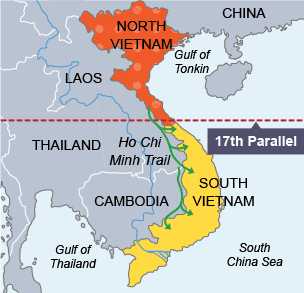
In the 1950s, the United States became involved in the Vietnam War. Why did the United States become involved in this war?
a)
to prevent the collapse of the government of North Vietnam
b)
to stop Vietnam from taking over Hong Kong
c)
to stop the spread of communism to South Vietnam
d)
to prevent attacks against United States shipping
22.
How did the Cuban Missile Crisis end?
a)
The Soviets and the U.S. entered into a nuclear war
b)
It never really ended, there are still tensions today
c)
Soviets backed down and pulled their missiles out of Cuba
d)
the Cubans forced the Soviets to leave because they didn't want war with the U.S.
23.

Senator Joseph McCarthy won national attention when he...
a)
Was convicted as a spy.
b)
Claimed hundreds of government employees were communists.
c)
Helped Eisenhower become president.
d)
Went to Korea and said atomic weapons should be used to break the stalemate.
24.
What did the Iron Curtain divide?
a)
North and South Korea
b)
Soviet Union and China
c)
Eastern and Western Europe
d)
America and Europe
25.

After Brown v. Board of Education, 9 AA students were admitted into a High School. The governor and state national guard stood in front of the doors stopping the admission. President Eisenhower sent federal troops to escort the students. Where did the event take place?
a)
Little Rock, Arkansas
b)
Montgomery, Alabama
c)
Washington DC
d)
Del Rio, Texas
26.

How did Martin Luther King, Jr.'s "I Have a Dream" speech impact the civil rights movement?
a)
It called for violent resistance, resulting in riots across the country.
b)
It inspired many people, giving strength and momentum to the movement.
c)
It was largely ignored by the movement, though regarded as a superbly written speech.
d)
It was considered controversial and fragmented the movement into small groups.
27.
The policy objectives of Reaganomics were based on the theory that —
a)
borrowing from foreign countries would help cover the costs of domestic programs
b)
significant increases in government spending would help reduce unemployment
c)
broad tax cuts and financial deregulation would promote economic expansion
d)
reducing trade barriers would result in a budget surplus
28.
Broad tax cuts, and financial deregulation, which would promote economic expansion, are examples of what policy's objective:
a)
Reaganomics
b)
Trade Imbalance
c)
Iran-Contra Affair
d)
Heritage Foundation
29.
How did the Watergate Scandal affect American politics?
a)
It had a negative impact because it caused distrust in the government.
b)
It had a positive impact because it brought the people together.
c)
It didn't impact anything.
30.

What did Iranian student activists do when the Shah of Iran was treated in an American hospital?
a)
they terrorized American travelers in Europe
b)
they forced an attack on Iraq
c)
they seized the American embassy and took hostages
d)
they staged an overthrow of the government
31.
Presidential scandal that occurred when a member of Harding's Ohio Gang leased oil rich government land in Wyoming
a)
Teapot Dome Scandal
b)
Court-Packing Scandal
c)
Iran-Hostage Crisis
d)
Gulf War
32.
FDR's attempt to gain more control over the Federal government by adding additional judges to the Supreme Court (to gain support for New Deal Leg.)
a)
Teapot Dome Scandal
b)
Watergate
c)
Court-Packing Scandal
d)
Manhattan Project
33.
Scandal that led to the resignation of President Nixon, following his attempt to cover up involvement in spying on the Democratic National HQ.
a)
Watergate
b)
Iran-Hostage Crisis
c)
Berlin Wall
d)
Island Hopping
34.
After the Shah of Iran was expelled from his country and sought refuge in the US, Iranian protesters overran the US Embassy.
a)
Iran-Contra
b)
Iran-Hostage
c)
Gulf War
d)
War on Terror
35.
Allied effort to supply West Berlin with supplies after it was cut off from the West by the USSR
a)
Berlin Wall
b)
Berlin Airlift
c)
Battle for Britian
d)
NAFTA
36.
Promise by President Harding following World War I to restore prewar prosperity to American.
a)
Rugged Individualism
b)
Return to Normalcy
c)
New Deal
d)
New Frontier
37.
Depression Era shantytowns that were sarcastically named after President blamed.
a)
Hoovervilles
b)
Roosevelt Rooms
c)
Oklahoma
d)
Buchanhans Barrios
38.
African American poet of the Harlem Renaissance.
a)
WEB DuBios
b)
Langston Hughes
c)
Jacob Riis
d)
Upton Sinclair
39.
Act passed by the US government that moved Native Americans to reservations and attempted to "Americanize" them.
a)
Dawes Act
b)
Homestead Act
c)
Wagner Act
d)
Volstead Act
40.
Free Trade Organization between North Americans countries (Mexico, USA, and Canada)
a)
OPEC
b)
NAFTA
c)
NATO
d)
League of Nations
41.
International governing body that was founded after WWI, failed because the United States did not join.
a)
United Nations
b)
League of Nations
c)
NATO
d)
Warsaw Pact
42.
Buying with the intent to sell (Cause of the Great Depression)
a)
Speculation
b)
Buying of the Margin
c)
High Tarriffs
d)
Over reliance on credit
43.
Super duper secret project to develop the Atomic Bomb, lead by Einstein and Oppenheimer.
a)
Project X
b)
Project Runway
c)
Manhattan Project
d)
The Projects
44.
After the US entered World War II, the following people were placed in internment camps because of "military necessity."
a)
Mexican-Americans
b)
Japanese-Americans
c)
African-Americans
d)
German-Americans
45.
Witch-hunt that was part of the second red scare was named after Senator
a)
Joseph McCarthy
b)
Douglas MacAurthur
c)
Harry S Truman
d)
Henry Cabot Lodge
46.
The richest man in the history of the world, built his wealth by horizontally integrating his oil company.
a)
Andrew Carnegie
b)
JP Morgan
c)
Henry Ford
d)
John D. Rockefeller
47.
New Immigrants to the US in the early 1900s came from what region?
a)
Southern and Eastern Europe
b)
South Eastern Asia
c)
Northern and Central Europe
d)
Latin America
48.
Passed during World War I, intended to keep people from sharing war secrets. This legislation also limited people's 1st Amendment rights.
a)
Espionage Act
b)
Perdition Act
c)
Temperance Act
d)
Clayton-Antitrust Act
49.
Organization of countries that produce the majority of the oil that is used today. Boycotted the USA after their support of Israel in the 1970s.
a)
OPEC
b)
NAFTA
c)
NATO
d)
USSR
50.
Invention by Thomas Edison that brought light to the world and extended the workday.
a)
Lightbulb
b)
Assembly Line
c)
Bessemer Process
d)
Telephone
51.
Organizations, such as Tammany Hall, that provided infrastructure and resources for poor immigrants in exchange for votes and political power.
a)
Political Machine
b)
Civil Rights Movement
c)
Populist Party
d)
Communism
52.
What was Ellis Island?
a)
An amusement park
b)
An immigration center in New Jersey
c)
An immigration center in New York
d)
The first capital of the United States
53.
Which Supreme Court case reversed "separate but equal" and led to the desegregation of public schools?
a)
Brown v Board of Education
b)
Texas v Johnson
c)
New Jersey v TLO
d)
Madison v Marbury
54.
Which Supreme Court case stated that all individuals must be read their rights at the time of arrest?
a)
U.S. v Leon
b)
Nixon v. U.S.
c)
Korematsu v U.S.
d)
Mirranda v Arizonia
55.
Owner/Operator of the Hull House, a settlement house in Chicago.
a)
Susan B. Anthony
b)
Jane Addams
c)
Sandra Day O'Connor
d)
Estee Lauder
56.
Founder of the NAACP, an early civil rights group.
a)
W.E.B. DuBios
b)
Ida Tarbell
c)
Thurgood Marshal
d)
Martin Luther King Jr.
57.
Jackie Robinson first rose to national prominence in the late 1940s when he-
a)
organized sit-ins to desegregate lunch counters
b)
enrolled in the racially segregated University of Mississippi
c)
helped bring an end to racial segregation in Major League Baseball
d)
participated in the Freedom Rides to desegregate interstate bus terminals
58.
How did the Zimmerman telegram influence U.S. entry into World War I?
a)
It announced the czar's overthrow in Russia.
b)
It revealed a proposed military alliance between Mexico and Germany.
c)
It contained orders for German U-boats to destroy British passenger ships.
d)
It described Romania's plan to abandon neutrality.
59.
The belief that it was the United States' destiny to expand west and conquer territory all the way to the Pacific Ocean
a)
Mexican-American War
b)
Manifest Destiny
c)
Black Exodus
d)
Cross of Gold Speech
60.
Who of the following played the greatest role in helping to build western railroads?
a)
Mexicans
b)
Chinese immigrants
c)
Native Americans
d)
Women
61.

These acts were in place during the World War I to silence critics
a)
Sherman Antitrust Act
b)
Espionage and Sedition Act
c)
Alien and Sedition Act
d)
Clayton Act
62.

Why did the government order rationing during WWII?
a)
to increase foreign trade
b)
to limit the growth of industry
c)
to conserve raw materials for the war effort
d)
to encourage women to enter the workforce
63.
According to the Preamble to the United States Constitution, our nation needed to form a "more perfect union." Which document had been the "law of the land" since 1781 and now needed to be replaced in 1787?
a)
the Virginia Plan
b)
the Bill of Rights
c)
the New Jersey Plan
d)
the Articles of Confederation
64.
John Locke's writing MOST LIKELY reflects the ideals of which movement?
a)
Enlightenment
b)
Imperialism
c)
Liberalism
d)
Romanticism
65.
Limited government is the concept that a government's power over its citizens should have limitations. Which of these is MOST closely associated with the idea of limited government?
a)
the Bill of Rights
b)
the Mayflower Compact
c)
the Articles of Confederation
d)
Washington's Farewell Address
66.
Which of these accurately reflects a WEAKNESS in the Articles of Confederation?
a)
Congress taxed citizens too much.
b)
There was no separation of powers.
c)
The document was too easily amended by the states.
d)
The central government held too much power over the states.
67.
What did “no taxation without representation” mean to colonists?
a)
The taxing power of British shopkeepers is represented in Parliament.
b)
There should be no taxation of British good entering the colonies.
c)
Taxation in the colonies should only be for British citizens.
d)
The colonists should not be taxed without representation in Parliament.
68.
Which statement about the Missouri Compromise (1820) is most accurate?
a)
Slavery was banned west of the Mississippi River.
b)
Unorganized territories would be governed by the United States and Great Britain.
c)
The balance between free and slave states was maintained.
d)
The 36°30' line formed a new boundary between the United States and Canada.
69.
Which 19th-century event supported the movement for women’s rights?
a)
Seneca Falls Convention
b)
Dred Scott decision
c)
Formation of the Republican Party
d)
Lincoln-Douglas debates
70.
Literacy tests and poll taxes were often used to
a)
enforce constitutional amendments added after the Civil War
b)
limit voter participation by African Americans
c)
promote equal educational opportunities for minority persons
d)
provide job training for freedmen
71.
Many Southern States tried to limit the effects of Radical Reconstruction by
a)
adopting federal laws mandating segregation
b)
enacting Jim Crow laws
c)
abolishing the Southern sharecropping system
d)
securing passage of new amendments to the United States Constitution
72.
The Monroe Doctrine (1823) was issued primarily because President James Monroe
a)
wanted to warn European powers against intervention in Latin America
b)
opposed the revolutions taking place in South America
c)
needed to establish a foothold in Panama for a future canal
d)
believed the United States should pursue overseas colonies
73.
Following Reconstruction, the passage of Jim Crow laws in the South limited the effectiveness of
a)
the 14th and 15th amendments
b)
the Freedmen’s Bureau
c)
Black Codes
d)
tenant farming and sharecropping
74.
In the late 1800s, how did railroad monopolies create economic hardships for farmers?
a)
by claiming productive land for business leaders to develop
b)
by charging high prices to ship agricultural goods to market
c)
by separating farmers from profitable markets in western cities
d)
by isolating farmers from technological developments in eastern cities
75.
In the 19th century, John D. Rockefeller was MOST associated with what company?
a)
U.S. Steel
b)
Standard Oil
c)
General Motors Corporation
d)
American Telephone and Telegraph
76.
Which of these helped to further the Westward Expansion in the United States after 1865?
a)
California Gold Rush
b)
Abolition of Slavery
c)
Transcontinental Railroad
d)
Lewis and Clark Expedition
77.
What term BEST describes the U.S. government's policies towards businesses in the late 19th century?
a)
Imperialist
b)
Laissez-faire
c)
Mercantilist
d)
Protectionist
78.
What group of immigrants arrived in large numbers on the U.S. west coast for the primary purpose of working on the Transcontinental Railroad in the 19th century?
a)
Chinese
b)
Irish
c)
Japanese
d)
Mexican
79.
The Pullman Strike of 1894 was ended when
a)
President Cleveland sided with the striking workers.
b)
the Federal government issued an injunction to end it.
c)
strikebreakers were hired to take the place of strikers.
d)
rioters destroyed the Pullman rail car factory in Illinois.
80.
Samuel Gompers was a leading proponent of what industrial issue?
a)
vertical integration
b)
the formation of trusts
c)
the crushing of labor unions
d)
the formation of labor unions
81.
With the creation of Hull House in 1889, Jane Addams accomplished all of the following EXCEPT
a)
created nurseries for children of working mothers.
b)
created educational and employment training opportunities for women.
c)
established the city’s first public playground, bathhouse, and public gymnasium.
d)
urged Congress to place restrictions on the immigration of people into the United States.
82.
In the case of Plessy v. Ferguson, the Supreme Court upheld the constitutionality of
a)
Jim Crow laws.
b)
poll taxes.
c)
literacy tests.
d)
grandfather clauses.
83.
Progressives shared a belief that industrialization and urbanization
a)
should be supported despite the dangers they posed.
b)
would not occur in the United States without their support.
c)
had created serious social and political problems.
d)
should be completely banned by legislation.
84.
Socially conscious journalists who dramatized the need for reform were known as
a)
yellow journalists.
b)
social gospelists.
c)
novelists.
d)
muckrakers.
85.
Upton Sinclair's The Jungle impacted the passage of the
a)
Twentieth Amendment.
b)
Eighteenth Amendment.
c)
Nineteenth Amendment.
d)
Meat Inspection Act in 1906.
86.
Territories annexed at the end of the Spanish-American War that established the United States as an imperialist power included all of the following EXCEPT
a)
Guam.
b)
Hawaii.
c)
Puerto Rico.
d)
The Philippines.
87.
Which is TRUE about the Roosevelt Corollary?
a)
It gave Europe the message that America would not intervene to stop the spread of fascism.
b)
It called for an embargo of any European nation competing for colonies in Africa and Southeast Asia.
c)
It led to a government policy of non-intervention and non-interference in the domestic affairs of Latin America.
d)
It called for immediate military intervention in any Latin American country experiencing unrest or political instability.
88.
Widespread anti-Chinese sentiment in the late-1800s resulted in
a)
native-born Chinese-Americans having their citizenship revoked.
b)
Congressional action aimed at prohibiting further Chinese immigration.
c)
Legal segregation of all Chinese-Americans into separate urban districts.
d)
deportation of all Chinese-Americans living in California, Oregon, and Washington.
89.
What was Justice Holmes decision in Shenck v. United States (1919)?
a)
Speech can be restricted when one is expressing themselves of public property
b)
Speech can be restricted when it presents a clear and present danger to society
c)
Speech can be restricted when suggesting overthrowing the US Government
d)
Speech can never really be restricted because of the 1st Amendment
90.
What was the result of FDR’s “Cash and Carry” and “Lend-Lease” acts?
a)
Congress could not choose to join WWII
b)
The unemployed were aided towards the end of the Great Depression
c)
Supplies were sent to Great Britain and other Allied nations to help them fight WWII
d)
The Nazi-Soviet Non-Aggression Pact was signed in 1939
91.
In his Fourteen Points Speech, Woodrow Wilson states “Absolute freedom of navigation upon the seas, outside territorial waters, alike in peace and in war, except as the seas may be closed in whole or in part by international action for the enforcement of international covenants.” What is he referring to here?
a)
The attack on Pearl Harbor
b)
Unrestricted Submarine Warfare
c)
The Sinking of the Titanic
d)
Italian dominance in the Mediterranean
92.

What was a major argument against Roosevelt's "Four Freedoms" in his claim that the U.S. should review its isolationist policies?
a)
Defending the "Four Freedoms" was not a justification of war.
b)
The "Four Freedoms" became the rallying cry as Americans mobilized for war.
c)
That Roosevelt was trying to radically change the face of America with his New Deal philosophy.
d)
The United States should remain isolationist no matter what happened in Europe and the rest of the world.
93.
Which statement BEST describes the demographic trend of the United States during the early 1940s?
a)
Women withdrew from the workforce in order to raise children.
b)
People moved from rural to urban areas to find industrial work.
c)
People moved from urban to rural areas to find agricultural work.
d)
African Americans returned to the South to buy cheap, available land.
94.

This image reflects the situation in the Midwest during the early 20th Century, a situation known as
a)
Dry Farming.
b)
The Dust Bowl.
c)
Deforestation.
d)
Dirty Farming.
95.
Which of these is the BEST reason as to why the Japanese attacked Pearl Harbor in 1941?
a)
The U.S. had seized Japanese territories in Hawaii.
b)
Japan wanted to retaliate for the U.S.'s assault on islands in the Pacific
c)
Japan hoped to destroy the U.S.'s will and ability to fight a war.
d)
American politicians had walked out on peace talks with the Japanese emperor in Tokyo.
96.
What factor(s) in the US south led to the Great Migration of almost 6 million African-Americans to the Mid-West and North during the early to mid 20th Century?
a)
total freedom and civil rights protection
b)
availability of jobs and economic opportunity
c)
the Harlem Renaissance led to more entertainment jobs
d)
the Civil Rights movement in the South forced them to move North
97.

All of these items led directly to what event?
a)
World War I
b)
World War II
c)
Great Depression
d)
Baby Boom Generation
98.

The states labeled "No Voting Rights" in 1919 would have been MOST affected by which Constitutional Amendment?
a)
18
b)
19
c)
25
d)
26
99.
Which of these was a reason for the collapse of the American economy which led to the Great Depression?
a)
Foreign governments began to boycott American-made goods.
b)
Government control of the economy led to severe inflation.
c)
Taxes were too high to support unemployment claims and social security payments.
d)
The boom of the 1920's rested on a weak foundation since the prosperity was not enjoyed by all economic groups.
100.

The "Dust Bowl" affected which area most?
a)
1
b)
2
c)
3
d)
4
101.
Which legislation was passed during the Second New Deal to give federal assistance to the elderly?
a)
The Wagner Act
b)
The Social Security Act
c)
The Fair Labor Standards Act
d)
The Emergency Banking Relief Act
102.
Which battle was the major turning point in the War in Pacific during WWII?
a)
Guadalcanal
b)
Iwo Jima
c)
Pearl Harbor
d)
Midway
103.
Which global organization did Woodrow Wilson attempt to develop in his Fourteen Points?
a)
United Nations
b)
League of Nations
c)
North America Free Trade Agreement
d)
North Atlantic Treaty Organization
104.
What was a major result of the Servicemen’s Readjustment Act of 1944 (GI Bill)?
a)
Millions of veterans received a college education.
b)
Women kept their factory jobs after World War II.
c)
Jobs were created by the Manhattan Project.
d)
Veterans were exempted from gasoline rationing.
105.
Which development resulted from the construction of the interstate highway system?
a)
increased suburbanization
b)
reduced air pollution
c)
decreased fuel consumption
d)
growth of long-distance passenger train service
106.

What does this photograph indicate about the United States in the 1950s?
a)
Extraordinary steps were taken to hide atomic weapons.
b)
The nation had become the only nuclear superpower.
c)
Much fear was created by the Cold War.
d)
Only government officials would be safe in a nuclear attack.
107.

Which year represents the height of the baby boomer generation?
a)
1945
b)
1947
c)
1957
d)
1950
108.

Which action did President Kennedy take following this statement?
a)
urging Allied forces to remove Soviet weapons from Cuba
b)
ordering a naval quarantine of Cuba
c)
breaking off diplomatic relations with the Soviet Union
d)
asking the United Nations to stop grain shipments to the Soviet Union
109.

This statement expresses President Lyndon B. Johnson’s view that the
a)
federal government is solely responsible for the war on poverty
b)
court system must be held accountable for poverty
c)
problem of poverty is easily solved
d)
entire country must help fight poverty
110.
Which development is most closely associated with the belief in the domino theory?
a)
military involvement in Vietnam
b)
construction of the Berlin Wall
c)
signing of the nuclear test ban treaty
d)
end of the Korean War
111.
President John F. Kennedy supported the 1961 Bay of Pigs invasion of Cuba as an effort to
a)
remove a communist dictator from power
b)
stop the flow of illegal drugs to the United States
c)
support Fidel Castro’s efforts for reform
d)
rescue hostages held by Cuban freedom fighters
112.
Which of the following best describes the counterculture of the 60’s and 70’s?
a)
Culture of the youth clashed with the establish, traditional culture
b)
Culture of the youth coincides with the established, traditional culture
c)
Culture of the baby boomers is accepted by the culture of America’s “Greatest Generation”
d)
African-American and Women’s Rights Activists supporting each other
113.
Lunch counter sit-ins and the actions of freedom riders are examples of
a)
steps taken in support of the Americans with Disabilities Act
b)
programs dealing with affirmative action
c)
violent acts by the Black Panthers
d)
nonviolent attempts to oppose segregation
114.

The effect of this Supreme Court ruling was to
a)
establish affirmative action programs in higher education
b)
require the integration of public schools
c)
desegregate the armed forces and the military academies
d)
force states to spend an equal amount on each public school student
115.
Cesar Chavez created the United Farm Workers Organization Committee (UFWOC) in 1966 primarily to
a)
secure voting rights for Mexican Americans
b)
improve working conditions for migrant laborers
c)
provide legal assistance to illegal aliens
d)
increase farm income
116.
The terrorist attacks of September 11, 2001, led the federal government to create the
a)
Environmental Protection Agency
b)
Department of Homeland Security
c)
Central Intelligence Agency
d)
Federal Bureau of Investigation
117.

The changes shown in the chart were most directly the result of the
a)
enactment of voting-reform laws by these southern states
b)
Supreme Court decision in Brown v. Board of Education
c)
passage of the Voting Rights Act of 1965
d)
executive branch’s resistance to protecting the civil rights of minorities
118.

The graph below provides information about world oil supplies in 2007
How has the relationship between oil reserves, production, and consumption influenced United States foreign policy?
How has the relationship between oil reserves, production, and consumption influenced United States foreign policy?
a)
The United States maintains military bases in Western European countries.
b)
The United States contributes humanitarian aid to Central African countries.
c)
The United States is committed to trade relations with Central Asian countries.
d)
The United States is interested in maintaining stability in Middle Eastern countries.
119.
The Camp David accords negotiated during President Jimmy Carter’s administration were an attempt to
a)
decrease United States control of the Panama Canal
b)
encourage the use of solar and other nonpolluting energy sources
c)
end inflationary oil prices
d)
establish peace in the Middle East
120.
The Camp David accords negotiated during President Jimmy Carter’s administration were an attempt to
a)
decrease United States control of the Panama Canal
b)
encourage the use of solar and other nonpolluting energy sources
c)
end inflationary oil prices
d)
establish peace in the Middle East
100 %

