wayground logo

Free Printable Worksheets

NEW

Font size

S
M
L
XL
Worksheets

REVIEW

Total questions: 39

Worksheet time: 42mins

Name
Class
Date
1.

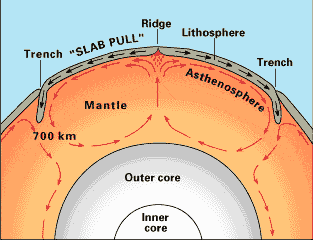
The movement of the tectonic plates is caused by

a)

the rotation of the Earth.

b)

convection currents in the Asthenosphere

c)

the gravity of the iron-nickel core.

d)

the Moho discontinuity.

2.

In some areas of the world, like California and Japan, earthquakes are a common occurrence. How can this best be explained?

a)

The strong ocean currents are undermining both areas causing earthquakes.

b)

Both areas are located near the edge of the Pacific Ocean, the unstable sand causes earthquakes.

c)

Both areas are subjected to strong ocean wind and waves that causes earthquakes.

d)

Both areas are on the boundary of active plates, the motion of the plates causes earthquakes.
3.
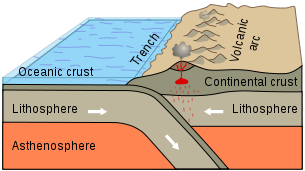
Subduction zones occur on Earth where dense oceanic crust dives under more buoyant continental crust. These boundaries are characterized by a deep ocean trench next to a high continental mountain range, large numbers of earthquakes and volcanoes. All of this is further evidence for the
a)
big bang theory.
b)
theory of plate tectonics.
c)
origin of the species.
d)
theory of natural selection.
4.
There are three types of plate boundaries. Which choice is NOT a type of plate boundary?
a)
convergent
b)
thrust
c)
divergent
d)
transform
5.

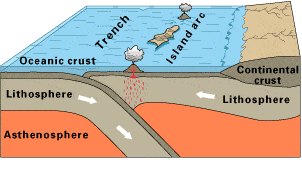
Observe this diagram of a plate boundary. One statement BEST describes what is happening. It is that

a)

the oceanic crust is melting.

b)

the denser ceanic crust is subducting under the less dense oceanic crust

c)

volcanic islands are forming.

d)

the tectonic plates are moving away from each other.
6.

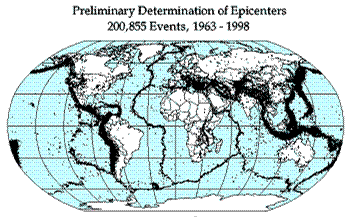
Earthquake epicenters (center of where the earthquakes started) were mapped for a 35 year period in the diagram above. The black dots indicate these epicenters. The black dots appear along what feature on Earth?

a)

hot spots

b)

plate boundaries

c)

rift zones

d)

sea floor spreading

7.
The Earth’s surface is not a solid surface but is divided into
a)
several oceanic plates.
b)
continental and crustal plates.
c)
seven continental plates.
d)
continental and oceanic plates.
8.

What is the source of energy that drives plate movement?

a)

the subducton of the sea floor

b)

the different densities of the oceanic and crustal plates

c)

convection currents in the asthenosphere

d)

the friction force between the plates that move past each other
9.
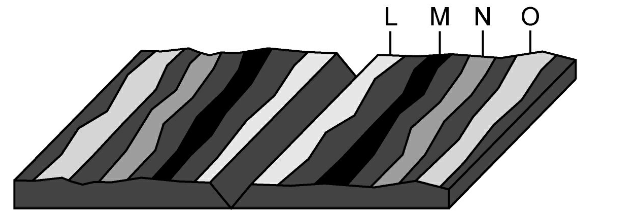
Where would the oldest rock be found?
a)
L
b)
M
c)
N
d)
O
10.
Mountains are created when....
a)
Two continental plates collide
b)
Two oceanic plates pull apart
c)
An Oceanic plate subducts under a Continental Plate
d)
Two continental plates pull apart
11.
Each one of the boxes on the Punnett Square represents what probability of an offsprings' genotype?
a)
25%
b)
1%
c)
10%
d)
0%
12.
Aa, DD, bB, yy are all examples of
a)
genotypes
b)
phenotypes
13.
aa always shows up as
a)
dominant
b)
recessive
14.
What you see, or the physical appearance.
a)
Genotype
b)
Phenotype
c)
Homozygous
d)
Heterozygous
15.

If this pedigree shows a recessive disorder, what MUST the genotype of individual 4 be?

a)

HH

b)

Hh

c)

hh

16.
This trait is recessive.  What is the genotype for person II-1?
a)
GG
b)
Gg
c)
gg
d)
can't be determined
17.
What is the genotype of the father?
a)
AA
b)
aa
c)
Aa
d)
AA or aa
18.
What is the net force?
a)
65 N left
b)
65 N right
c)
35 N left
d)
35 N right
19.
What is the net force?
a)
11 N left
b)
11 N right
c)
3 N left
d)
3 N right
20.
The graph shows how the speed of an object changed over time. During which segments of this graph were the forces acting on the object balanced?
a)
R only
b)
Q and S
c)
R and T
d)
R, S and T
21.
This list below includes six different scenarios. Which objects in the list experience an unbalanced force?
a)
The ball, the cat, and the flag
b)
The marble, the book and the toy car
c)
The cat, the book, and the flag
d)
The marble, the ball, the cat, and the toy car
22.
What is Newton's First Law
a)
F=ma
b)
Every action has an equal and opposite reaction
c)
An object at rest stays at rest, an object in motion stays in motion. 
d)
Friction 
23.
What is a force?
a)
the PUSH or PULL on an object 
b)
The MOTION an object creates
c)
The objects HITTING one another
d)
Going REALLY FAST
24.
What is the magnitude (size) and direction of the net force?
a)
21 N to the Left
b)
3 N to the Left
c)
21 N to the Right
d)
3 N to the Right
25.
If the box is on the top of the table and is not moving, are the forces on it balanced or not balanced?
a)
balanced
b)
unbalanced
26.
___________________ forces cause changes in motion.
a)
Balanced
b)
Unbalanced
27.
Gravitational potential energy depends on the ________ and ________ of the object. 
a)
Height and mass
b)
Friction and movement
c)
Mass and Movement
d)
Height and Friction 
28.
When you stretch a rubber band, you are storing __________ energy. 
a)
kinetic 
b)
potential
c)
none of the above
d)
all of the above 
29.
A stretched object, such as a rubber band, has _____________
potential energy.
a)
electrical
b)
gravitational
c)
kinetic
d)
elastic
30.
Qand Qare two charges creating an electric field. Based on the electric field lines, we can conclude
a)
Qand Qare both positive
b)
Qand Qare both negative
c)
Qis positive and Qis negative
d)
Qis negative and Qis positive
31.
Which type of energy increases when you compress a spring?
a)
elastic potential energy
b)
kinetic energy
c)
radiant energy
d)
sound energy
32.

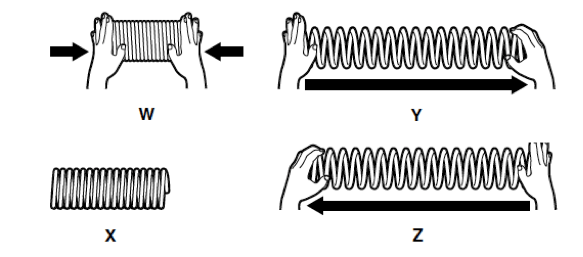
Elastic potential energy is energy stored in an object, such as a spring, due to the object being stretched or compressed. In which position is it most likely that the spring has lost its elastic potential energy?

a)

W

b)

Y

c)

X

d)

Z

33.

How could you increase the gravitational potential energy of an object without changing its mass and gravity?

a)

Make the object larger

b)

Lower the object towards the ground

c)

Raise the object farther off the ground

d)

Allow the object to roll on the ground
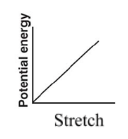
34.

What potential energy is this graph representing?

a)

Electric

b)

Elastic

c)

Magnetic

d)

Gravitational

35.
This kid is using a slingshot. Does the slingshot have max or min elastic potential energy?
a)
max
b)
min
c)
no elastic potential energy
36.
This spring has been compressed. What happened to its elastic potential energy?
a)
more elastic potential energy
b)
less elastic potential energy
c)
the same amount of elastic potential energy
37.
What happens when two north poles of a magnet are placed together?
a)
they repel
b)
they attract
c)
they cancel each other out
d)
the strength of the magnet is doubled
38.
A north pole and a south pole will attract.
a)
True
b)
False
39.
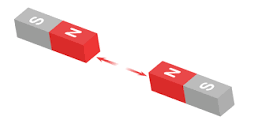
What will happen when these magnets are brought close together?
a)
They will attract each other.
b)
They will repel each other.
c)
Both magnets will turn to the left
d)
Both magnets will turn to the right