
 Worksheets
WW2 & Between the Wars
Total questions: 60
Worksheet time: 40mins

The leader of the Soviet Union (Russia) starting in 1924?
Marx
Lenin
Trotsky
Stalin
What were the "Purges" in Soviet Russia under Stalin?
An elimination of potential political rivals through staged trials and executions
A medical system for eliminating disease
The process by which agriculture was modernized
A well known jazz group
What were TWO successes that Stalin could claim by 1939?
He had successfully modernized Russian society and industry
He had made Russia a nuclear power
He had successfully expanded the borders of Russia
He had protected Russia from the effects of the Great Depression
Which of these was NOT a result of Stalin's rule?
Changing agriculture into a system of collective farms
Forcing people to pay money to Stalin
The deaths of millions of people from famine
The creation of the "Gulags" (prison labor camps)
Which of the following is NOT a characteristic of totalitarianism?
government control of the economy
free and open discussion of ideas
rule by a dictator
government control of communications and media
Which event caused the US to enter the WW2?
sinking of Lusitania
explosion of USS Maine
attack on Pearl Harbor
dropping the atomic bomb
Which of the following was NOT an Allied power in WW2?
Japan
Soviet Union
France
Great Britian
A new military technology during WW2 was?
atomic bomb
tanks
submarines
trench warfare
Which parts of Japan's attack on Pearl Harbor were failures? Check the two answers that apply?
They only destroyed a tiny portion of the US fleet
They united the US people into support for WW2
They failed to destroy US aircraft carriers
They sustained heavy losses during the attack
According to the documentary "WW2 from Space", which two factors were vital for success during WW2? Select the two correct answers.
Having a large army
Air superiority
Naval power
Oil (Fuel) supplies
Why was Hitler (Germany) motivated to attack Russia? Select the 2 correct answers
To avenge Russian victory in WW1
His hatred of Jewish people & of communism
To create a path into Asia
He sought raw materials and living space (lebensraum)
Why is Pearl Harbor considered a turning point in WW2?
It brought the USA with her vast industrial and economic resources into the Allied side.
It increased the chances of Japanese victory
It increased the amount fuel available to the Axis Powers
It brought the USA with her vast industrial and economic resources in the Axis side
Which of these is NOT a reason that the US dropped the Atomic Bombs on Japan in 1945?
To bring the war to a swift conclusion
As part of a long campaign of strategic bombing of Japanese cities
To allow the US to make peace with Japan (as opposed to the Soviet Union)
In attempt to kill the Emperor of Japan
What is one reason that WW2 was different from WW1?
The use of tanks
The high number of civilians killed
The use of submarines
The high number of soldiers killed
Which battle front experienced the highest number of casualties during WW2?
Eastern Front (Germany and Russia)
Pacific Theater (the USA and Japan)
Asia (Japan vs China & her allies)
Western Front (Germany vs allied powers)
What % of the US population wanted to stay out of WW2 before December, 1941?
10
25
50
75
Which group of people were targeted for extermination by Hitler and the Nazi's in the Holocaust?
The Slavs
Jewish people
Chinese people
French people
Which is these is NOT a reason for the high number of deaths in WW2?
Strategic bombing
Civilian deaths
Famine (Starvation)
Disease
The Axis Powers were which three countries?
Germany, Soviet Union (Russia) and Japan
Germany, Italy and Japan
The USA, Britain, France and Soviet Union
Germany, Japan and the USA
Which of these was NOT a decisive battle in turning the war in the favor of the Allies in 1942/43?
Stalingrad (Russia beats Germany)
Battle of the Atlantic (Germany's submarine fleet defeated by Allies)
Dropping the Atomic Bomb on Japan
Battle of Midway (US naval fleet inflicts heavy losses on Japan)
What is the significance of D-Day?
The Allies open a Eastern front in Asia
The Allies open a Western Front in Europe
The Axis opened a Southern front in Africa
The Allies invaded Japan
Fascism started in which country?
Germany
Italy
Russia
France
Did Fascism reject ideas like equality, individual rights and democracy
TRUE
FALSE
In what ways is Fascism different to communism? Select the two correct answers.
Fascism is nationalistic whereas communism has international goals
Fascism is international in nature while communism is nationalistic.
Fascism denies the equality of individuals whereas communism stresses equality
Fascism stresses equality whereas communism denies equality
Why did wealthy business owners in Italy & Germany support Fascism? Choose two answers
It appealed to their sense of fairness
Fascism was supportive of private property (like the businesses they owned)
It appealed to their desire to increase business overseas
Fascism offered an alternative to socialism/communism
TRUE / FALSE : Stalin's Russia, Mussolini's Italy & Hitler's Germany were all Totalitarian regimes?
TRUE
FALSE
How can The League of Nation's response to Italy's invasion of Ethiopia and their response to Japan's invasion of Manchuria be considered similar?
STRONG: They imposed penalties (sanctions) on both countries that were enforced
STRONG: Their military forces were able to stop both Italy and Japan
WEAK: The League of Nations had no tools (like a military force or a method to impose penalties) to check aggressive countries. Italy and Japan could do what they wanted.
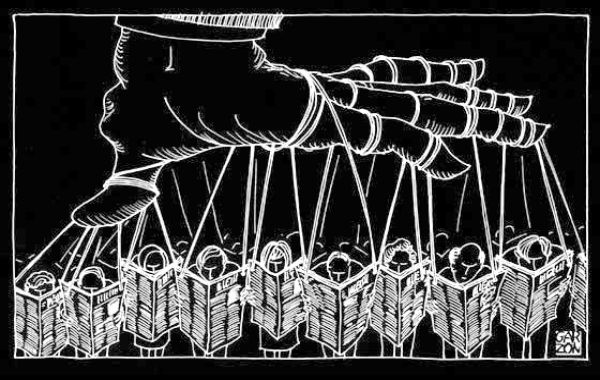
A system of government that exerts complete control over its citizens; individuals have no rights and all opposition to the government is suppressed (forcibly stopped/prevented)
Monarchy
Totalitarianism
Democracy
Communism


Which organization was created to prevent future wars?
League of Nations
Axis Alliance
Triple Alliance
Mandate system
Which event is most closely associated with the beginning of World War II in Europe?
Signing of the Munich Agreement
Building the Berlin Wall
Invasion of Poland by Nazi forces
Assassination of Arch Duke Franz Ferdinand

Which sequence shows the correct chronological order of these World War II events, from earliest to latest?
1 - 2 - 3 - 4
3 - 4 - 1 - 2
3 - 4 - 2 - 1
4 - 3 - 1 - 2
How did totalitarian countries control their populations?
Through use of terror (murder, imprisonment)
Through surveillance (spying)
Through control of the media (newspapers & radio)
All of the above
Why did the Great Depression have such a major impact on the World?
It forced people to emigrate for work
It forced countries to work together
It was global in nature and lasted a long time
It redistributed wealth to different parts of the world
What made the Great Depression different from previous downturns in the economy? Choose 2 answers
It only affected the United States
It affected multiple countries
Its duration (how long it lasted) was short
Its duration (how long it lasted) was long
Which is of these is NOT a reason Japan pursued a policy of expansion in the 1930's?
Its increased population meant it needed room for its people
It needed natural resources like coal, oil and iron ore
It wanted to export Buddhism to other parts of Asia
It wanted new sources of food
What of these were NOT a reason Japan was frustrated / angry at the Western Powers after the Great Depression?
Countries like Australia & the USA had closed immigration for Japanese people
Western countries had reduced trade opportunities for Japan
Western countries refused to accept Japanese religious beliefs
Western countries wanted to limit the size of Japan's empire
Japan went to war with the USA in 1941 because the US had cut off their supply of oil and other natural resources. TRUE/FALSE
TRUE
FALSE

What were things that Hitler proposed in his book "Mein Kampf" ("My Struggle")? Check all that apply.
The superiority of the Aryan Race
The inferiority of Jews, Slavs and other people
That Germany should defy (challenge) the obligations of the Treaty of Versailles
That German people needed "lebensraum" (living space "blood and soil") in Eastern Europe.
That history was defined as a struggle between different races of people.
Which of these was NOT important in the rise of the Nazi's after 1928?
The financial support the Nazi's got from wealthy industrialists (business owners)
The Great Depression and its negative impacts on the German people like unemployment, poverty and hunger
The ability of Hitler to draw support from a wide section of German people?
The unified opposition of the Social Democrats & Communist party?
How did Hitler and the Nazi's finally get power in Germany?
They staged a successful overthrow of the Government
Hitler was elected as President of Germany
Hitler was invited to be Chancellor of Germany
They won a majority of seats in the German Parliament
Why were most Germans happy with Nazi rule? Check all answers that apply.
They provided jobs
They made extensive use of propaganda and youth groups
They completed a program of building national projects like new roads and hospitals
They restored (renewed) national pride through building up the army
Nazi Germany was unable to gain self-sufficiency in terms of natural resources and food production. Why was this important?
It demonstrated that they were unable to achieve most of their goals
It gave them an added incentive to go to war and invade other countries
It motivated them to "collectivize" their farms like the Soviet Union
Which of these were NOT results of the rule of Stalin?
An increase in literacy (reading and writing)
An increase in luxury goods
An improvement in the living standards of the average person
Increased opportunities for females in the workplace
Following Japan's takeover of Manchuria, which Asian country did it invade next (in 1937)?
French Indo-China (Vietnam)
Indonesia
Korea
China
Why were most Germans happy with Nazi rule? Check all answers that apply.
They provided jobs
The Nazi made extensive use of propaganda and youth groups
They completed a program of building national projects like new roads and hospitals
They restored (renewed) national pride through building up the army

Hitler violated the Treaty of Versailles by doing all of the following except?
tripled size of miltiary
continued paying reparations
occupied the Rhineland
took over Austria
What was the name of the land in Czechoslovakia that contained a majority of German-speaking people?
Rhineland
Sudetenland
Austria

What was the importance of the Nazi-Germany non-aggression pact (deal) in 1939 (between Germany & the Soviet Union)?
It meant that Germany could invade Poland without fear of opposition from Russia (the Soviet Union)
It meant that the Soviet Union could invade Poland without fear of opposition from Germany.
How did the Treaty of Versailles encourage the start of WWII in relation to Germany? Select the two correct answers
The payment of reparations made the impact of the Great Depression worse in Germany
It rearranged the map of Europe to benefit Germany, enraging the rest of the world
It gave Germany an incentive to think kindly of other countries
Its harsh terms, created an environment which spawned extreme parties like the Nazi's.

Who met with Hitler and arranged the Munich Agreement in 1938?
Winston Churchill
Franklin Delano Roosevelt
Woodrow WIlson
Neville Chamberlain
In order to keep the peace and avoid war, Britain (and other European countries) pursued this policy with Hitler? (It didn't work)
atonement
mediation
appeasement
nationalism
On September 1, 1939 Germany invaded this country and started WWII in Europe?
France
Poland
Austria
Britain
Click on all the examples of how Hitler was able to successfully appeal to different groups of people?
His defiance (challenge) of the Treaty of Versailles appealed to all Germans
His promise of jobs & economic security appealed to the working class
His promise to protect them from economic ruin & communism appealed to the middle class
His promise to protect them from Communism & to provide a disciplined workforce appealed to wealthy industrialists (large biz owners)
How did WW1 influence the birth and growth of Fascism in Italy? CHECK ALL THAT APPLY
Many Italians thought that the Treaty of Versailles was harsh on Italy
Italy was in chaos after WW1 as many workers refused to work and peasants seized land.
Many Italians came back from the war with strong nationalist feelings
Many Italians were concerned by the new popularity of Communism

Which country is home to the bagpipes? A musical instrument, whose sound is considered as heavenly by some, and by others, like the sound of a cat being strangled?
Wales
England
Scotland
Ireland

