wayground logo

Free Printable Worksheets

NEW

Font size

S
M
L
XL
Worksheets

8. Musclular System Revision Quiz BMS191

Total questions: 55

Worksheet time: 37mins

Name
Class
Date
1.

The property of all muscles that can be defined as the muscle tissue having a electric gradient which can reverse when stimulated is?

a)

Excitability

b)

Contraction

c)

Elongate

2.

What is the correct order of structure of Skeletal Muscle?

a)

Muscle Fiber, Endomysium, Fascicle, Epimysium, Perimysium, Tendon

b)

Muscle Fiber, Endomysium, Epimysium, Fascicle, Perimysium, Tendon

c)

Muscle Fiber, Fascicle, Endomysium, Perimysium, Epimysium, Tendon

d)

Muscle Fiber Fascicle, Endomysium, Epimysium, Perimysium, Tendon
3.
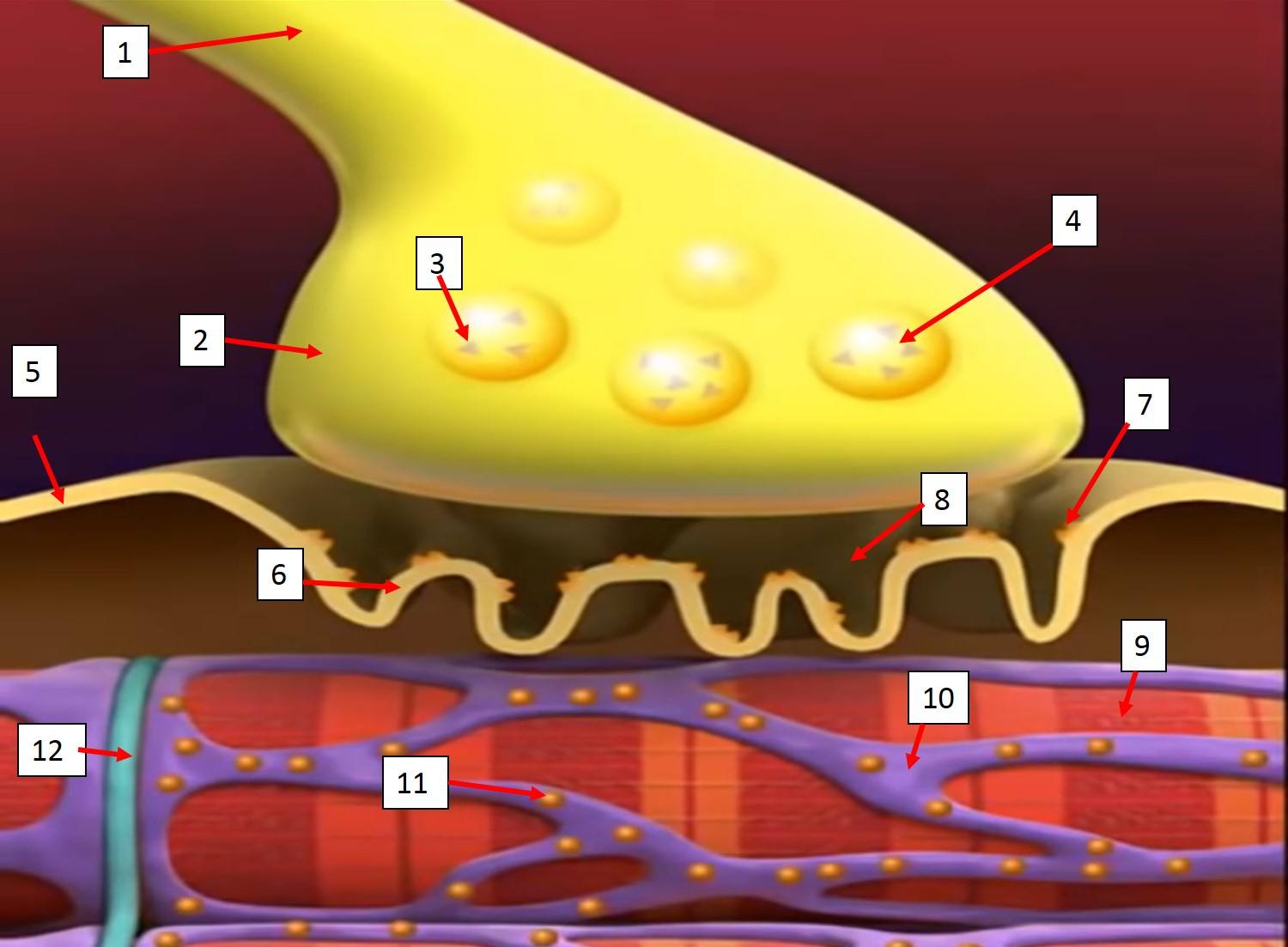
The gap between a neuron and a muscle cell: (#4 in the diagram)
a)
synaptic cleft
b)
sarcolemma
c)
vesicle
d)
Ca2+ ion
4.
The neurotransmitter stored in the axon terminal identified as #3
a)
Acetylcholine
b)
Protein Channel
c)
Calcium Ion (Ca2+)
d)
Syanptic Cleft
5.
The organelle that stores ACh in the axon is identified as #4
a)
Motor Neuron
b)
Axon Terminal of Motor Neuron
c)
Sarcolemma
d)
 Vesicle
6.

The specialized part of the cell membrane of the muscle fiber identified as #5

a)

Sodium ion (Na+)

b)

Axon Terminal of Motor Neuron

c)

motor end plate

d)

Vesicle

7.
Another name for a muscle cell.
a)
Fiber
b)
Sacrolemma
c)
Sacromere
d)
Fascicle
8.

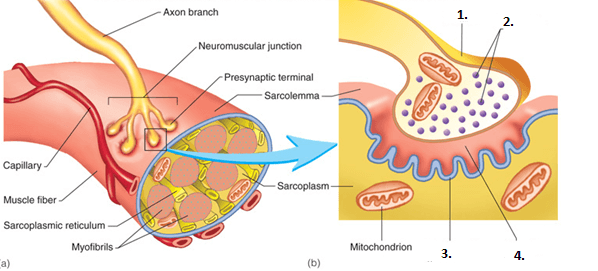
What is the name off label 1?

a)

Myofubrill

b)

Nucleus

c)

Nucleolus

d)

Sarcolemma

9.

What is the name off label 2?

a)

Sacrolemma

b)

Nucleus

c)

Mitochondrion

d)

Sacroplasm

10.

What is the name off label 3?

a)

Sacrolemma

b)

Mitochondrion

c)

Myofibril

d)

Sacroplasm

11.

What is the name off label 4?

a)

Sacrolemma

b)

Mitochondrion

c)

Sarcoplasm

d)

Myofibril

12.

What is the name off label 5?

a)

Sarcolemma

b)

Mitochondrion

c)

Sarcoplasm

d)

Myofibril

13.

Myofibrils are made of Actin which is

a)

thin filaments

b)

thick filaments

14.

Myofibrils are made of Myosin which is

a)

thin filaments

b)

thick filaments

15.
Name this tissue
a)
Skeletal
b)
Cardiac
c)
Smooth
16.
This type of muscle tissue is found only in the heart
a)
Skeletal
b)
Cardiac
c)
Smooth
17.

Name the tissue

a)

Skeletal

b)

Cardiac

c)

Smooth

18.
This type of muscle tissue is found in the walls of hollow organs such as the stomach 
a)
Skeletal
b)
Cardiac
c)
Smooth
19.
The three types of muscles are:
a)
smooth, cardiac, and skeletal
b)
smooth, medium, and hard
c)
skeletal, circulatory, and respiratory
d)
soft, rough, and fluffy
20.
Muscle tissue
a)
Is tissue that functions in lining, covering, and glandular tissue
b)
Is tissue involved in protecting, supporting, and binding together other body tissues
c)
Is tissue that contracts and shortens to produce movement 
d)
Tissue that receives and conducts electrochemical impulses from one part of the body to another
21.
Which ion below IS NOT critical to muscle contraction?
a)
Sodium Ion
b)
Calcium Ion
c)
Potassium Ion
d)
Phosphorus Ion
22.
Which of the Proteins listed below IS NOT a myofibril protein?
A.  Actin
B.  Troponin
C.  Trypsin
D.  Tropomyosin
E.  Myosin
F.  Titin
a)
All of these listed are myofibril proteins
b)
Troponin is not a myofibril protein.
c)
Trypsin is not a myofibril protein.
d)
Titin is not a myofibril protein.
23.
A mitochondria's role in muscle contraction is the production of...
a)
Synthesis of ATP
b)
Metabolism of ATP
c)
Synthesis of Proteins
d)
Metabolism of Worn out Proteins
24.
Which protein is responsible for helping the muscle 'relax' back to its neutral position?
a)
Actin
b)
Myosin
c)
Titin
d)
Tropomyosin
25.
Which is more true to cause muscle contraction?
a)
Actin Pulls on the myosin
b)
Myosin Pulls on the Titin
c)
Myosin Pulls on Actin
d)
Actin Pulls on Titin
26.
Which ion, when present, changes the conformation of tropomyosin?
a)
Calcium
b)
Sodium
c)
Potassium
d)
Lithium
27.
Which TWO IONS are pumped in/out of the sarcolemma as part of muscle contraction?
a)
Sodium / Calcium
b)
Calcium / Potassium
c)
Sodium / Potassium
28.
In order for tropomyosin to change conformation, calcium has to bind with...
a)
Voltage Gated Ion Channel
b)
Ligand Gated Ion Channel
c)
Troponin Protein
d)
Actin Protein
29.
What opens the ligand gated sodium/potassium channel?
a)
Calcium Ion Binding to the channel protein.
b)
Acetylcholine binding to the channel protein.
c)
Electrical Signal opening the channel protein.
d)
Acetylcholinesterase binding to the channel protein.
30.
What opens the Calcium Ion Transport Channel embedded in the pre-synaptic terminal?
a)
Binding of Acetylcholine
b)
Binding of Calcium Ion
c)
An Action Potential
d)
Binding of Sodium Ion
31.
Calcium that will eventually enter the muscle cell to bind with troponin is stored in the...
a)
T-Tubule of the Muscle Cell
b)
Sarcoplasmic Reticulum of the Muscle Cell
c)
The Sarcolemma of the Muscle Cell
d)
The interstitial space outside the muscle cell near the pre-synaptic terminal.
32.
Which of the following occurs first in muscle contraction?
a)
Calcium Ion Enters the Pre-synaptic Terminal
b)
Acetylcholine Enters the Synaptic Cleft
c)
Sodium Ion Enters the Sarcolemma
d)
Calcium Ion Enters the Sarcoplasm (Cytoplasm).
33.
Which of the following occurs first in muscle contraction?
a)
Myosin /Actin Cross bridge shifts to move actin.
b)
Phosphate is released form the myosin globular head
c)
Calcium Enters the Sarcoplasm (Cytoplasm) of the muscle cell.
d)
ADP is released form the myosin globular head.
34.
Which of the following occurs first in muscle contraction?
a)
Myosin globular head 'uncoils' releasing stored energy.
b)
Cross Bridges are formed between actin and myosin
c)
Tropomyosin changes shape (conformation) to expose myosin binding sites.
d)
Calcium Binds with Troponin
35.
During muscle contraction the 'Z' Lines will...
a)
Disappear
b)
Get Farther apart
c)
Get Closer Together
d)
Appear Thicker
36.
During full muscle contraction the H Zone will...
a)
Disappear
b)
Get wider
37.
During full muscle contraction the A Band will...
a)
Disappear
b)
Get wider
c)
Stay the same
d)
Get narrower
38.
a)
Trapezius
b)
Gluteals
c)
Deltoid
d)
Hamstring
39.

What muscle is the arrow pointing to?

a)

Pectoralis (Pecs)

b)

Biceps

c)

Triceps

d)

Lats

40.
a)

Biceps Brachii

b)

Brachialis

c)

Deltoid

d)

Brachioradialis

41.
a)
Tricep
b)
Deltoid
c)
Hamstring
d)
Bicep brachii
42.

Name this muscle

a)

Pectorals

b)

Latissimus Dorsi

c)

Rectus Abdominis

d)

Gastrocnemus

43.

What muscles are highlighted in the picture?

a)

Adductor Muscles

b)

Tibialis Anterior

c)

Iliopsoas

d)

Quadriceps Femoris

44.

name the muscle

a)

sartorius

b)

Vastus Intermedius

c)

Rectus Femoris

d)

Vastus Lateralis

45.

name the muscle

a)

Vastus Medialis

b)

Vastus Intermedius

c)

Rectus Femoris

d)

Vastus Lateralis

46.

name the muscle

a)

Vastus Medialis

b)

Vastus Intermedius

c)

Rectus Femoris

d)

Vastus Lateralis

47.

name the muscle

a)

achilles

b)

Gastrocnemius

c)

Anterior crus

d)

Soleus

48.
a)
Latissimius Dorsi
b)
Trapezius
c)
Triceps
d)
Erectors
49.
What is the red muscle?
a)
biceps brachii
b)
triceps brachii
c)
posterior deltoid
d)
extonsor indicis
50.
Identify the muscle.
a)
Obliques
b)
Trapezius
c)
Gluteus Maximus
d)
Latissimus Dorsi
51.
Identify the muscle.
a)
Gluteus Maximus
b)
Quadriceps
c)
Hamstrings
d)
Deltoids
52.

What is shown in the picture?

a)

biceps

b)

biceps femoris (hamstring)

c)

gastrocnemius (calf)

d)

deltoid

53.

Identify the muscle

a)

gastrocnemius

b)

semitendinosis

c)

biceps femoris

d)

semimembranosis

54.

Identify the muscle

a)

gastrocnemius

b)

semitendinosus

c)

biceps femoris

d)

semimembranosus

55.

The ___ can be found attached to the femur & calcaneus. When it contracts, it plantar flexes the foot.

a)

Gastrocnemius

b)

Soleus

c)

Sacrospinalis

d)

Sternocleidomastoid