wayground logo

Free Printable Worksheets

NEW

Font size

S
M
L
XL
Worksheets

Evolution

Total questions: 51

Worksheet time: 37mins

Name
Class
Date
1.
In natural selection, the selective agent is the
a)
humans
b)
mutations
c)
breeders
d)
environment
2.
what did Charles Darwin observe in finch populations of the Galapagos Islands off the coast of South America?
a)
different species on different islands
b)
all species on one of the islands
c)
identical species on all the islands
d)
the same species as North America
3.
Mutations are important because they bring about
a)
death of the organism in which they develop
b)
genetic variation needed for a population to evolve
c)
benefits for the individual, not for the population
d)
Hardey-Weinberg equilibrium within a population
4.

What is the term for a feature that allows an organism to survive better in its environment?

a)

variation

b)

adaptation

c)

homologous structure

d)

vestigial structure

5.
Natural selection results in change over time by acting on traits that are
a)
heritable
b)
new
c)
mutated 
d)
better than the best
6.
What is the process in which humans breed organisms for certain traits?
a)
natural selection
b)
inheritance
c)
artificial selection
d)
descent withOUT modification
7.
Darwin wrote that organisms with traits that are best suited to the environment will ________________
a)
increase in number
b)
become extinct
8.
Some organisms that share a common ancestor have features that have different functions, but similar structures.  These are known as
a)
vestigial structures
b)
analogous structures
c)
homologous structures
d)
fossil structures
9.
What is another name for natural selection?
a)
survival of the smartest
b)
survival of the fastest
c)
survival of the biggest
d)
survival of the fittest
10.
What is the study of organisms at the early stages of development?
a)
DNA studies
b)
embryology 
c)
extinction
d)
fossil record
11.
Scientist find dinosaur fossils in the bottom of a cliff and mammals fossils in the middle layer, what can be inferred?
a)
dinosaurs ate plants
b)
dinosaurs were eaten by the mammals
c)
they lived at the same time
d)
dinosaurs lived before the mammals
12.
Ostrich wings are examples of
a)
homologous structures
b)
vestigial structures
c)
adaptations
d)
traits
13.
Change over time is
a)
evolution
b)
generation
c)
growth
d)
biogenesis
14.
This makes an organism more suited to its enviornment
a)
species
b)
lifespan
c)
adaptation
d)
mutation
15.
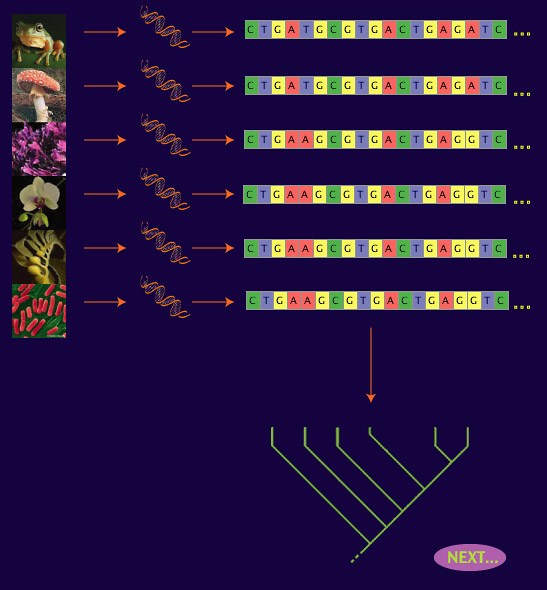
The tree of life is a metaphor for what idea?
a)
we came from a common ancestor
b)
we need water and sunlight to survive
c)
we have multiple species
d)
we are old
16.
Who was Charles Darwin?
a)
A naturalist who came up with the theory of evolution
b)
A scientist who studied plants
c)
A geologist who looked at rocks and fossils
d)
A paleontologist who studied dinosaurs
17.
Another word for adapt is ____________.
a)
change
b)
create
18.
Which of the following is NOT an example of natural selection? 
a)
People selectively breeding hamsters.
b)
Insect populations developing resistance to certain pesticides.
c)
Bacteria becoming resistant to antibiotics.
d)
Male birds of certain species developing colorful feathers to attract female mates.
19.
Which species’ DNA is most similar to the DNA of the toothed whale? 
a)
Hippopotamus 
b)
Baleen Whale
c)
Grazing Mammals
d)
Camels
20.
When an organism completely dies out, it is called.....
a)
Adaption
b)
Extinction
c)
Fossilization
d)
Mutation
21.
The separation of a group of individuals from the rest of the population is referred to as 
a)
genetic drift
b)
natural selection
c)
geographic isolation
d)
survival of the fittest
22.
Two organisms that are closely related would have
a)
very similar DNA sequence
b)
exactly the same DNA sequences
c)
no proteins in common
d)
completely different DNA sequence
23.

When organisms are better adapted to their environment they will survive and reproduce more successfully than organisms less adapted. This process is called what?

a)

Selective breeding

b)

Natural Selection

c)

Cloning

d)

Evolution of all species

24.

Scientists have collected millions of fossils of different organisms, and have developed a timeline of life on Earth. What do we call this?

a)

Mutation

b)

Natural Selection

c)

The theory of evolution

d)

Fossil Record

25.

Sometimes bones in the front limbs of animals are very similar in structure. What do we call similar bone structures that indicate a link to a common ancestor?

a)

Adaptations

b)

Gradualism

c)

Homologous Structures

d)

Extinction

26.
A well-tested concept that explains a wide range of observations is called a(an):
a)
hypothesis
b)
experiment
c)
cause and effect
d)
scientific theory
27.
A group of similar organisms that can mate with each other and produce fertile offspring is called a species.  
a)
True  
b)
False
28.

In Darwin's theory of evolution, he uses his idea of _________________ to explain evolution.

a)

descent with modification

b)

species dying out

c)

when species use new traits

29.
Tiktaalik is a...
a)
Fish with huge legs
b)
An alligator
c)
Fish with arm like fins
30.
If an organism has a vestigial structure, that structure likely once had a function in a(n)
a)
close relative
b)
early ancestor
c)
unrelated organism
d)
embryological stage
31.
Genetic variation can arise from a random change in the DNA of a gene.  The change is called a(n)
a)
mutation
b)
gene flow
c)
gene pool
d)
allele
32.

What type of structures are shown?

a)

Homologous

b)

Analogous

c)

Vestigial

d)

Heterologous

33.

What type of structures are shown?

a)

Homologous

b)

Analogous

c)

Vestigial

d)

Heterologous

34.

According to fossil records, the horses that lived 50 million years ago were much smaller, weaker and slower than modern horses. Which process is most likely responsible for the changes that have led to the increased size, strength, and speed in horses?

a)

evolution by natural selection

b)

migration

c)

inbreeding

d)

commensalism

35.

Which of the following is not considered a VESTIGIAL structures in humans.

a)

coccyx

b)

appendix

c)

wisdom teeth

d)

kidneys

36.

All dogs have the common ancestor the wolf. This is an example of -

a)

divergent evolution

b)

convergent evolution

37.
The system of binomial nomenclature was developed by ___________
a)
Linneaus
b)
Mayr
c)
Darwin
d)
Mr. King
38.
__________ characters are similar characteristics that have evolved separately in two unrelated organisms.
a)
analogous
b)
homologous
c)
cladistic
d)
phylogenic
39.

What does it mean when organisms share a common ancestor?

a)

They evolved from 1 species that lived in the past

b)

They are the same species

c)

The organisms have exactly the same traits

d)

The organisms are very different from one another

40.

Evolution is a THEORY and is subject to change if new evidence is found.

a)

True

b)

False

41.
What book did Darwin  write?
a)
Evolution in Biology
b)
The Origin of Species
c)
The Giving Tree
d)
Discovering Argentina.
42.

Did human beings evolved from apes?

a)

Yes and we evolved through natural selection

b)

Yes and we evolved through survival of the fittest

c)

No but we share a common ancestor

d)

Yes and we evolved through adapting to the environment

43.
Charles Darwin called the ability of an organism to survive and reproduce in its specific environment 
a)
diversity.
b)
evolution
c)
adaptation. 
d)
 fitness.
44.
What do we call differences among heritable traits?
a)
Variation
b)
Adaptation
c)
Evolution
d)
Speciation
45.
Choose which scientist corresponds best with the statement: 
survival of the fittest
a)
Darwin 
b)
Lamarck
46.
Choose which scientist corresponds best with the statement: 
use or disuse
a)
Darwin 
b)
Lamarck
47.
Thomas Malthus concluded that
a)
population increased arithmetically while food production increased geometrically.
b)
the world's rate of population increase was higher than the development of food supplies.
c)
moral restraint was producing lower crude birth rates.
d)
population growth was outpacing available resources in every country.
48.

Populations are controlled by war, disease & famine.

a)

Malthus

b)

Hutton

c)

Lyell

d)

Lamarck

e)

Wallace

49.

One of the first theories of evolution. Organisms can acquire traits over their lifetime.

a)

Malthus

b)

Hutton

c)

Lyell

d)

Lamarck

e)

Wallace

50.

Wrote "Principles of Geology". Geologic events that occurred in the past will continue to occur in the future.

a)

Malthus

b)

Hutton

c)

Lyell

d)

Lamarck

e)

Wallace

51.
When more offspring are being produced, there is a competition of limited resources---this is known as:
a)
Struggle for Existence
b)
Survival of the Fittest
c)
Descent with Modification
d)
Adaptation