wayground logo

Free Printable Worksheets

Font size

S
M
L
XL
Worksheets

APES Review

Total questions: 76

Worksheet time: 44mins

Name
Class
Date
1.

Which of the following water cycle process are connected to surface water on the Earth?

I. ground water infiltration

II. surface water runoff

III. evaporation

a)

I only

b)

I and II only

c)

II and III only

d)

I, II, and III

2.

Which of the following is a non-point source of water pollution?

a)

Effluent from a sewage treatment plant

b)

BP refiner in Indiana discharging ammonia in a river.

c)

Runoff of pesticides from regional farms into the Illinois River.

d)

Hot water discharges from a nuclear power plant.

3.

Which of the following is a probable impact of increased use of inorganic (lab-made) fertilizers in a watershed?

a)

Hypoxia in the Gulf of Mexico

b)

Increase in storm severity in southeastern U.S.

c)

Water shortages in California

d)

Saltwater intrusion on the East Coast.

4.

What is the health risks could be connected to eating some fish from lakes or the ocean?

a)

They may be invasive species that impact native fish species populations.

b)

The Omega-3 fatty acids found in some fish can have a negative impact on cardiovascular health.

c)

If they are high on the food chain they may contain high levels of mercury or PCB's.

d)

They may have been exposed to inorganic nutrients from fertilizers.

5.

Which of the following are not a water treatment procedures used to disinfect and kill harmful bacteria?

a)

Distillation

b)

Chlorine

c)

UV rays

d)

Ozone

e)

Desalination

6.

Which law sets standards limiting pollutants for community's water supplies?

a)

Clean Water Act (CWA)

b)

Safe Drinking Water Act (SDWA)

c)

National Environmental Policy Act (NEPA)

d)

Resource Conservation and Recovery Act (RCRA)

7.

What is it called when a persistent pollutant (like mercury or PCBs) builds up in the tissues of an organism as they continue to eat something that contains the pollutant?

a)

Negative Feedback Loop

b)

Biomagnification

c)

Tragedy of the Commons

d)

Bioaccumulation

e)

Positive Feedback Loop

8.
This law regulates the discharges of pollutants into all waters that have a significant connection with navigable waterways.  Also, must have a permit to dump these pollutants. Also, requires certain steps in sewage treatment. 
a)
Safe Drinking Water Act (SDWA)
b)
Clean Water Act (CWA)
c)
Oil Pollution Act
d)
National Environmental Policy Act (NEPA)
9.

What is the main source of mercury in the Great Lakes?

a)

Natural sources

b)

Coal-burning power plants

c)

Sewage effluent

d)

Automobile emissions

10.
Which of the following is an indicator species whose presence in a river or stream indicates excellent water quality?
a)
Crayfish
b)
Leech
c)
Left-handed snails
d)
Dobsonfly larva
11.

The pollution of waterways creating conditions in which productivity is decreased and gills of bottom dwelling organisms are clogged is due to

a)

erosion and sedimentation

b)

runoff and flooding

c)

herbicides and eutrophication

d)

mining and acid deposition

12.
What do we call the land area that supplies water to a river system?
a)
runoff
b)
recharge
c)
watershed
d)
valley
13.
What is the top of the water-filled spaces in the ground called?
a)
Groundwater
b)
Reservoir
c)
Water Table
d)
Well
14.

Which is a type of wastewater?

I. Sewage water from toilets

II. Water from showering and bathing

III. Water from washing clothes

a)

I only

b)

II only

c)

III only

d)

I and II

e)

I, II, and III

15.

Human wastewater entering into bodies of water such as rivers or lakes can be dangerous because

I. it causes a drop in the biological oxygen demand.

II. it can lead to cultural eutrophication.

III. the wastewater can carry pathogens.

a)

I only

b)

II only

c)

III only

d)

II and III

e)

I, II, and III

16.
Which element accumulates in the environment due to use of fertilizers?
a)
oxygen
b)
hydrogen
c)
nitrogen
d)
carbon
17.
Which has the least negative impact on wildlife habitat?
a)
agriculture
b)
development
c)
deforestation
d)
recreation
18.
Which is true of urban sprawl?
a)
it occurred in the 1800s
b)
it lasted 20 years in the 1990s
c)
it began in 1950 and continues until today
d)
it began in the 1990s and continues to today
19.
The large scale removal of trees by cutting or burning is called _______________.
a)
urbanization
b)
deforestation
c)
desertification
d)
overpopulation
20.
The movement of people from rural areas to big cities is called ________.
a)
urbanization
b)
deforestation
c)
desertification
d)
excommunication
21.
What are some bad things attributed to population growth?
a)
autism & genetic diseases
b)
religious conflict
c)
low wages & unemployment
d)
burning fossil fuels & increased CO2 production
22.
Which crops provide more than half of the caloric human nutritional needs. 
a)
Rice, Barley
b)
Rice, Wheat
c)
Rice, Soybean
d)
Rice, Maize
23.
Which is not a Global Common
a)
Seas
b)
Air
c)
Genetically Modified Plants
d)
Minerals 
24.
This author helped change the pesticide policy in the United States.
a)
Rachel Carson
b)
Aldo Leopold
c)
Theodore Roosevelt
d)
Henry David Thoreau 
25.
This fire burns undergrowth and leaf litter. It kills seedling and small trees. It can protect the forest from pathogens. 
a)
Crown
b)
Ground
c)
Surface
26.
Which of the following is a threat to forest ecosystems? 
a)
climate change
b)
unsustainable logging
c)
invasive species 
d)
All of these
27.
A hectare (ha) is an area equal to a square that is 100 meters on each side. If the plot of land is 300 m x 300 m, how many hectares is the plot?
a)
9
b)
90
c)
900
d)
9000
28.
Unfenced grasslands in tropical and temperate climates that supply forage for grazing animals are called
a)
rangeland
b)
pastures
c)
savannah
d)
steppes
29.
The best example of selective cutting is
a)
loggers cut small groups of intermediate or mature trees, resulting in less erosion and loss of nutrients on the hillside
b)
loggers cut a thin strip of trees along a hillside, the forest naturally regenerates, and then they cut a new strip next to the regenerated one
c)
a managed forest containing one or two species of trees, one section is clear-cut and replanted. It will be clear cut again once the trees are large enough
d)
loggers cut all trees in an area, resulting in a loss of nutrients in the soil and in sediment gathering in the stream downslope
30.
Which of the following is NOT an economic service provided by forests?
a)
provide habitat
b)
recreation
c)
lumber
d)
job opportunities 
31.
The step in the nitrogen cycle where plants take up nitrate and use it to make biological molecules is:
a)
nitrification
b)
ammonification
c)
nitrogen fixation
d)
assimilation
32.
The step in the nitrogen cycle where bacteria convert ammonia (NH3) to nitrate (NO3-) is:
a)
nitrification
b)
ammonification
c)
nitrogen fixation
d)
assimilation
33.
What part of the nitrogen cycle deals with the conversion of nitrogen in waste products or dead organisms into ammonia?
a)
nitrification
b)
ammonification
c)
denitrification
d)
nitrogen fixation
34.
Nitrogen gas accounts for what percentage of the atmosphere?
a)
55%
b)
5%
c)
Less than 1%
d)
78%
35.
Nitrogen is essential for living organisms to make:
a)
Lipids
b)
Carbohydrates
c)
Proteins
d)
Fats
36.
Which of the following is a Nitrite?
a)
NO3-
b)
NO2-
c)
N2
d)
NH3
37.
Which of the following is a Nitrate?
a)
NO3-
b)
NO2-
c)
N2
d)
NH3
38.
Which of the following is a atmospheric nitrogen?
a)
NO3-
b)
NO2-
c)
N2
d)
NH3
39.
Which of the following is ammonia?
a)
NO3-
b)
NO2-
c)
N2
d)
NH3
40.
Plants or animals that die and are broken down, or living organisms that excrete waste while they are living are recycled into the soil by
a)
detritus
b)
atmospheric nitrogen
c)
nitrogen-fixing bacteria
d)
decomposers
41.

A secondary pollutant

a)

forms in the stratosphere.

b)

is transformed by sunlight or water.

c)

cannot be directly tracked.

d)

does not directly harm humans.

e)

forms primarily from incomplete combustion.

42.

Which is a source of sulfur dioxide found in nature?

a)

Forest fires

b)

Lightning strikes

c)

Plant emissions

d)

Volcanoes

e)

Soil

43.

Which size of particulate matter causes the greatest health concerns?

a)

PM2.5

b)

PM10

c)

PM100

d)

PM30

e)

PM15

44.

Carbon monoxide

a)

increases lung cancer rates.

b)

leads to the formation of photochemical smog.

c)

is most problematic in rural areas

d)

does not directly cause deaths.

e)

is produced by incomplete combustion.

45.

High levels of photochemical smog are due to

I. nitrogen dioxide.

II. sulfur dioxide.

III. VOCs

a)

I only

b)

I and II only

c)

II and III only

d)

I and III only

e)

I, II, and III

46.

Thermal inversions

a)

increase the rate of smog formation.

b)

trap high concentrations of pollution at ground level.

c)

result in increased levels of acid deposition.

d)

are caused by high levels of precipitation.

e)

reduce the negative effects of VOCs.

47.

Acid deposition forms as a result of

a)

nitrogen oxides and photochemical smog.

b)

carbon monoxide and VOCs.

c)

sulfur dioxide and VOCs.

d)

nitrogen oxides and sulfur dioxide.

e)

carbon monoxide and photochemical smog.

48.

The effects of acid deposition include

a)

increased cancer rates in aquatic organisms.

b)

decreased aquatic biodiversity.

c)

decreased mobilization of metals.

d)

increased pH of lake water.

e)

decreased human health in impacted areas.

49.

If carbon monoxide emissions decreased from 145 million tons annually to 80 million tons annually, by what percentage have emissions been reduced?

a)

41 percent

b)

45 percent

c)

47 percent

d)

52 percent

e)

55 percent

50.

How many ozone atoms can a single chlorine atom break down?

a)

5,000

b)

10,000

c)

50,000

d)

100,000

e)

500,000

51.

Which is NOT a result of the reduction in stratospheric ozone?

a)

Reduced photosynthetic activity

b)

Increased skin cancer

c)

Increased eye problems

d)

Increased birth defects

e)

Suppressed immune systems

52.

When is the Antarctic ozone hole largest?

a)

Early spring

b)

Late summer

c)

Mid-summer

d)

Late fall

e)

Early winter

53.

Which outdoor air pollutant is also a significant indoor air pollutant?

a)

Sulfur dioxide

b)

Nitrogen oxides

c)

Carbon monoxide

d)

Lead

e)

Ozone

54.

The primary source of radon is

a)

electronics.

b)

indoor fires.

c)

household chemical fumes.

d)

rocks and soils.

e)

construction materials

55.

Asbestos

a)

is used for insulation.

b)

can be easily removed and treated.

c)

can be a problem in new construction.

d)

causes skin irritation, nausea, and fatigue.

e)

is commonly used in furniture.

56.
Which is NOT a type of aquatic ecosystem?
a)
ocean
b)
estuary
c)
monastery
d)
wetland
57.
This means the amount of salt dissolved in water.
a)
salinity
b)
salutation
c)
saturation
d)
saltiness
58.
Which has higher oxygen levels?
a)
faster moving water
b)
slower moving water
c)
speed of water has no effect on oxygen content
d)
all water has the same amount of oxygen
59.
Which of the following leads to a decrease in birthrates among women?
a)
Higher Education
b)
High Infant Mortality Rate
c)
No Prenatal Care
d)
No contraceptives
60.
Birthrate remains high, death rate begins to fall, total population increasing
a)
Stage 1 Demographic Transition
b)
Stage 2 Demographic Transition
c)
Stage 3 Demographic Transition
d)
Stage 4 Demographic Transition
61.
All of the following are density independent factors EXCEPT
a)
Limited food
b)
Earthquakes
c)
Hurricanes
d)
Torandoes
62.
The measure of the quality of life is also known as the
a)
Total Fertility Rate
b)
Replacement Level Fertility
c)
Infant Mortality Rate
d)
Birth Rate
63.
The most populous country in the world
a)
China
b)
India
c)
US
d)
Brazil
64.
A pyramid shaped age structure diagram would represent what type of growth?
a)
Declining
b)
Stable
c)
Rapid
65.
The number of children an average woman would have during her reproductive years
a)
Birthrate
b)
IMR
c)
TFR
d)
Life expectancy
66.
All of the following are characteristics of R selected species except
a)
No prenatal care
b)
Short Lifespan
c)
Early reproductive age
d)
Few Offspring
67.
The number of individuals an environment can support is known as the
a)
Total Fertility Rate
b)
Exponential Growth
c)
Limiting Factor
d)
Carrying Capacity
68.
A country that represents stable growth
a)
Japan
b)
Germany
c)
Afghanistan
d)
Canada
69.
A country that represents Rapid Growth
a)
United States
b)
Russia
c)
China
d)
Iraq
70.
A population experiencing declining growth
a)
Russia
b)
Nigeria
c)
United States
d)
Australia
71.
A small community started out with 10 people in year 1.  During year 1 they had 10 births and 5 deaths.  What was this community's growth rate for year 1?
a)
50 %
b)
5 %
c)
75 %
d)
1.5 %
72.
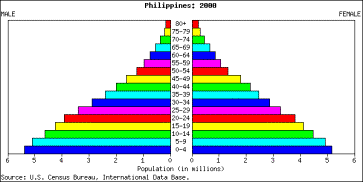
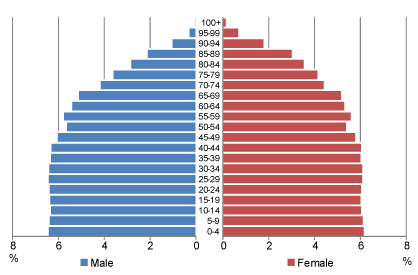
According to the population pyramid of this country, its population is most likely...
a)
growing slowly.
b)
growing rapidly.
c)
decreasing.
d)
not changing.
73.
What kind of growth is this country experiencing?
a)
Exponential Growth
b)
Stable Growth
c)
Declining Growth
74.
Which statement about human population growth is LEAST likely to be correct?
a)
Modern medicine has allowed human populations to extend well past the earth's carrying capacity, as more people survive for longer.
b)
Technological advances in farming and medicine will allow human populations to continue to grow without natural limits.
c)
Advances in agriculture have allowed the world's food supply to expand dramatically in the last 100 years.
d)
Worldwide, humans are reproducing more quickly than mortality is removing people from the population.
75.
The most populous country in the world are China, India, and
a)
Indonesia
b)
Russia
c)
The United States
d)
Mexico
76.
Factors that affect the total fertility rate of the human population include which of the following?
I. Cultural traditions
II. Government policies and economic incentives
III. Education level and economic opportunities for females

a)
I only
b)
II only
c)
I and II only
d)
I, II, and III