
 Worksheets
7th Grade Final Quiz
Total questions: 106
Worksheet time: 3hrs 15mins
What is Newton's 2nd law of motion?
"For every action, there is an equal and opposite reaction."
"Apples hurt when they fall on your head."
"A body at rest will remain at rest, and a body in motion will remain in motion unless it is acted upon by an external force."
"The force acting on an object is equal to the mass of that object times its acceleration."
This is velocity divided by time:
Your mouth
speed
distance
acceleration
This is speed plus direction?
Velocity
Acceleration
Rate of motion
Quickness
Gravity's effect on mass is called:
Fatness
Weight
Mass Effect
Rejection
If you apply the same amount of force to two objects with different masses, the bigger object will accelerate faster or slower?
Faster
Slower
The same
It won't move
If an object is accelerating, what forces are acting on it?
Darkside forces
Balanced forces
Unbalanced forces
Lightside forces
What is Newton's 3rd law of motion?
"For every action, there is an equal and opposite reaction."
"Apples hurt when they fall on your head."
"A body at rest will remain at rest, and a body in motion will remain in motion unless it is acted upon by an external force."
"The force acting on an object is equal to the mass of that object times its acceleration."
What is magnetic force?
A force exerted by electrically charged particles
A force exerted by magnets that can be felt by objects near a magnet
A force exerted by magnets that makes an object become electrically charged
A force exerted by a magnet only when it physically touches an object
What is a magnetic material?
A material that becomes positively charged when a magnet is brought near it.
A material that produces a magnetic force.
A material that becomes negatively charged when a magnet is brought near it.
A material that is attracted or repelled by a magnet.
Why is Earth's magnetosphere important?
It deflects dangerous solar wind from the sun
It keeps us in orbit around the sun
it keeps the moon in orbit around the earth
it prevents extraterrestrial objects from crashing into earth
What happens if you cut a magnet in half?
Nothing
The magnets repel
There will be two magnets
Which is not a way to strengthen an electromagnet? Select all that apply.
Use a bigger power source
Use a plastic wire
Use a bigger magnetic material
Wrap the wire around the magnetic material more times.
Rocks formed under great pressure but no heat are _____.
igneous
metamorphic
sedimentary
sediment

The best answer for section "A" in the diagram
metamorphic/melting
compaction/cementation
weathering/erosion
heat/pressure

The best answer for section "C" in the diagram
metamorphic/melting
compaction/cementation
weathering/erosion
heat/pressure

The best answer for section "B" in the diagram.
metamorphic/melting
compaction/cementation
weathering/erosion
heat/pressure


In a tectonic plate demonstration during class, Mrs. Smith
pushes two pieces of modeling clay together. What kind of
plate boundary was the teacher demonstrating?
Convergent
Earthquake
Equator
Divergent
Where does magma rise to the top to become new crust?
one plate splits into two distinct plates
one plate grinds against another plate
two plates separate and move apart from one
another.
two plates meet and collide with one another.
When crust is neither created nor destroyed, what boundary is it formed along?
convergent
divergent
collisional
transform
Where do most volcanoes occur? Choose all that apply.
convergent boundaries
in deserts
on coastal plains
divergent boundaries
When tectonic plates of more density and less density collide, what happens?
The plate that is more dense fractures.
The plate that is more dense rises.
The plate that is less dense subducts(Goes under).
The more dense plate subducts(Goes under).
Continents to continent plate boundaries produce what feature when they collide?
Rift Valleys
Mid-ocean ridges
Tall mountain ranges
Deep-sea trenches
Where do volcanoes and earthquakes occur?
Under the flat surface of plates
Above the flat surface of the plates
Along plate boundaries
At the center of plate
Alfred Wegener proposed the Theory of Continental Drift. Which one of these does NOT support the theory Wegener proposed?
Fossils that were similar were found on different continents.
Bacteria was found all over the world.
Shape of continents fit together to form a supercontinent called Pangea
Climate seen as glacial or ice sharring are found all over the world.
Rift Valley is a feature of what plate boundary?
Obtrusive
Divergent
Transform
Convergent
Why does the Ring of Fire around the Pacific Ocean have the most volcanoes?
boundary plates
divergent plate
convergent plates
transform plates
fossilized mark that is formed in soft sediment by the movement or actions of an animal.
Petrified
Mold
Cast
Index
Trace Fossil
As a part of an investigation, some scientists excavated rocky layers in an area. They found some rock samples with ancient fossils embedded in them.
What tool would help the scientists view the fossilized rock in more detail?
a color filter
a magnifying glass
a meter stick
a triple-beam balance
Saying you are older than your sister is an example of?
Absolute age dating
Relative age dating
Fossils
Radioactive dating
What does absolute age tell us about a rock layer or fossil?
The 'exact' age of a fossil determined by radiometric dating
The relative age of a fossil determined by radiometric dating
Younger rock layers sit on top of older rock layers
Older rock layers sit on top of younger rock layers

Which fossil would make the best index fossil?
Beetle
Flower
Frog
Fish

Use relative age dating to put the rock layers in correct order from oldest to youngest.
B, D, A, E, C
C, E, D, A, B
A, C, E, D, B
C, E, D, B, A

Which of the fossils is the oldest?
Dinosaur
Bird
Shell
Ammonite
The relative age of rock is _________
Its age compared to the age of other rocks
Less than the age of the fossils the rock contains
The number of years since the rock formed
Its age based on how much Carbon-14 the rock contains
The geologic time scale is a record of _________
the thickness of sedimentary rock layers
The rate of fossil formation
The life forms and geological events of Earth's history
The time since the evolution of dinosaurs
What does absolute age tell us about fossils and rock strata?
the actual age in numbers
a comparison age (1 thing is older than another thing)
what should be used as an "index fossil"
how the rock strata was formed
When rock strata are placed in order of their formation based on layers, it is called ...
absolute age
radiometric dating
relative age
stacking
The law of superposition states that, in horizontal layers of sedimentary rock, each layer is _____.
younger than the layer above it and older than the layer below it
neither older nor younger than the other layers
older than the layer above it and younger than the layer below it
always older than any vertical layers
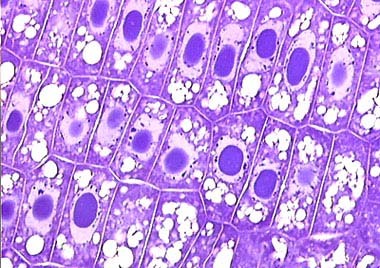
Which structures are unique only to plant cells?
Cell Membrane
Cell Wall
Mitochondria
Chloroplast
Which cell organelle helps break down food to release energy?
Mitochondria
Nucleus
Vacuole
Endoplasmic Reticulum
Which three statements are part of the cell theory?
Cells are the smallest unit of living things that can perform the processes necessary for life.
The basic components of life consist of a nucleus, cell membrane, and mitochondrion.
All living things are composed of cells
Living cells come only from other living cells
Atoms are composed of cells
Which organelle is much larger in plant cells than animal cells and is used to store food and waste?
Nucleus
Vacuole
Ribosomes
Chloroplasts
What are organelles?
Parts that come together to make an organ system.
A group of similar cells that perform similar functions.
A group of organs that perform similar functions
Tiny structures within a cell that allow the cell to live, grow, and reproduce.
When compared to a prokaryotic cell, a eukaryotic cell ...
does not have a nucleus
has DNA that is circular
has more types of organelles
stores it's DNA in a nucleus rather than in the cytoplasm
There are 3 main differences between a plant and an animal cell. Plant cells contain .....
a cell membrane
a cell wall
a nucleus
a larger vacuole
chloroplasts
Some unicellular organisms are similar to __________ because they have the ability to __________.
reptiles, lay eggs
birds, fly
plants, produce sound
animals, move
The ______________ is a membrane bound organelle that contains an organism’s genetic material and helps control and regulate cellular processes.
cell membrane
nucleus
mitochondria
chloroplast
Which of the following is shared by ALL cells and organisms?
made of many cells
needs oxygen
made of a single cell
ability to reproduce
Bacteria, protists, fungi, and animals are all types of living things. Which of the following must be true about all these organisms?
they can all move
they are made up of one or more cells
they can make their own food
they all need oxygen
A cell that has a nucleus and organelles is called a
prokaryotic cell
eukaryotic cell
bacterial cell
cytoplasmic cell
Cells can divide to make more cells like themselves. What is this process called?
photosynthesis
development
growth
reproduction
Which statement about cells is part of cell theory?
cells are found in most living things
cells with cell walls are plant cells
all cells capture energy from sunlight
all cells come from other living cells
The part of a flower that contains the pollen
stigma
style
anther
filament
Type of asexual reproduction that produces two identical cells
vegetative propagation
binary fission
budding
regeneration
Type of asexual reproduction where the offspring grows out of the parent organism
vegetative propagation
binary fission
budding
regeneration
Type of asexual reproduction when one plant grows new plants
vegetative propagation
budding
regeneration
binary fission
Identify three animal behaviors that increase their odds of reproduction
nest building
bright flowers
colorful feathers
herding
Identify three animal behaviors that help plants increase their odds of reproduction
transfer seeds
pollinate flowers
animal waste provides fertilizer
herding
Identify three specialized plant structures and/or characteristics that help increase heir odds of reproduction
vocalization
seeds with wings that catch the wind
flower odor
bright colored petals
Pair of genes where one is dominant and he other is recessive
heterogeneous
homogeneous
genotype
phenotype
Both genes are the same
heterogeneous
homogeneous
genotype
phenotype
Actual gene make-up (bb,Bb)
heterogeneous
homogeneous
genotype
phenotype
Physical appearance (brown hair, blue eyes)
heterogeneous
homogeneous
genotype
phenotype
Some students are observing the behavior of a male bird in the schoolyard. Which of the following observed behaviors might increase the probability of reproductive success?
Made a chirping sound
Flew from a tree to the ground
Flew away when a cat appeared
Hopped along a tree branch
Male widow birds (Euplectus progne) have very long tail feathers. What evidence would support the claim that these tails are used by the birds to attract mates and lead to reproductive success?
In every generation, the small number of males with the longest tail feathers produce the greatest number of offspring.
Even though the wingspan of males does not exceed 15 centimeters, some males have tail feathers 50 centimeters long.
Only the males of the species have long tail feathers, and the females always have much shorter tail feathers.
The males with the longest tail feathers are the easier to locate in their habitat than those with shorter tail feathers.
Which of the following plant adaptations allows plants to use animals to transport their seeds to new locations?
strong stems
sweet fruit
deep roots
large leaves
The offspring of sexually reproducing organisms can be distinguished from the offspring of asexually reproducing organisms by studying which of the following?
The extent of variety in the genetic information in the population of offspring
The diet and habitat requirements for each individual organism
The average amount of time involved between fertilization and birth of the offspring
The relative sizes in height of the organisms when they reach adulthood

How will natural selection most likely produce changes?
the most attractive organisms will live and reproduce
the organisms that reproduce the most will survive through generations
the organisms that reproduce earlier to avoid the winter will live longer
the organisms that reproduce during winter will live longest

Mutations can be negative because
They can cause cancer
They can cause birth defects
They can help an organism thrive in its environment.
They can affect offspring.
A mutation is defined as:
A change in the cell's structure
Anything that changes in an embryo
Any change in the physical features of a human
A change in the DNA sequence
A Dominant trait is...
A trait that shows in a person's phenotype when present.
The capital letter in a punnet square
All of the Above
A recessive trait is...
A trait that shows in a person's phenotype when a dominant trait is not present
The lowercase letter in a punnet square
All of the Above
Shows the traits that separate organisms
cladogram
phylogenetic tree
evolutionary origin
common ancestor



