
 Worksheets
Lesson 1-3: Earth's Atmosphere Review
Total questions: 102
Worksheet time: 1hrs 13mins

Which two describe the layer: Troposphere
Layer closest to earth
The hottest layer
Layer farthest from earth
Where weather occurs

In which layers of the atmosphere does temperature decrease as altitude increases? Check all that are true.
Troposphere
Stratosphere
Mesosphere
Thermosphere
The layers of the atmosphere are classified according to changes in
temperature and air pressure
altitude and air quality
humidity and temperature
air pressure and oxygen
What do greenhouse gases do?
Reflect the sun's energy
Block the sun's infrared radiation
Act as a thermal blanket for the Earth, absorbing heat and warming the surface
They help light up the moon at night
If we didn't have the 'greenhouse effect' at all, Earth would
have volcanoes erupting everywhere
Cool to a point where we could not live here
Catch on fire
blow up from being hit by meteors
What is happening to sea levels because of climate change
They are staying the same
They are decreasing
There are more waves
They are increasing
Infrared Radiation that is not absorbed by Greenhouse Gases is reflected back ....
to the Earth
to space
to the toposphere
to the ocean

Which are greenhouse gases?
Oxygen
Carbon Dioxide
Nitrogen
Water Vapor
Ozone
What is the transfer of heat by circulation of the heated parts of a liquid or gas?
Conduction
Convection
Coriolis Effect
Radiation
Which best explains how the Earth’s atmosphere is warmed?
Radiation from the sun warms the surface and the atmosphere is heated through conduction and convection.
Radiation from the sun warms the surface and the atmosphere is heated through evaporation and convection.
Convection from the sun warms the surface and the atmosphere is heated through conduction and radiation.
Convection from the sun warms the surface and the atmosphere is heated through evaporation and conduction.
What two processes of heat transfer would cause the water in a pot on the stove to boil?
radiation and convection
conduction and radiation
radiation and evaporation
conduction and convection
What type of energy transfer occurs when two things are in direct contact (touching)?
Condensation
Conduction
Convection
Radiation
Which of the following shows a transfer of energy by means of conduction?
Standing near a warm fire.
Watching a microwave oven cook your food.
Grabbing a metal seat belt buckle after a car has been closed up in the sun all day.
Feeling the breeze that blows over the land during the day and toward the sea later that night.
What is the transfer of heat by the circular movement of molecules?
Condesation
Conduction
Convection
Radiation
To check if an iron is hot, you place your hand near the iron and feel that it is warm without touching it. What type of heat transfer is this?
Condensation
Conduction
Convection
Radiation
When you play outside in the sun too long and receive a sunburn, which type of heat transfer is this?
Conduction
Convection
Evaporation
Radiation
A student must choose three items to demonstrate conduction, convection, and radiation from solar energy. The student quickly chooses water and a metal bowl. Which of the following items should the student choose to complete the experiment?
Rubber ball
food coloring
heat lamp
ice cube
What is the main source of energy that drives all weather patterns?
Sun
Moon
Oceans
Mountains


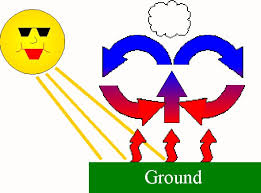
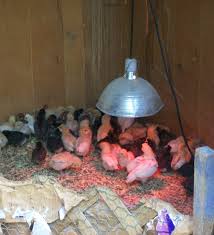
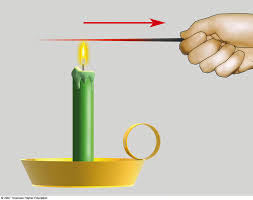

Which best explains why a hot air balloon floats?
The heated air expands to fill the balloon. The air in the balloon is now lighter than the surrounding air, causing the balloon to rise.
The heated air expands to fill the balloon. The air in the balloon is now heavier than the surrounding air, causing the balloon to rise.
The heated air contracts to fill the balloon. The air in the balloon is now denser than the surrounding air, causing the balloon to rise.
The heated air contracts to fill the balloon. The air in the balloon is now lighter than the surrounding air, causing the balloon to rise.
Which best explains how ice melts in a person’s hand?
The heat from a person’s hand transfers by radiation to the ice, causing it to melt.
The heat from a person’s hand transfers by conduction to the ice, causing it to melt.
The cool temperature of the ice transfers by radiation to a person’s hand, cooling it off.
The cool temperature of the ice transfers by conduction to a person’s hand, cooling it off.
What is the original source of most of the energy that people use?
Energy that reaches Earth’s surface by radiation from the Sun.
Energy that reaches Earth’s surface by convection from the Sun.
Energy that reaches Earth’s surface by radiation from Earth’s core.
Energy that reaches Earth’s surface by conduction from Earth’s core.

Which part of the diagram shows conduction?
Part A
Part B
Part C
Which best describes the flow of heat?
from a larger object to a smaller object
from a warmer object to a cooler object
from a cooler object to a warmer object

A cold metal spoon is placed in a bowl of hot soup. Which best describes how the spoon is affected?
The heat from the soup does not affect the temperature of the spoon.
The heat from the soup is conducted through the spoon, making the spoon warmer.
The cold air in the room radiates into the soup, cooling it, and keeping the spoon cool.
The cold from the spoon is conducted into the soup, causing the soup to cool to the same temperature as the spoon.T
Label according to the relative amount of gasses in the atmoshere
Nitrogen
Oxygen
Other gasses
Why does the troposphere experience (have) the greatest amount of atmospheric pressure compared to the other atmospheric layers?
It produces the ozone layer.
It has the highest temperatures.
It contains a high concentration of gas particles.
It is the region in which weather occurs.
Which of these statements BEST describes (explains) temperature as elevation in the atmosphere increases?
Temperature remains constant with elevation in the thermosphere.
Temperature remains constant with elevation in the mesosphere.
Temperature generally decreases with elevation in the stratosphere.
Temperature generally decreases with elevation in the troposphere.
The BEST description of the troposphere is the layer of the atmosphere with the
most ozone.
greatest density.
highest altitude.
coldest temperature.
Which graph BEST illustrates (shows) the change in density in the lowest layer of Earth’s atmosphere as altitude increases?


In which layer of Earth’s atmosphere does weather occur?
mesosphere
stratosphere
thermosphere
troposphere
An atmospheric layer of a specific (exact) gas provides (gives) shielding (protection) from harmful ultraviolet light from the Sun, allowing life to thrive (live) on Earth. What gas makes up this layer?
H2O
CO2
N2
O3
Why does the troposphere experience (have) the greatest amount of atmospheric pressure compared to the other atmospheric layers?
It produces the ozone layer.
It has the highest temperatures.
It contains a high concentration of gas particles.
It is the region in which weather occurs.
Which of these statements BEST describes (explains) temperature as elevation in the atmosphere increases?
Temperature remains constant with elevation in the thermosphere.
Temperature remains constant with elevation in the mesosphere.
Temperature generally decreases with elevation in the stratosphere.
Temperature generally decreases with elevation in the troposphere.
The BEST description of the troposphere is the layer of the atmosphere with the
most ozone.
greatest density.
highest altitude.
coldest temperature.
Which graph BEST illustrates (shows) the change in density in the lowest layer of Earth’s atmosphere as altitude increases?
In which layer of Earth’s atmosphere does weather occur?
mesosphere
stratosphere
thermosphere
troposphere
An atmospheric layer of a specific (exact) gas provides (gives) shielding (protection) from harmful ultraviolet light from the Sun, allowing life to thrive (live) on Earth. What gas makes up this layer?
H2O
CO2
N2
O3
Atmospheric greenhouse gases help heat the atmosphere by
increasing the amount of solar radiation reaching Earth.
storing energy produced by human activity.
absorbing infrared radiation released by Earth.
increasing the average density of air.
Which of these gases, on average, has the lowest volume in the atmosphere of Earth?
oxygen
nitrogen
water vapor
carbon dioxide
On Mount Everest the temperature decreases as the altitude increases. The summit (highest point) of this mountain is in which atmospheric layer?
mesosphere
stratosphere
thermosphere
troposphere

The table indicates (shows) the percentages (amount) of some gases in the atmosphere of Mars. Which gas in the atmosphere of Mars is the primary (main) gas found in the atmosphere of Earth?
carbon dioxide
nitrogen
argon
methane
Which trait (characteristic) is common in gases that contribute (give) to Earth’s greenhouse effect?
the ability to trap heat
a tendency to lose electrons
a tendency to exist as diatomic molecules
the ability to bond with multiple other elements
The temperature of the stratosphere increases (goes up) with altitude because of the presence of
nitrogen
water vapor
ozone
carbon monoxide
A weather balloon is about 2 meters wide when it is near the ground. It grows to about 6 meters wide at higher altitudes. Which change MOST likely makes the balloon become wider at higher altitudes?
More gases enter the balloon.
The gas inside the balloon gets much hotter.
The air pressure surrounding the balloon decreases.
Sunlight breaks down the material of the balloon.
Some jet airplanes fly in a layer of the atmosphere where temperature generally (mostly) increases with altitude. What is this layer of the atmosphere?
mesosphere
stratosphere
thermosphere
troposphere
Which BEST explains why air temperatures near mountaintops are often much colder than air temperatures near sea level?
Large amounts of snowfall decrease the temperature.
Air near mountaintops is less dense.
Strong winds near mountaintops decrease temperatures.
The lack of vegetation at sea level allows the ground to absorb more heat.
When a plane flies, it travels through air that contains (has) gases, liquids, and solids. This area is BEST described as the
atmosphere
lithosphere
biosphere
hydrosphere
In which layer of the atmosphere does MOST of Earth’s weather occur (take place)?
the exosphere, which is the outermost layer
the troposphere, which is the lowest layer
the thermosphere, which has the highest temperature
the stratosphere, which contains a sub-layer of ozone
How is the stratosphere different from the troposphere?
The clouds in the stratosphere produce more rain.
The air in the stratosphere has a greater density.
The composition of the stratosphere lacks ozone.
The temperature of the stratosphere warms at higher altitude.
Which trait (characteristic) is common in gases that contribute (give) to Earth’s greenhouse effect?
the ability to trap heat
a tendency to lose electrons
a tendency to exist as diatomic molecules
the ability to bond with multiple other elements
The temperature of the stratosphere increases (goes up) with altitude because of the presence of
nitrogen
water vapor
ozone
carbon monoxide
A weather balloon is about 2 meters wide when it is near the ground. It grows to about 6 meters wide at higher altitudes. Which change MOST likely makes the balloon become wider at higher altitudes?
More gases enter the balloon.
The gas inside the balloon gets much hotter.
The air pressure surrounding the balloon decreases.
Sunlight breaks down the material of the balloon.
Some jet airplanes fly in a layer of the atmosphere where temperature generally (mostly) increases with altitude. What is this layer of the atmosphere?
mesosphere
stratosphere
thermosphere
troposphere
How is the stratosphere different from the troposphere?
The clouds in the stratosphere produce more rain.
The air in the stratosphere has a greater density.
The composition of the stratosphere lacks ozone.
The temperature of the stratosphere warms at higher altitude.
The effect of Earth's rotation on the direction of winds and currents.
Coriolis effect
El Niño effect.
0 degrees latitude, where the Sun's rays are the most intense.
Equator
Prime Meridian
North Pole
Tropics
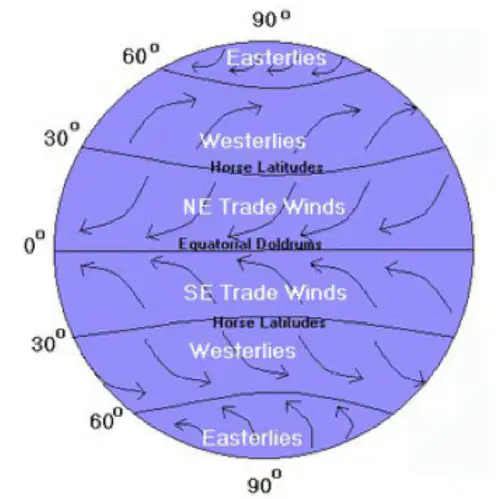
prevailing winds that blow from west to east between 30 degrees and 60 degrees latitude in the northern and southern hemispheres
Westerlies
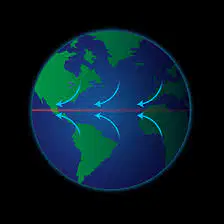
Steady winds that blow from east to west from 30 degrees latitude to the equator in the northern and southern hemispheres
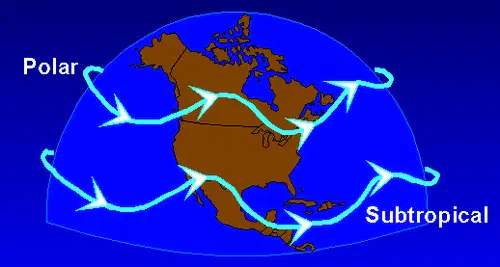
A narrow belt of strong winds blows in the upper troposphere ( about 10 km above Earth's surface). Planes flying West to East can get a boost!
Cold winds that blow from the east to the west near the North Pole and South Pole
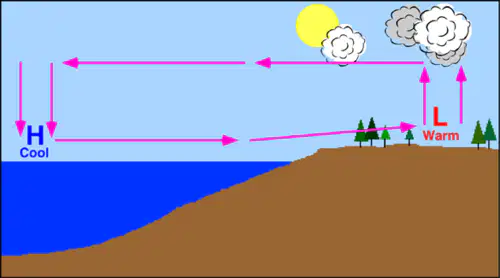
movement of air from sea to land during the day when cooler air from above the water moves over the land, forcing the heated, less dense air above the land to rise
Movement of air from land to sea at night, created when cooler, denser air from the land forces up warmer air over the sea.
A frequently windless area near the Equator
Horse Latitude
Tropical Jet Stream
Are regions of high pressure and gentle winds at about 30 degrees north and south latitude
Doldrums
Horse Latitudes
Easterlies
Westerlies
winds that blow steadily from specific directions over long distances
Local winds
winds that blow over short distances
Local Winds
Global Winds
Occurs at night when cooler air over land moves onto the water and pushes warmer air upward.
land breeze
sea breeze
doldrums
jet streams
As the sun warms the air along mountainsides, warm air moves upward in what is known as a
valley breeze
mountain breeze
ocean breeze
summer breeze
At night, when the mountains cool, cold air moves down into the valley, creating a
valley breeze
mountain breeze
ocean breeze
summer breeze
Occurs when cooler air over water moves onto the land and pushes the warm, less dense air upward.
sea breeze
land breeze
trade wind
doldrums
Which of the following heat up faster?
land
water
They both heat up at the same rate.
Neither land or water change temperature.

