
 Worksheets
All Fall Content
Total questions: 109
Worksheet time: 4hrs 38mins
Name
Class
Date
1.
A solar eclipse only happens during a ________ moon.
a)
New
b)
Cresent
c)
Gibbous
d)
Full
2.
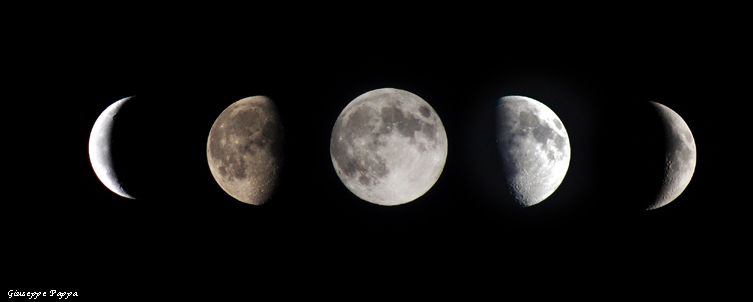
A solar eclipse only occurs during which moon phase?
a)
1st Quarter
b)
New Moon
c)
Full Moon
d)
3rd Quarter
3.

a)
solar eclipse
b)
lunar eclipse
4.
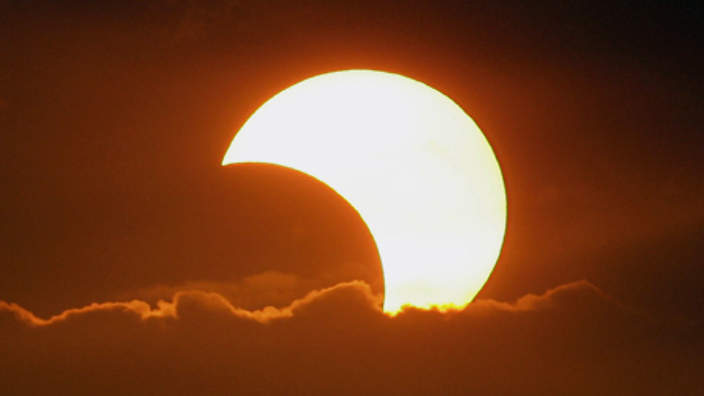
This image is an example of
a)
Lunar Eclipse
b)
Full Moon
c)
New Moon
d)
Solar Eclipse
5.
In order to have an eclipse, the Moon, Sun and Earth have to be?
a)
Below each other
b)
Above each other
c)
In alignment
6.
Which type of eclipse occurs when the Moon comes directly between Earth and the Sun?
a)
Lunar eclipse
b)
Solar eclipse
7.

a)
solar eclipse
b)
lunar eclipse
8.
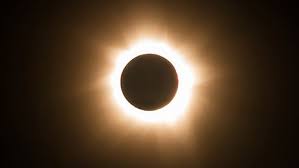
During a solar eclipse...
a)
The sun is blocked by the moon
b)
The Earth is blocked moon
c)
The moon is blocked by the sun
d)
You are blocked
9.
During a solar eclipse...
a)
The sun is blocked by the moon
b)
The Earth is blocked moon
c)
The moon is blocked by the sun
d)
You are blocked
10.
An eclipse in space is when....
a)
one object passes through the shadow of another object.
b)
two shadows collide.
c)
the moon is in the waxing crescent phase.
d)
the Sun and Moon are side by side.
11.
An eclipse in space is when....
a)
one object passes through the shadow of another object.
b)
two shadows collide.
c)
the moon is in the waxing crescent phase.
d)
the Sun and Moon are side by side.
12.
What is the order during a lunar eclipse
a)
sun, moon, earth
b)
sun, earth, moon
13.

This type of eclipse occurs when the moon blocks the sunlight from reaching Earth?
a)
Solar eclipse
b)
Lunar eclipse
14.

In thinking about a solar eclipse, what does the ball in the diagram represent?
a)
the Earth
b)
the Moon
c)
the Sun
15.

In thinking about a solar eclipse, what does the light source in the diagram represent?
a)
the Earth
b)
the Moon
c)
the Sun
16.
The order of a lunar eclipse is..
a)
Sun-Earth-Moon
b)
Earth-Sun-Moon
c)
Moon-Sun- Earth
d)
Earth-Moon-Sun
17.
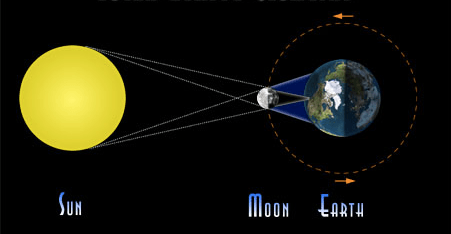
Which type of eclipse is shown in this picture?
a)
Solar Eclipse
b)
Orbit
c)
Lunar Eclipse
d)
Total Eclipse
18.
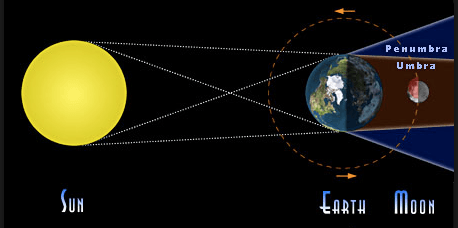
Which type of eclipse is shown in the diagram?
a)
Solar Eclipse
b)
Lunar Eclipse
c)
Total Eclipse
d)
Partial Eclipse
19.
When does a lunar eclipse occur?
a)
At night
b)
When the moon's shadow is on the earth
c)
when the moon comes between the sun and earth
d)
During the day
20.
This image is an example of
a)
Lunar Eclipse
b)
Full Moon
c)
New Moon
d)
Solar Eclipse
21.
A solar eclipse only occurs during which moon phase?
a)
1st Quarter
b)
New Moon
c)
Full Moon
d)
3rd Quarter
22.

What moon phase would be seen from Earth when the moon is at position 1?
a)
new moon
b)
first quarter
c)
third quarter
d)
full moon
23.

What moon phase is this?
a)
waxing crescent
b)
waxing gibbous
c)
waning crescent
d)
waning gibbous
24.

What phase of the moon would be visible from Earth when the moon is at position 1?
a)
new moon
b)
first quarter
c)
full moon
d)
third quarter
25.

What phase of the moon would be visible when the moon is at position 3?
a)
new moon
b)
first quarter
c)
full moon
d)
third quarter
26.

What moon phase would be visible from Earth when the moon is at position 5?
a)
first quarter
b)
third quarter
c)
new moon
d)
full moon
27.
What does "waxing" mean?
a)
growing
b)
shrinking
c)
lighted
d)
dark
28.
What does "waning" mean?
a)
growing
b)
shrinking
c)
lighted
d)
dark
29.
If the Sun, Earth, and Moon are in perfect alignment, the Earth would have a _______ tide.
a)
Spring
b)
Neap
c)
Normal
30.
Most places on Earth experience about how many high and low tides in 24 hours?
a)
2 high and 2 low tides
b)
4 high and 4 low tides
c)
1 high and 1 low tides
31.
Tides are caused mainly by what?
a)
Moon’s gravitational pull
b)
Sun’s gravitational pull
c)
Earth’s gravitational pull
32.
This type of eclipse occurs when the moon blocks the sunlight from reaching Earth?
a)
Solar eclipse
b)
Lunar eclipse
c)
Total eclipse
33.
When the Earth's shadow falls on the moon, the shadow causes what to happen?
a)
Lunar eclipse
b)
Solar eclipse
c)
Partial eclipse
34.
For a solar eclipse to occur, what has to happen?
a)
The sun must be directly between Earth and the moon.
b)
The moon must be directly between Earth and the Sun.
c)
Earth must be directly between the Sun and the moon.
35.
Water flows toward the high tides, halfway between them causing ____________.
a)
neap tide
b)
high tide
c)
spring tide
d)
low tides
36.
The bulge of water on the side of the Earth closest to the moon produces ___________.
a)
high tide
b)
low tide
c)
neap tide
d)
spring tide
37.
A[n] ___________ tide occurs when the sun, Earth, and the moon are nearly in a line.
a)
spring
b)
high
c)
low
d)
neap
38.
Differences in the moon's and sun's pull on different sides of the Earth cause _________.
a)
gravity
b)
lunar phases
c)
tides
d)
dabbing
39.
A[n] ______________ tide occurs when the sun is at right angles to the line between Earth and the moon.
a)
high
b)
neap
c)
low
d)
spring
40.
in what formation must the Earth Sun and Moon be for a neap tide to occur?
a)
a right angle
b)
a straight line
c)
an obtuse angle
d)
an acute angle
41.
when do neap tides occur?
a)
on the weekends
b)
in-between the first and third quarters of the moon
c)
July fourth - November eleventh
d)
February - June
42.
A[n] ___________ tide occurs when the sun, Earth, and the moon are nearly in a line.
a)
spring
b)
high
c)
low
d)
neap
43.
The bulge of water on the side of the Earth closest to the moon produces ___________.
a)
high tide
b)
low tide
c)
neap tide
d)
spring tide
44.

Which body has the greater effect on Earth's tides?
a)
Sun
b)
Saturn
c)
Moon
d)
Venus
45.

Wha type of tide would this arrangement of earth-moon-sun create?
a)
full moon tide
b)
new moon tide
c)
neap tide
d)
spring tide
46.

What type of tides would this arrangement of earth-moon-sun create?
a)
neap tide
b)
spring tide
c)
new moon tide
d)
full moon tide
47.

A mixture of gases that surrounds the Earth like a blanket.
a)
atmosphere
b)
troposphere
c)
ozone
d)
nitrogen
48.
Gas in the atmosphere that protects the Earth from the Sun's rays
a)
atmosphere
b)
troposphere
c)
ozone
d)
nitrogen
49.
The gas that makes up most of Earth’s atmosphere
a)
lifting
b)
troposphere
c)
wind funnel
d)
nitrogen
50.
Lowest layer of the atmosphere
a)
lifting
b)
troposphere
c)
wind funnel
d)
nitrogen
51.
The air we breathe is mostly made of
a)
nitrogen
b)
oxygen
52.
Weather happens in the
a)
troposhphere
b)
mesosphere
c)
stratosphere
d)
exosphere
53.
Which layer of the atmosphere do we live in?
a)
troposhphere
b)
mesosphere
c)
stratosphere
d)
exosphere
54.
Meteor showers occur in the
a)
troposhphere
b)
mesosphere
c)
stratosphere
d)
exosphere
55.

Where is the altitude the greatest?
a)
1
b)
2
c)
3
d)
4
56.

What is the major cause for air pollution?
a)
factories and cars
b)
cigarretes
c)
deforestation
d)
oil spills
57.
Which air quality day is the worst?
a)
green
b)
orange
c)
red
d)
yellow
58.
Increase in which gas is primarily responsible for increased global warming?
a)
Carbon dioxide
b)
Water vapor
c)
Methane
d)
Nitric oxides
59.
Global warming is due to
a)
Greenhouse gases
b)
Nitric and sulfuric acids
c)
CFCs
d)
Ozone depletion
60.
The ozone layer protects us from
a)
UV rays
b)
CFCs
c)
Increased atmospheric heat
d)
Decreased atmospheric heat
61.
Which of these problems can be caused by air pollution?
a)
Respiratory problems
b)
Reduced food sources for humans
c)
Increased disease for humans
d)
Decrease in global temperatures
62.
Which of the following is the correct order of the atmosphere layers from Earth to space?
a)
troposphere, stratosphere, mesosphere, thermosphere, exosphere
b)
troposphere, mesosphere, thermosphere, exosphere, stratosphere
c)
thermosphere, stratosphere, mesosphere, troposphere, exosphere
d)
troposphere, stratosphere, mesosphere, exosphere, thermosphere
63.
The layers of the atmosphere are classified according to changes in _________.
a)
altitude
b)
density
c)
composition
d)
temperature
64.

Where is the air pressure the greatest?
a)
1
b)
2
c)
3
d)
4
65.

Where is the temperature the highest?
a)
1
b)
2
c)
3
d)
4
66.
What is the water cycle?
a)
the 3 forms of water
b)
the movement of water on, above, or below the surface of the Earth
c)
when water melts
d)
when clouds form
67.

What part of the water cycle does this picture show?
a)
condensation
b)
precipitation
c)
evaporation
68.
Which of these is an example of precipitation?
a)
snow
b)
air
c)
clouds
d)
vapor
69.
Which is the opposite of condensation?
a)
runoff
b)
evaporation
c)
precipitation
d)
transpiration
70.
Which best explains why runoff is important?
a)
It returns water to other locations on Earth
b)
It increases the chance of flooding
c)
It makes evaporation occur faster
d)
It increases condensation
71.
Snow, sleet, hail, and rain are all examples of ________________.
a)
evaporation
b)
condensation
c)
accumulation
d)
precipitation
72.

What is it called when WATER is FORMED from an LIQUID to a WATER VAPOR Oor an [GAS]?
a)
EVAPORATION
b)
PRECIPITATION
c)
TRANSPIRATION
73.

What is the next stage after EVAPORATION in the water cycle?
a)
CONDENSTATION
b)
GROUNDWATER
74.

After the rain falls down onto Earth's surface, what most likely happens? What is it called?
a)
1. The remains of the water is soaked into the ground.
2.Groundwater
2.Groundwater
b)
1. Groundwater
2. The remains of the water is soaked into the ground.
2. The remains of the water is soaked into the ground.
c)
1. Groundwater
2. Transpiration happens to the plants.
2. Transpiration happens to the plants.
d)
1. The liquid turns into an gas or an water vapor
2. Evaporation
2. Evaporation
75.

What is it called when plants give off water vapor as a waste product?
a)
condensation
b)
evaporation
c)
sublimation
d)
transpiration
76.
What is the energy source for the water cycle?
a)
the sun
b)
the earth
c)
water
d)
the moon
77.
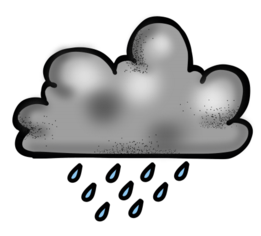
What part of the water cycle does this picture show?
a)
condensation
b)
precipitation
c)
evaporation
78.
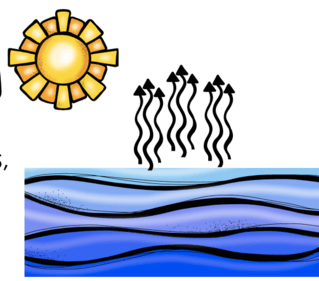
What part of the water cycle does this picture show?
a)
condensation
b)
precipitation
c)
evaporation
79.
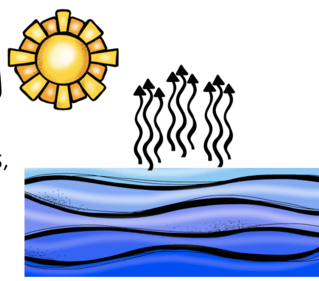
Evaporation happens when the sun ___________ water and turns it into vapor.
a)
cools
b)
heats up
c)
freezes
d)
lights up
80.
What is the process during which water cools and turns from a gas to a liquid?
a)
Codensation
b)
Runoff
c)
Precipitation
d)
Evaporation
81.
The water cycle has no start or end
a)
true
b)
false
82.
The water cycle is also known as ..........
a)
Hypertonic Solution
b)
Hydrological Cycle
c)
Hyperlogical Cycle
d)
None of these
83.
What is a layer of rock or sediment that holds water?
a)
glacier
b)
well
c)
aquifer
d)
natural spring
84.

When the water vapor in the air changes back to liquid, what does it form?
a)
rain,hail,sleet, or snow
b)
water
c)
condensation
d)
snow and water
85.

What causes water vapor to move?
a)
wind
b)
snow
c)
water
d)
lava
86.

What is water that flows in rivers and streams into the oceans and lakes?
a)
evaporating
b)
condensing
c)
precipitating
d)
runoff
87.
Water stored below the Earth's surface is called:
a)
Groundwater
b)
Bogs
c)
Water in the ground
88.
The amount of space between soil is:
a)
Porosity
b)
Permeability
89.
A material with a high porosity has:
a)
Little space
b)
A lot of space
90.
A substance has a low permeability when:
a)
Water can flow through easily
b)
Water CAN'T Flow through easily
91.
What are sources of water pollution?
a)
Precipitation as Acid rain
b)
Runoff water & Groundwater
c)
Industry & Household waste
d)
All of these
92.
True or False: Long hair MUST be tied back during a laboratory investigation.
a)
True
b)
False
93.
True or False: The wearing of flip flops and other open toed shoes are acceptable during a laboratory investigation during the hot summer months.
a)
True
b)
False
94.
If you spill or break something during an experiment, what is the FIRST thing you should do?
a)
Tell the teacher.
b)
Clean it up.
c)
Cover it with a paper towel.
d)
Leave it for someone else.
95.

The lab equipment seen in the image should be worn during a lab investigation when...
a)
using glassware.
b)
using chemicals.
c)
using heat/fire.
d)
using any of the above.
96.

Identify the piece of lab equipment seen in the image.
a)
Erlenmeyer Flask
b)
Graduated Cylinder
c)
Beaker
d)
Test Tube
97.

Identify the primary function of the lab equipment seen in the image.
a)
Mixing liquids
b)
Measuring liquid volume
c)
Mixing solids
d)
Measuring mass
98.
Which of the following should NOT be worn during a lab investigation?
a)
Flip flops
b)
Loose, long hair
c)
Dangling jewelry
d)
All of the above
99.

Identify the piece of lab equipment seen in the image.
a)
Microviewer
b)
Dissecting Scope
c)
Microscope
d)
Electron Imager
100.
The pH scale is a range from:
a)
1-7
b)
0-14
c)
1-14
d)
1-20
101.
A(n) ______ is a substance with a pH less than 7
a)
Acid
b)
Alkaline
c)
Base
d)
Buffer
102.
A(n) _______ is a substance with a pH greater than 7.
a)
Base
b)
Acid
c)
Buffer
d)
Water
103.
What is the only substance with a neutral pH of 7?
a)
Milk
b)
Orange Juice
c)
Water
d)
Blood
104.
A solution with a pH of 3.6 would be...
a)
Acid
b)
Base
c)
Neutral
d)
Acid and Base
105.
A solution with a pH of 8.6 would be...
a)
Acid
b)
Base
c)
Neutral
d)
Acid and Base
106.
Tastes Sour
a)
Acids
b)
Bases
c)
Salts
d)
All
107.
Tastes bitter.
a)
Acids
b)
Bases
c)
Salts
d)
All
108.

Bleach is a strong base, what is the pH level of bleach?
a)
13
b)
14
c)
1
d)
2
109.

According to the pH range which substance is more acidic than lemon juice
a)
Hydrochloric acid
b)
cabbage
c)
milk
100 %

