wayground logo

Free Printable Worksheets

Font size

S
M
L
XL
Worksheets

2021 Honors CFE Review Big Bang, Stars, EM Spectrum

Total questions: 111

Worksheet time: 1hrs 27mins

Name
Class
Date
1.

The Big Bang Theory explains the formation of the...

a)

Earth

b)

Sun

c)

Universe

d)

Solar System

2.

How does Cosmic Microwave Background Radiation support the Big Bang Theory?

a)

Microwaves are found everywhere in the universe.

b)

Microwaves occurred at the time of the Big Bang

c)

Microwaves are useful in our everyday lives

3.

As galaxies move away from our galaxy

a shift on the electromagnetic spectrum is noticed. This phenomena is

called _____________.

a)

redshift

b)

blueshift

4.

Cosmic Microwave Background Radiation is a form of _________.

a)

Matter

b)

Energy

c)

Visible Light

d)

Water

5.
What does the Big Bang theory suggest?
a)
The universe was just there
b)
The Milky Way is the only solar system
c)
The universe is continually expanding
d)
The universe is collapsing in toward a single point
6.

Why is the light from distant galaxies red-shifted?

a)

They produce more red light than nearby galaxies

b)

They are moving away from us

c)

The longer wavelengths are filtered out more by dust

d)

They are moving toward us

7.

The "afterglow" of the energy from the origin of the universe that we see today.

a)

Cosmic microwave radiation

b)

sunlight

c)

Doppler effect

d)

Cosmic explosions

8.

How is the "Big Bang" described?

a)

an explosion

b)

an expansion

c)

a contraction

9.
The change in wavelength of light or sound that is due to the relative motion of the source towards or away from an observer.
a)
Radar Effect
b)
Doppler Effect
c)
Light Effect
d)
Reflection
10.

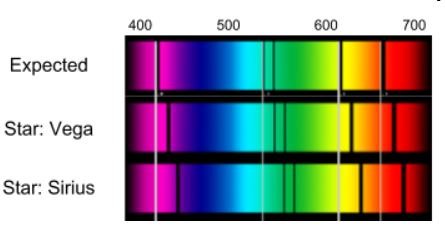
What is true about these stars?

a)

Both of these stars are moving away from us.

b)

Both of these stars are moving towards us.
11.

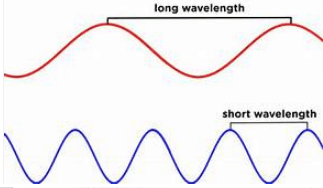
What happens to the wavelengths of energy if they are moving AWAY from a source?

a)

The waves stretch out and get longer.

b)

The waves compress and get shorter.

12.
What type of radiation does an optical telescope collect?
a)
infrared
b)
radio
c)
visible
d)
x-ray
13.
What does the amount of spectral shift tell us?
a)
velocity
b)
color
c)
temperature
d)
all of these
14.
Which of the following does the radiation from a star tell us
a)
temperature
b)
velocity
c)
composition
d)
all of these
15.
Which one is NOT an advantage that radio telescopes have over visible light telescopes?
a)
Radio Telescopes can be used 24/7
b)
Radio telescope images are not distorted by atmosphere
c)
Radio telescopes can use several telescopes to get one image
d)
Some radiation is partially blocked by the atmosphere
16.
What is an interferometer?
a)
Interference from the atmosphere
b)
a blurry image caused by the atmosphere
c)
Using two or more radio telescopes to act as one telescope
d)
a telescope that uses only infrared radiation
17.
What are two solutions that astronomers have used to fix the atmosphere-telescope problem?
a)
Radio telescopes and Reflecting Telescopes
b)
Refracting Telescopes and Reflecting Telescopes
c)
Radio Telescopes and Space Telescopes
d)
Radio Telescopes and Refracting Telescopes
18.
The two reasons why scientists build huge telescopes on mountaintops is because of...
a)
light pollution and reduced distortion
b)
light pollution and easier to gather light
c)
easier to gather light and reduced distortions
d)
light pollution and easier to see deep space
19.

Why do space telescopes take better pictures?

a)

They are higher up.

b)

They can take pictures even during the day.

c)

They are outside the Earth's atmosphere.

d)

The light from the Sun is blocked by the shadow of the Earth.

20.

Which type of telescope could NOT be used on the surface of the Earth?

a)

microwave

b)

infrared

c)

radio

d)

ultraviolet

21.

Telescopes that detect radiation outside of visible are created because...

a)

they detect images we cannot normally see.

b)

they look cool.

c)

they detect sounds we cannot normally hear.

d)

they detect messages from alien species.

22.
Radio telescopes biggest advantage is that they:
a)
Can be used during the day
b)
Can be used in any type of weather
c)
Almost all radio waves make it to the surface
d)
All of these
23.
What is a disadvantage of using a space telescope?
a)
The images are clearer due to the absence of the Earth's atmosphere
b)
All wavelengths can be observed in space.
c)
Astronomer's can "see" through clouds of gas and dust
d)
It is challenging to repair a space telescope
24.
What will the Sun become at the end of its lifecycle?
a)
red giant
b)
red dwarf
c)
white dwarf
d)
super nova
25.
Which color star is the coldest?
a)
Yellow Star
b)
Red Star
c)
Orange Star
d)
Blue Star
26.
The explosion of a massive star is called a
a)
black hole
b)
neutron star
c)
supergiant
d)
supernova
27.
Stars are made mostly of 
a)
hydrogen and oxygen
b)
sodium and helium
c)
oxygen and nitrogen
d)
hydrogen and helium
28.
What is responsible for bringing the particles together when a star is first born?
a)
Electrostatic Attraction
b)
Heat Energy
c)
Cosmic Radiation
d)
Gravity
29.
Protostars become stars when
a)
cold, dense nebulae form.
b)
fusion begins in their cores.
c)
they produce thermal energy.
30.
Stars are formed in a large cloud of gas and dust called a
a)
cumulonimbus cloud
b)
nebula
c)
neutron star
d)
black hole
31.
Review Question - What happens to the gases given off during a supernova? 
a)
They become black holes.
b)
They completely evaporate in space.
c)
They become future stars and planets.
32.
Challenge - Which of these is a remnant of a supernova event: similar to a large atomic nucleus?
a)
black hole
b)
white dwarf
c)
neutron star
33.

Once a high mass star fuses all of its hydrogen, it begins to fuse elements in which order?

a)

Helium, Carbon, Iron, Silicon, Oxygen

b)

Helium, Carbon, Neon, Oxygen, Silicon, Iron

c)

Iron, Silicon, Oxygen, Neon, Carbon, Helium

d)

High mass stars only fuse hydrogen and helium

34.

Why do even the most massive stars stop fusing at iron?

a)

Iron absorbs energy instead of releasing it

b)

Iron releases energy instead of absorbing it

c)

Iron is the least stable element

d)

Iron just hates fusing

35.

What are two possible results of a Type II supernova?

a)

Neutron Star and Black Hole

b)

Planetary Nebula and Black Hole

c)

Neutron Star and Planetary Nebula

d)

Black Hole and White Dwarf

36.

Neutron stars have incredibly strong gravity because...

a)

They are crazy dense

b)

They are crazy hot

c)

They are spinning crazy fast

d)

They are just plain crazy

37.
When our Sun becomes a Red Giant, it will engulf _______.
a)
just Mercury
b)
all the inner planets.
c)
the entire solar system
d)
just Mercury and Venus
38.
The core of a Red Giant collapses and becomes a ___________________.
a)
White Dwarf
b)
Blue Supergiant
c)
Red Supergiant
d)
Black Hole
39.
When a massive star begins to cool and expand it is known as a _______________.
a)
Blue Supergiant
b)
Red Giant
c)
Red Supergiant
d)
White Dwarf
40.
When the core of a Red Supergiant collapses, a bright event known as a ___________ occurs.
a)
superdupernova
b)
supernova
c)
big bang
d)
black hole
41.
After a supernova, the core can collapse into a neutron star, or if massive enough even a ___________.
a)
Black Hole
b)
White Dwarf
c)
Brown Dwarf
d)
Black Dwarf
42.
When a Red Giant's outer atmosphere drifts away it is now known as a ____________.
a)
planetary cloud
b)
White Dwarf cloud
c)
planetary nebula
d)
expanding nebula
43.
More massive stars continue to fuse elements in their cores all the way up to ________.
a)
silicon
b)
iron (Fe)
c)
carbon
d)
plutonium
44.
One possible outcome that is left after a supernova is a super dense core called a _____________.
a)
neutron star
b)
Yellow Star
c)
Red Giant
d)
Black Dwarf
45.
A black hole is an object so dense with so much gravity that even ________ cannot escape.
a)
man
b)
bacon
c)
spaceships
d)
light
46.
Everything you see around you was made inside ________.
a)
the earth
b)
factories
c)
stars
d)
an oven
47.

What is a protostar?

a)

A star that has died

b)

A smaller than average star

c)

A big, blue star that is on the main sequence of the HR diagram

d)

A contracting mass of gas which represents an early stage in the formation of a star

48.
What are the final two stages of a medium mass star?
a)
white dwarf - black dwarf
b)
neutron star - black hole
c)
supernova - neutron star
d)
pulsar - neutron star
49.
The life cycles of stars are determined by their:
a)
mass (size)
b)
color
c)
distance from Earth
d)
luminosity
50.
Our sun is currently in what star stage?
a)
Protostar
b)
Nebula
c)
Main Sequence
d)
Red Giant
51.
______ is a force that causes dust particles to stick together in a nebula.
a)
nuclear fusion
b)
gravity
c)
hydrogen
d)
friction
52.
Which of the following list the correct order of the life cycle of massive stars?
a)
Nebula --> protostar --> main sequence --> red supergiant --> supernova --> blackhole
b)
Nebula --> protostar --> main sequence --> red giant --> planetary nebula --> white dwarf --> black dwarf
c)
Nebula --> protostar --> main sequence --> supernova --> red giant --> blackhole
d)
Nebula --> protostar --> blackhole --> red supergiant --> supernova --> main sequence
53.
Once a star uses up all of its _________, the star will begin to go into its death phase.
a)
light
b)
heat
c)
energy
d)
hydrogen
54.
What determines if a star becomes a giant or a supergiant?
a)
star size
b)
star temperature
c)
star color
d)
star luminosity
55.
What type of stars burn Hydrogen as fuel?
a)
Main Sequence
b)
Red Giants
c)
White Dwarfs
d)
Red Supergiants
56.
A white dwarf is the final stage for _________ mass stars like our Sun.
a)
small/medium
b)
large
c)
super massive
57.
Which type of stars are fusing Helium and heavier elements?
a)
Main Sequence
b)
White Dwarfs
c)
Blue Giants
d)
Red Giants
58.
We consider these stars 'dead' because they no longer are carrying out fusion in their cores.
a)
White Dwarfs
b)
Red Dwarfs
c)
Red Giants
d)
Brown Dwarfs
59.
What characteristic of a star causes a star to be the brightest or have the highest luminosity?
a)
Temperature
b)
Size
c)
Shape
d)
Color
60.
Where does a star begin and end its life?
a)
Black Hole
b)
Galaxy
c)
Nebula
d)
Solar System
61.
Which star on the main sequence will stay on the main sequence the longest because it burns fuel much slower?
a)
Red Dwarfs
b)
Blue Giants
c)
White Dwarfs
d)
Red Giants
62.
The path a star takes during its life cycle depends solely on its _____.
a)
temperature
b)
luminosity
c)
mass
d)
location
63.
The main sequence stars with the highest mass are ____ ______.
a)
Red Dwarfs
b)
Blue Giants
c)
White Dwarfs
d)
Red Giants
64.
As the mass of a star increases, its life expectancy __________ because it burns fuel more rapidly.
a)
decreases
b)
increases
65.
A medium-mass star like our sun is expected to live for __________ years.
a)
10 Billion
b)
10 Thousand
c)
10 Million
d)
10 trillion
66.
Low to Medium mass stars like our Sun will not explode in a Supernova because they do not have enough mass. They will 'puff off' their outer layers of gas leaving a __________ nebula behind.
a)
planetary
b)
supernova remnant
c)
shockwave
d)
black hole
67.
As a whole, Giants are considered hotter than White Dwarfs.
a)
True
b)
False
68.
In the diagram given, what happens as we move to the left?
a)
Stars Get Larger
b)
Stars get Colder
c)
Stars get hotter
69.
Which star is the coldest?
a)
Yellow Star
b)
Red Star
c)
Orange Star
d)
Blue Star
70.
Compared to the rest of the stars, our sun is considered...
a)
Extremely Large and Cold
b)
Small with a medium temperature
c)
Medium size with medium temperature
71.

What characteristics are used to classify stars?

a)

Flammability, weight, and reactivity

b)

Temperature/color and brightness

c)

Conductivity, luster, and density

d)

Malleability, distance, and viscoscity

72.

Which star is hotter than Deneb

a)

Procyon

b)

Sun

c)

Regel

d)

Banard's Star

73.

Which star is brighter than the sun?

a)

Sirius B

b)

Procyon B

c)

Van Maanan's Star

d)

Aldebaran

74.

Which of the following lists the lifecycle of a star correctly?

a)

Supergiant, Giant, Dwarf, Nebula

b)

Supernova, Supergiant, Giant, Dwarf

c)

Dwarf, Main Sequence, Supergiant, Giant

d)

Main Sequence, Giant, Supergiant, Dwarf

75.

What is the Hertzsprung-Russel Diagram?

a)

A map which tells the approximate location of stars in the Milky Way galaxy and their distance from Earth.

b)

A table that alphabetically lists stars by name and includes dates of when the star was first charted.

c)

A chart which organizes stars into categories based on the amount of Hydrogen they burn.

d)

A graph used to classify stars according to their luminosity, color, temperature, and stage.

76.

Knowing the color of a star also tells us its __________

a)

age

b)

location

c)

temperature

d)

name

77.
Which electromagnetic waves have the highest frequencies and the shortest wavelengths?
a)
microwaves
b)
visible light
c)
gamma rays
78.
Which electromagnetic waves are used in ovens and cell phone communications?
a)
Infrared rays
b)
ultraviolet rays
c)
microwaves
79.
Which type of waves are used in broadcasting?
a)
radio waves
b)
infrared rays
c)
x-rays
80.
For waves in any medium, as the wavelength decreases, what happens to the frequency?
a)
It also decrease
b)
It stays the same
c)
It increases
81.
How much of the electromagnetic spectrum is made up of visible light?
a)
only a small portion
b)
a very l;arge portion
c)
about half
82.
Which of the following has wavelengths longer than microwaves?
a)
Infrared waves
b)
Radio waves
c)
Visible light
83.
Which electromagnetic waves allow us to diagnose & treat cancer?
a)
Gamma rays
b)
X-rays
c)
Ultraviolet rays
84.
The electromagnetic spectrum includes the complete range of electromagnetic waves placed in order of:
a)
increasing amplitutde
b)
increasing wavelength
c)
increasing frequency
85.
Which of the following has frequencies higher than ultraviolet rays?
a)
visible light
b)
infrared rays
c)
x-rays
86.
Which electromagnetic waves help doctors detect broken bones inside your body?
a)
gamma rays
b)
x-rays
c)
ultraviolet rays
87.
Which of the following lists the electromagnetic waves in order of increasing wavelength?
a)
X-rays, visible light, radio waves
b)
gamma rays, microwaves, UV rays
c)
infrared rays, radio waves, x-rays
88.
Which electromagnetic waves are used in devices such as heat lamps & TV remote controls?
a)
ultraviolet rays
b)
microwaves
c)
infrared rays
89.
Which of the following lists the electromagnetic waves in order of decreasing frequency?
a)
X-rays, microwaves, infrared rays
b)
UV rays, visible light, x-rays
c)
infrared rays, microwaves, radio waves
90.
Radar uses which type of electromagnetic waves to detect objects & measure their distance and speed?
a)
microwaves
b)
infrared rays
c)
x-rays
91.
A wave with a large wavelength will have a ______ frequency and _____ energy
a)
high, low
b)
high, high
c)
low, high
d)
low, low
92.
Which has the LONGEST wavelength and, therefore, the lowest frequency/energy
a)
Gamma Rays
b)
Radio Waves
c)
Visible Light
d)
Infrared rays
93.
Which has the SHORTEST wavelength and, therefore, the highest frequency/most energy
a)
Radio waves
b)
Ultraviolet Rays
c)
Gamma Rays
d)
X-rays
94.
Which section of the spectrum is the ONLY one we can see?
a)
X-rays
b)
Visible Light
c)
Gamma Rays
d)
Ultraviolet Rays
95.
How are electromagnetic waves different from other waves? 
a)
They have very short wavelengths 
b)
They transmit energy instead of matter 
c)
They can travel through empty space
d)
They can change direction by reflection 
96.
As the frequency of an electromagnetic wave increases, the amount of energy in that wave...
a)
increases.
b)
decreases.
c)
stays the same.
97.
High frequency waves have _________ wavelengths.
a)
varying
b)
long
c)
the same
d)
short
98.
The distance between two crests or two troughs of a wave is called:
a)
frequency
b)
amplitud
c)
wavelength
d)
hertz
99.
The height of the wave from the rest position is known as the _____________.
a)
amplitude
b)
crest
c)
trough
d)
wavelength
100.
What are electromagnetic waves?
a)
sound waves
b)
electric & magnetic fields (energy) that travel through empty space very quickly
c)
Someone's name
d)
things like longitudinal waves
101.
The distance between one point of a wave to the same point on the next wave.
a)
frequency
b)
wavelength
c)
amplitude
d)
crest
102.
The highest point of  a transverse wave
a)
crest
b)
trough
c)
amplitude
d)
wavelength
103.
The lowest point of  a transverse wave
a)
crest
b)
trough
c)
amplitude
d)
wavelength
104.
The type of wave with the shortest wavelength and highest frequency.  This type of wave is extremely harmful.
a)
radio
b)
infrared
c)
gamma
d)
x ray
105.
This color has the shortest wavelength
a)
Indigo
b)
red
c)
Yellow
d)
violet
106.
If an object appears black, this means all 7 colors of the visible light spectrum are _____
a)
reflected
b)
abosrbed
c)
diffracted
107.
If an object appears white, this means all 7 colors of the visible light spectrum are _____
a)
reflected
b)
abosrbed
c)
diffracted
d)
refracted
108.
If an object appears blue, this means that ______
a)
all colors are absorbed except blue, blue is reflected
b)
all colors are reflected except blue, blue is absorbed
109.
Light waves travel fastest in ________ 
a)
solid
b)
liquid
c)
gas
d)
vacuum
110.
Sound waves travel fastest in ____
a)
solid
b)
liquid
c)
gas
d)
vacuum
111.
Which of the following types of radiation has the shortest wavelength and the highest frequency?
a)
Radio Waves
b)
Infrared
c)
Visible
d)
X-Rays