Wayground logo

Free Printable Worksheets

Font size

S
M
L
XL
Worksheets

Electromagnetic Spectrum

Total questions: 54

Worksheet time: 42mins

Name
Class
Date
1.
Which electromagnetic waves have the highest frequencies and the shortest wavelengths?
a)
microwaves
b)
visible light
c)
gamma rays
2.
Which electromagnetic waves are used in ovens and cell phone communications?
a)
Infrared rays
b)
ultraviolet rays
c)
microwaves
3.
Which type of waves are used in broadcasting?
a)
radio waves
b)
infrared rays
c)
x-rays
4.
Electromagnetic waves that help your body produce vitamin D are called?
a)
ultraviolet rays
b)
x-rays
c)
gamma rays
5.
For waves in any medium, as the wavelength decreases, what happens to the frequency?
a)
It also decrease
b)
It stays the same
c)
It increases
6.
How much of the electromagnetic spectrum is made up of visible light?
a)
only a small portion
b)
a very l;arge portion
c)
about half
7.
Which of the following has wavelengths longer than microwaves?
a)
Infrared waves
b)
Radio waves
c)
Visible light
8.
Which electromagnetic waves allow us to diagnose & treat cancer?
a)
Gamma rays
b)
X-rays
c)
Ultraviolet rays
9.
Which of the following has frequencies higher than ultraviolet rays?
a)
visible light
b)
infrared rays
c)
x-rays
10.
Which electromagnetic waves help doctors detect broken bones inside your body?
a)
gamma rays
b)
x-rays
c)
ultraviolet rays
11.
Which of the following lists the electromagnetic waves in order of increasing wavelength?
a)
X-rays, visible light, radio waves
b)
gamma rays, microwaves, UV rays
c)
infrared rays, radio waves, x-rays
12.
Which electromagnetic waves are used in devices such as heat lamps & TV remote controls?
a)
ultraviolet rays
b)
microwaves
c)
infrared rays
13.
Which of the following lists the electromagnetic waves in order of decreasing frequency?
a)
X-rays, microwaves, infrared rays
b)
UV rays, visible light, x-rays
c)
infrared rays, microwaves, radio waves
14.
Radar uses which type of electromagnetic waves to detect objects & measure their distance and speed?
a)
microwaves
b)
infrared rays
c)
x-rays
15.
True or false: as you move along the spectrum, radio to gamma waves, the wavelengths decrease in size (get smaller)
a)
true
b)
false
16.
A wave with a large wavelength will have a ______ frequency and _____ energy
a)
high, low
b)
high, high
c)
low, high
d)
low, low
17.
Select the correct order of waves on the EMS from the longest wavelength to the shortest wavelength
a)
Radio, Micro, Infra, Visible, Ultra, X-ray, Gamma
b)
Gamma, X-ray, Ultra, Vis, Infra, Micro, Radio
c)
Vis, Micro, Infra, Ultra, X-ray, Gamma, Radio
d)
Micro, Radio, Vis, Infra, Ultra, X-ray, Gamma
18.
Which has the LONGEST wavelength and, therefore, the lowest frequency/energy
a)
Gamma Rays
b)
Radio Waves
c)
Visible Light
d)
Infrared rays
19.
Which has the SHORTEST wavelength and, therefore, the highest frequency/most energy
a)
Radio waves
b)
Ultraviolet Rays
c)
Gamma Rays
d)
X-rays
20.
Which section of the spectrum is the ONLY one we can see?
a)
X-rays
b)
Visible Light
c)
Gamma Rays
d)
Ultraviolet Rays
21.
How are electromagnetic waves different from other waves? 
a)
They have very short wavelengths 
b)
They transmit energy instead of matter 
c)
They can travel through empty space
d)
They can change direction by reflection 
22.
Which of the following electromagnetic waves has the lowest energy?
a)
gamma ray
b)
infrared wave
c)
visible light wave
d)
microwave
23.
As the frequency of an electromagnetic wave increases, the amount of energy in that wave...
a)
increases.
b)
decreases.
c)
stays the same.
24.
High frequency waves have _________ wavelengths.
a)
varying
b)
long
c)
the same
d)
short
25.
The distance between two crests or two troughs of a wave is called:
a)
frequency
b)
amplitud
c)
wavelength
d)
hertz
26.
The height of the wave from the rest position is known as the _____________.
a)
amplitude
b)
crest
c)
trough
d)
wavelength
27.
Which portion of the electromagnetic spectrum includes the entire range of light that can be detected by the human eye? 
a)
ultraviolet light
b)
visible light
c)
infrared light
d)
x-rays
28.
If the wavelength of an electromagnetic wave is longer, what is true about the energy? 
a)
Energy is higher.
b)
Energy is lower. 
c)
Energy is not dependent on wavelength. 
29.
Which part of the electromagnetic spectrum has high enough energy to cause damage to eyes and skin, and sometimes even cancer? 
a)
infrared light
b)
visible light
c)
ultraviolet light
d)
microwaves
30.
Which of the following electromagnetic waves has the highest energy? 
a)
radio waves
b)
microwaves
c)
infrared light
d)
visible light
31.

Which of the following electromagnetic waves has the lowest energy?

a)

infrared light

b)

visible light

c)

ultraviolet light

d)

x-rays

32.
Which of the following electromagnetic waves is given off as heat? 
a)
ultraviolet light
b)
x-rays
c)
gamma rays
d)
infrared rays
33.
Which is the correct order of waves of the electromagnetic spectrum, from lowest energy to highest energy? 
a)
radio waves, microwaves, infrared waves, visible light, ultraviolet light, x-rays, gamma rays
b)
gamma rays, x-rays, ultraviolet light, visible light, infrared light, microwaves, radio waves
34.
Cell phones use_____________waves.
a)
Microwaves
b)
Gamma
c)
XRays
d)
Radio 
35.
Infrared waves are used in__________________.
a)
Bath tubs
b)
Microwaves
c)
Remote Controls
d)
Tanning
36.
Cancer can be treated with_______________waves.
a)
Penicillin
b)
Radio
c)
Infrared
d)
Gamma
37.
EM waves________________travel through space.
a)
Never
b)
Cannot
c)
Can
d)
Wish they could
38.
_____________________light is the only type of EM wave detected by the human eye.
a)
Red
b)
Gamma
c)
Microwave
d)
Visible
39.
EM waves ________ a medium.
a)
require
b)
don't require
c)
can have
d)
sometimes have
40.
EM waves _______ travel the same speed in a vacuum. 
a)
never
b)
sometimes
c)
always
d)
can
41.
_____ have the longest wavelengths and lowest frequencies of all electromagnetic waves.
a)
microwaves
b)
radio waves
c)
gamma rays
d)
ultraviolet
42.
This type of EM wave can cause skin cancer. 
a)
microwaves
b)
ultraviolet ray
c)
radio
d)
infrared
43.
_______ carry the greatest amount of energy. 
a)
x-rays
b)
gamma rays
c)
infrared rays
d)
visible light
44.
Nuclear weapons are examples of __________. 
a)
x-rays
b)
ultraviolet rays
c)
gamma rays
d)
infrared rays
45.
All electromagnetic waves have _________ wavelengths and ________ frequencies.
a)
different, similar
b)
different, different
c)
similar, similar
d)
similar, different
46.
The higher the frequency the ______ the energy. 
a)
higher
b)
lower
c)
neither, stays the same
47.
This type of EM wave shows a break in bones.
a)
gamma ray
b)
x-ray
c)
brokenometer
d)
radio wave
48.
________ is an EM wave that has the LEAST energy.
a)
radio
b)
gamma rays
c)
microwaves
d)
visible light
49.

What is the correct order of the visible light spectrum starting with the longer wavelength?

a)

Red, yellow, orange, blue, violet, indigo

b)

Violet, indigo, blue, green, yellow, orange, red

c)

Green, yellow, blue, indigo, red, orange

d)

Red, orange, yellow, green, blue, indigo, violet

50.

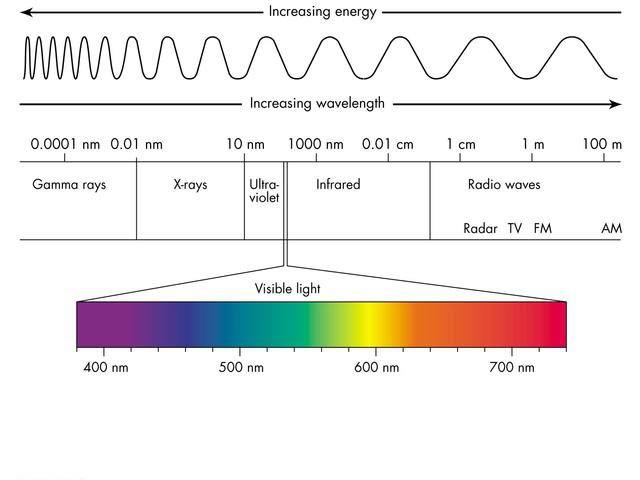
What does the picture below illustrate?

a)

Visible Light Spectrum

b)

Electromagnetic Spectrum

c)

Frequency Indicator

d)

Color Line

51.

What is the saying that can help you remember the order of the visible spectrum?

a)

ROYGBIV

b)

RYOBIVG

c)

ROYBVIG

d)

RIBYOVG

52.

Light is a type of energy that travels as an ______________ ____________.

a)

Longitudinal Wave

b)

Electric Current

c)

Electromagnetic Wave

d)

Magnetic Wave

53.

A prism can be used to...

a)

separate visible light into colors

b)

make a beam of light brighter

c)

measure the speed of light

d)

make UV light visible

54.

___________ is a form of energy that we can see with our eyes.

a)

Radio Waves

b)

Visible Light

c)

Ultraviolet

d)

Reflection