
 Worksheets
Earthquakes
Total questions: 58
Worksheet time: 1hrs 27mins
Earthquakes most often occur
in the middle of plates
near plate boundaries
where thunderstorms are
along the coast


Which zone is larger?
S wave shadow
P waves shadow
shadow zones are equal

Around what time did the first P wave get detected?
100 sec
120 sec
150 sec
160 sec

Which location is farther from the epicenter?
Seismogram B (top)
Seismogram C (bottom)

Which location would experience a more intense earthquake?
Seismogram A (top)
Seismogram B (bottom)
Which portion of the Earth can S waves NOT travel through?
Crust
Mantle
Core

Which letter represents surface waves?
A
B
C
All are surface waves

Which station was closest to the earthquake's epicenter?
Station A
Station B
Station C

Scientists are able to create an image like this by studying
electromagnetic waves
P and S waves
P and Surface waves
S and Surface waves

This model demonstrates a
P wave shadow zone
S wave shadow zone
Surface wave shadow zone
Convection currents

This model represents a
P wave shadow zone
S wave shadow zone
Surface wave shadow zone
Convection currents
Measures how much an energy an earthquake releases, which is shown by the amplitude of seismic waves
Magnitude
Epicenter
Focus
L-wave
This type of wave travels along Earth's crust and can be very destructive.
P wave
S wave
Surface wave
EM waves
Where do earthquakes occur?
Along fault lines
Along coastlines
In mountainous areas
None of the above
True or False: The earth’s crust is made up of moving parts called plates
True
False
What is a seismic wave?
Escaping energy from colliding plates
A tectonic plate
A massive tidal wave
Someone waving to you
Which of these describes Convergent Boundaries?
Two plates sliding next to each other
Two plates pushing towards each other
Two plates pushing away from each other
One plate sliding over another plate
Which of these describes Divergent Boundaries?
Two plates pushing towards each other
Two plates pushing away from each other
One plate sliding on top of another plate
Two plates sliding next to each other
Which of these describes Transform Boundaries?
Two plates pushing away from each other
Two plates sliding towards each other
Two plates sliding next to each other
A plate sliding over another plate

In your opinion, which boundary do you think would cause the most violent/deadly earthquakes?
Transform
Convergent
Divergent
Where does an earthquake start?
focus
epicenter
upper mantle
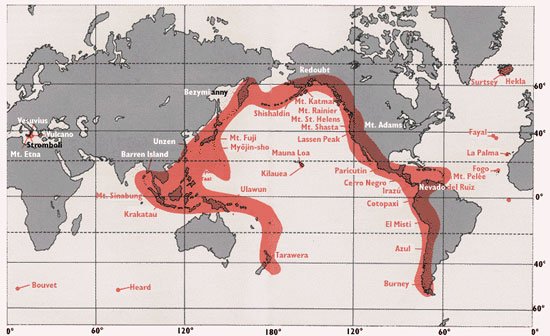
This is the name for the chain of volcanos around the edge of the Pacific Plate.
March Maddness
Earthquake Alley
Ring of Fire
Circle of Death

Where is the point on the Earth’s surface directly above the starting point of an earthquake?
Epicenter
Fault
Magma chamber
Which type of wave is the first to arrive after an earthquake occurs?
P Wave
Rayleigh Wave
S Wave


Many earthquakes happen along the borders of...
Countries
Tectonic Plates
Climate Zones
None of the above.

What are the puzzle pieces of the Earth's surface called?
Tectonic plates
Subductions
Earthquakes
Convergents
Most injuries during an earthquake result from _____________.
the ground moving during an earthquake.
the collapse of buildings and other structures or falling objects and flying glass.
loose soil and rock.
the San Andreas fault.
An area on Earth's surface where no direct seismic waves from a particular earthquake can be detected.
fault zone
focus
shadow zone
seismic gap
A seismograph is an instrument that records vibrations . . . . .
in the atmosphere
above the ground
in the ground
in Earth's core
Undersea earthquakes can cause a sudden drop or rise in the ocean floor creating a __________________.
hurricane
tsunami
P wave
S wave
________________ has the highest earthquake hazard level of the contiguous United States.
Alaska
California
China
South Carolina
All earthquakes result from movement along plate boundaries.
True
False
A measure of the strength of an earthquake is called the _____________.
focus
magnitude
epicenter
intensity
The Focus is . . . .
a seismic wave that travels through the body of a medium.
a seismic wave that travels along the surface of a medium and that has a stronger effect near the surface of the medium than it has in the interior.
the point on the Earth's surface directly above an earthquake's starting point.
the location within Earth along a fault at which the first motion of an earthquake occurs.
A Surface Wave is . . . .
a seismic wave that travels through the body of a medium.
a seismic wave that travels along the surface of a medium and that has a stronger effect near the surface of the medium than it has in the interior.
the point on the Earth's surface directly above an earthquake's starting point.
the location within Earth along a fault at which the first motion of an earthquake occurs.
An Epicenter is . . . .
a seismic wave that travels through the body of a medium.
a seismic wave that travels along the surface of a medium and that has a stronger effect near the surface of the medium than it has in the interior.
the point on the Earth's surface directly above an earthquake's starting point.
the location within Earth along a fault at which the first motion of an earthquake occurs.
What instrument is used to record the intensity of an earthquake?
Barometer
Seismometer
Hydrometer
Anemometer
Which layer of the Earth is liquid?
Crust
Mantle
Outer core
Lithosphere
What is the scale called that measures the magnitude of earthquakes?
Richter Scale
Fujita Scale
Beaufort Scale
Scoville Scale

