wayground logo

Free Printable Worksheets

NEW

Font size

S
M
L
XL
Worksheets

Y12 DA Physics

Total questions: 69

Worksheet time: 3625secs

Name
Class
Date
1.
What is represented by the blue lines?
a)
Trough
b)
Crest
c)
Wavelength
d)
Amplitude
2.
What part is represented by the blue lines?
a)
Crest
b)
Resting Point
c)
Wavelength
d)
Amplitude
3.
What part is the arrow pointing to?
a)
Crest
b)
Trough
c)
Amplitude
d)
Wavelength
4.
What part is the arrow pointing to?
a)
Crest
b)
Trough
c)
Amplitude
d)
Wavelength
5.
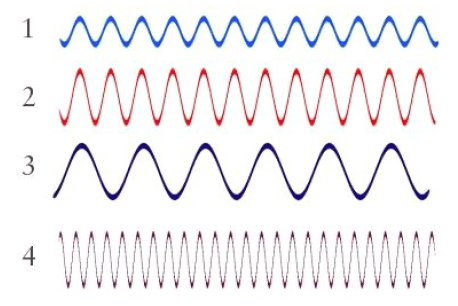
Which wave in the diagram has the greatest wavelength?
a)
1
b)
2
c)
3
d)
4
6.
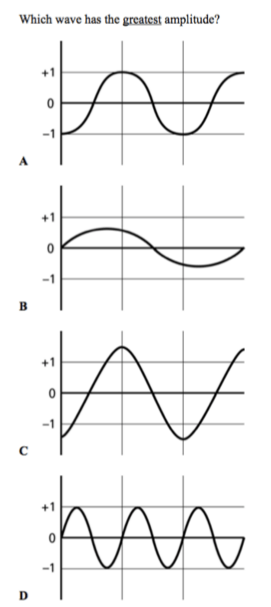
Which wave has the greatest amplitude?
a)
A
b)
B
c)
C
d)
D
7.
What kind of wave is pictured?
a)
Transverse
b)
Longitudinal
c)
surface
d)
none of the above
8.
Sound is an example of which type of wave?
a)
Transverse
b)
Longitudinal
c)
Both
d)
Neither
9.
Light is an example of which type of wave?
a)
Transverse
b)
Longitudinal
c)
Both
d)
Neither
10.
Cell phones and televisions use this type of EM wave.  It has the longest wavelength with the lowest frequency.
a)
radio wave
b)
tv wave
c)
Gamma wave
d)
ultra violet
11.
Which part of the electromagnetic spectrum has high enough energy to cause damage to eyes and skin, and sometimes even cancer? 
a)
infrared light
b)
visible light
c)
ultraviolet light
d)
microwaves
12.
These are the waves that are used to penetrate solids and are used to create medical images.
a)
visible light
b)
gamma rays
c)
x rays
d)
microwaves
13.
Light bending as it passes from one medium (object) to another is...
a)
Refraction
b)
Reflection
14.
A prism separating white light is an example of...
a)
Refraction
b)
Reflection
15.

In the diagram, which letter represents the angle of incidence?

a)

A

b)

B

c)

C

d)

D

16.
........... – the angle between the normal and the incident ray.
a)
Angle of incidence
b)
Angle of reflection
c)
Angle of coincidence
d)
Angle of direction
17.
All stars start as gas and dust in a(n)
a)
nebula
b)
black hole
c)
red giant
d)
black dwarf
18.
After the main sequence, a low mass star becomes a
a)
black dwarf
b)
protostar
c)
red giant
d)
supergiant
19.
After the main sequence, a high mass star becomes a
a)
black dwarf
b)
protostar
c)
red giant
d)
supergiant
20.
The final stage of a low mass star is a 
a)
neutron star
b)
nebula
c)
black hole
d)
black dwarf
21.
After a supergiant, a high mass star explodes and forms a
a)
supernova
b)
red giant
c)
black hole
d)
planetary nebula
22.
A high mass star can end as this stage, which is so dense that not even light can escape!
a)
black dwarf
b)
white dwarf
c)
supernova
d)
black hole
23.
When a nebula heats up, a "baby" star forms in the middle. It is called a
a)
supernova
b)
supergiant
c)
white dwarf
d)
protostar
24.

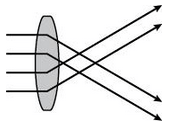
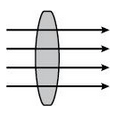
The above lens is a type of ___.

a)

diverging lens

b)

converging lens

c)

divergent lens

d)

convergent lens

25.

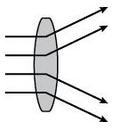
Which lens represents the path light takes through a diverging lens?

a)
b)
c)
d)
26.

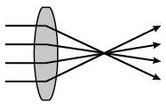
Which figure represents the path light takes through a converging lens?
a)
b)
c)
d)
27.

A lens that is thicker in the middle than on the outside is called ___.

a)

diverging

b)

concave

c)

convex

d)

achromatic

28.

A lens that is thinner in the middle than on the outside is called ___.

a)

diverging

b)

concave

c)

convex

d)

achromatic

29.
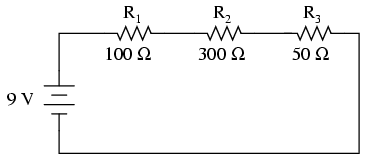
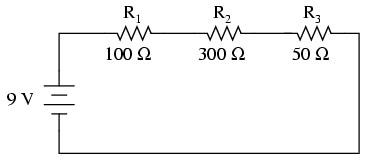
The picture shows an electrical circuit. This circuit is a series circuit because: 
a)
It has 3 light bulbs.
b)
The same current flows through all three light bulbs.
c)
It uses a single battery.
d)
The electrical current is divided between the three light bulbs.
30.
The total resistance in this circuit is 
a)
100 ohms
b)
450 ohms
c)
400 ohms
d)
30 ohms
31.
The total current through this circuit is
a)
0.02 amps
b)
0.09 amps
c)
50 amps
d)
9 amps
32.
As the resistance of a circuit increases, the current will...
a)
increase
b)
decrease
c)
stay the same
33.
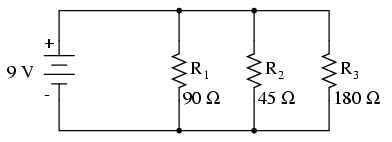
In a parallel circuit which of the following is the same value throughout the circuit?
a)
Voltage
b)
Current
c)
Resistance
d)
Charge
34.
The total resistance of this circuit is 
a)
25.7 ohms
b)
315 ohms
c)
324 ohms
d)
90 ohms
35.
What will happen if one light bulb is removed from this circuit?
a)
The other bulbs will go out.
b)
The other bulbs will stay on
c)
The other bulbs will get dimmer.
d)
The battery will become stronger.
36.
Does this diagram represent a series or parallel circuit?
a)
series circuit
b)
parallel circuit
37.
What size resistor would produce a 3 Amp current flow with a 12 Volt battery
a)
1 Ohm
b)
3 Ohms
c)
4 Ohms
d)
12 Ohms
38.
What is resistance measured in?
a)
Ω (Ohms)
b)
V (Volts)
c)
A (Amps)
d)
W (Watts)
39.

Voltage divided by Current

(V / I)

a)

Current

b)

Power

c)

Resistance

d)

Watts

40.
Current times Resistance equals
 (I X R)
a)
Power
b)
Voltage
c)
Amperage
d)
Ohm
41.

How does the thickness of a wire affect resistance?

a)

A thicker wire has more resistance

b)

A thinner wire has more resistance

c)

Thickness of a wire does not affect resistance

42.

If the length of a wire increases, the resistance ____________

a)

a. decreases

b)

b. increases

c)

c. stays the same

d)

d. unknown

43.
If the hair dryer and the vacuum cleaner are both on, what is the power used?
a)
2600 watts
b)
400 watts
c)
2200 watts
d)
1100 watts
44.
Electrical power can be calculated using
a)
Resistance x Voltage
b)
Voltage x Current 
c)
Voltage ÷ Current
45.
Watts is the same as...
a)
Joules per second
b)
Voltage per second
c)
Current per second
46.
The voltage supplied to a circuit is 17 V and the current running through is 10 A. What is the power generated?
a)
170 W
b)
170 A
c)
1.7 V
d)
1.7 W
47.
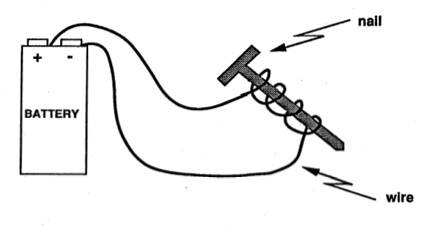
This is a picture of a simple electromagnet. How can the electromagnet be made stronger?
a)
Add more coils of wire to the nail.
b)
Use a smaller battery.
c)
Reverse the poles of the magnet.
d)
Remove all the coils and the nail.
48.
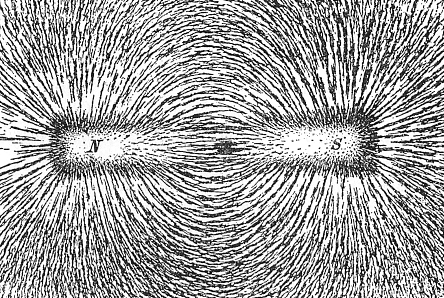
Surrounding every magnet is a __________  __________.
a)
magnetic field
b)
electrical current
c)
another magnet
d)
an enemy
49.
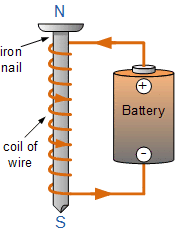
In order for an electromagnet to be formed, an __________ current must pass through a coil of __________ wrapped around an ________ core.
a)
wire, iron, electric
b)
electric, wire, iron
c)
iron, electric, wire
d)
excited, hair, apple
50.
What would increase the strength of an electromagnet?
a)
Increasing the amount of current flowing through the wire.
b)
Inserting a wooden core inside the coil
c)
Changing the direction of the current
d)
Decreasing the number of coils of wire
51.
What is the metal center of an electromagnet called?
a)
The current
b)
The wire
c)
The coil
d)
The ferromagnetic core
52.

Cosmic Microwave Background Radiation is a form of _________.

a)

Matter

b)

Energy

c)

Visible Light

d)

Water

53.

As galaxies move away from our galaxy

a shift on the electromagnetic spectrum is noticed. This phenomena is

called _____________.

a)

redshift

b)

blueshift

54.

How does Cosmic Microwave Background Radiation support the Big Bang Theory?

a)

Microwaves are found everywhere in the universe.

b)

Microwaves occurred at the time of the Big Bang

c)

Microwaves are useful in our everyday lives

55.
The three pieces of evidence for our current theory of the universe are:
a)
blueshift, CMB, moon landing.
b)
redshift, IBM, Andromeda galaxy.
c)
redshift, CMB, distribution of elements.
d)
doppler effect, light spectra, fusion.
56.
The CMB is:
a)
the remaining energy from the big bang.
b)
incredibly hot.
c)
visible to the human eye.
d)
only located in certain places in the universe.
57.
The only elements in the universe were hydrogen and helium until:
a)
the big bang.
b)
humans came along.
c)
stars began doing fusion.
d)
the redshift was discovered.
58.
Our theory of the universe was confirmed by the discovery of:
a)
fusion.
b)
cosmic microwave background radiation.
c)
the Andromeda galaxy.
d)
the Doppler effect.
59.
Light waves that are stretched out by objects moving apart:
a)
have a shorter wavelength.
b)
travel faster than the speed of light.
c)
are invisible.
d)
appear more red.
60.

Which of the following always has a negative charge?

a)

a proton

b)

an electron

c)

a battery

d)

all of the above

61.
this is the symbol for a _____?
a)
switch
b)
light 
c)
battery
d)
wires
62.
what is this symbol for?
a)
light bulb
b)
cell
c)
battery
d)
resistor
63.
This is the symbol for a ...
a)
Bulb
b)
Battery
c)
Horn
d)
Fuse
64.
This is the symbol for a ...
a)
Wire
b)
Battery
c)
Buzzer
d)
Fuse
65.
This is the circuit symbol for ...
a)
an AC current source
b)
a DC current source
c)
an ammeter
d)
a voltmeter
66.
This is the circuit symbol for ...
a)
an AC current source
b)
a DC current source
c)
an ammeter
d)
a voltmeter
67.
This is the circuit symbol for ...
a)
an AC current source
b)
a DC current source
c)
a battery
d)
a single cell
68.
a)
Closed switch
b)
Push switch
c)
Trap door
d)
AC Power supply
69.

This is the symbol for a...

a)

Light Emitting Diode

b)

Fuse

c)

Fixed Resistor

d)

Variable Resistor