wayground logo

Free Printable Worksheets

Font size

S
M
L
XL
Worksheets

Biology Final

Total questions: 65

Worksheet time: 3hrs 7mins

Name
Class
Date
1.
Every living organism is made up of one or more cells
a)
True
b)
False
2.
A cell is...
a)
the basic unit of structure and function in living organism
b)
an organism
c)
a basic part of everything that we see
d)
found only in animals, not plants
3.
Which of the following are NOT found in animal cells
a)
chloroplasts and cytoplasm
b)
chloroplasts and cell wall
c)
cell wall and cell membrane
d)
mitochondria and nucleus
4.
This organelle is a rigid outer layer that protects plant cells.
a)
Cell Membrane
b)
Cell Wall
c)
Nucleus
d)
Chloroplast 
5.
What phase of mitosis is shown in the picture?
a)
Prophase
b)
Anaphase
c)
Telophase
d)
Metaphase
6.
What phase of mitosis is shown in the picture?
a)
Prophase
b)
Anaphase
c)
Telophase
d)
Metaphase
7.
What phase of mitosis is shown in the picture?
a)
Prophase
b)
Anaphase
c)
Telophase
d)
Metaphase
8.
Chromatid pairs separate and move to opposite ends of the cell
a)
Metaphase
b)
Telophase
c)
Interphase
d)
Anaphase
9.
What phase of mitosis is shown in the picture?
a)
Prophase
b)
Anaphase
c)
Telophase
d)
Metaphase
10.
Results of cell division or mitosis include all of the following EXCEPT?
a)
growth
b)
repair damaged cells
c)
replace damaged cells
d)
dead cells
11.
Two new nuclei form and the cytoplasm splits
a)
Metaphase 
b)
Telophase
c)
Anaphase
d)
Prophase
12.
Which of the following lists, in order, the phases of mitosis?
a)
interphase, metaphase, anaphase, telophase
b)
prophase, metaphase, anaphase, telophase
c)
prophase, metaphase, anaphase, interphase
d)
prophase, anaphase, metaphase, telophase
13.
What kind of cells are made in MEIOSIS?
a)
Haploid cells
b)
Diploid Cells
c)
Skin Cells
d)
Liver Cells
14.
What causes genetic variation in meiosis?
a)
chromosomes lining up
b)
crossing over of chromosomes
c)
separation of chromosomes
d)
chromosomes pulling apart
15.
The chromosomes that pair up during meiosis, are called __________ chromosomes.  
a)
homozygous 
b)
asexual
c)
homologous
d)
genes
16.
Which cellular process is shown?
a)
meiosis
b)
endocytosis
c)
mitosis
d)
phagocytosis
17.
What phase is represented?
a)
metaphase 1
b)
metaphase 2
c)
anaphase 1
d)
anaphase 2
18.
What phase is  shown in the picture?
a)
metaphase 2
b)
anaphase 2
c)
metaphase 1
d)
telophase 1
19.
Meiosis makes sperm and egg cells. In humans, sperm and egg cells each have _____ chromosomes. Therefore a fertilized human egg cell (sperm and egg cell combined) would create a cell with _____ chromosomes.
a)
23, 46
b)
46, 23
c)
2, 4
d)
50, 100
20.
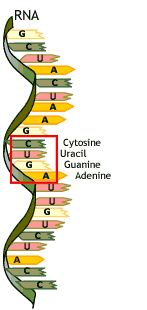
In RNA, Uracil pairs with ______. 
a)
cytosine
b)
adenine
c)
guanine
d)
thymine
21.
The process to go from DNA to mRNA is _______
a)
translation
b)
transcription
c)
replication
22.
The process to go from mRNA to a protein is called ____
a)
transcription
b)
rRNA
c)
replication
d)
translation
23.
What is the three base sequence of mRNA that codes for a single amino acid?
a)
Anticodon
b)
Codon
c)
Protein
24.
What is the location in the cell for transcription?
a)
nucleus
b)
cytoplasm
c)
ribosome
d)
mitochondria
25.
Translation is the process where
a)
mRNA is created in the Nucleus
b)
mRNA is decoded to form a protein 
c)
glucose molecules are made
d)
is where lipids are synthesised
26.

Which of the following are differences in the structure between RNA and DNA

a)

DNA uses deoxyribose sugar, RNA uses sugar ribose

b)

DNA pairs Adenine with Uracil, RNA pairs Adenine with Thymine

c)

DNA is a double helix, RNA is a single helix

d)

DNA pairs Adenine with Thymine, RNA pairs Adenine with Uracil

27.

Which organelle is the location where protein is made?

a)

Ribosome

b)

Nucleus

c)

Cytoplasm

d)

Nucleotide

28.
Replicate the following strand of DNA: 
AATCATGGA
a)
AATCATGGA
b)
TTAGTACCT
c)
UUAGUACCU
d)
GGATAUCUA
29.
The enzyme that unzips the DNA to prepare for replication
a)
helicase
b)
replicase
c)
polymerase
d)
synthase
30.
The bonds that hold the two strands of DNA together come from...
a)
the attraction of phosphate groups 
b)
strong bonds between  bases and sugars
c)
carbon to carbon bonds in the sugar
d)
weak hydrogen bonds between the bases
31.
Which organelle is DNA usually found in?
a)
cell membrane
b)
vacuole
c)
chloroplast
d)
nucleus
32.
The nucleic acid DNA is composed of
a)
sugar, protein, and nitrogenous bases.
b)
protein, nitrogenous bases, and phosphate.
c)
nitrogenous bases, phosphate, and RNA.
d)
sugar, phosphate, and nitrogenous bases.
33.
Name this structure
a)
double helix
b)
nucelotide
c)
twisted ladder
d)
hydrogen bond
34.
In pea plants, the tall allele is dominant to the short allele. What key would demonstrate this?
a)
Tall = T
Short = S
b)
Tall = T
Short = t
c)
Tall = t
Short = T
d)
Tall = TT
Short = tt
35.
A heterozygous long-tusked elephant is crossed with a homozygous recessive short-tusked elephant. What is the probability of the offspring having short tusks?
a)
0%
b)
25%
c)
50%
d)
75%
36.
A heterozygous long-tusked elephant is crossed with a homozygous recessive short-tusked elephant. What is the probability of the offspring having short tusks?
a)
0%
b)
25%
c)
50%
d)
75%
37.
Jabba the Hutt has finally decided to settle down and have a family. He has undergone genetic testing and learned that he is heterozygous for Hutt Fungal Syndrome, which is caused by recessive alleles. He is worried that his children might suffer from this syndrome. His Hutt mate has undergone genetic testing and discovered she is homozygous dominant for the syndrome. Should Jabba be worried?
a)
Yes
b)
No
38.
T - tall and t = short
In the punnett square below, what belongs in the missing square
a)
tt
b)
Tt
c)
Bb
d)
TT
39.
Heterozygous is when...
a)
the alleles are the same
b)
the alleles are different
c)
the alleles are absent
d)
the alleles are present
40.
In a heterozygous genotype, the ___________ allele takes over in the phenotype.
a)
recessive
b)
dominant
c)
lower case letter
d)
both 
41.
G = green, g = yellow
The genotype for a yellow plant is...
a)
GG
b)
Gg
c)
gg
d)
all of the choices result in yellow
42.
Which of the following alleles is homozygous (purebred) recessive?
a)
Tt
b)
tt
c)
TT
d)
t
43.
What is the dominant trait?
a)
yellow pea seeds
b)
green pea seeds
c)
there is no dominant seed
d)
Jolly green giant
44.
What is the yellow seed genotype?
a)
aa
b)
Aa
c)
AA
d)
AA or Aa
45.
What genotype would go in box 2?
a)
BB
b)
Bb
c)
bb
46.
Which of the following is homozygous dominant?
a)
Jj
b)
Rr
c)
MM
d)
ee
47.
T4 - Based off this Punnett Square, what fraction of the offspring will have wrinkled, yellow seeds?
a)
9/16
b)
3/16
c)
1/16
d)
16/16
48.
In a pedigree, what shape represents a male?
a)
circle
b)
square
c)
triangle
d)
diamond
49.
Lisa has two grandmothers in this picture.
a)
Mona and Jackie
b)
Marge and Mona
c)
Selma and Jackie
d)
Patty and Selma
50.
How many girls in this family express this recessive disorder?
a)
4
b)
5
c)
6
d)
7
51.
What is the genotype of the great-grandfather? (Individual 2)
a)
A_
b)
aa
c)
Aa
d)
AA
52.
How many individuals are there in the 3rd generation?
a)
2
b)
3
c)
4
d)
6
53.
a)
Not Affected Male
b)
Not Affected Female
c)
Affected Male
d)
Affected Female
54.
How many people in this whole pedigree have the trait/disease?
a)
2
b)
3
c)
4
d)
6
55.
What does a vertical line coming down from a square and circle that are connected by horizontal line indicate?
a)
They are cousins
b)
The children
c)
Aunts and Uncles
56.
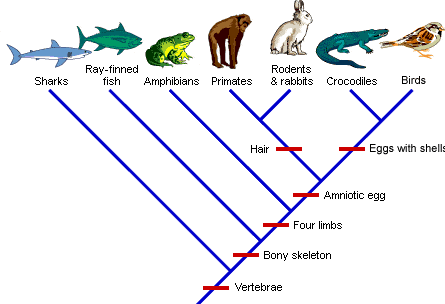
According to this cladogram, sharks are MOST closely related to which organism? 
a)
Amphibians
b)
Ray finned fish
c)
Crocodiles
d)
Birds
57.
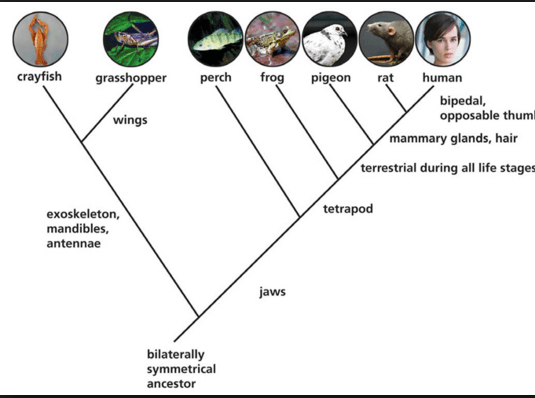
According to the cladogram, which organism is most distantly related to the human?
a)
crayfish
b)
grasshopper
c)
perch
d)
frog
58.
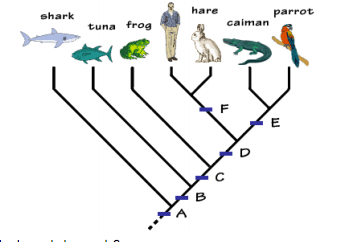
On the cladogram, which organism is the closest relative of the human?
a)
Frog
b)
Hare
c)
Caiman
d)
Parrot
59.
Individuals that are well adapted to their environment will survive and produce:
a)
Fewer mutations
b)
Stronger genes
c)
More offspring
d)
Better traits
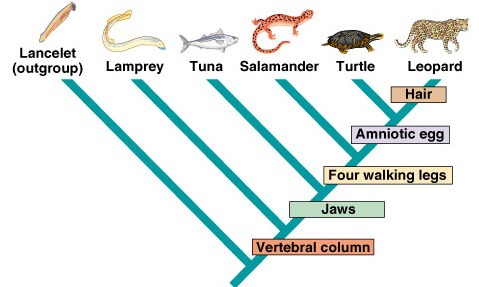
60.

Which is the newest trait?

a)

Amniotic egg

b)

Walking legs

c)

Jaws

d)

Hair

61.

What is this a picture of?

a)

Pedigree

b)

Cladogram

c)

Family Tree

d)

Oak Tree

62.

What characteristic do all the organisms on this cladogram share?

a)

Being bi-pedal & having language

b)

Complex brains

c)

Fully binocular vision

d)

Partial binocular vision & opposable thumbs

63.
The ____________ regulates what enters and leaves the cell.
a)
mitochondria
b)
cell membrane
c)
golgi bodies
d)
cytoplasm
64.
What creates the protein for the cell?
a)
Cytoplasm
b)
Nucleus
c)
Golgi bodies
d)
Ribosomes
65.

How did you enjoy the class? (Be honest)

a)

IT WAS AWESOME!

b)

It was good for a science class

c)

Eh its school

d)

Hated it