wayground logo

Free Printable Worksheets

Font size

S
M
L
XL
Worksheets

Earth Systems 2nd Semester Exam Review

Total questions: 72

Worksheet time: 44mins

Name
Class
Date
1.

Huge pieces of lithosphere that slowly move on the asthenosphere and consist of the crust and the rigid, uppermost part of the mantle

a)

tectonic plates

b)

North American Plate

c)

Eurasian Plate

d)

African Plate

2.

the place where two different plates have contact.

a)

Pacific Plate

b)

Mountains

c)

Earthquakes

d)

Plate Boundaries

3.

Occurs when two tectonic plates move toward each other and collide

a)

convergent boundary

b)

subduction

c)

volcanic eruptions

d)

divergent boundary

4.

Occurs when two tectonic plates move away from each other.

a)

Divergent Boundary

b)

Convergent Boundary

c)

Volcanic eruptions

d)

Mountain building

5.

Occurs when two tectonic plates slide past each other

a)

Transform Boundary

b)

Ocean Basin

c)

Divergent Boundary

d)

Spreading ridges

6.
What was the main reason Wegener’s continental drift hypothesis was rejected?
a)
He did not have any evidence
b)
His proposed mechanisms were physically impossible
c)
He did not propose any mechanisms.
7.
A divergent boundary at two oceanic plates can result in a ____.
a)
volcanic island arc
b)
continental volcanic arc
c)
earthquake
d)
ocean ridges (seafloor spreading)
8.
The formation of the Hawaiian Islands is associated with ____.
a)
a transform boundary
b)
hot spots
c)
convergent boundaries
d)
divergent boundaries
9.
According to the theory of plate tectonics, ________.
a)
the asthenosphere is divided into plates
b)
the lithosphere is divided into plates
10.
How does the age of the seafloor sediments change with increasing distance from the ocean ridge?
a)
age decreases
b)
age stays the same
c)
age increases
d)
age varies without a pattern
11.

What is the weaker, hotter zone beneath the lithosphere that allows for motion of Earth's rigid outer shell?

a)

crust

b)

outer core

c)

asthenosphere

d)

inner core

12.
What is a break in the lithosphere along which movement in an earthquake has first occurred?
a)
Earthquake
b)
Epicenter
c)
Fault
d)
Focus
13.
Where is the point at which the first movement occurs during an earthquake?
a)
Epicenter
b)
Focus
c)
Fault
d)
Plate
14.
Where is the point on the Earth’s surface directly above the focus of an earthquake?
a)
Epicenter
b)
Fault
c)
Hypocenter
d)
Tremor
15.
Which type of wave is the first to arrive after an earthquake occurs?
a)
P Wave
b)
Rayleigh Wave
c)
S Wave
d)
Shear Wave
16.
What is an instrument that detects and records waves produced by earthquakes? (This piece of equipment can measure the magnitude of an earthquake.)
a)
Epicenter
b)
Fault
c)
Seismogram
d)
Seismograph
17.
What is the measure of the amount of energy released in an earthquake?
a)
Earthquake
b)
Epicenter
c)
Magnitude
d)
Seismogram
18.
Which scale rates earthquakes based on the amount of damage done?
a)
Mercalli Scale
b)
Richter Scale
c)
Seismogram Scale
d)
Bernoulli Scale
19.
What is a smaller earthquake that follows a larger earthquake?
a)
Aftershock
b)
Liquefaction
c)
Seismic Gap
d)
Tsunami
20.
What is a large ocean wave that results from an underwater earthquake, landslide, or volcanic eruption?
a)
Aftershock
b)
Liquefaction
c)
Seismic Gap
d)
Tsunami
21.
What type of volcano has steep slopes made of alternating layers of ash and silica rich lava?
a)
Caldera
b)
Cinder Cone
c)
Composite Volcano
d)

Shield Volcano

22.
Where are most volcanoes found?
a)
Southern Hemisphere
b)
Ring of Fire
c)
Mid-Atlantic Ridge
d)
Hot Spots
23.
What is molten rock that has reached the Earth's surface?
a)
Aa
b)
Lava
c)
Magma
d)
Pahoehoe
24.
The natural chemical or physical processes that breaks down rock on Earth's surface.
a)
weathering
b)
erosion
c)
deposition
d)
jackhammering
25.
The process by which water, ice, wind or gravity moves weathered rock and soil from one place to another.
a)
weathering
b)
erosion
c)
deposition
d)
dumptruck
26.
This type of weathering occurs when rock is physically broken down into smaller pieces of rock.
a)
mechanical weathering
b)
chemical weathering
c)
erosion weathering
d)
deposition
27.
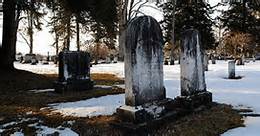
These gravestones have slowly broken down and turned a blackish color due to the action of:
a)
ice wedging
b)
abrasion
c)
acid rain
d)
mechanical weathering
28.
What are the two factors that affect the rate at which weathering occurs?
a)
climate and mass of rock
b)
climate and size of rock
c)
type of rock and size of rock
d)
type of rock and climate
29.
Which of the following is NOT one of the three layers of soil?
a)
topsoil
b)
undersoil
c)
subsoil
d)
bedrock
30.
_______ is the type of soil used most often with plants. It is a mixture of clay, sand, and silt.
a)
loam
b)
humus
c)
mud
d)
dirt
31.
You dig a small hole in the soil and the next day it rains. The hole fills with water, but does not empty even after several days of dry weather. What is the soil mostly made of?
a)
clay
b)
sand
c)
humus
d)
silt
32.
Soil is made of
a)
weathered rocks and minerals
b)
dead plants and animals
c)
air and water
d)
all of the above
33.
What conservation method refers to forming steps in a hill to prevent water erosion?
a)
windbreaks
b)
contour plowing
c)
terrace farming
d)
strip cropping 
34.
What soil conservation is this?
a)
Cover Crops
b)
Soil Conservation
c)
Crop Rotation
35.

How are barrier islands created?

a)

When winds and waves move sand and other sediments

b)

by their parents

c)

because the ocean had a hurricane and moved a bunch of rocks and then they formed

d)

because i wanted them too.

36.
 A ______________________ helps protect the shore from being worn away by the action of the ocean’s waves and is parallel to the mainland. 
a)
agriculture
b)
barrier island
c)
Carolina Bays
d)
marsh
37.

What is an area of land drained by a main river and its tributaries?

a)

Watershed

b)

Bath Tub

c)

Drainage Basin

d)

Water Cycle

38.
A triangle-shaped (deposit) landform at the mouth of a river as it empties into a body of water is
a)
weather
b)
delta
c)
landform
39.

America's largest watershed

a)

The Savannah River

b)

The Gulf of Mexico

c)

The Mississippi River

d)

The Columbia River

40.

Location of most of Earth's fresh water

a)

rivers and lakes

b)

the polar ice caps

c)

underground caverns

41.

Most of Earth's water

a)

salty

b)

fresh

c)

clear

d)

tasteless and odorless

42.

The purpose of dams is to

a)

control flooding

b)

provide water for agriculture

c)

ensure a drinking water supply

d)

all of the above

43.

Around the world water is used for

a)

Agriculture

b)

Manufacturing

c)

Meeting personal needs

d)

All of the above

44.

This would help preserve the environment of coastal areas

a)

Limiting development

b)

Pumping fresh sand on depleted beaches

c)

Digging more wells for drinking water

d)

Increasing tourism opportunities

45.

Glaciers grow and shrink depending on

a)

rates of snowfall

b)

temperature

c)

changes in geography

d)

all of the above

46.

The _________ measures atmospheric pressure

a)

anemometer

b)

thermometer

c)

barometer

d)

wind vane

47.

Energy from the sun travels to Earth by

a)

convection

b)

conduction

c)

meteorology

d)

radiation

48.

A narrow band of high-speed winds in the upper atmosphere

a)

microburst

b)

jet stream

c)

hurricane

d)

derecho

49.

The fraction of sunlight reflected by Earth's surface

a)

mirage

b)

albedo

c)

aurora

50.

Westerlies would be most likely to blow

a)

near the equator

b)

near the North and South poles

c)

in middle-latitude areas such as the United States

d)

none of the above

51.

Condensation and precipitation

a)

remove water vapor from air

b)

add water vapor to air

c)

have no effect on water vapor in air

52.

Earth absorbs ____ percent of the solar energy that strikes it.

a)

0.7

b)

7.0

c)

70

53.

The temperature of Earth's surfaces increases due to heat trapped by the atmosphere.

a)

the greenhouse effect

b)

the Coriolis effect

c)

the heat island effect

d)

the Faraday effect

54.

Affects the angle at which the sun's rays strike the earth

a)

latitude

b)

auroras

c)

solar wind

d)

sunspots

55.

Clouds meet mountains, drop their water on one side, then leave a dry area on the other side.

a)

rain shadow

b)

monsoon

c)

El Niño

d)

La Niña

56.

The primary elements of climate. Select all that apply.

a)

temperature

b)

precipitation

c)

animal life

d)

plant life

57.

Temperatures in a city are warmer than those in surrounding rural areas

a)

heat island

b)

highland climate

c)

derecho

d)

solar maximum

58.

Tree rings will tend to narrow under the following conditions (select all that apply)

a)

cool weather

b)

low rainfall

c)

warm weather

d)

high rainfall

59.

The average weather conditions over a long period of time

a)

climate

b)

microclimate

c)

mean temperature

60.

Compared to water, land heats up and cools down

a)

faster

b)

slower

c)

at about the same rate

61.

The area near the Great Lakes has unusually heavy snowfall in the winter. This is an example of a

a)

rain shadow

b)

microclimate

c)

seasonal maximum

62.

Over the past 100 years average temperatures have increased about __________ Celsius.

a)

0.01

b)

0.1

c)

1.0

d)

10.0

63.

Winds that bring heavy rains for several weeks in a row are _______________.

a)

monsoons

b)

derechos

c)

microbursts

d)

jet streams

64.

As air warms it

a)

rises

b)

sinks

c)

maintains its altitude

65.

A part of the atmosphere with the same pressure, temperature and humidity

a)

air mass

b)

air Jordan

c)

air region

d)

air section

66.

An air mass has the characteristics of the atmosphere

a)

in its source region

b)

in its destination region

67.

Continental polar, continental tropical, Maritime polar, Maritime tropical

a)

types of air masses

b)

types of climate regions

68.

This weather event is associated with latent heat

a)

hurricane

b)

tornado

c)

blizzard

d)

drought

69.

A weather balloon uses this to transmit information back to Earth

a)

radiosonde

b)

computer

c)

a human operator

70.

A pattern of numbers and symbols that shows weather information

a)

station model

b)

climate model

c)

meteorological data

d)

none of the above

71.

A line that connects points having the same temperature

a)

isotherm

b)

isobar

c)

isogesis

d)

isolation

72.

This image is the result of reflected ______________ waves

a)

light

b)

radio

c)

gamma

d)

ultraviolet