wayground logo

Free Printable Worksheets

NEW

Font size

S
M
L
XL
Worksheets

Biology EOC Review

Total questions: 70

Worksheet time: 4hrs 38mins

Name
Class
Date
1.
This organelle acts like a gatekeeper, allowing some materials to pass through it, but not others. 
a)
Cytoplasm
b)
Cell Membrane
c)
Mitochondria
d)
Vacuole
2.
What structure is in plant cells but not animal cells?
a)
Cell Membrane
b)
Mitochondria
c)
Cell Wall
d)
Vacuole
3.
This organelle is a gel-like fluid that takes up most of the space inside the cell. 
a)
Cytoplasm
b)
Cell Membrane
c)
Vacuole
d)
Golgi Body
4.
Where is the genetic material found in the cell? 
a)
Nucleolus
b)
Cytoplasm
c)
Nucleus
d)
Chloroplast
5.
What distinguishes a eukaryotic cell from a prokaryotic cell is the presence of 
a)
A cell wall
b)
A nucleus
c)
DNA
d)
Ribosomes
6.
What structure is responsible for making proteins?
a)
Nucleus
b)
Mitochondria
c)
Golgi Apparatus
d)
Ribosome
7.
This organelle moves materials throughout the cell. 
a)
Endoplasmic Reticulum
b)
Ribosomes
c)
FedEx
d)
Golgi Complex
8.
What is the difference between rough and smooth Endoplasmic Reticulum?
a)
There is no difference.
b)
Plants have rough ER, animals have smooth ER.
c)
What type of injuries the Doctors treat.
d)
Rough has ribosomes, smooth does not.
9.
During the interphase stage of the cell cycle,
a)
the cell's chromosomes are duplicated.
b)
the cell's chromosomes condense into rod-like structures.
c)
the cell divides into two identical daughter cells.
d)
the cell divides into two unique daughter cells.
10.
Cytokinesis is a process that occurs during the cell cycle.  During cytokinesis,
a)
the cytoplasm is divided to form two separate cells.
b)
the cell grows and performs normal life processes.
c)
the chromosomes of the cell are duplicated.
d)
the nuclear material of the cell is divided.
11.
Mitosis and meiosis are methods of cell division.
Which of the following is true of these two methods?
a)
Mitosis involves only one division, while meiosis involves two divisions.
b)
Meiosis involves one division, while mitosis involves two divisions.
c)
Meiosis involves two or more divisions, while mitosis involves exactly two divisions.
d)
Mitosis involves two or more divisions, while meiosis involves exactly two divisions.
12.
Daughter cells produced when cells undergo mitosis are genetically __________, and daughter cells produced when cells undergo meiosis are genetically __________ .
a)
flawed, perfect
b)
diverse, identical
c)
perfect, flawed
d)
identical, diverse
13.
How are the processes of mitosis and meiosis similar to each other?
a)
Both processes result in the same number of cells produced.
b)
Both processes begin with similar events, including chromosome replication.
c)
Both processes involve only one division of cellular materials.
d)
Both processes end with the same number of chromosomes present in each cell.
14.
Cellular reproduction in multicellular organisms occurs through the process of mitosis.  What is the purpose of mitosis?
a)
to replace old cells such as red blood cells
b)
to replace old chromosomes
c)
to form gametes (e.g. sperm and ova)
d)
to form new somatic cells
15.
Which of the following cells are produced through meiosis?
a)
sex cells
b)
stem cells
c)
somatic cells
d)
all of these
16.
A giraffe sex cell divides by meiosis.  The daughter cells produced each have __________ chromosomes.
a)
62
b)
15
c)
93
d)
31
17.
The diagram represents a stage of mitosis in which the chromosomes line up in the middle of the cell.
What is the name of this phase of mitosis?
a)
telophase
b)
anaphase
c)
metaphase
d)
prophase
18.

In the structure of DNA, which nucleotide always pairs with adenine?

a)

cytosine

b)

guanine

c)

thymine

d)

uracil

19.
During DNA replication, what would be the complementary strand to the original DNA segment of GCTAAT?
a)
CGATTA
b)
GGATTA
c)
GGAUUA
d)
GGUTTU
20.

How does an offspring of a mushroom or mold (asexual reproduction) compare to its parent?

a)

It is identical.

b)

It is very similar.

c)

It is slightly different.

d)

It is the exact opposite.

21.
Genotype refers to the ...
a)
physical expression of the genes
b)
the possible combination of alleles in a gene
c)
whether an allele is dominant or recessive
d)
how an organism will appear
22.
An offspring will receive how many alleles from each parent to determine a specific trait?
a)
one
b)
two
c)
three
d)
five
23.
What is a phenotype
a)
The genetic make up (code)
b)
The physical trait
24.
having two of the same genes for the trait (sometimes called purebred).
a)
homozygous
b)
hetrozygous
c)
protein
d)
chromosome
25.
Two brown eyed parents (Bb) have a baby. What is the chance the baby is blue eyed?
a)
0 %
b)
25%
c)
50%
d)
75%
26.
An allele whose trait only shows up when no dominant allele is present.
a)
hidden allele
b)
dominant allele
c)
recessive allele
d)
present allele
27.
Incomplete dominance means that the traits are
a)
expressed equally
b)
dominant
c)
recessive
d)
blended
28.
Brown fur color is dominant over black fur color. Which of the following is the actual genotype of ALL of the offspring in the next generation of this cross for fur color?
AA x aa
a)
AA
b)
Aa
c)
aa
d)
brown fur
29.
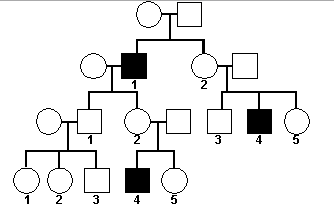
If this pedigree shows an autosomal recessive disorder, what MUST the genotype of individual II-3 be?
a)
HH
b)
Hh
c)
hh
d)
None of the above
30.
What type of heredity is shown in the pedigree?
(hint: check your notes - "modes of inheritance")
a)
Sex-Linked Dominant
b)
Sex-Linked Recessive
c)
Autosomal Dominant
d)
Autosomal Recessive 
31.

If this pedigree shows a recessive disorder, what MUST the genotype of individual 4 be?

a)

HH

b)

Hh

c)

hh

32.
Huntington's Disease is a dominant trait.
What is the correct genotype for individual I-2?
a)
HH
b)
Hh
c)
hh
d)
H_
33.
Which of the following is a fossil?
a)
a plant that has recently died
b)
a group of organisms that can reproduce
c)
a structure or organ that no longer functions
d)
a trace of an organisms that existed in the past
34.
In natural selection, the selective agent is the
a)
humans
b)
mutations
c)
breeders
d)
environment
35.
Mutations are important because they bring about
a)
death of the organism in which they develop
b)
genetic variation needed for a population to evolve
c)
benefits for the individual, not for the population
d)
Hardey-Weinberg equilibrium within a population
36.

What is the term for a feature that allows an organism to survive better in its environemtn?

a)

variation

b)

adaptation

c)

homologous structure

d)

vestigial structure

37.
What increases genetic variation when animals move from one population to another
a)
genetic drift
b)
sexual selection
c)
bottleneck effect
d)
gene flow
38.
What is another name for natural selection?
a)
survival of the smartest
b)
survival of the fastest
c)
survival of the biggest
d)
survival of the fittest
39.
Proteins are made of monomers called ___________
a)
Nucleotides
b)
Monosaccharides
c)
Amino Acids
d)
Glycerol and fatty acids
40.
The element _______is found in all of the organic compounds.
a)
Iron
b)
Nitrogen
c)
Carbon
d)
Oxygen
41.
DNA and RNA are examples of 
a)
Carbohydrates
b)
Lipids
c)
Proteins
d)
Nucleic Acids
42.
Monosaccharides are monomers of
a)
Carbohydrates
b)
Lipids
c)
Proteins
d)
Nucleic Acids
43.
Waxes, oils and fats are examples of
a)
Carbohydrates
b)
Lipids
c)
Proteins
d)
Nucleic Acids
44.

Which macromolecule is shown?

a)

lipid

b)

protein

c)

nucleic acid

d)

carbohydrate

45.

Which macromolecule is shown?

a)

lipid

b)

protein

c)

nucleic acid

d)

carbohydrate

46.
What is the function of nucleic acids?
a)
store genetic information
b)
store energy (long-term)
c)
store energy (short-term)
d)
build skin, hair, nails, muscles
47.
What type of macromolecule are enzymes?
a)
Protein
b)
Carbohydrate
c)
Lipid
d)
Nucleic Acid
48.
Which of the following organic compounds is the main source of energy for living things?
a)
carbohydrates
b)
lipids
c)
nucleic acids
d)
proteins
49.
Carbohydrates are made of... 
a)
C H O
b)
C H O N
c)
C H O N P
d)
C H O N S
50.
Lipids are made of... 
a)
C H O
b)
C H O N
c)
C H O N P
d)
C H O N S
51.
Proteins are made of... 
a)
C H O
b)
C H O N
c)
C H O N P
d)
C H O N S
52.
Which macromolecule stores energy, insulates us, and makes up the cell membrane?
a)
lipids
b)
proteins
c)
carbohydrates
d)
nucleic acids
53.
This is one job proteins do NOT have in the body
a)
insulation
b)
structure for tissues and organs
c)
speed up chemical reactions
d)
transport things through cell membrane
54.
What are the four macromolecules?
a)
proteins, nucleic acids, carbohydrates, and lipids
b)
monosaccharides, lipids, polysaccaharides, and proteins
c)
RNA, DNA, proteins, and carbohydrates
d)
proteins, DNA, RNA, and steroids
55.
Identify the macromolecule in the picture.
* look at the R.....
a)
carbohydrates
b)
lipids
c)
proteins 
d)
nucleic acids
56.
Identify the macromolecule in the picture
* cholesterol and triglycerides
a)
carbohydrate
b)
protein
c)
lipid
d)
nucleic acid
57.
What are the functions of lipids?
a)
provide quick energy/
insulation
b)
repair tissues
c)
2nd source of energy/ insulates
d)
build struc
tures 
58.
Proteins are formed from?
a)
bonded carbs
b)
bonded amino acids
c)
glycerol
d)
fatty acids
59.
What molecule is represented in the image? 
a)
amino acid
b)
carbs
c)
lipid
d)
mono
sacch
aride
60.
The Human Genome Project has made diagnosing genetic disorders easier.Once a genetic disorder is diagnosed, ____ can be used as a possible treatment.
a)
cell cultures
b)
gene therapy
c)
DNA fingerprinting
d)
PCR
61.
____ are produced when DNA from another species is inserted into the genome of an organism, which then begins to produce the protein encoded on the recombinant DNA.
a)
vectors
b)
plasmids
c)
transgenic organisms
d)
gene guns
62.
The entire collection of genes within human cells is referred to as the ______.
a)
human genome
b)
karyotype
c)
pedigree
d)
gene map
63.

Which of the following best describes "restriction enzymes?"

a)

Enzymes that cut DNA

b)

Enzymes that build DNA

c)

Enzymes that dissolve DNA

d)

Enzymes that turn DNA into RNA

64.
In the energy pyramid here, how much of the energy in the producers gets passed to the herbivores?
a)
10%
b)
20%
c)
80%
d)
90%
65.
What may happen if the snowshoe hare was removed from the food web pictured?
a)
The insects in the habitat would increase.
b)
The shrew population would decrease due to being only hawk food source.
c)
The willow tree population would decrease.
d)
Foxes would dies due to no food source. 
66.
In the food web shown, the snail would be considered...
a)
primary consumer
b)
secondary consumer
c)
tertiary consumer
d)
producer
67.
Which of the following leads to a decrease in biodiversity?
a)
protection of ecosystems
b)
pollution control
c)
selective cutting
d)
introduction of exotic or invasive species
68.
symbiotic relationship in which both organisms benefit
a)
competition
b)
Mutualism
c)
nitrogen fixation
d)
energy pyramid
69.
a relationship between two in which one species, the predator, feeds on the other species, the prey
a)
chemosynthesis
b)
predation
c)
cellular respiration 
d)
commensalism
70.
symbiotic relationship in which one organisms benefits and the other organism is not affected
a)
invasive (non-native) species
b)
mutualism 
c)
nitrogen fixation
d)
commensalism