Wayground logo

Free Printable Worksheets

Font size

S
M
L
XL
Worksheets

Astronomy Class Review

Total questions: 40

Worksheet time: 30mins

Name
Class
Date
1.
Which layer of Earth is located above the outer core?
a)
crust
b)
inner core
c)
mantle
d)
lithosphere
2.
Which of these two layers is a solid?
a)
innercore
b)
Outercore
3.

Why does the troposphere experience (have) the greatest amount of atmospheric pressure compared to the other atmospheric layers?

a)

It produces the ozone layer.

b)

It has the highest temperatures.

c)

It contains a high concentration of gas particles.

d)

It is the region in which weather occurs.

4.

Which of these statements BEST describes (explains) temperature as elevation in the atmosphere increases?

a)

Temperature remains constant with elevation in the thermosphere.

b)

Temperature remains constant with elevation in the mesosphere.

c)

Temperature generally decreases with elevation in the stratosphere.

d)

Temperature generally decreases with elevation in the troposphere.

5.

The BEST description of the troposphere is the layer of the atmosphere with the

a)

most ozone.

b)

greatest density.

c)

highest altitude.

d)

coldest temperature.

6.

In which layer of Earth’s atmosphere does weather occur?

a)

mesosphere

b)

stratosphere

c)

thermosphere

d)

troposphere

7.

Atmospheric greenhouse gases help heat the atmosphere by

a)

increasing the amount of solar radiation reaching Earth.

b)

storing energy produced by human activity.

c)

absorbing infrared radiation released by Earth.

d)

increasing the average density of air.

8.

Which of these gases, on average, has the lowest volume in the atmosphere of Earth?

a)

oxygen

b)

nitrogen

c)

water vapor

d)

carbon dioxide

9.

A weather balloon is about 2 meters wide when it is near the ground. It grows to about 6 meters wide at higher altitudes. Which change MOST likely makes the balloon become wider at higher altitudes?

a)

More gases enter the balloon.

b)

The gas inside the balloon gets much hotter.

c)

The air pressure surrounding the balloon decreases.

d)

Sunlight breaks down the material of the balloon.

10.
Which of the following is NOT a characteristic used to classify stars?
a)
Color
b)
Temperature
c)
Size
d)
Shape
11.
Define star constellations.
a)
Imaginary patterns of stars
b)
Extremely hot stars
c)
Extremely cool stars.
d)
Solar Nebulas
12.
The brightness of a star as seen from earth is defined as:
a)
Apparent Brightness
b)
Absolute Brightness
c)
Brightness
d)
Candid Brightness
13.
The brightness the star would have if it were a standard distance from earth.
a)
Apparent Brightness
b)
Absolute Brightness
c)
Brightness
d)
Candid Brightness
14.
A light year is a measurement of:
a)
Time
b)
Distance
c)
Gravity
d)
None of the Above
15.
Explosion of a high-mass star.
a)
White Dwarf
b)
Planetary Nebula
c)
Supernova
d)
Neutron Star
16.
True or False - The hottest stars are blue.
a)
True
b)
False
17.
True or false: as you move along the spectrum, radio to gamma waves, the wavelengths decrease in size (get smaller)
a)
true
b)
false
18.
Select the correct order of waves on the EMS from the longest wavelength to the shortest wavelength
a)
Radio, Micro, Infra, Visible, Ultra, X-ray, Gamma
b)
Gamma, X-ray, Ultra, Vis, Infra, Micro, Radio
c)
Vis, Micro, Infra, Ultra, X-ray, Gamma, Radio
d)
Micro, Radio, Vis, Infra, Ultra, X-ray, Gamma
19.
Which has the SHORTEST wavelength and, therefore, the highest frequency/most energy
a)
Radio waves
b)
Ultraviolet Rays
c)
Gamma Rays
d)
X-rays
20.
Which section of the spectrum is the ONLY one we can see?
a)
X-rays
b)
Visible Light
c)
Gamma Rays
d)
Ultraviolet Rays
21.
How are electromagnetic waves different from other waves? 
a)
They have very short wavelengths 
b)
They transmit energy instead of matter 
c)
They can travel through empty space
d)
They can change direction by reflection 
22.
As the frequency of an electromagnetic wave increases, the amount of energy in that wave...
a)
increases.
b)
decreases.
c)
stays the same.
23.
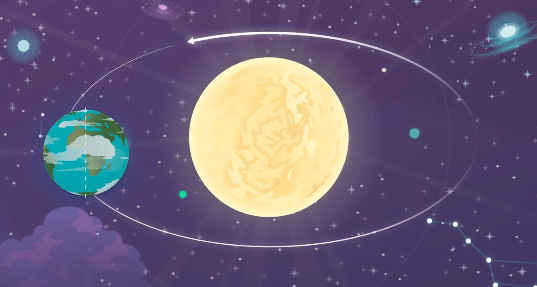
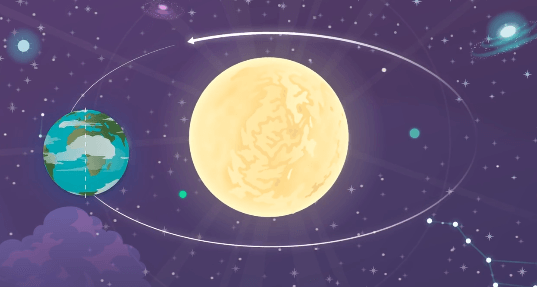
How long does it take for the Earth to make one full orbit around the Sun?
a)
one day
b)
one week
c)
one month
d)
one year
24.
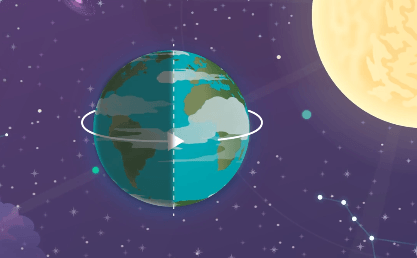
The Earth is rotating on its axis, creating _____
a)
the 12 months
b)
the years
c)
the seasons
d)
day and night
25.
As the Earth travels around the Sun, it creates a pattern that makes _____
a)
the months
b)
the years
c)
the seasons
d)
day and night
26.
What looks to be the motion of the Sun in the sky is really caused by the motion of _____
a)
the Earth
b)
the stars
c)
the planets
d)
the Earth's axis
27.
The spinning movement of the Earth about its axis is called the Earth's _____
a)
revolution
b)
rotation
c)
precession
d)
orbit
28.
The movement of the Earth around the Sun is called its _____
a)
revolution
b)
rotation
c)
precession
d)
gyration
29.
When the part of the world that you're living in is leaning towards the Sun, its _____
a)
winter
b)
spring
c)
summer
d)
fall
30.
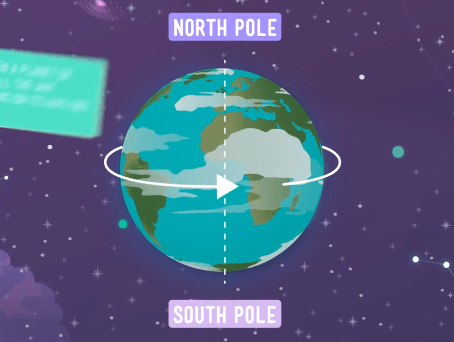
The invisible line that passes through the North Pole and the South Pole is called Earth's ____
a)
axis
b)
equator
c)
ecliptic
d)
prime meridian
31.
What are ocean tides?
a)
Long waves due to the gravitational pull of the moon only.
b)
Long period waves caused by wind.
c)
Short period waves caused by wind. 
d)
Long waves due to the gravitational pull between the Earth,sun and the moon
32.

What is a high tide?

a)

Sea pulled TOWARD the moon where Earth is CLOSEST to the moon

b)

Sea pulled AWAY from the moon where Earth is FARTHEST to the moon

c)

Sea pulled AWAY from the moon where Earth is CLOSEST to the moon

33.
Which body has the greater effect on Earth's tides?
a)
Sun
b)
Saturn
c)
Moon 
d)
Venus
34.
At the same time the sea is drawn to the moon, another tidal bulge takes place on other side of Earth?
a)
Yes
b)
No
c)
Maybe
d)
I don't know!
35.
When the moon is at full moon or new moon, what type of tide will we experience?
a)
rip tide
b)
spring tide
c)
neap tide
d)
breaker tide
36.

How long does it take the Earth to rotate once on its axis?

a)

24 days

b)

365 days

c)

24 hours

d)

28 days

37.

How long does it take for the Earth to Revolve around the Sun?

a)

24 hours

b)

24 days

c)

365 days

d)

28 days

38.

The reason that the Sun appears to rise in the East and set in the West.

a)

Sun revolving around the Earth

b)

Sun rotating on its axis

c)

Earth revolving around the Sun

d)

Earth rotating on its axis

39.
The phases of the Moon are caused by the
a)
tilt of the Earth
b)
tilt of the Moon
c)
revolution of the Earth around the Sun
d)
revolution of the Moon around the Earth
40.
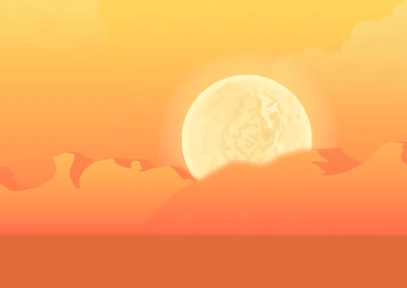
Jessica watches the Sun set in the evening sky. What causes the setting of the Sun?
a)
The distance between Earth and the Sun is increasing
b)
The tilt of Earth on its axis is constantly changing.
c)
Earth is revolving around the Sun.
d)
Earth is rotating on its axis.