
 Worksheets
8th End of Year Exam Review
Total questions: 162
Worksheet time: 2hrs 52mins


Geologic processes that occur suddenly
uniformitarism
catastrophism
geologic time scale
Geologic processes that happened in the past can be explained by current processes
Catastrophism
Uniformitarianism
Geologic Time Scale
All of fossils discovered on Earth
Mold
Cast
Fossil Record
Trace Fossil
Fossils in which minerals replace an organism's cells
Trace Fossils
Petrified Fossils
Mold
Cast
Solid copy of the shape of an organism
Cast
Mold
Trace Fossil
Index Fossil
Evidence of ancient organism such as a footprint
Petrified Fossil
Mold
Cast
Trace Fossil
Breakdown of radioactive isotope to stable isotope
Half-life
Radioactive Decay
Radiometric Dating
Used to determine whether an object is older or younger than other objects
Superposition
Relative Dating
Fossil
Crosscutting
States that younger rocks lie above older rocks if the layers have not been disturbed
Law of crosscutting
Law of superposition
Relative Dating
Absolute Dating
An ordered arrangement of rock layers that is based on the relative ages of the rocks
Superposition
Crosscutting
Layered
Geologic Column
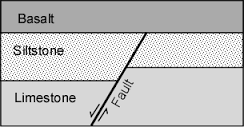


Time needed for half of radioactive isotope to undergo radioactive decay to form daughter isotope
Full-Life
Half-Life
Radioactive Life
What is NOT a way for fossils to be preserved?
Amber
Frozen
Buried in sedimentary rock
Buried in igneous rock
As a tree grows, it forms a ring on the trunk. If the tree ring is thick, that indicates the tree grew well due to
lack of precipitation
plenty of precipitation
more birds living in trees
more squirrels living in tree
What is NOT a characteristic of an index fossil?
lived during short geologic time span
found in large area
unique features
uncommon
An eon is the largest unit of time on the geologic time scale. It is divided into eras which are divided into _______.
periods
epochs
What division of time was the longest ?
Paleozoic
Mesozoic
Cenozoic
Precambrian
What era did dinosaurs go extinct ?
Paleozoic
Mesozoic
Cenozoic
What is the geological time scale ?
A clock
A calendar
Something that divides Earths history into groups
Put the ERAs of the Phanerozoic EON in the correct order(oldest to youngest):
Paleozoic, Mesozoic, Cenozoic
Cenozoic, Mesozoic, Paleozoic
Mesozoic, Paleozoic, Cenozoic
Where is DNA found in eukaryotic cell?
Cell membrane
Mitochondria
Nucleus
Chloroplast
What is a molecule in a cell that contains information a cell needs to live and function and traits an organism inherits?
Nucleus
DNA
Allele
Punnett Square
What is chromatin organized in specific lengths that are rod shaped or X shaped?
Gene
Allele
Pedigree
Chromosome
What holds together two chromatids?
Nucleus
Pedigree
Gene
Centromere
What stage of the cell cycle does a cell spend most time in?
Interphase
Mitosis
Cytokinesis
Which of the following is the order of the mitosis phases?
Telophase, Anaphase, Metaphase, Prophase
Anaphase, Metaphase, Prophase, Telophase
Prophase, Metaphase, Anaphase, Telophase
Prophase, Anaphase, Metaphase, Telophase
What phase of mitosis is described: duplicated chromosomes line up in the middle of the cell?
Prophase
Metaphase
Anaphase
Telophase
What phase of mitosis is described: nuclear membranes form around each complete set of chromosomes?
Prophase
Metaphase
Anaphase
Telophase
What phase of mitosis is described: duplicated chromosomes condense to be two chromatids held together by a centromere?
Prophase
Metaphase
Anaphase
Telophase
What phase of mitosis is described: chromatids from duplicated chromosomes and are pulled to opposite sides of cell?
Prophase
Metaphase
Anaphase
Telophase


Prophase
Interphase
Anaphase
Telophase


What allele is represented by a capital letter?
Dominant
Recessive
A _______________ allele will only show in an organism's phenotype if they are two present.
dominant
recessive
Classify the following genotype: FF
Heterozygous
Homozygous Dominant
Homozygous Recessive
Classify the following genotype: rr
Heterozygous
Homozygous Recessive
Homozygous Dominant
Classify the following genotype: Ee
Heterozygous
Homozygous Dominant
Homozygous Recessive
The following genotype BB is classified as a _____________.
purebred
hybrid
The genotype Cc is classified as ____________.
purebred
hybrid
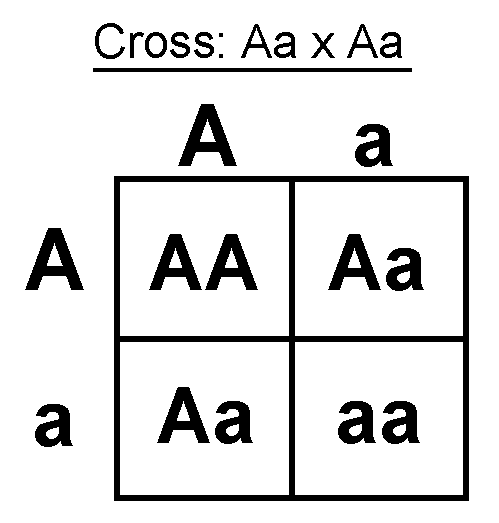
What are the possibilities of the phenotypes for the offspring? (A=brown hair and a=blond hair)
50 % Brown Hair and 50% Blond Hair
25 % Brown Hair and 75% Blond Hair
75 % Brown Hair and 25% Blond Hair
0% Brown Hair and 100% Blond Hair

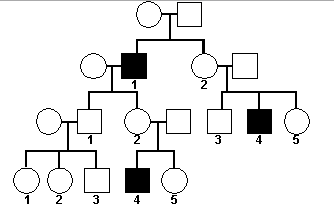
_________________ are useful to trace sex-linked disorders associated with alleles on sex chromosomes.
Punnett squares
Pedigrees
Who developed the theory of evolution?
Darwin
Mendel
Newton
Einstein
What is a trait that increases an organism's ability to survive and reproduce?
homologous
vestigial
variation
adaptation

What is this an example of?
homologous structures
variation
unused structures
DNA similarties
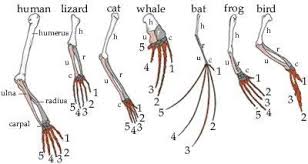
What is this an example of?
unused structures
patterns of early development
homologous structures
fossil record
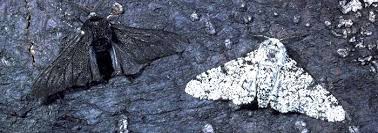
The cause of artificial selection is…
the environment
humans
variations
adaptations
Which term refers to the process by which individuals that inherit advantageous traits survive and reproduce more successfully than other organisms?
Evolution
Variation
Adaptation
Natural Selection
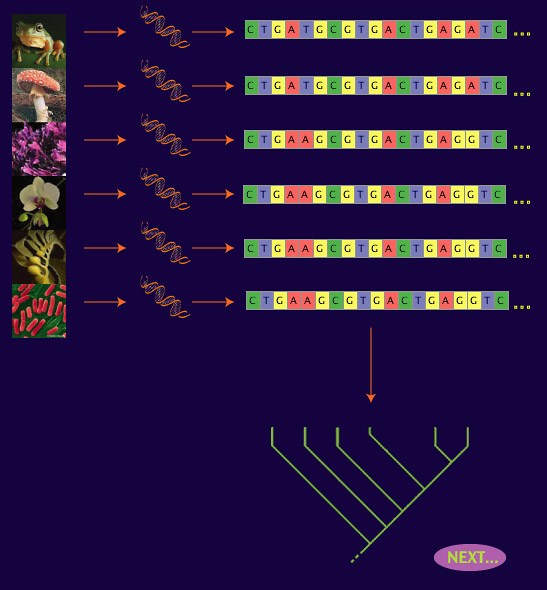

Which of the following is a term for a group of similar organisms that can reproduce fertile offspring?
naturalist
population
species
fossil

Change over time...
Evolution
Naturalist
Extinction
Overproduction
The white feathers of a snowy owl allow it to blend in with its environment during the winter months (snow). This is an example of ________________
Species
Evolution
Adaptation
Variation
The opossum and kangaroo both incubate their young in a pouch. This provides evidence that they
are descended from a common ancestor
have very similar skeletal structures
belong to the same species
must travel great distances to eat
Which terms describes all of the fossils that have been discovered?
Common Ancestor
Homologous Structures
Evolution
Fossil Record

The following image is a mammoth. Which trait most suggests that the mammoth was adapted to live in a cold climate?
Long, flexible trunk
Sharp, curved tusks
Broad, powerful body
Thick, furry coat
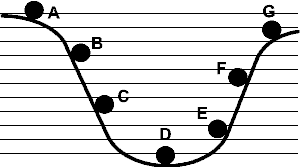
At which point does the ball has the greatest gravitational potential energy (GPE)?
A
G
D
C
G
Which of the following is the correct equation for calculating an object's gravitational potential energy?
GPE = mgh
GPE = mg / h
GPE = mg + h
GPE = gh
What is the value of the Earth's acceleration due to gravity (g)?
9.8 m/s2
100 m/s2
25 m/s2
3.14 m/s2
What is the gravitational potential energy (GPE) of a 1 kilogram book that is 1 meter above the ground?
9.8 Joules
1.0 Joule
0.10 Joule
11.8 m/s2
A rubber band is an example of _______________ potential energy.
gravitational
elastic
chemical
Food is an example of ___________ potential energy.
chemical
gravitational
elastic
Combination of all forces acting on object
force
contact forcef
field
net force
Push or pull
field
force
gravity
drag
Forces on object produce a net force that is 0 N, no motion
Balanced
Unbalanced
Forces on object produce a net force that is not 0 N, results in motion
Balanced
Unbalanced
Area in which object experiences a force at a distance
force
drag
field
friction
Force exerted during contact between objects
distance force
contact force
gravitational force
friction

If a 10 kilogram object accelerates suddenly at 15 m/s2, how much force was applied to the object?
150 Newtons
15 Newtons
150 kilograms
100 kilograms
If a force of 500 Newtons was applied to an object with a mass of 50 kilograms, what will the object's acceleration be?
10 m/s2
100 m/s
100 m/s2
1 m/s2
If an object was accelerating at 10 m/s2, and a force of 10 newtons was required to accelerate it, what was the object's mass?
1 kilogram
10 kilograms
2 kilograms
5 kilograms
What is the force of a falling object that has a mass of 40 kg?
9.8 N
40 N
392 N
39.2 N
1st
Law of Motion
2nd
Law of Motion
3rd
Law of Motion
1st
Law of Motion
2nd
Law of Motion
3rd
Law of Motion
1st
Law of Motion
2nd
Law of Motion
3rd
Law of Motion
1st
Law of Motion
2nd
Law of Motion
3rd
Law of Motion
1st
Law of Motion
2nd
Law of Motion
3rd
Law of Motion
If two chairs with different masses are dropped out of a window and air resistance is ignored, then
the heavier chair will hit the ground first
the lighter chair will hit the ground first
neither chair will hit the ground and they will float
they will hit the ground at the same time
Which of the following would have the most inertia, thus the most tendency to resist a change in motion?
feather
tablet
a dog
semi-truck
Why don't action/reaction forces not cancel when part of the 3rd law of motion?
They do cancel; net force is balanced.
They act on the same object.
They act on different objects.
Gravity prevents them from cancelling.

Why does a compass needle point north?
The compass is a bar magnet
Because north is up
Because it's magic
It lines up with the Earth's magnetic field and is attracted to south magnetic pole

What are the lines around the magnet called?
Electric field lines
Magnetic field lines
North pole field lines
South pole field lines
Both magnetic forces and electric forces are ___________.
contact forces
forces that act at a distance
What is the meaning of conduction ?
Having to objects TOUCH each other and transfer protons from one object to the next.
Having to objects touch each other and transfer electrons from one object to the next.
Having to objects touch each other and seperate protons from one object to the next.
None of the above
An electric ____________ is the fundamental property of matter that leads to electromagnetic interactions between particles that make up matter.
field
charge
force
An electric _________ surrounds a charged object when an electric force is exerted another charged object.
force
field
charge
An electric ___________ occurs between charged objects.
charge
field
force
the path that an electric current takes
electrical circuit
static electricty
electric force
electric current
a complete loop without any breaks in it through which electric current flows
open circuit
closed circuit
a material in which electric charge cannot easily flow
conductor
insulator
a material through which electric charge can easily flow
conductor
insulator
Battery is
AC source
DC source
none of the above
all of the above

What are the 3 basic components of a circuit?
voltage difference, conductors, device using electrical energy
Battery, voltage difference, conductors
Battery, Wire, conductors
ALL of them

What is the power source in this circuit?
Bulb
Switch
Wire
Battery


What type of circuit is shown?
Parallel
Series
Open


This circuit does not work because…
the bulbs are not connected properly
the two batteries are not powerful enough
there is a break in the circuit
the two batteries are not arranged correctly


_____________ is the relationship between electricity and magnetism.
Magnetismelectro
Electricity
Electromagnetism
Solenoid
Coil of wire with current
Solenoid
Electromagnet
Electrical Insulator
Solenoid with a ferromagnetic core
Electrical insulator
Electromagnet
Magnet
Solenoid with a ferromagnetic core
Electrical insulator
Electromagnet
Magnet
Converts mechanical energy to electrical energy
Electric Motor
Electromagnet
Generator
Who was the physicist who discovered that electric current produces a magnetic field?
Charles Darwin
Hans Christian Oersted
Gregor Mendel
Isaac Newton
Electrical companies use generators to produce electricity. It is then transmitted over long distances at high voltages using a step-up _______________.
motor
generator
electromagnet
transformer

