Worksheets
8th Grade 2nd Semester Final (2021)
Total questions: 162
Worksheet time: 2hrs 47mins
Weathering is the process of -
Moving sediment from one place to another
Dropping or leaving sediment in a location
Breaking down rocks into sediment
An example of chemical weathering is -
Ice wedging
Oxidation
Animals burrowing
Crashing waves
An example of physical weathering is -
Plant roots and leaves releasing acids
Carbonic acid dissolving limestone
Large temperature changes
Lichens growing on rocks

Ice wedging is an example of -
Physical weathering
Chemical weathering
Both physical AND chemical weathering
Over millions of years, weak carbonic acid can dissolve limestone to form -
Cracks in rocks
Caves and caverns
Mountains and cliffs
Carbonic acid is formed in nature when -
Water dissolves particles of soil to form mud
The oxygen molecules in water bond with minerals in rocks
Water bonds with carbon dioxide in the air and/or soil

Plant roots conduct -
Physical weathering
Chemical weathering
Both physical AND chemical weathering

Fallen plant leaves help break down rocks as they -
Release or leach acids as they decompose
Get into cracks, expand, and make the cracks wider
Scratch and wear away the surface of rocks

Ice wedging is most likely to occur during which months of the year ?
December - February
March - May
June - August
September - November
Which of the following is an example of erosion
the sun shining on a rock
Wind abrasion rounding the corners of a rock
A river carrying soil to the ocean
A lichen growing on a rock
Which of the following is an example of deposition?
A tree root lifting up a section of sidewalk
Potholes caused by melting and freezing of water
The formation of caves
A pile of rocks at the bottom of a hill after a landslide
Which of the following is an example of mechanical weathering?
Rust forming on a rock cliff
Acid rain causing blurred inscriptions on a ancient tomb
Rounded pebbles in a stream bed
A sudden rainstorm on a hot day
Which of the following is an example of chemical weathering?
Rust forming on a rock cliff
Frost action breaking a rocky ledge apart
A flat, rounded piece of rock breaking off a rock's surface
Rocks falling from high places
How do chemical and mechanical weathering processes differ?
Chemical weathering breaks rocks into smaller pieces but mechanical weathering doesn't
Chemical weathering affects only igneous rocks but mechanical weathering affects all types of rocks
Chemical weathering involves water but mechanical weathering does not
Chemical weathering changes the composition of the rock but mechanical weathering does not
Mechanical weathering can occur from ALL the following EXCEPT
Burrowing by animals
Ice expands when frozen and cracks rocks
Trees roots expand as they grow and crack rocks
Carbonic acid eats away layers of limestone rock
Chemical weathering can occur from ALL of the following EXCEPT
Acids given off by lichens and mosses eat away at rocks
Sulfuric acid causes blurred words on gravestones and monuments
Wind blows sand which wears away cliffs
Rust caused by oxygen combining with iron-bearing minerals in rocks causes red bands on limestone cliffs
Susan rubs two rocks together. One of the rocks wears away to form small particles. What would most likely happen if this rock continues to break into small pieces after Susan puts the rocks back on the ground?
The pieces may become part of the soil
The pieces may become part of the bedrock
The pieces may become part of the ice wedging process
The pieces may become part of the organic matter in the soil
A river starts as a steep channel in the mountains. It then leaves the mountains and enters a flatter area of land. It meanders across a plain and then enters the ocean. Which of the following actions causes the deposition of sand at a delta?
River water slowing as it enters the ocean
Saltwater and freshwater mixing together
Ocean waves transporting sand toward the land
Ocean water slowing as it reaches the coast
Wind erosion of soil can be reduced by
Planting trees along the edges of fields
Planting crop rows parallel to the land contours
Flattening hill slopes into terraces
Building dams in streams


Which particles will be transported by a stream moving at a velocity of 5 cm/s?
pebbles, sand, silt, and clay, only
sand, silt, and clay, only
silt and clay, only
clay, only

The Genesee River flows across both the Allegheny Plateau and the Erie-Ontario Lowlands in New York State. This river flows
northward, in the same general direction as the Hudson River
northward, in the same general direction as the Niagara River
southward, in the same general direction as the Hudson River
southward, in the same general direction as the Niagara River
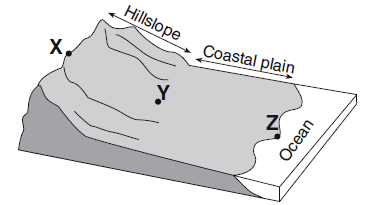
Compared to the stream velocity between point X and point Y, the stream velocity between point Y and point Z is most likely
greater, since the slope of the land decreases
greater, since the slope of the land increases
less, since the slope of the land decreases
less, since the slope of the land decreases

Erosion is most likely greatest at locations
A and B
B and C
C and D
D and A

A river's current carries sediments into the ocean. Which sediment size will most likely be deposited in deeper water farthest from the shore?
pebble
sand
slit
clay
Sediment is deposited in a river delta because the
velocity of the river decreases
force of gravity decreases
volume of the river increases
gradient of the river increases
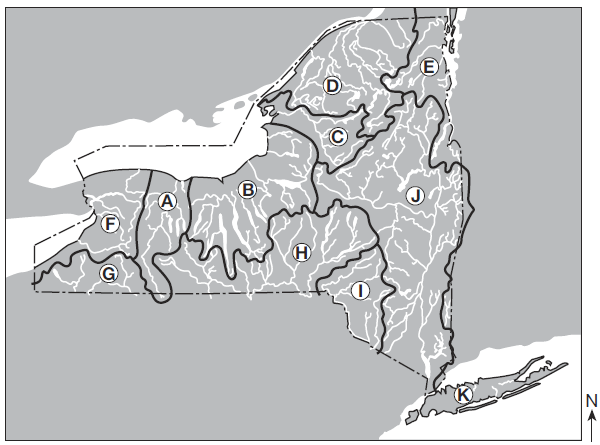
Over which two landscape regions do the streams in watershed D flow?
Tug Hill Plateau and the Catskills
Tug Hill Plateau and Erie-Ontario Lowlands
Adirondack Mountains and Champlain Lowlands
Adirondack Mountains and St. Lawrence Lowlands

The Genesee River in watershed A generally flows in which direction?
north
south
east
west

In which major watershed is the Susquehanna River located?
F
H
I
J
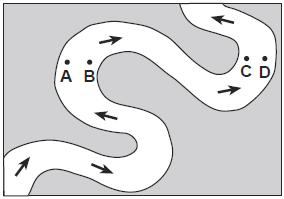
Which two locations have the greatest stream velocities?
A and B
B and C
C and D
D and A

The three areas separated by highland divides are called
Tributaries
meanders
watersheds
floodplains

Which landform is produced at location E where the Mississippi River enters the Gulf of Mexico?
delta
drumlin
tributary
floodplain

At which location would the Mississippi River's discharge most likely be the greatest?
A
B
C
D

What is the name of the largest sediment that can be transported by a stream moving at a velocity of 100 centimeters per second (cm/s)?
silt
sand
pebbles
cobbles
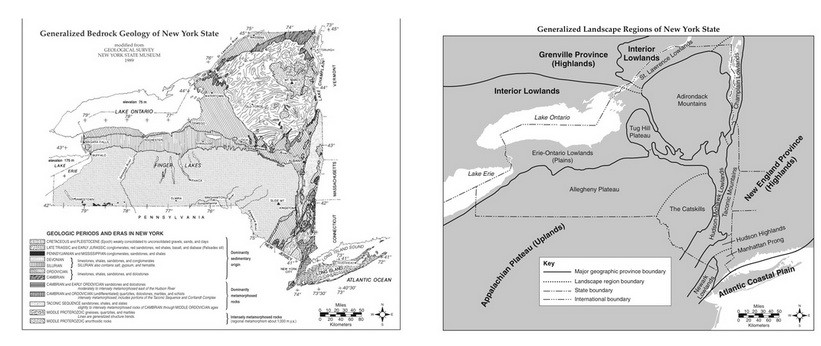
Which two cities are located in the Interior Lowlands?
Elmira and Binghamton
Riverhead and New York City
Massena and Old Forge
Buffalo and Watertown
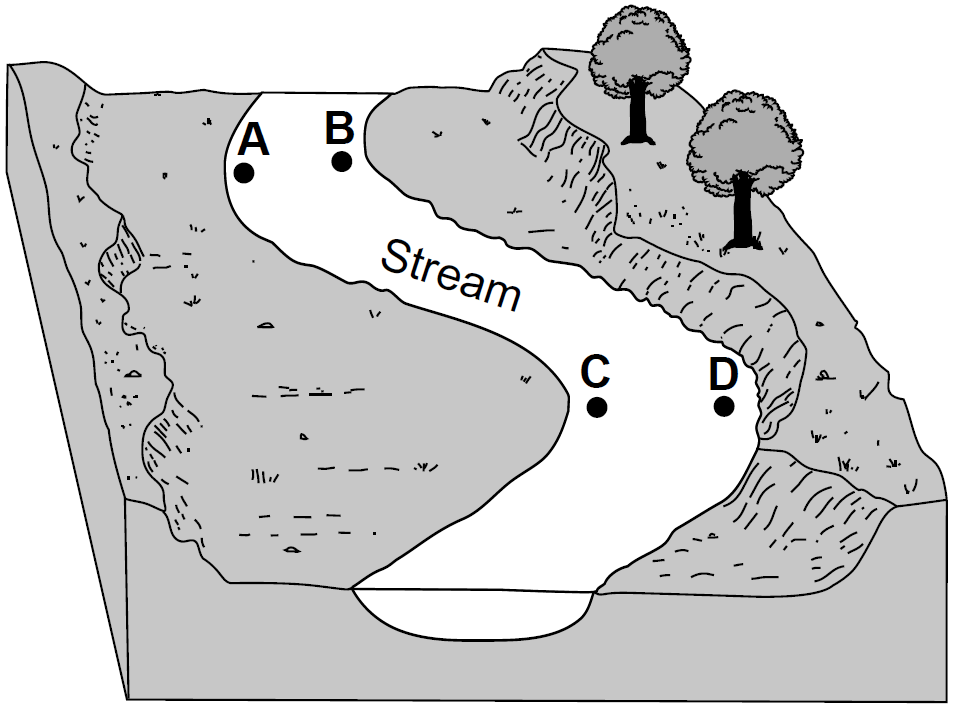
At which two locations would the stream most likely be the deepest?
A and B
B and C
C and D
D and A
A river's current carries sediments into the ocean. Which sediment size will most likely be deposited in deeper water farthest from the shore?
pebbles
clay
silt
sand

The greatest stream velocities are found closest to points
A and B
B and C
C and D
D and A

The streambank on the outside of this meander is steeper than the streambank on the inside of this meander because the water on the outside of this meander is moving
faster, causing erosion
slower, causing erosion
faster, causing deposition
slower, causing deposition

At which point does the greatest stream erosion occur?
A
B
C
D
Which of the following statements about how minerals are used is FALSE?
Aluminum is frequently used in batteries, ammunition, glass, and ceramics.
Desirable properties of metals are combined in ores.
Nonmetals are used for many purposes around the world.
Rubies are nonmetallic minerals prized for their beauty.
Ore minerals can form in all of the following places EXCEPT
at the surface of an area that was once covered by water
at the bottom of a water body
in fractures within rocks
in a bed of hot, flowing lava
Sand, gravel, and granite are examples of
metallic minerals
metallic elements
nonmetallic minerals
aluminum
Which of the following describes a metallic mineral?
silver
a mineral that conducts electricity, has a shiny surface, and is opaque
copper
all of the above
A company is likely to mine a site if the site
is rich in minerals
contains gold
contains minerals that can be extracted economically
does not contain gangue minerals
Which of the following minerals is NOT available commercially
ore minerals
gangue minerals
metallic minerals
nonmetallic minerals
___ are pure substances that cannot be broken down into simpler substances by ordinary chemical means.
Minerals
Compounds
Crystals
Elements
Which of the following statements about minerals is FALSE?
Minerals have a crystalline structure.
Humans can create minerals to suit specific needs.
Minerals are inorganic materials.
Minerals cannot be liquids or gases.
The following are steps a mining company is likely to follow. One step is premature (listed too soon). Which step is listed too soon?
Step 1: Search for suitable mining sites.
Step 2: Make a geological map of the potential site.
Step 3: Take rock samples at the site.
Step 4: Start mining.
Which of the following would be the most economical method for subsurface mining a deposit of salt?
room-and-pillar mining
longwall minng
solution mining
quarrying
In longwall mining,
a network of entries is cut into seams of ore deposits
ore is mined downward, layer by layer
a shearer is moved back and forth across the face of the seam
hot water is injected into the ore to dissolve the ore, and then air bubbles lift the ore to the surface
Open pits called _______ are used to mine stone and gravel.
overburdens
cyanide heaps
solar evaporation ponds
quarries
A technology that was developed in the 1850s and that used water cannons to remove gold from ancient riverbeds covered with soil is called
solar evaporation
hydraulic mining
placer minng
open-pit mining
_____________ often form at bends in a river where the water flows more slowly and heavier materials are likely to settle out.
Dredges
Placer deposits
Seams
Fans
Flux and slag occur in the process of
smelting
undersea mining
placer mining
hydraulic mining
Which phrase best describes hydraulic mining performed int California goldfields in the 1850s?
great success
environmental disaster
environmentally friendly
clean process
Which of the following mining methods would most likely be used to mine salt?
room-and-pillar mining
quarrying
solar evaporation
open-pit mining


Which rock is formed form the cooling of volcanic ash on Earth's surface?
intrusive igneous
foliated metamorphic
extrusive igneous
organic sedimentary
Rocks that form from colling magma inside Earth?
Igneous intrusive
Igneous extrusive
Metamorphic foliated
Metamorphic nonfoliated
Any rock that forms from another rock as a result of changes in heat or pressure (or both) is a:
chemical rock
igneous rock
sedimentary rock
metamorphic rock
This is a natural solid that is made of one or more minerals.
Mineral
Fossil
Rock
Sediment
This is the continuous process of rock changing from one type to another.
Igneous rocks
Sedimentary rocks
Metamorphic rocks
Rock Cycle
What type of rock might contain evidence of past life?
Sedimentary Rock
Igneous Rock
Metamorphic Rock
Which of the following lists the steps an igneous rock undergoes in order to become a sedimentary rock, in the correct order?
Deposition, erosion, melting, cooling
Erosion, weathering, eruption, cooling
Dissolving, deposition, cooling, fracture
Weathering, erosion, deposition, cementation
Limestone is a sedimentary rock. During the rock cycle, limestone is changed into marble, a metamorphic rock. The processes that act on limestone and change it into marble are
weather and erosion
heat and pressure
compacting and cementing
melting, cooling, and hardening

According to the diagram, what process is shown by letter A?
extrusion
erosion
crystallization
intrusion
According to the diagram, what process is shown by letter B?
compaction & cementation
weather & erosion
heat & pressure
melting
If a lot of heat is applied to a rock, it will turn into
magma
rocks
sediment
metamorphic rocks
Describes a group of living things that are no longer living.
fossil
extinct
endangered
dinosaur
The hardened remains of a living thing that died long ago.
fossil
extinct
endangered
minerals
Why are there more animal fossils than plant fossils?
Animals are smaller than plants.
Plants have harder bodies than animals.
Plans have softer bodies than animals.
Animals eat plants.
Which type of fossil would look just like the body part of a once-living thing?
mineral
footprint
cast
petrified wood
Which is an imprint fossil?
bone
a cast
an animal track
amber fossil
Which type of rock are most fossils found?
sedimentary rock
metamorphic rock
igneous rock
fossils

An animal has sharp, pointy teeth, what can we infer about this animal?
The animal lived in the water
The animal lived near the beach.
The animal is a carnivore.
The animal only ate plants.
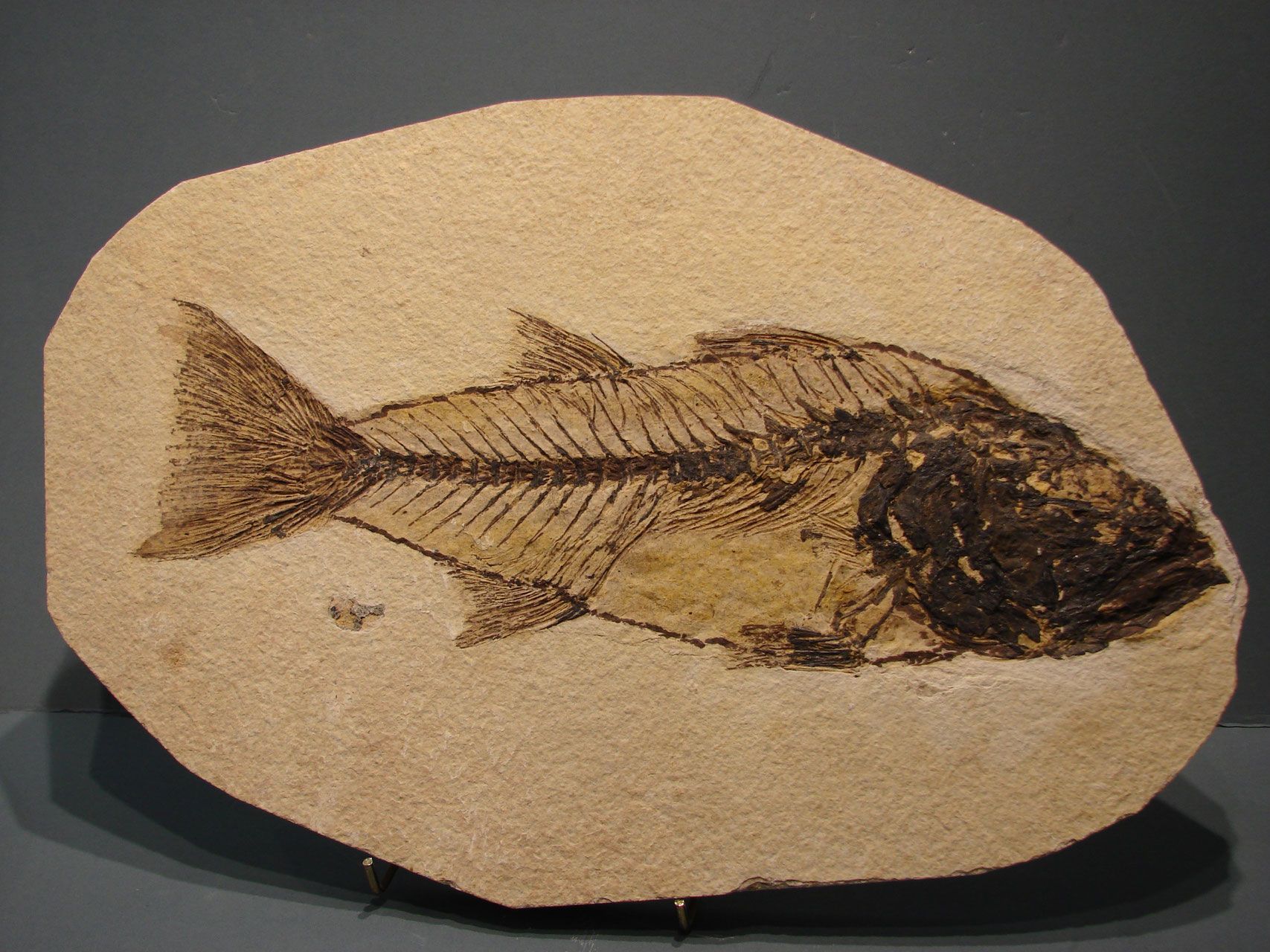
If a scientist found a fish fossil in the desert, what can they infer?
An animal ate the fish.
The water covered the area long ago.
Today's fish looks the same
The fish is endangered.
How are an elephant and a mammoth alike?
They are both endangered.
They are both extinct.
They both have tusks.
They both live in a warm climate.
What statement is true about fossils?
All living organisms leave behind fossils.
Fossils show that camels never change.
Some living things have not really changed in millions of years.
Plant fossils have never changed.
What needs to happen FIRST for a fossil to form?
A plant or animal must be covered by sediment.
A plant or animal must die and decompose.
Sediments fill a a mold to form a cast.
An earthquake shifts the land up.
Which of these animals is extinct?
Camel
Rhino
Red Panda
Saber-toothed cat
Why are there a lot of fern fossils?
Ferns are hard like bones.
Ferns have changed little over time.
Ferns were larger than all plants.
Most animals ate ferns.
How can you make a mold of an ancient seashell?
Press the seashell in model clay.
Draw the seashell
Press the seashell in model clay to make a mold then fill it in.
Trace the seashell

This type of fossil is tree sap hardened and replaced by minerals.
Petrified wood
Imprint
Amber
Mold
Turtles look much like they did millions of years ago. What can we infer about turtle fossils?
They did not change over time.
The turtle survived the ice age.
Turtles went extinct.
Turtles were never endangered.

What can we infer about animals with dull teeth?
They ate other animals.
They ate only plants.
They ate nothing.
They only ate fish.

Which statement is true?
Layer C is the oldest
Layer B is older than Layer A
Layer B is older than Layer C
Layer A is the youngest
Which type of rock can contain fossils?
Metamorphic
Stereosonic
Sedimentary
Igneous

What type of fossil is pictured here?
Mold fossil
Trace fossil
Cast fossil
Body fossil

What type of fossil is pictured here?
Mold fossil
Trace fossil
Cast fossil
Body fossil

What type of fossil is pictured here?
Forest fossil
Trace fossil
Cast fossil
Body fossil

What type of fossil is pictured here?
Mold fossil
Trace fossil
Cast fossil
Body fossil
Which conditions might lead to fossil formation? (Choose 3)
Decomposition
Getting buried quickly by sediment
getting trapped in a tar pit
getting eaten by another animal
making a footprint in mud

What conclusions could you make about the environment where this fossil formed?
It was under water.
It might have been a grassland.
It was snowy and cold.
It was a desert.
What is a good rule to follow when determining the age of rock layers?
The oldest is always on the top.
The rock layers get older as you dig deeper.
The layers position does not necessarily tell you about the age.
The youngest is always on the bottom.
Which is the most common fossil type?
Body fossil
Trace fossil
Cast fossil
Mold fossil