wayground logo

Free Printable Worksheets

NEW

Font size

S
M
L
XL
Worksheets

Core Review 19

Total questions: 52

Worksheet time: 54mins

Name
Class
Date
1.
Matter can not be created nor destroyed: it can only be
a)
Destroyed a little bit
b)
Invisible
c)
Transformed, rearrenged
d)
None of the above
2.
When balancing an equation you can
a)
alter subscripts
b)
change the identities of the products
c)
change the identities of the reactants
d)
write in coefficients
3.
Which number should be placed before O2 on the reactants side of the equation to make the equation balanced? N2 + ___O2 → 2NO2
a)
1
b)
2
c)
3
4.
Does this chemical equation support the law of conservation of mass? H2 + O2 --> H20
a)
Yes
b)
No
5.
N2 + 3H2 --> 2NH3
What is the total number of moles of NH3 produced when 10 moles of H2 reacts completely with N2?
a)
6.7
b)
2.0
c)
3.0
d)
15.0
6.
H2+Cl2-->2HCl
What is the total number of moles of HCl produced when 3 moles of H2 is completely consumed?
a)
5
b)
2
c)
3
d)
6
7.
H2+Cl2-->2HCl
How many moles of Cl2 is needed to react with 3 moles of H2?
a)
5
b)
2
c)
3
d)
6
8.
2Na + 2H2O → 2NaOH+ H2
How many grams of hydrogen are produced if 120 g of Na are available?
a)
5.2 g
b)
2.6 g
c)
690 g
d)
45 g
9.
CH4 + 2 O2 → CO2 + 2 H2O
How many moles of carbon dioxide are produced from the combustion of 110 g of CH4?
a)
13.7 mol
b)
2.75 mol
c)
6.11 mol
d)
6.85 mol
10.
What is the definition of molar mass?
a)
number of grams per one mole of a substance
b)
whole number ratio that is a multiple of a chemical formula
c)
simplest, whole number ratio of a chemical formula
d)
6.02 x 10^23 particles per one mole of a substance
11.
Molar mass is in units of ________.
a)
grams
b)
grams/mole
c)
mole
d)
moles/gram
12.
What is the molar mass of AuCl3?
a)
96 g
b)
130 g
c)
232.5 g
d)
303.3 g
13.

The starting temperature of a reaction was 21 degrees Celsius and the ending temperature was 44 degrees Celsius. What type of reaction occurred?

a)

EXOthermic

b)

ENDOthermic

14.
What type of energy can chemical transform into?
a)
Heat
b)
Light
c)
Electrical
d)
All of the above
15.
Why must we balance chemical equations? 
a)
Our teacher said so
b)
to abide by the law of conservation of energy
c)
to abide by the law of conservation of mass
16.
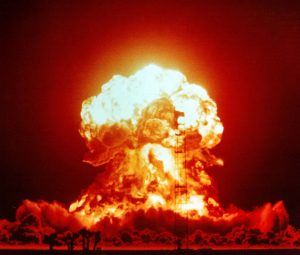
What type of reaction is shown in the photo?
a)
Exothermic
b)
Isothermic
c)
Endothermic
d)
None of the  above
17.
What tool is used to measure the amount of heat in a material?
a)
meter stick
b)
spring scale
c)
graduated cylinder
d)
thermometer
18.
What are the products in the chemical equation pictured?
a)
CO2
b)
CO2 and H2O
c)
CHand O2
d)
O2
19.
How do you know that energy is being absorbed during a chemical reaction?
a)
Temperature increases
b)
Temperature decreases
20.

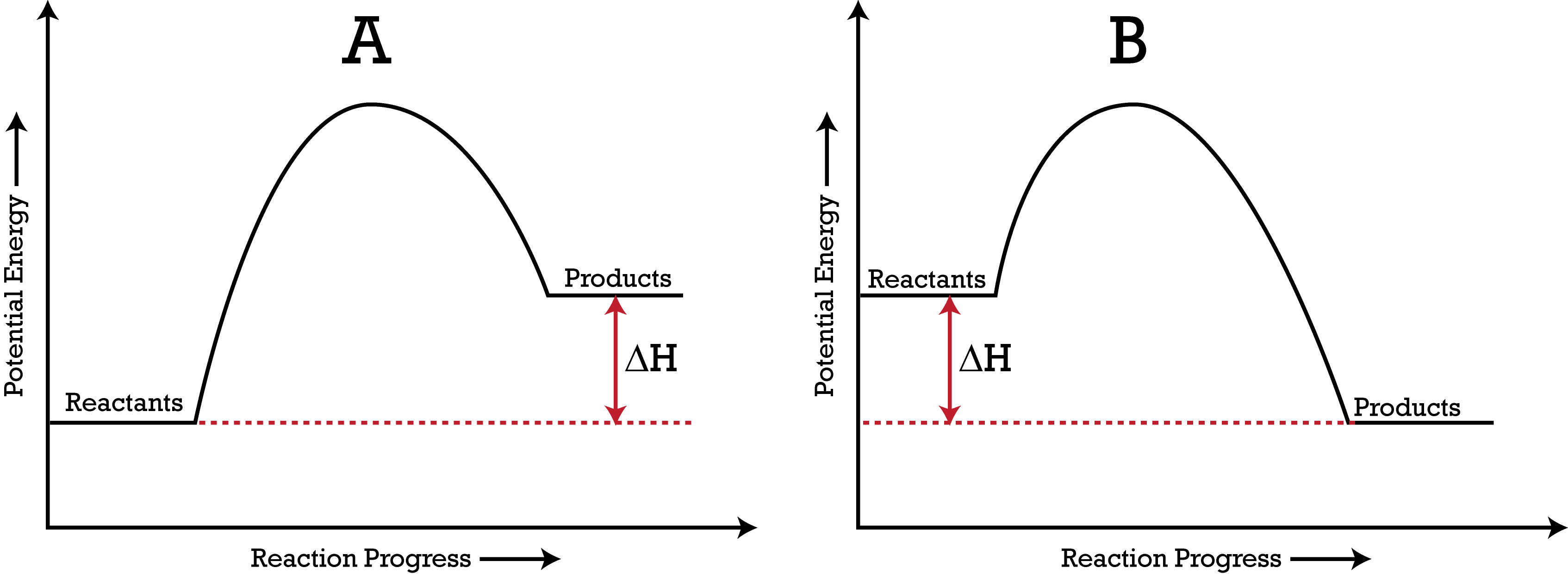
Which PE Diagram represents an endothermic reaction?

a)

A

b)

B

21.

What is the rate of reaction?

a)

How much energy is needed for a reaction to occur.

b)

The energy required to break a bond.

c)

The time it takes for a reaction to occur.

d)

Collision Theory

22.
If the reactant particles collide with less than the activation energy, the particles will be rebound, and no reaction will occur.
a)
True
b)
False
23.

How does a catalyst work in speeding up a reaction?

a)

By lowering the activation energy or reaction

b)

by giving them more energy

c)

by making them more available

24.
What are the PRODUCTS of the chemical reaction pictured?
a)
CH4 and CO2
b)
CH4 and O2
c)
CO2 and H2O
d)
O2 and H2O
25.

Which size marble chips produced the quickest rate of reaction when added to HCl.

a)

Small

b)

Medium

c)

Large

d)

I dont know

26.
A ______________ is a substance that increases the rate of a reaction without being used up during the reaction. 
a)
catalyst
b)
product
c)
reactant
d)
solute
27.

What is the concentration of a solution if 2.0 moles of sodium chloride is dissolved in 0.50 liter of water?

a)

0.5 M

b)

1.0 M

c)

2.0 M

d)

4.0 M

28.

100.0 mL of 2.500 M KBr solution is on hand. You need 0.5500 M. How much water should be added to create this concentration?

a)

454.5 mL

b)

354.5 mL

c)

22 mL

d)

137 mL

29.

What is the concentration of a solution that was made by adding 10.00 g of KF in 2.0 L of water?

(molar mass K = 39.09; F = 19.99)

a)

5.0 mol/L

b)

0.25 mol/L

c)

0.13 mol/L

d)

0.085 mol/L

30.

What is the concentration in molarity when 11.0 g of CaCl2 is added to water to make a 100 mL solution?

a)

0.10 M

b)

1.00 M

c)

11.0 M

d)

110 M

31.

How many milliliters of a 4.0 M NaCl solution will be needed to make 500 mL of a 2.0 M NaCl solution?

a)

100 mL

b)

250 mL

c)

500 mL

d)

2500 mL

32.
A solution has 10 moles of ammonia in 2L of solution. What is the molarity? 
a)
5.0 M
b)
20 M
c)
0.5 M
d)
0.2 M
33.
How many moles of HNO3 are needed to prepare 5L of a 2M solution? 
a)
10 mol
b)
2.5 mol
c)
0.4 mol 
d)
100 mol 
34.

molality is

a)

the moles of solute in 1g of solvent

b)

the moles of solute in 1g of solution

c)

the moles of solute in 1kg of solvent

d)

the moles of solute in 1kg of solution

35.

Colligative properties of solutions are those properties that depend on

a)

the amount of solute only

b)

the identity of solute only

c)

both the identity and the amount of solute

36.

The boiling point of a solution is ___________ that of a pure solvent

a)

more than

b)

less than

c)

equal to

37.
In order of most to least penetrating radiation we have
a)
Alpha , Beta,  Gamma
b)
Beta , Gamma , Alpha
c)
Gamma, Beta, Alpha
d)
Gamma, Alpha, Beta
38.
The technetium-99 isotope has a half-life of 6.0 hours. If 100.0 mg were injected into a patient how much remains after 18 hours?
a)
33.0 mg
b)
12.5 mg
c)
.33 mg
d)
15.8 mg
39.
The half life of Thorium-234 is 24 days. What fraction of the element remains after 96 days
a)
1/2
b)
1/4
c)
1/8
d)
1/16
40.
The time taken for half of an amount of radioactive atoms to decay.
a)
Nuclear fusion
b)
Full-life
c)
Dead time
d)
Half-life
41.
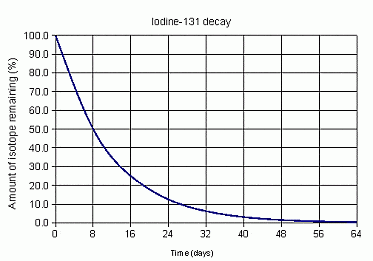
What is the half-life of iodine-131?
a)
32 days
b)
8 days
c)
16 days
d)
24 days
42.

Which of the two graphs show a state of equilibrium being reached?

a)

A

b)

B

c)

A and B

d)

Neither.

43.
When the rate of the forward reaction is equal to the rate of backward reaction, the system is said to be in
a)
Chemical Equilibrium
b)
Chemical Balance
c)
Stoichiometry
d)
Chemical Reaction
44.
Which of the following is NOT true at equilibrium?
a)
The forward and reverse reactions proceed at the same rate.
b)
The concentrations of reactants and products do not change.
c)
The concentration of the reactants is equal to the concentration of the products.
d)
The forward and reverse reactions continue to occur.
45.

2SO2(g)+O2(g) ⇌ 2SO3(g) + Heat


Adding SO2(g) will

a)

shift equilibrium right

b)

shift equilibrium left

c)

increase rate of reaction

d)

have no change

46.

2SO2(g)+O2(g) ⇌ 2SO3(g) + Heat


Increasing the temperature will...

a)

shift equilibrium right

b)

shift equilibrium left

c)

increase pressure

d)

have no change

47.

2SO2(g) + O2(g) ⇌ 2SO3(g) + Heat


Removing O2(g) will

a)

shift equilibrium right

b)

shift equilibrium left

c)

increase pressure

d)

have no change

48.

What type of solution is formed when the H+ ions equal the OH- ions?

a)

acidic

b)

basic or alkaline

c)

neutral

d)

enzymatic

49.
acid + base ₋>
a)
salt + hydrogen
b)
salt + water
c)
salt + carbon dioxide + water
d)
salt
50.
I have 25mL of 1M HCl which neutralises 20mL of NaOH. What is the concentration of the NaOH?
a)
0.8 M
b)
1 M
c)
1.25 M
51.
A 50.0 mL sample of Ca(OH)2 is neutralized by 300.0 mL of HCl solution with a pH of 1.3. Calculate the molarity of the Ca(OH)2 solution.
a)
1.0 M
b)
0.50 M
c)
0.15 M 
d)
0.30 M
52.
The rate of a chemical reaction is NOT affected by which of the following:
a)
temperature
b)
concentration
c)
particle size (surface area)
d)
All of these affect reaction rates