wayground logo

Free Printable Worksheets

Font size

S
M
L
XL
Worksheets

EXTRA CREDIT HOMEWORK

Total questions: 120

Worksheet time: 2hrs 8mins

Name
Class
Date
1.

This is an extra credit assignment for students who are failing. Is it mandatory? Select NO

a)

No

b)

Yes

2.

Will Ms. Jones harass you about completing this assignment? Select Nope

a)

Nope

b)

Yes

3.

Is Ms. Jones going to listen to you complaining about it being too much work? (Select Nope becuase you should have been doing homework)

a)

Nope, because you should have been doing homework

b)

Yes

4.
Which gas in our atmosphere is most abundant?
a)
Argon
b)
Oxygen
c)
Nitrogen
d)
Carbon Dioxide
5.
What is the percentage of oxygen in Earth's atmosphere?
a)
1%
b)
21%
c)
78%
d)
90%
6.
What is the percentage of nitrogen in Earth's atmosphere?
a)
1%
b)
21%
c)
78%
d)
90%
7.
In which layer of the atmosphere does weather occur?
a)
Mesosphere
b)
Thermosphere
c)
Stratosphere
d)
Troposphere
8.
What causes the temperature to increase in the stratosphere?
a)
Nitrogen
b)
Ozone
c)
Water Vapor
d)
carbon dioxide
9.
This layer is where weather occurs.
a)
troposphere
b)
thermosphere
c)
exosphere
d)
stratosphere
10.
Which layer protects the earth from meteors?
a)
Troposphere
b)
Stratosphere
c)
Mesosphere
d)
Thermosphere
11.
Describe how the ozone layer protects the earth.
a)
Absorbs solar radiation, Protects Earth from UV Rays,  and emits heat
b)
Ozone in the lower atmosphere is a pollutant
12.
Which layer of the atmosphere contains the ozone layer? 
a)
Mesosphere
b)
Stratosphere
c)
Ionosphere
d)
Exosphere
13.
Which front does this image represent ? 
a)
Cold front
b)
Stationary front
c)
Occluded Front 
d)
Warm front
14.
Based on the information provided in the weather map, which city shown most recently saw a drop in temperature? 
a)
Boise
b)
Denver
c)
Louisville
d)
Shreveport
15.
Based on the weather map, which city will most likely experience increasing temperatures during the next 24 hours? 
a)
Denver, because it is raining there
b)
Minneapolis, because a cold front is approaching
c)
Atlanta, because a warm front is approaching
d)
Houston, because it is in a high pressure area
16.
The boundary  between two air masses is known as:
a)
front
b)
storm
c)
climate
d)
flood
17.
Which front does this image represent ? 
a)
Cold front
b)
Stationary front
c)
Occluded Front 
d)
Warm front
18.
The main human activity that releases greenhouse gases is
a)
using bottled water
b)
burning fossil fuels
c)
texting on cellphones
d)
eating meat
19.
Warm air rises and the cool air sinks demonstrates this type of heat transfer. 
a)
conduction
b)
convection
c)
radiation
d)
Insolation 
20.
When warm air rises and cools high in the atmosphere and then sinks to the earth creates _________ currents
a)
convection
b)
surface
c)
deep
d)
precipitaiton
21.

The green pigment that captures energy of the sun is called chlorophyll

a)

True

b)

False

22.
Protists that make their own food are...
a)
Autotrophs
b)
Heterotrophs
c)
Plantotrophs
d)
Sigotrophs
23.
Protist require water in their environment to survive
a)
True
b)
False
24.
What does the word Pseudo mean?
a)
Large
b)
Small
c)
Real
d)
Fake
25.
What is Cilia?
a)
A tail like structure that help protist move
b)
Hair like fibers that help protist move
c)
A place where spores are kept
d)
A fake foot that help protist move
26.
What is Flagella?
a)
A tail like structure that help protist move
b)
Hair like fibers that help protist move
c)
A place where spores are kept
d)
A fake foot that help protist move
27.
What is a pseudopod?
a)
A tail like structure that help protist move
b)
Hair like fibers that help protist move
c)
A place where spores are kept
d)
A fake foot that help protist move
28.
What would happen if you take away light from a plant-like protist?
a)
Nothing
b)
It will grow better
c)
It will starve
d)
It will become a heterotroph
29.
Which type of protist is shown in the picture?
a)
euglena
b)
paramecium
c)
amoeba
d)
prokaryotic
30.
Which type of protist is shown in the picture?
a)
euglena
b)
paramecium
c)
amoeba
d)
eukaryotic
31.
Which type of protist is shown in the picture?
a)
euglena
b)
paramecium
c)
amoeba
d)
autotroph
32.
What is the name for an organism that can produce its own food?
a)
heterotroph
b)
autotroph
c)
amoeba
d)
eukaryotic
33.
What is the name of an organism that cannot produce its own food and must get it from another source?
a)
prokaryotic
b)
eukaryotic
c)
autotroph
d)
heterotroph
34.
How are protists different than bacteria?
a)
Protists are eukaryotic and bacteria are prokaryotic
b)
Protists are prokaryotic and bacteria are eukaryotic
c)
There is no difference; protists and bacteria are the same thing
d)
Protists are always unicellular and bacteria are always multicellular
35.
Which of the following is true ALL organisms in the protist kingdom?
a)
They are multicellular
b)
They live in moist environments
c)
They move using cilia
d)
They move using flagella
36.
What is the name of the structure shown in the model?
a)
cilia
b)
flagella
c)
amoeba
d)
pseudopod 
37.
Which of the following is NOT a function of the cilia?
a)
to sweep food into the paramecium's "mouth"
b)
to allow the paramecium to move
c)
to secrete poison to kill predators
d)
to trap food
38.
Which of the following is the best model for cilia?
a)
A
b)
B
c)
C
d)
D
39.
A pseudopod literally means...
a)
small hair
b)
long tail
c)
no nucleus
d)
false foot
40.
What is a common type of protozoan with cilia and two types of nuclei?
a)
Amoeba
b)
Cilia
c)
Paramecium
41.
What are the 3 structures of a protist that allow it to move?
a)
Cilia, flagella, and pseudopodia
b)
Cilia, amoeba, and protozoans
c)
Cilia, flagella, and amoeba
42.
Protists are capable of producing:
a)
Sexually
b)
Asexually
c)
Asexually and Sexually
43.
Name this protist?
a)
Amoeba
b)
Euglena
c)
Paramecium 
d)
Volvox
44.
Name this protist?
a)
Euglena 
b)
Amoeba 
c)
Paramecium 
d)
Volvox
45.
Reproduction without the use of sex cells is called what? 
a)
Sexual Repoduction
b)
Asexual Reporduction
46.
How does this protist move? 
a)
Flagellum
b)
Cilia 
c)
Pseudopods
47.
How does this protist move? 
a)
Cilia
b)
Pseudopods
c)
Flagellum 
48.
A protist that can make its own food is called what? 
a)
Heterotroph
b)
Autotroph
49.
Which protist has an oral groove and a gullet? 
a)
Paramecium 
b)
Volvox
c)
Amoeba 
d)
Euglena 
50.
What are the finger like projections called? 
a)
Flagella 
b)
Cilia 
c)
Pseudopods
d)
Veela 
51.
Most protists live
a)
on dry rocks
b)
in moist places
c)
in deserts
d)
in cold, dry climates
52.
What body system protects your organs?
a)
Nervous System
b)
Cardiovascular System
c)
Respiratory System
d)
Skeletal System
53.
 Each body system includes two or more organs that work together.  This means that body systems are interrelated.
a)
True
b)
False
54.
What system moves the body?
a)
Endocrine System
b)
Muscular System
c)
Cardiovascular System
d)
Skeletal System
55.
What body system breaks down food for energy?
a)
Urinary System
b)
Digestive System
c)
Lymphatic System
d)
Respiratory
Respiratory System
56.
What system sends and receives messages?
a)
Immune System
b)
Urinary System
c)
Digestive System
d)
Nervous System
57.
This system gets rid of waste.  What is it?
a)
Muscular System
b)
Urinary System
c)
Lymphatic System
d)
Endocrine System
58.
What system carries oxygen to the blood?  
a)
Cardiovascular System
b)
Respiratory System
c)
Nervous System
d)
Endocrine System
59.
What system protects the body from disease?
a)
Lymphatic System
b)
Endocrine System
c)
Immune System
d)
Urinary System
60.
The reproductive system allows for the creation of new life (babies).
a)
True
b)
False
61.
What is responsible for delivering oxygen and removing carbon dioxide from the body?
a)
cell nucleus
b)
excretory system
c)
nervous tissue
d)
respiratory system
62.
The main purpose of the ____________ system is to break food particles into pieces that can be used.
a)
circulatory
b)
respiratory
c)
digestive
d)
skeletal
63.
Major organs of the digestive system
a)
Kidneys, nephrons
b)
Stomach, intestines, mouth
c)
Heart, blood vessels, blood
d)
Liver, kidneys, heart
64.
Major organs of the nervous system
a)
Kidneys, nephrons
b)
Stomach, intestines, mouth
c)
Heart, blood vessels, blood
d)
Brain, spinal cord, nerve
65.
Major organs of the skeletal system
a)
Muscles, tendons
b)
Bones, ligaments
c)
Marrow, periostium, nerves
d)
Ribs, quadriceps, femur
66.
Heart, blood vessels, blood
a)
Digestive system
b)
Excretory system
c)
Circulatory system
d)
Immune system
67.
Nose, trachea, lungs, alveoli
a)
Respiratory system
b)
Endocrine system
c)
Muscular system
d)
Skeletal system
68.
Major organs of the muscular system
a)
Shoulder-blade, kneecap, triceps
b)
Muscles, tendons
c)
Bones, ligaments
d)
Heart, intestines, stomach
69.
Major organs of the immune system
a)
Kidneys, lymph nodes, nose
b)
Stomach, brain, pituitary gland
c)
Skin, stomach, breathing passages, blood
d)
Bacteria, virus, fungi
70.
Pituitary gland, pancreas, thyroid, adrenal gland
a)
Digestive system
b)
Integumentary system
c)
Endocrine system
d)
Immune system
71.

What is a group of cells that are alike and work together?

a)

a cell team

b)

a tissue

c)

a cell family

72.

A group of tissues that work together is a(n) ______________________.

a)

cell

b)

organ

c)

organ system

73.

Organs that work together are part of a(n) ________________________.

a)

cells

b)

tissue

c)

organ system

74.

When similar cells group together it is called a tissue

a)

true

b)

false

75.
What kind of energy is in a rock at the edge of a cliff?
a)
Potential
b)
Kinetic
76.
Which is the best example that something has kinetic energy?
a)
a. a car parked on a steep hill 
b)
b. a tennis ball rolling across the court
c)
c. a picture hanging on the wall 
d)
d. a piece of coal before it's burned 
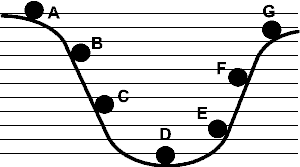
77.

Which point has the most potential energy?

a)

G

b)

F

c)

B

d)

A

78.

Which 2 letters have the most kinetic energy

a)

W & Y

b)

X & Z

c)

W & X

d)

X & Y

79.
How much potential energy is at the top of a hill on a rollar coaster ride
a)
100%
b)
50%
c)
0%
d)
20%
80.
At which point is kinetic energy greatest?
a)
W
b)
X
c)
Y
d)
Z
81.
Energy due to motion is ____________ energy. 
a)
Potential 
b)
Energy
c)
Kinetic
d)
Friction
82.
The faster an object moves, the ________ kinetic energy it has. 
a)
more
b)
less
c)
none of the above
d)
all of the above 
83.
Can energy be destroyed?
a)
no
b)
yes
84.
Energy can not be created or destroyed, only converted from one form to another.
a)
true
b)
false
85.

What energy transformation occurs in the chameleon as it quickly launches its tongue to catch an insect?

a)

Radiant --> Chemical

b)

Thermal --> Chemical

c)

Chemical --> Mechanical

d)

Mechanical --> Chemical

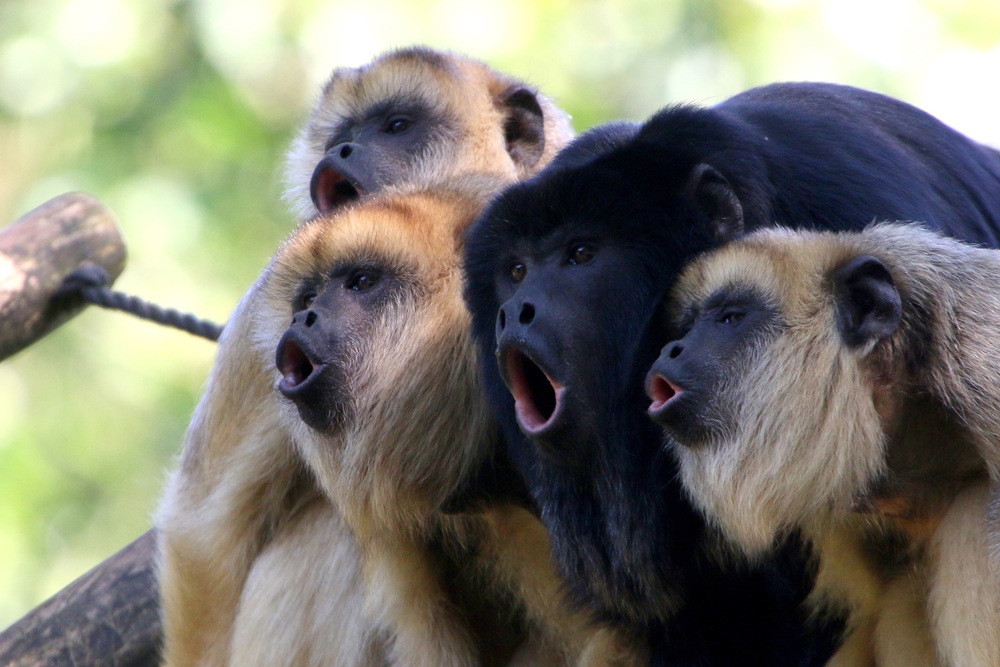
86.

What energy transformation occurs as howler monkeys loudly call to each other in the forest?

a)

Chemical --> Mechanical --> Sound

b)

Chemical --> Sound --> Thermal

c)

Sound --> Chemical --> Radiant

d)

Mechanical --> Chemical --> Sound

87.

What energy transformation occurs as as an elephant walks through the savanna?

a)

Thermal --> Chemical + Mechanical

b)

Mechanical --> Chemical + Thermal

c)

Radiant --> Chemical + Mechanical

d)

Chemical --> Mechanical + Thermal

88.

What happens to chemical energy as it is used by cells to perform various functions?

a)

It is often broken into smaller pieces

b)

It is usually converted into other types of energy

c)

It is typically released as a waste product in the form of a gas

d)

It disappears as it is crushed and destroyed

89.
Location of object.
a)
Position
b)
Reference Point
c)
Area
d)
Place
90.
Location for comparison.
a)
Position
b)
Location
c)
Reference Point
d)
Direction
91.
Change in position over time.
a)
Location
b)
Velocity
c)
Motion
d)
Movement
92.
Distance over time.
a)
Travel
b)
Motion
c)
Velocity
d)
Speed
93.
How is speed calculated?
a)
S= D/M
b)
S= D/T
c)
S= T/D
d)
T= S/D
94.
Can be measured in seconds (s)
a)
Distance
b)
Time
c)
Speed
d)
Acceleration
95.
Can be measured in meters per second (m/s)
a)
Distance
b)
Time
c)
Speed
d)
Acceleration
96.
Can be measured in meters (m)
a)
Distance
b)
Time
c)
Speed
d)
Acceleration
97.
What is the speed of an object that travels 20 meters in 4 seconds?
a)
80 m/s
b)
0.2 m/s
c)
5 m/s
d)
24 m/s
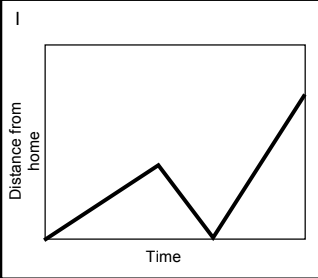
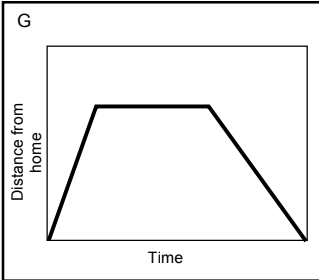
98.
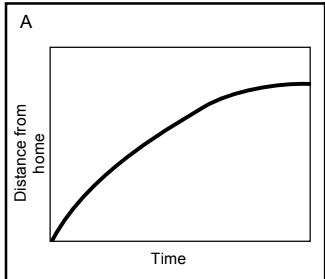
What does this graph represent?
a)
Constant speed
b)
Acceleration
c)
Not moving
99.
What is happening at C?
a)
Stationary
b)
Accelerating
c)
Fast steady speed; moving away from the starting position
d)
Slower steady speed; moving away from the starting position
100.
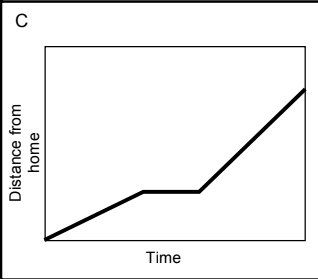
Which runner had a head start?
a)
A
b)
B
c)
C
101.
a)
b)
c)
d)
102.
a)
b)
c)
d)
103.
a)
b)
c)
d)
104.
a)
b)
c)
d)
105.
a)
b)
c)
d)
106.

What is the speed of segment A?

a)

0.5 m/s

b)

2 m/s

c)

3 m/s

d)

0 m/s

107.

What is the speed of segment B?

a)

0.5 m/s

b)

2 m/s

c)

3 m/s

d)

0 m/s

108.

What is the speed of segment D?

a)

0.5 m/s

b)

2 m/s

c)

3 m/s

d)

0 m/s

109.

What is the speed of segment C?

a)

0.5 m/s

b)

2 m/s

c)

3 m/s

d)

0 m/s

110.

What is the total time traveled?

a)

20 s

b)

30 s

c)

40 s

d)

50 s

111.
Where the warm and cold air meet and stall, clouds and fog form, and it may rain or snow.  It could bring many days of clouds and precipitation.  
a)
Warm Front
b)
Cold Front
c)
Occluded Front 
d)
Stationary Front 
112.
Located at the leading edge of a temperature drop off. Bring heavy thunderstorms, rain, and hail. Cool, fair weather is likely to follow.  
a)
Warm Front
b)
Cold Front
c)
Occluded Front
d)
Stationary Front 
113.
Located at the leading edge of a warm air mass. Brings gentle rain or light snow, followed by warmer, milder weather.  
a)
Warm Front
b)
Cold Front 
c)
Occluded Front 
d)
Stationary Front 
114.
This is the symbol for a... 
a)
Stationary Front
b)
Occluded Front
c)
Cold Front
d)
Warm Front
115.
This is the symbol for a... 
a)
Stationary Front
b)
Occluded Front
c)
Cold Front
d)
Warm Front 
116.
Identify the type of front that is shown in the image.
a)
Occluded Front
b)
Cold Front
c)
Stationary Front
d)
Warm Front
117.
Identify the type of front that is shown in the image.
a)
Occluded Front
b)
Cold Front
c)
Stationary Front
d)
Warm Front
118.
Identify the type of front that is shown in the image.
a)
Occluded Front 
b)
Cold Front
c)
Stationary Front
d)
Warm Front
119.
What type of storm front is this? 
a)
warm front
b)
cold front
c)
stationary front
d)
occluded front
120.
What type of storm front is this?
a)
warm front
b)
cold front
c)
stationary front
d)
occluded front