wayground logo

Free Printable Worksheets

NEW

Font size

S
M
L
XL
Worksheets

Gas Laws Test Review

Total questions: 46

Worksheet time: 4hrs 40mins

Name
Class
Date
1.
In order to convert to Kelvin, you add ______ to the Celsius measurement.
a)
372
b)
273
c)
237
d)
732
2.
What is 50 C in Kelvin?
a)
223
b)
323
c)
100
d)
50
3.
100 degrees Celsius is equal to _______ Kelvin. 
a)
0 K
b)
273 K
c)
173 K
d)
373 K
4.
If a balloon is cooled what will happen to the volume?
a)
Volume will increase
b)
Volume will decrease
c)
Volume will not change
5.
Which of the following would increase the (gas) pressure of a system?
a)
Increase the Temperature
b)
Pump in more gas
c)
Decrease the volume
d)
All of these
6.
The following graph shows ____ relationship. 
a)
Direct
b)
Inverse
7.
Boyle's law :  The pressure and volume of a gas show a _____ relationship. 
a)
Inverse 
b)
Direct 
8.
In the ideal gas law, which variable represents the gas constant?
a)
n
b)
R
c)
T
d)
V
9.
You have a gas that has a pressure of 2 ATM and a volume of 10L.  What would be the new volume if the pressure was changed to 1 ATM?
a)
5 L
b)
20 L
c)
It would stay at 10L
d)
1 L
10.
A sample of gas with a volume of 30.0 mL at 25.0oC is heated to 50.0oC.  What is the new volume of the gas?
a)
60.0 mL
b)
15.0 mL
c)
27.5 mL
d)
32.5 mL
11.
A sample of oxygen gas has a volume of 150.0 mL when its pressure is .947 atm. What will the volume of the gas be if it is lowered to a pressure of 0.658 atm and the temperature remains constant?
a)
72 mL
b)
144 mL
c)
216 mL
d)
288 mL
12.
Determine the Kelvin temperature required for 0.0470 mol of gas to fill a balloon to 1.20 L under .998 atm pressure. 
a)
0 K 
b)
107 K 
c)
207 K 
d)
307 K 
13.
Determine the number of moles in a container of gas at STP with a volume of 99.2 L. 
a)
2222.08 moles
b)
4.43 moles
c)
22.4 moles 
d)
76.8 moles
14.
Determine the initial temperature of a random gas when the initial volume is 2.2 L and it is cooled to 88K with a volume of 0.85 L. 
a)
0.029 K
b)
0.021 K
c)
227.76 K
d)
34 K
15.
Which variable is held constant when using Boyle's Law?
a)
Temperature
b)
Pressure
c)
Volume
d)
number of moles
16.
What is the correct formula for Boyle's Law?
a)
V1/T1=V2/T2
b)
P1V1=P2V2
c)
P1/T1=P2/T2
d)
PV=nRT
17.
What would you expect to see if temperature increased if you were using Charles's Law?
a)
volume would decrease proportionally
b)
volume would increase proportionally
c)
pressure would increase proportionally
d)
pressure would decrease proportionally
18.
Gay-Lussac's law shows the directly proportional relationship between which two variables?
a)
pressure-temperature
b)
volume-temperature
c)
volume-pressure
d)
temperature-number of moles
19.
Which gas law would best be used when there are no variables being held constant?
a)
Boyle's Law
b)
Charles's Law
c)
Ideal Gas Law
d)
Combined Gas Law
20.
Which law?
a)
Charles 
b)
Boyle
c)
Hunsecker
d)
Newton
21.
Which law?
a)
Charles 
b)
Boyle
c)
Hooke
d)
Peter Pan 
22.

Which law?

a)

Boyle

b)

Charles

c)

Landis

d)

Boykin

23.
When the temperature is constant (k) inside a balloon, if you add pressure on it, the volume will ..... 
a)
Decrease
b)
Increase
c)
Not Change at all
d)
Particles will solidify 
24.
For example, if you increase the temperature of a gas inside a balloon, the balloon will....
[pressure is constant (k)]
a)
Expand (increase in volume)
b)
Deflate (decrease in volume
25.
Pick the best answer to explain all properties of gases....
a)
They're fluids 
Can be compressed
Little space between particles 
b)
They're solids 
Can be compressed
Lots of space between particles 
c)
They're fluids 
Cannot be compressed
Lots of space between particles 
d)
They're fluids 
Can be compressed
Lots of space between particles 
26.
Why does a car get low tire pressure in the COLD...what two variables are to blame? 
a)
Pressure and Temperature
b)
Temperature and Volume
c)
Volume and Pressure
d)
Temperature and Weight 
27.

Which Gas Law is inversely proportional?

a)

Boyle's

b)

Charles

c)

Gay-Lussac's

d)

Ideal Gas Law

28.
A gas that has a pressure of 2 atm and a volume of 10 L.  What would be the new volume if the pressure was changed to 1 atm?
a)
P1/T1 = P2/T2
b)
P1V1 = P2V2
c)
V1/n1 = V2/n2
d)
PV = nRT
29.
A sample of a gas has a volume of 852 mL at 298 K. What temperature is necessary for the gas to have a volume of 945 mL?
a)
Pt = P1 + P2 + P3 + ...
b)
P1V1 = P2V2
c)
V1/T1 = V2/T2
d)
P1V1/T1 = P2V2/T2
30.
Determine the number of moles in a container of gas at STP with a volume of 99.2 L. 
a)
V1/n1 = V2/n2
b)
PV = nRT
c)
P1/T1 = P2/T2
d)
V1/T1 = V2/T2
31.
A sample of gas with a volume of 30.0 mL at 25.0oC is heated to 50.0oC.  What is the new volume of the gas?
a)
P1V1 = P2V2
b)
P1/T1 + P2/T2
c)
PV = nRT
d)
V1/T1 = V2/T2
32.
A 220.0 mL sample of helium gas is in a cylinder at 105 kPa and 275 K. The piston is pushed in until the sample has a new temperature of 310 K and new pressure of 150 kPa. What is the new volume of the gas? 
a)
P1V1/T1 = P2V2/T2
b)
PV = nRT
c)
P1V1 = P2V2
d)
Pt = P1 + P2 + P3 + ...
33.
A gas fills a balloon at a temperature of 27 oC and 1 atm of pressure. What will the pressure of the balloon be if the gas is heated to 127 oC?
a)
P1V1 = P2V2
b)
PV = nRT
c)
P1/T1 = P2/T2
d)
V1/T1 = V2/T2
34.
True or False: Gases can be compressed. 
a)
True
b)
False
35.
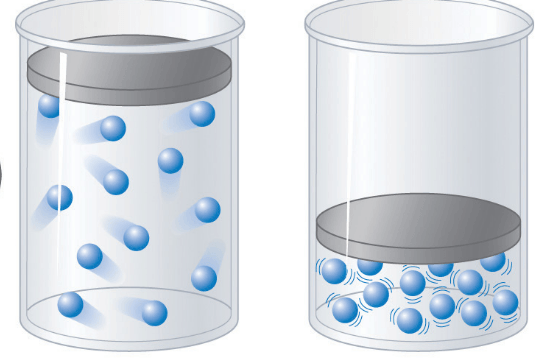
Which container will have a lower pressure?
a)
left
b)
right
c)
they both have the same pressure
d)
I don't know
36.

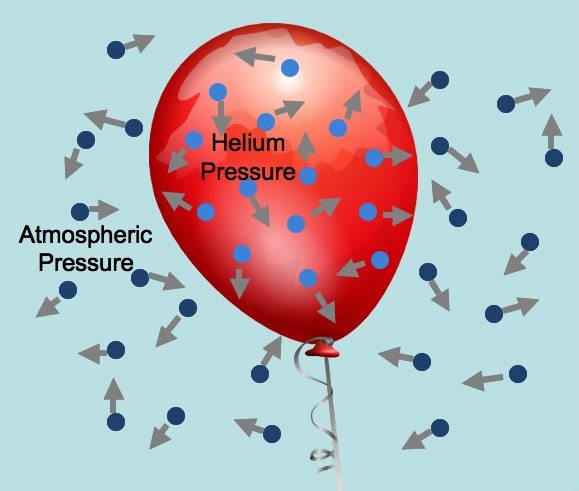
What causes pressure?

a)

The walls of the container

b)

The vacuum in the container

c)

The collisions of the particles with the container

d)

Atmospheric pressure acting on the outside walls
37.
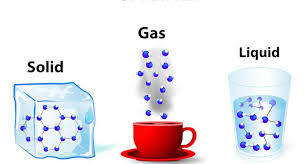
Of these three states of matter, which one has the most kinetic energy? 
a)
Solid 
b)
Liquid 
c)
Gas
38.
As the temperature increases so does the.. 
a)
Potential Energy 
b)
Kinetic Energy  
39.

Absolute zero is ____________.

a)

The only time molecules would not be moving

b)

0 degrees Celsius

c)

273 K

d)

The temperature in outer space

40.
All of the following statements are TRUE about the behavior of gases according to the Kinetic Molecular Theory EXCEPT:
a)
Gases have elastic collisions
b)
Gases do not attract or repel
c)
Gases are in constant random motion
d)
Gases stick to the sides of the container and to each other
41.

In all gas laws calculations, temperature must be measured in

a)

Kelvins (K)

b)

Celcius (ºC)

c)

Farenheit (ºF)

42.

atm, mmHg, and kPa are units used to measure

a)

pressure

b)

temperature

c)

volume

43.

Which of the following is a unit used to measure volume?

a)

mmHg

b)

L

c)

K

d)

mol

44.

The kinetic molecular theory helps us understand ______

a)

the behavior of gases

b)

how to calculate moles

c)

the attraction between the particles of a solid

d)

how to calculate temperature

45.

What is standard temperature?

a)

0 degrees Celsius

b)

0 K

c)

373 K

d)

-273 degrees Celsius

46.

Which is NOT standard pressure?

a)

101.3 kPa

b)

14.7 psi

c)

760 atm

d)

760 mmHg