wayground logo

Free Printable Worksheets

Font size

S
M
L
XL
Worksheets

Earth Science Final Exam Review

Total questions: 192

Worksheet time: 5hrs 4mins

Name
Class
Date
1.
What kind of weather is usually associated with a high pressure system?
a)
Sunny weather
b)
Precipitation (rain, snow, etc.)
2.

Is this weather or climate? It's raining today, so I need an umbrella.

a)

weather

b)

climate

3.

Is this weather or climate? The weather in December tends to be cold and snowy.

a)

weather

b)

climate

4.

Which is NOT an example of extreme weather?

a)

blizzard

b)

tornado

c)

flooding

d)

rain

5.

Which statement best describes the difference between weather and climate?

a)

Weather is what you expect; climate is what you get.

b)

Weather and climate are the same thing.

c)

Climate is what you expect; weather is what you get.

d)

Weather happens in the atmosphere and climate happens on the ground.

6.
Which of the following statements about air pressure is true?
a)
Air pressure increases as altitude increases.
b)
Air pressure decreases as altitude increases.
c)
The atmosphere's air pressure does not vary
d)
Warm air tends to have higher air pressure than cold air
7.
Which accurately describes the atmosphere?
a)
Composed of masses of air particles that are constantly circulating.
b)
Composed entirely of nitrogen and oxygen which react to form ozone.
c)
Comoposed of masses of air particles that move very little, if at all.
d)
Composed of several layers that increase in density as altitude increases.
8.
The graph shows how temperature changes with altitude in the Earth's atmosphere. In the troposphere...
a)
Temperature decreases as altitude increases
b)
Temperature increases as altitude increases
c)
Temperature alternately increases and decreases as altitude increases
d)
Temperature stays the same as altitude increases
9.
Which of the choices below is one of the primary gases found in the atmosphere?
a)
Oxygen
b)
Argon
c)
Carbon Dioxide
d)
Helium
10.
Earth's atmosphere is made up of four different layers. In which of the following layer does virtually all of Earth's weather take place?
a)
Stratosphere
b)
Mesosphere
c)
Thermosphere
d)
Troposphere
11.

What would happen to temperatures on Earth if the atmosphere did not exist?

a)

Nothing would happen to change the temperatures.

b)

All temperatures would decrease.

c)

All temperatures would increase.

d)

Temperatures would become more extreme.

12.

If you climbed a mountain, how you you expect the temperature to change as you climbed higher?

a)

Temperature would increase

b)

Temperature would decrease

c)

Temperature would not change

13.
What is the greenhouse effect?
a)
The warming of a planet due to trapped radiation.
b)
The cooling of Earth due to air pollution.
c)
The heating of a solid, such as a rock.
14.
What happens to the temperature if more greenhouse gases are released into the atmosphere?
a)
Temperature goes up
b)
Temperature goes down
15.
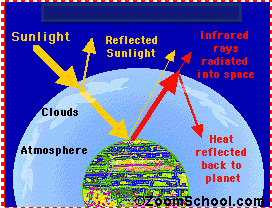
What does this diagram illustrate?
a)
Ozone Layer
b)
The Greenhouse Effect
c)
Ultraviolet Radiation
d)
Layers of the atmosphere
16.
Which of the following is NOT a greenhouse gas?
a)
Oxygen
b)
Carbon Dioxide
c)
Methane
d)
Nitrous Oxide
17.
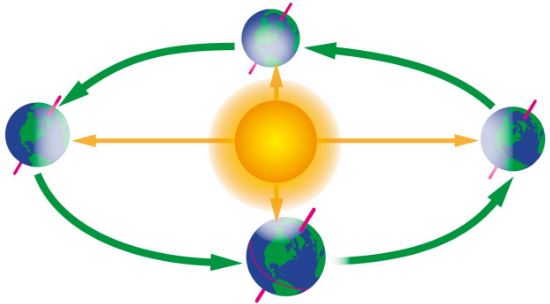
At position A, which hemisphere would have summer?
a)
Northern hemisphere
b)
Southern hemisphere
18.
What happens when the area in which you live tilts away from the sun?
a)
It is summer.
b)
It is spring.
c)
It is winter.
d)
It is fall.
19.
Why do we experience the changing of the season on the earth?
a)
distance from the sun
b)
rotation of the earth
c)
change in solar output
d)
tilt of the earth's axix
20.
Why is the Equator warmest?
a)
Because it is closest to the sun.
b)
Because it receives the most direct sunlight
c)
Because no clouds form here.
d)
Because it is far from the sun
21.
In spring/summer, the axis of the earth is pointed away or toward the sun?
a)
towards
b)
Neither away or toward
c)
away
22.
Which season is taking place in the Northern Hemisphere in Position 1?
a)
Winter
b)
Spring
c)
Summer
d)
Fall
23.
Which season is taking place in the Northern Hemisphere in Position 2?
a)
Winter
b)
Spring
c)
Summer
d)
Fall
24.
Which season is taking place in the Northern Hemisphere in Position 3?
a)
Winter
b)
Spring
c)
Summer
d)
Fall
25.
Day and night is caused by the _____________ of earth on its axis.
a)
revolution
b)
orbit
c)
rotation
26.
What are the reasons for the seasons?
a)
Earth's tilt and rotation.
b)
Earth's rotation and revolution.
c)
Earth's tilt and revolution.
d)
Earth's tilt and resolution
27.
When the Northern Hemisphere of Earth is Leaning away from the Sun, What season is the Southern Hemisphere experiencing?
a)
Summer
b)
Winter
c)
Spring
d)
Fall
28.
When experimenting with the growth of a plant, a scientist uses three (of the same type of) plants, two different fertilizers, equal light, and equal water. What type of variable is the fertilizer?
a)
Dependent
b)
Independent
c)
Control
d)
Compound
29.
Research Question: Does the type of gasoline put in a car effect how fast the car can drive. What is the independent variable?
a)
Type of gasoline
b)
which car the gas is put into
c)
how fast the car can drive
d)
how much gas is put into the car
30.
What would the INDEPENDENT variable be in an experiment testing which types of paper airplane goes furthest?
a)
the paper used
b)
the type of paper airplane
c)
the distance of each plane's flight
d)
how hard the plane is thrown
31.
Ms. S set up an experiment to see how the mass of a ball affects the distance it rolls off a ramp. What is the dependent variable?
a)
Distance traveled by the ball
b)
Height of the ramp
c)
Mass of the ball
d)
Where the experiment took place.
32.
Tiffany was investing how fast it took Hayden to react to different sounds. Identify the independent variable.
a)
How fast Hayden reacted
b)
different sounds
c)
types of music
d)
Hayden
33.
The independent variable is the ONE thing you _____.
a)
change
b)
keep the same
c)
experiment with
d)
investigate
34.
 In a controlled experiment, the variable that is changed to test the hypothesis is called the –
a)
Controlled Variable
b)
Responsive Variable
c)
Dependent Variable
d)
Independent Variable
35.
The measurable factor in an experiment is known as the: 
a)
Control
b)
Independent Variable
c)
Constant
d)
Dependent Variable
36.
In a well designed experiment, you should change how many variables?
a)
only one
b)
no more than two
c)
none at all
d)
as many as are needed
37.
Everything you want to remain the same or unchanged is called are called  the ___________ variables.
a)
independent
b)
dependent
c)
controlled
38.
What is the definition of CONVECTION
a)
When heat transfers through waves.
b)
When heat transfers from objects that are touching.
c)
a  hot liquid or air that  expands, becomes less dense, and rises or becomes more dense, and sinks.
d)
Heat traveling from the sun
39.
When I cold front is approaching, what happens?
a)
warm air is pushing under cold air causing humid weather and lower temperatures
b)
warm air is pushing under cold air causing humid weather and higher temperatures
c)
warm air rises, cools, and causes rain and thunderstorms
d)
cold air is pushed over warm air causing rain and thunderstorms
40.
When a warm front is approaching, what happens?
a)
advancing cold air pushes up and over retreating warm air causing warm temperatures and mild rain
b)
advancing warm air pushes up and over retreating cold air causing warm temperatures and mild rain
41.
The symbol on a weather map for a cold front is what?
a)
a line with triangles on it
b)
a line with semi-circles on it
c)
a line with squares on it
d)
a line with circles on it
42.
The symbol on a weather map for a warm front is what?
a)
a line with triangles on it
b)
a line with circles on it
c)
a line with semi-circles on it
d)
a line with circles on it
43.
If an air mass is rising, it must be
a)
cold and less dense
b)
cold and more dense
c)
warm and more dense
d)
warm and less dense
44.
If an air mass is sinking, it must be
a)
cold and less dense
b)
cold and more dense
c)
warm and more dense
d)
warm and less dense
45.
In a high pressure area, the weather will likely be
a)
warmer and clear skies
b)
warm but cloudy
c)
cold and rainy
d)
cold and clear
46.
In a high pressure area
a)
the winds will be moving clockwise
b)
the winds will be moving counter-clockwise
c)
the winds will be calm
d)
the air will be rising
47.
In a high pressure systems
a)
there are few clouds because the air in moving downward
b)
there are many clouds because the air is very humid
c)
there are few clouds because the air is moving outward
d)
there are many clouds because the air is moving upward
48.
A front is
a)
where warm air is cooling at earth's surface
b)
a line where hot and cold air are separating
c)
a line where two different air masses meet
d)
where cold air is rising and forming rain clouds
49.
A severe storm that involves strong winds and forms over warm water is:
a)
tornado
b)
thunderstorm
c)
hurricane
d)
blizzard
50.
A severe storm which involves a funnel cloud forming from a cumulonimbus cloud:
a)
hurricane
b)
tornado
c)
thunderstorm
d)
blizzard
51.
This severe weather involves lightning, rain, and forms from a cumulonimbus cloud.
a)
thunderstorm
b)
tornado
c)
hurricane
d)
blizzard
52.
What is the most abundant gas found in the atmosphere?
a)
Carbon Dioxide
b)
Nitrogen
c)
Oxygen
d)
Water Vapor
53.
________________ are made of water vapor that condenses in the troposphere.
a)
dew
b)
clouds
c)
evaporation
d)
transpiration
54.
Warm air near the Earth’s surface rises and then cools and drops, this creates a _________________ in the atmosphere.
a)
run-off
b)
Greenhouse Effect
c)
convection current
d)
water cylce
55.
Because the earth is spinning on its axis, the global winds appear to curve. This is known as the __________ ________.
a)
Coriolis Effect
b)
Greenhouse Effect
c)
Climate Effect
d)
Atmosphere Effect
56.
Where does a hurricane form?
a)
Over a cold body of water
b)
Over a warm body of water
c)
Over cold land
d)
Over warm land
57.
What kind of weather is usually associated with a low pressure system?
a)
Sunny weather
b)
Precipitation (rain, snow, etc.)
58.
What layer does weather occur in?
a)
mesosphere
b)
troposphere
c)
thermosphere
d)
stratosphere
59.
Where is the ozone layer located?
a)
Thermosphere
b)
Troposphere
c)
Stratosphere
d)
Mesosphere
60.
The Coriolis effect deflects wind direction. How does this process impact ocean surface currents?
a)
The wind deflects the currents to the right in the Northern Hemisphere and to the left in the Southern Hemisphere.
b)
The wind deflects the currents to the left in the Northern Hemisphere and to the right in the Southern Hemisphere.
c)
The wind deflects the currents to the left in both hemispheres.
d)
The wind deflects the currents to the right in both hemispheres.
61.
This circle graph shows the percentages of different gases in Earth’s atmosphere.       Which gas is represented by Gas #1?  
a)
carbon dioxide
b)
hydrogen 
c)
.   nitrogen 
d)
oxygen
62.
An increase in carbon dioxide in the atmosphere is associated with an increase in global temperature. Which property of carbon dioxide is responsible for this temperature increase?
a)
Carbon dioxide transmits more sunlight than other atmospheric gases.
b)
Carbon dioxide efficiently turns sunlight into heat.
c)
Carbon dioxide keeps heat in the atmosphere from escaping into space.   
d)
Carbon dioxide stores solar energy in chemical bonds.
63.
Some jet airplanes fly in a layer of the atmosphere where temperature generally increases with altitude. What is this layer of the atmosphere?
a)
mesosphere 
b)
stratosphere 
c)
 thermosphere 
d)
troposphere
64.
Which element makes up MOST of the air we breathe.
a)
carbon
b)
nitrogen 
c)
oxygen 
d)
argon
65.
Which MOST likely contributes to the rotational pattern of a hurricane that develops in the Atlantic Ocean?
a)
Gulf Stream
b)
Coriolis effect
c)
low relative humidity
d)
high-pressure systems
66.
Which is responsible for creating wind?
a)
wave action 
b)
solar energy 
c)
trees blowing
d)
gravitational force
67.
Uneven heating of Earth’s surface by the Sun causes which of these?
a)
wind patterns
b)
cloud formation 
c)
volcanic activity 
d)
nutrient cycling
68.
Which layer of the atmosphere contains the greatest amount of water vapor?
a)
 thermosphere
b)
mesosphere 
c)
stratosphere 
d)
troposphere
69.
An air mass travels north over the Pacific Ocean, from the tropics, and then eastward across the United States. Which weather pattern can be expected?
a)
cool and dry 
b)
warm and dry 
c)
cool and wet 
d)
warm and wet
70.
Ocean currents, prevailing wind patterns, and other atmospheric disturbances are initially caused by which of these?
a)
differences in the phases of the moon
b)
gravitational pull of the Sun   
c)
incoming solar radiation
d)
ozone layer depletion
71.
Nonrenewable energy sources, such as oil and natural gas, are formed from the remains of organisms buried beneath the surface of Earth. What is one advantage of using natural gas instead of solar power to generate electricity?
a)
Natural gas is free to extract and use.
b)
Natural gas is safer than solar energy.
c)
Natural gas plants can convert gas to electricity.
d)
Natural gas plants can make power at night.
72.
Why does the troposphere experience the greatest amount of atmospheric pressure compared to the other atmospheric layers?
a)
It produces the ozone layer.
b)
It has the highest temperatures
c)
It contains a high concentration of gas particles.
d)
 It is the region in which weather occurs.
73.
The arrows represent air rising from above the ocean surface higher into the atmosphere.       Rising warm air leads to the formation of which of these?
a)
tsunamis
b)
high tides
c)
hurricanes
d)
greenhouse gases
74.
The process by which water vapor in the atmosphere cools and becomes a liquid is called
a)
evaporation. 
b)
perspiration. 
c)
condensation.
d)
transportation.
75.
In which layer of the atmosphere does MOST of Earth’s weather occur?
a)
the exosphere, which is the outermost layer
b)
the troposphere, which is the lowest layer
c)
the thermosphere, which has the highest temperature
d)
the stratosphere, which contains a sub-layer of ozone
76.
A scientist compared the atmospheric composition of a newly discovered planet to the atmosphere of Earth.     Which conclusion about the unknown planet can be made by using the information provided?
a)
It is not suitable for animals.
b)
It will sustain a small human population.
c)
It has enough oxygen for small mammals.
d)
It has many carbon-dioxide-releasing organisms.
77.
A mass of air under high pressure travels southward from the polar area toward the equator. How will Earth’s motion MOST likely affect this air mass?
a)
The air mass will experience increased pressure.
b)
The air mass will mix with a low-pressure system.
c)
The air mass will reverse direction and travel back to the pole.
d)
The air mass will appear to turn and move in a westerly direction.
78.
When visiting the beach, Felicity observed that a breeze blew in from the ocean during the day and out toward the ocean at night. Which factor is MOST responsible for the direction of land and sea breezes in coastal regions?
a)
the revolution of Earth around the Sun
b)
the uneven heating between the land and water 
c)
the gravitational pull of Earth on the atmosphere 
d)
the daily rise and fall of tides in a regular pattern
79.
Which trait is common in gases that contribute to Earth’s greenhouse effect?
a)
the ability to trap heat
b)
a tendency to lose electrons
c)
 a tendency to exist as diatomic molecules
d)
the ability to bond with multiple other elements
80.
The temperature of the stratosphere increases with altitude because of the presence of
a)
nitrogen.
b)
water vapor.
c)
ozone.
d)
carbon monoxide.
81.
Measurements of carbon dioxide concentrations in the air taken over the past decade have shown a
a)
leveling off.
b)
slow increase.
c)
steady decline.
d)
dramatic increase.
82.
How does the ocean affect weather on Earth?
a)
Waves in the ocean push on the air above, which causes storms to form.
b)
Salt in the ocean dries the air above, causing the air to heat up and rise.
c)
Water evaporates from the ocean, causing clouds to form and send rain back to Earth.
d)
Water in the ocean is cooler than the air above, which causes the air temperature to remain low.
83.
Which of these MOST likely causes winds to blow on Earth?
a)
Earth spins quickly, causing air to blow around.
b)
The gravity of Earth and the Moon push and pull the air.
c)
Warm air rises and cool air falls toward Earth’s surface.
d)
Ocean waves push air onto the shore and across Earth’s surface.
84.
When cold air is at the tops of mountains, the air
a)
will flow toward areas of lower pressure in valleys.    
b)
will flow toward areas of higher pressure in valleys. 
c)
is considered to be less dense than warmer air.
d)
is considered to be free of oxygen atoms.
85.
A diagram is shown.       Which statement is correct about this diagram?
a)
The least amount of evaporation happens at Location 1.
b)
Location 4 receives the least amount of precipitation.
c)
Location 2 receives snow while Location 3 receives rain.
d)
The greatest amount of condensation happens at Location 4.
86.
Atmospheric greenhouse gases help heat the atmosphere by
a)
increasing the amount of solar radiation reaching Earth.
b)
storing energy produced by human activity.
c)
absorbing infrared radiation released by Earth.
d)
increasing the average density of air.
87.
Going north from the equator, hot, moist climates are replaced by hot, dry climates. The boundary between these two climate types is determined by which factor?
a)
altitude above sea level
b)
types of local plant cover
c)
circulation patterns of regional air masses
d)
distance to the nearest mountain range
88.
Many countries depend on the energy from fossil fuels. Some scientists suggest using renewable sources of energy instead. Why would scientists MOST likely suggest using renewable sources of energy?
a)
They are safer for the environment.
b)
They are cheaper to develop. 
c)
They are easier to transport. 
d)
They produce more energy.
89.
Automobile engines built today are designed to be gas efficient. Gas-efficient engines MOST likely affect a city by reducing
a)
air pollution.
b)
heat pollution. 
c)
noise pollution. 
d)
light pollution.
90.
A high-speed wind, called a jet stream, is moving from the west to the east across the United States. Which characteristic of this jet stream is MOST important in predicting weather patterns?
a)
The jet stream controls the speed of surface wind.
b)
The jet stream controls the direction of surface wind.
c)
The jet stream separates moist northern air from dry southern air.
d)
 The jet stream separates cold northern air from warm southern air.
91.
Water vapor sometimes condenses into stratus clouds that are in contact with the ground. What forms as a result of this process?
a)
ozone
b)
methane
c)
fog
d)
smoke
92.
Doppler radar shows a vertical rotating column of air with high wind speeds. Which is most likely occurring?
a)
the formation of a hurricane
b)
the formation of a tornado
c)
approaching warm front
d)
approaching snowstorm
93.
Which two factors are MOST responsible for a flash flood?
a)
the distance from rivers and the time when it rains
b)
the temperature of the rain and the time since it last rained
c)
how much rain is falling and how long the rain lasts
d)
how far the water must flow and time of the year it is raining  
94.
an atmospheric shield providing the Earth with protection from ultra-violet rays which can cause sun burn, skin cancer and the destruction of the delicate plant life which supports the planet's food chain
a)
ozone layer
b)
CFC
c)
mesosphere
d)
intrusive
95.
deep steep-sided depression in the ocean floor caused by the subduction of oceanic crust beneath either other oceanic crust or continental crust.
a)
seafloor
b)
continental margin
c)
oceanic trench
d)
delta
96.
an area of land that delivers runoff water, sediment, and dissolved substances to surface water bodies, such as rivers or lakes.
a)
water table
b)
saturation zone
c)
runoff
d)
watershed
97.
the physical, chemical, and biological processes by which rock at or near the Earth's surface is broken down into smaller pieces.
a)
physical
b)
weathering
c)
crest
d)
depos
98.
living parts of the environment that can renew or replace themselves
a)
non renewable resource
b)
mineral
c)
weather
d)
renewable resource
99.
a large amount of gas and dust in space, spread out in an immense volume, birthplace of stars
a)
nova
b)
nebula
c)
dwarf
d)
star
100.
A(n) _____ is a scientist who might forecast a storm.
a)
geologist
b)
astronomer 
c)
meteorologist
d)
oceanographer
101.
About 70 percent of the earth’s surface is covered with _____.
a)
land 
b)
oceans
c)
continents
d)
standard time zones
102.

Earth's rotation causing water and wind to move right (North of the Equator) and left (South of the Equator) is called

a)

Global Warming Winds

b)

Trade Route Winds

c)

Surface Winds

d)

Coriolis Effect

103.

What is NOT an interaction between the Earth and the Sun?

a)

Seasons

b)

Ocean Currents

c)

Climate

d)

Mineral deposits

104.

Which of the following does NOT describe a mineral?

a)

Naturally Occurring

b)

Crystalline Solid

c)

Man-made

d)

Inorganic

105.

Which tectonic plate movement could form transform faults?

a)

Plates spreading apart

b)

Plates sliding past each other

c)

Plates colliding and crumpling

d)

One plate sinking under another

106.
Australia is moving north towards the equator at the following speed:
a)
7 km per hour
b)
7 km per year
c)
7 m per year
d)
7 cm per year
107.
Tsunamis (tidal waves) are caused by:
a)
Two tectonic plates colliding
b)
The Moon
c)
The Sun
d)
The wind
108.
The inner core of the Earth is:
a)
gas
b)
solid
c)
plasma
d)
liquid
109.
Fossils are generally found in:
a)
Igneous Rocks
b)
Metamorphic Rocks
c)
Bindoon Rocks
d)
Sedimentary Rocks
110.
Approximately what percentage of the Earths surface is covered by Oceans?
a)
30%
b)
60%
c)
70%
d)
90%
111.
Volcanic ash is a good geologic time marker because the ash
a)
 is deposited rapidly over a large area
b)
 spreads evenly in all compass directions
c)
 is easily weathered and eroded
d)
remains in the atmosphere for millions of years
112.
The change in life-forms in the fossil record from less complex organisms to more complex organisms over time is best explained by
a)
extinction 
b)
evolution 
c)
dynamic equilibrium
d)
original horizontality
113.
The graph shows the yearly air temperature and precipitation of a location on Earth.  This location would be most likely at a latitude of
a)
b)
35° S 
c)
 50° N
d)
 90° N
114.
A strong earthquake that occurs on the ocean floor could result in the formation of
a)
 a tsunami 
b)
 a delta 
c)
an El Niño event
d)
an ocean current
115.
Which climate conditions most likely produce a landscape with rounded hills, large river valleys with many tributaries, and tropical vegetation?
a)
cool and arid
b)
 cool and humid
c)
warm and arid
d)
warm and humid
116.
Which agent of erosion most likely moves sediments in a sand dune?
a)
wind
b)
glaciers
c)
wave action
d)
running water
117.
Where can the oldest layer be found?
a)
The top layer
b)
The middle layer
c)
They are all the same age
d)
The bottom layer
118.
Which type of plate boundary DOES NOT cause volcanoes?
a)
Convergent
b)
Transform
c)
Divergent
119.
The cycle of the moon lasts about a _.
a)
day
b)
year
c)
week
d)
month
120.
If the Sun, Earth, and Moon create a 90 degree angle, the Earth would have __________.
a)
Spring tides
b)
Neap tides
c)
Normal tides
121.
How old do Paleontologists believe the Earth is?
a)
2015 years old
b)
3.6 billion years old
c)
4.6 billion years old
d)
4.6 million years old
122.

The presence of the same ______ on several continents supports the hypothesis of continental drift.

a)

a. rocks

b)

b. fossils

c)

c. nether a nor b

d)

d. both a and b

123.

Continental drift states that continents moved _________ to their current location.

a)

slowly

b)

quickly

c)

very little

d)

vertically

124.

They hypothesis that continents have slowly moved to their current locations is called _______.

a)

Magnetic reversal

b)

Convection

c)

Continental drift

d)

Continental slope

125.

Plates move apart at _______ boundaries.

a)

Convergent

b)

Transform

c)

Stable

d)

Divergent

126.

Plates slide past one another at _____.

a)

Subduction zone

b)

Transform boundaries

c)

Convection currents

d)

Divergent boundaries

127.

______ are formed when two continental plates collide.

a)

Mountain ranges

b)

Volcanoes

c)

Strike slip faults

d)

Rift valleys

128.

A _______ forms where two oceanic plates collide.

a)

Transform boundary

b)

Hot spot

c)

Subduction zone

d)

Rift valley

129.

Most earthquakes happen_______.

a)

Without warning

b)

In areas where earthquakes have occurred in the past

c)

Along plate boundaries

d)

All of the above

130.

_____ is the force that squeezes rocks together.

a)

Tension

b)

Elastic limit

c)

Shear

d)

Compression

131.
A metamorphic rock is formed through:
a)
sediment cementing together over time. 
b)
a different type of rock changing over time due to heat and pressure.
c)
the cooling and solidification of magma. 
d)
Two parent rocks producing a baby rock. 
132.
An INTRUSIVE igneous rock with large crystals is formed:
a)
When magma cools quickly. 
b)
At the bottom of the ocean. 
c)
When magma cools slowly, allowing time for crystals to grow. 
d)
At the top of a mountain. 
133.
Coal is a fossil fuel made up of:
a)
Long-dead dinosaur fossils that have been subjected to heat and pressure 
b)
It is created by humans to create oil. 
c)
The shells of marine life that have been cemented together into rock. 
d)
Dead organic plant material from swamps that has been subjected to heat and pressure
134.
Examples of nonrenewable energy include:
a)
coal and oil. 
b)
hydro and nuclear. 
c)
solar and wind. 
d)
Nuclear is the only non-renewable energy. 
135.
One piece of evidence that the continents have drifted over time is:
a)
We have found "matching" fossils on different continents, indicating that those continents were once together. 
b)
Land bridges ('nuff said).
c)
We can track the ancient paths of continents through seismology. 
136.
I know that obsidian (a shiny, glass-like volcanic rock) is an EXTRUSIVE igneous rock because:
a)
It's large crystal was formed by cooling slowly inside a volcano. 
b)
It is most often found in the areas surrounding volcanoes. 
c)
It is smooth and glassy because it cooled so quickly large crystals did not have the time to grow. 
137.
Sediment cores can help us determine:
a)
The age of the Earth. 
b)
The atmospheric conditions of Earth's past. 
c)
When different organisms lived. 
d)
All of the above. 
139.
What is the core of the Earth mostly made up of?
a)
rock
b)
magma
c)
Nickel and Iron
d)
hydrogen and carbon
139.
What is the core of the Earth mostly made up of?
a)
rock
b)
magma
c)
Nickel and Iron
d)
hydrogen and carbon
140.
Which of the following is NOT used by geologists to identify rocks?
a)
smell
b)
taste
c)
color
d)
hardness
141.
Earthquakes occur because:
a)
two plates are grinding past each other. When the plate gets "stuck" and finally releases, and Earthquake occurs because of stored up energy.
b)
Underneath the ocean there is a feature called the mid-ocean ridge. When plates collide here, an earthquake occurs. 
c)
Tsunamis in the ocean cause a "ripple effect" or earthquakes on land. 
d)
an avalanche at higher elevations produces earthquakes at lower elevations. 
142.

Rocks are classified as igneous, metamorphic, or sedimentary according to

a)

their color.

b)

how they formed.

c)

their shape.

d)

the minerals they contain.

143.

Which statement is true of ALL rocks?

a)

Rocks contain fossils.

b)

Rocks are formed in layers.

c)

Rocks are composed of minerals.

d)

Rocks contain organic material.

144.

Which process is mostly responsible for the breaking down of the rock cliff into sand-sized sediment?

a)

faulting

b)

weathering

c)

precipitation

d)

metamorphosis

145.

Which human activity would help reduce the amount of carbon dioxide in the atmosphere?

a)

decrease the number of recycling programs

b)

increase the human population

c)

decrease the burning of fossil fuels

d)

increase the number of cars being driven

146.

Which two gases, when released into the atmosphere, are believed to contribute most to global warming?

a)

nitrogen and oxygen

b)

methane and carbon dioxide

c)

nitrogen and methane

d)

methane and oxygen

147.

Which energy source is renewable?

a)

solar

b)

natural gas

c)

coal

d)

oil

148.

Which would not be a good strategy for reducing the amount of fossil fuels people use in the United States?

a)

keep your home and cars as warm as possible in the winter with furnace heat and as cool as possible in the summer with air conditioners

b)

reduce waste, recycle materials, reuse products

c)

use public transportation or car-pool when possible

d)

turn off lights, computers, and electronic devices when not in use

149.

Which energy source is considered nonrenewable?

a)

oil

b)

sunlight

c)

biomass

d)

moving water

150.

Which statement is best supported by the diagram?

a)

Chemicals applied by farmers lower the level of pollution in drinking water.

b)

Human activities do not affect groundwater.

c)

Toxic waste is safe if buried below the level of the basements of nearby homes.

d)

Drinking water can become polluted from unsuspected sources.

151.

Choose the phase of the Moon that an observer at X would see when the Sun, Earth, and the Moon are in the positions shown in the diagram. Assume there is no eclipse at that time.

a)
b)
c)
d)
152.

How will the presence of power plants burning fossil fuels most likely affect the water cycle?

a)

Sulfur and nitrogen emissions dissolve in rainwater to form acid rain.

b)

Runoff containing emissions causes very large algal blooms in ponds.

c)

Emissions cause the pH of water to change from 5.1 to 8.3.

d)

It will decrease the accumulation of water in the ocean.

153.

Acid precipitation can dissolve aluminum from soil. As aluminum is dissolved, it can flow into lakes and contaminate the water. High concentrations of aluminum in lakes is fatal to many forms of aquatic life. This scenario provides evidence for which of these concepts?

a)

Environmental change can impact the quality of life for living organisms.

b)

Environmental change always has a negative impact on organisms.

c)

Acid rain is the most important environmental problem to address.

d)

Acid rain is the leading cause of death to fish in lakes.

154.

A student created a diagram of farmland with runoff from cornfields to a nearby pond. What was the student probably trying to model?

a)

how acid rain kills pond plants

b)

how pond water is use to irrigate crops

c)

how fertilizers can get into ponds and cause algae blooms

d)

how toxic chemicals from industrial wastes can poison pond water

155.

Which best explains why population growth can result in water shortages and rationing in certain areas?

a)

Aquifers recharge slowly.

b)

Lake water is reserved for recreation.

c)

Increasing biomass decreases evaporation rates.

d)

Tall buildings impede the development of rain clouds.

156.

Which human activity directly affects the quality of freshwater resources?

a)

depleting the ozone layer

b)

burning gasoline in car engines

c)

throwing trash out of car windows

d)

allowing runoff from agricultural fields

157.

Raising livestock, such as sheep and cattle, results in the production of large amounts of methane gas. Methane has the same effect in the atmosphere as carbon dioxide. As more livestock are raised to provide food for humans, what is the most likely effect of the increase in methane?

a)

acid rain

b)

ozone thinning

c)

water pollution

d)

global warming

158.

The graph above shows global carbon dioxide emissions and how temperatures have varied from the mean temperature. Which conclusion is scientifically valid and supported by the empirical evidence reported in the graph?

a)

The increase in mean temperature directly resulted in an increase of carbon dioxide emissions.

b)

The increase in mean temperature directly resulted in a decrease of carbon dioxide emissions.

c)

The increase in carbon dioxide emissions directly resulted in an increase of mean temperature.

d)

The increase in carbon dioxide emissions directly resulted in a decrease of mean temperature.

159.

Which process leads a star to glow and produce energy?

a)

gravitational pull

b)

protostar development

c)

nuclear fission

d)

nuclear fusion

e)

battery replacement

160.

Which of the following has the longest wavelength?

a)

microwaves

b)

infrared

c)

radio waves

d)

red light

e)

blue light

161.

Immediately after the big bang, the Universe began to __________.

a)

cool down

b)

heat up

c)

condense

d)

shrink

e)

ignite

162.

Helium in the sun is produced by which of the following processes?

a)

chemical reaction

b)

nuclear fusion

c)

nuclear fission

d)

change of hydrogen from liquid to gas

e)

reverse osmosis

163.

Which of the following are greenhouse gases?

a)

carbon dioxide, methane, water vapor

b)

carbon dioxide, methane, oxygen, argon

c)

methane, nitrogen, helium

d)

water vapor, ice crystals

e)

nitrogen, oxygen, carbon dioxide

164.

Which of the following is a renewable resource?

a)

wind

b)

natural gas

c)

mineral deposits

d)

coal

e)

batteries

165.

How can population density affect population growth?

a)

Areas of low population density will often have needs that outmatch available resources.

b)

Areas of high population density will have fewer needs and greater available resources.

c)

Areas of low population density will have no needs.

d)

Areas of high population density will have greater needs and may deplete available resources.

e)

None of the above.

166.
What is soil made out of?
a)
Dirt
b)
Weathered Rock
c)
Organic Material
d)
Weathered Rock and Organic Material
167.

What type of plate boundary forms a mid ocean ridge where sea floor spreading happens?

a)

Transform (slides past each other)

b)

Convergent (comes together)

c)

Divergent (moves away from each other)

d)

Primary (moves first)

168.

What processes can happen to change any rock into sediments?

a)

Weathering and erosion

b)

Weathering and cooling

c)

Heat and pressure

d)

Heat and erosion

169.
An index fossil was found in Africa. The same type of index fossil was found in Asia. What does this tell us?
a)
This tells us nothing important.
b)
The rock layer in Africa and Asia were formed during the same time period.
c)
The fossils are not related.
d)
The fossils can be found all over the world.
170.

Which type of rock forms at the bottom of a body of water, and has layers?

a)

Igneous

b)

Metamorphic

c)

Mineral

d)

Sedimentary

171.
Which type of rocks use the processes of compaction and cementation to form?
a)
Igneous
b)
Mineral
c)
Sedimentary
d)
Metamorphic
172.
Which of the following energy resources are nonrenewable?
a)
Solar energy
b)
Hydroelectric Energy
c)
Wind Energy
d)
Fossil Fuels
173.
Which type of rock is formed by heat and pressure?
a)
Metamorphic
b)
Igneous
c)
Sedimentary
d)
Talc
174.
Earthquakes and volcanoes are most likely found in which locations? 
a)
at plate boundaries
b)
in oceans
c)
in the middle of continents
d)
in the middle of plates
175.
In Seafloor Spreading, molten material rises from the mantle and erupts or flows out 
a)
along the edges of all the continents
b)
along mid-ocean ridges
c)
in the deep ocean trenches
d)
in the north and south poles
176.
About how long does it take the moon to make one complete cycle around the earth?
a)
65 days
b)
8 days
c)
365 days
d)
29.5 days
177.
As the moon's shape appears to get smaller, we say that the moon is _.
a)
swelling
b)
waxing
c)
waning
d)
disappearing
178.
largest number of individuals of a population that the environment can support  
a)
carrying capacity
b)
primary succession 
c)
denitrification
d)
mutualism
179.
The largest planet is
a)
Jupiter
b)
Saturn
c)
Neptune
d)
Pluto
180.
What was the name of Alfred Wegener’s super continent?
a)
Westwood
b)
Pangaea
c)
Mesoamerica
d)
Laurasia
181.
What are the remains of prehistoric organisms called?
a)
Indicators
b)
Replicas
c)
Fossils
d)
Epochs
182.
According to the law of superposition, which layer is the youngest?
a)
A
b)
B
c)
C
183.
Magma.. 
a)
hot, liquid rock inside the earth. 
b)
melted, cooled rock
184.
Igneous Rocks..
a)
rock formed by heat or pressure
b)
melted, cooled and hardened rock
c)
solid material that settles 
185.
Runoff
a)
top layer of groundwater 
b)
ocean animals
c)
surface water that flows into rivers
186.
Which layer of the earth is nearest the surface?
a)
inner core
b)
outer core
c)
mantle
d)
crust
187.
Which mineral will scratch the other mineral?
a)
the softer mineral will scratch the harder mineral
b)
a hardness of 5 will scratch a hardness of 8
c)
the one with a dull luster will scratch the one with a shiny luster
d)
the harder mineral will scratch the softer mineral
188.
How is igneous rock formed?
a)
melted rock from a volcano cools
b)
extreme heat and pressure
c)
bits of rock layering and cementing together
d)
deposition and cementation
189.
Can rocks change form from sedimentary to igneous?
a)
yes
b)
no
190.
From where does the light come that makes the moon visible?
a)
the moon
b)
the sun
c)
another planet
d)
the Earth
191.
What is true during a lunar eclipse?
a)
the moon has stopped rotating
b)
the moon is reflecting the sun's light
c)
the moon is in the shadow of the Earth
d)
the moon is reflecting the sun's light on the dark side
192.
Acid rain can damage
a)
Drinking water sources
b)
Aquatic life
c)
Architecture/buildings
d)
All options are correct