
 Worksheets
CP Biology 2nd Semester Final Review
Total questions: 187
Worksheet time: 3hrs 46mins
Name
Class
Date
1.
Nucleotides are monomers of
a)
Carbohydrates
b)
Lipids
c)
Proteins
d)
Nucleic Acids
2.
What is the function of nucleic acids?
a)
store genetic information
b)
store energy (long-term)
c)
store energy (short-term)
d)
build skin, hair, nails, muscles
3.

Which macromolecule is shown?
View Figure 3 (if not visible)
View Figure 3 (if not visible)
a)
lipid
b)
protein
c)
nucleic acid
d)
carbohydrate
4.
What type of macromolecule are enzymes?
a)
Protein
b)
Carbohydrate
c)
Lipid
d)
Nucleic Acid
5.
Each enzyme only has 1 substrate that will fit its active site. What is this called?
a)
reusablility
b)
denaturation
c)
specificity
d)
fragility
6.
With what 3 letters do enzymes typically end?
a)
-ose
b)
-ase
c)
-ese
d)
-tic
7.
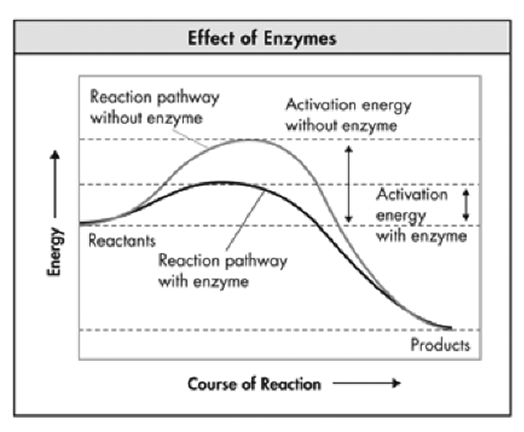
The graph shows how enzymes affect reactions in cells. Which statement best summarizes the information shown in the graph?
a)
Enzymes increase the energy of the reactants.
b)
Enzymes decrease the energy level of the products.
c)
Enzyme decrease the activation energy of the reaction.
d)
Enzymes reverse the direction of the reaction.
8.
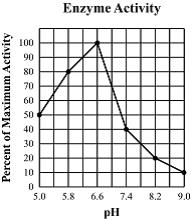
Which of the following conclusions can be drawn from this graph?
a)
The optimum pH of the enzyme is 6.6.
b)
The optimum pH of the enzyme is 5.8
c)
The enzyme’s activity increases as pH increases 5.0 to 9.0
d)
The enzyme’s activity is greater around pH of 8.0 .
9.
Any substance that is acted upon by an enzyme is called a(n)?
a)
Coenzyme
b)
Substrate
c)
Vitamin
d)
Polypeptide
10.
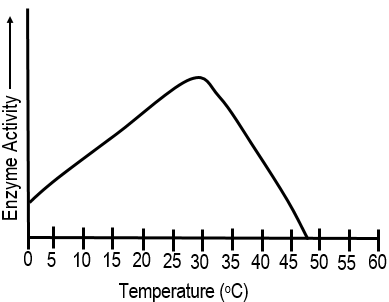
Based on the graph, what is the optimal temperature for this enzyme?
a)
15oC
b)
40oC
c)
30oC
d)
35oC
11.
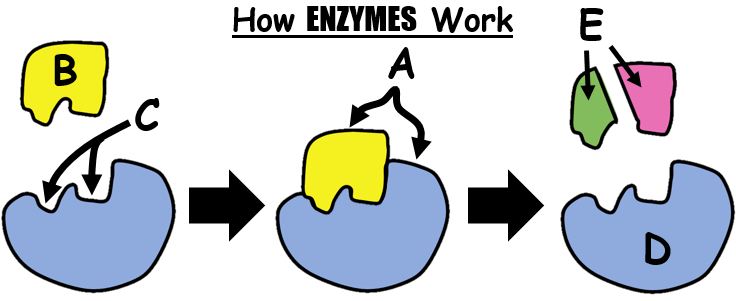
In the diagram, what is letter A?
a)
product
b)
substrate
c)
enzyme-substrate complex
d)
active site
12.
What is the function of an enzyme?
a)
enzymes break themselves into small pieces
b)
enzymes slow down chemical reactions
c)
enzymes speed up chemical reactions
d)
enzymes combine products to form reactants
13.
What happens when enzymes are heated to a high temperature?
a)
The enzymes die.
b)
The shapes of the enzyme are altered denature
c)
The enzymes' amino acid sequence changes.
d)
The enzymes remain the same
14.
Which of these is NOT true?
a)
Enzymes can denature (change shape) when the temperature gets too high.
b)
Enzymes can only be used once in a chemical reaction.
c)
Extreme pH can denature enzymes.
d)
Enzymes speed up chemical reactions.
15.
Which of these is most likely an enzyme?
a)
Sucrose
b)
Galactose
c)
Fructose
d)
Amylase
16.
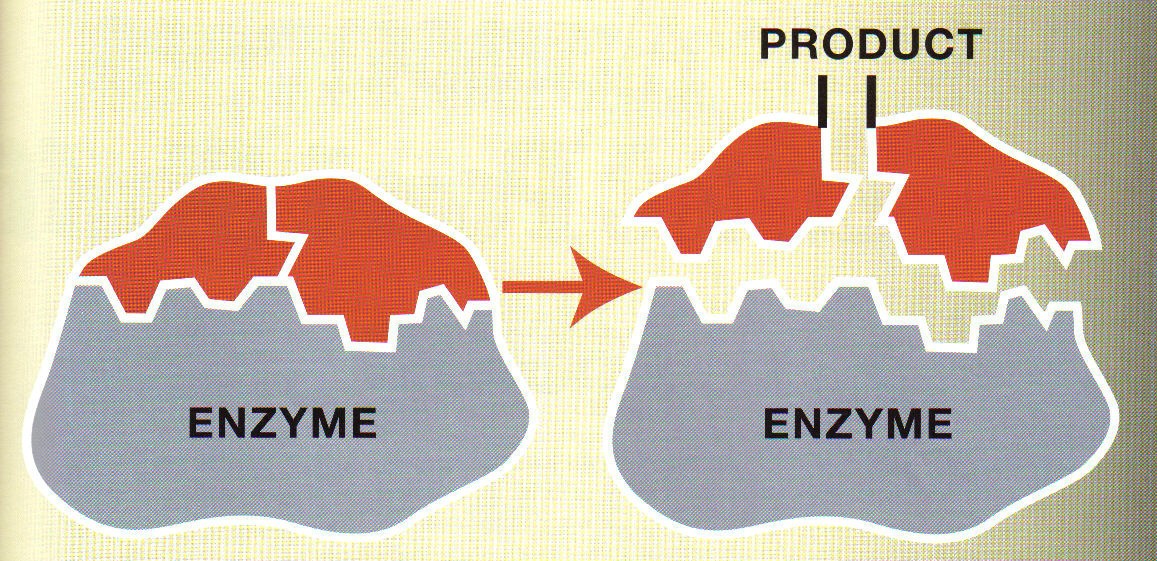
Enzymes speed up reaction rates by changing...
a)
Activation Energy
b)
pH
c)
Hydrogen Bonds
d)
Kinetic Energy
17.
How do enzymes speed up chemical reaction?
a)
Increasing activation energy
b)
Decreasing activation energy
c)
Increasing deactivation energy
d)
Decreasing deactivation energy
18.
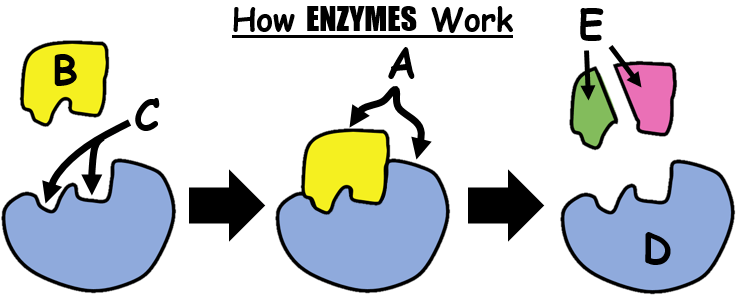
Letter D...
a)
active site
b)
enzyme
c)
substrate
d)
products
19.
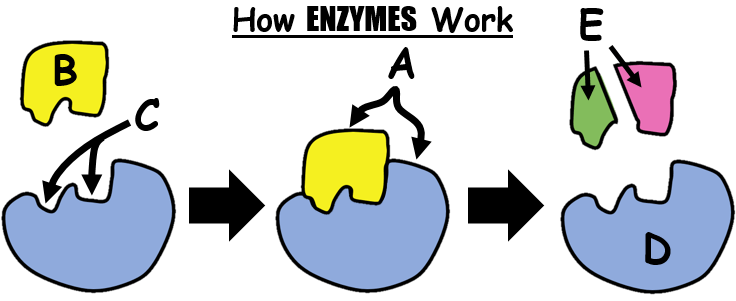
Letter B...
a)
active site
b)
enzyme
c)
substrate
d)
products
20.
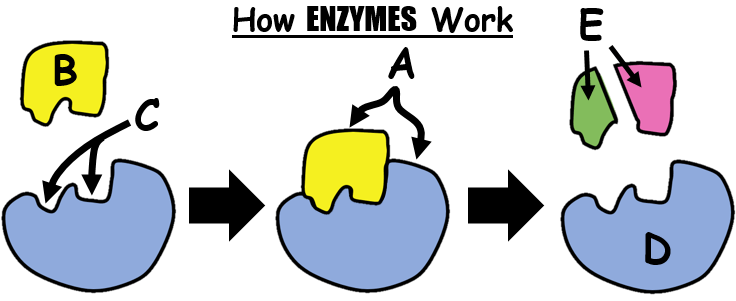
Letter C...
a)
active site
b)
enzymes
c)
substrate
d)
products
21.
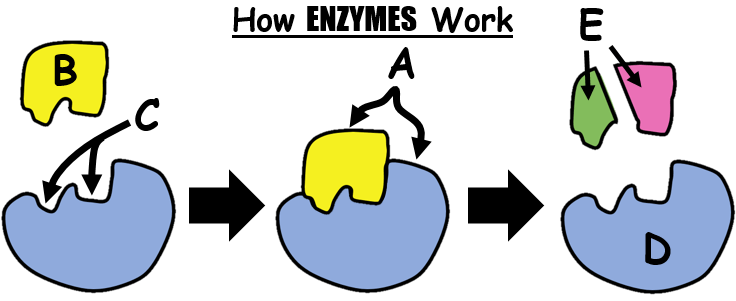
Letter E...
a)
active site
b)
enzyme
c)
substrate
d)
products
22.
What is the source of energy for photosynthesis?
a)
carbohydrates-chemical
b)
sunlight-radiant
c)
heat-thermal
d)
television-electrical
23.
What are the reactants (what's needed) for photosynthesis?
a)
glucose and oxygen
b)
light, water, and carbon dioxide
24.
What is the purpose of photosynthesis?
a)
make glucose
b)
make ATP
c)
make light
d)
release carbon dioxide
25.
What are the products (what's made) during photosynthesis?
a)
glucose and oxygen
b)
water, light, and carbon dioxide
26.

In which organelle (part of the cell) does photosynthesis take place?
a)
mitochondria
b)
chloroplast
c)
nucleus
d)
cell membrane
27.
All living things do which of the following?
a)
Chemosynthesis
b)
Respiration
c)
photosynthesis
d)
all of the answers
28.
How can photosynthesis be related to cellular respiration?
a)
What's produced (made) by one is needed (the reactants) for the other
b)
They both produce the same products
c)
They both have the same reactants (need the same things)
d)
These 2 processes have nothing in common
29.
A plant is releasing a gas. What is the most likely the gas?
a)
co2
b)
methane
c)
water vapor
d)
oxygen
30.
Aerobic respiration is different from anaerobic respiration in that aerobic respiration needs...
a)
chlorophyll
b)
carbon dioxide
c)
glucose
d)
oxygen
31.
How many ATP are produced normally in aerobic respiration?
a)
2
b)
33
c)
4
d)
36
32.
What are the reactants in the equation for cellular respiration?
a)
oxygen and lactic acid
b)
carbon dioxide and water
c)
glucose and oxygen
d)
water and glucose
33.
What is the correct equation for cellular respiration?
a)
6O2 + C6H12O6 -> 6CO2 + 6H2O + Energy
b)
6O2 + C6H12O6 + Energy -> 6CO2 + 6H2O
c)
6CO2 + 6H2O -> 6O2 + C6H12O6 + Energy
d)
6CO2 + 6H2O + Energy -> 6O2 + C6H12O6
34.
Where does the Krebs Cycle take place?
a)
inner mitochondria
b)
inside chloroplast
c)
inner cytoplasm
d)
inner nucleus
35.
Cellular Respiration's goal is to
a)
make water
b)
make ATP
c)
make glucose
d)
make oxygen
36.
What is cellular respiration?
a)
the breakdown of glucose to release ATP
b)
the breakdown of glucose to release NADH
c)
the breakdown of glucose to release FADH
d)
the breakdown of glucose to release carbon
37.
The energy carrier that the cell uses to power its day to day activities is
a)
ATP
b)
NADH
c)
FADH2
d)
glucose
38.
Which of the following equations best represents photosynthesis?
a)
C + O2 + H2O = CO2 +HOH
b)
6CO2 + 6H2O = C6H12O6 + 6O2
c)
6C + 6 H2O = C6H12O6
d)
C6H12O6 = 6CO2 + 6H2O
39.
Most plants appear green because chlorophyll
a)
absorbs green light.
b)
absorbs violet light.
c)
reflects green light.
d)
does not absorb violet light.
40.

Autotroph or heterotroph?
a)
Autotroph
b)
Heterotroph
41.

Autotroph or heterotroph?
a)
Autotroph
b)
Heterotroph
42.
Where do the light-dependent reactions occur?
a)
thylakoid membrane
b)
stroma
c)
mesophyll
d)
mitochondria
43.
What is the primary function of the light-dependent reactions of photosynthesis?
a)
To produce glucose
b)
To produce NADPH and ATP
c)
To use ATP
d)
To produce RuBP
44.
Which of the following is NOT a product of the light-dependent reactions?
a)
ATP
b)
NADPH
c)
Oxygen
d)
Glucose
45.

Use the diagram to answer the question. Between which parts of the molecule must the bonds be broken to form an ADP molecule?
a)
A and B
b)
A and C
c)
B and C
d)
C and D
46.

Use the diagram to answer the question. Which chemical is an electron carrier molecule?
a)
H2O
b)
carbon dioxide
c)
NADP+
d)
oxygen
47.
Plants need carbon dioxide from their environment to produce glucose during which stage of photosynthesis?
a)
The light-dependent stage
b)
The light-independent stage (The Calvin Cycle)
c)
The electron transport chain
d)
ATP formation
48.
__________ is a stack of thylakoids
a)
Granum
b)
Stomata
c)
Stroma
d)
Chloroplast
49.
Where is glucose synthesized?
a)
Photosystem II
b)
Photosystem I
c)
Calvin Cycle
d)
Glycolysis
50.
What molecule absorbs sunlight for photosynthesis?
a)
chloroplast
b)
thylakoid
c)
grana
d)
chlorophyll
51.
The Calvin Cycle takes place in the
a)
stroma
b)
nucleus
c)
thylakoid
d)
cytoplasm
52.
________ has to be split during the light reactions so that the electrons that have left photosystem II can be restored.
a)
H2O
b)
CO2
c)
ATP
d)
NADPH
53.
Which of the following is the correct equation for PHOTOSYNTHESIS?
a)
carbon dioxide + water --> oxygen + glucose
b)
carbon dioxide + glucose + water --> oxygen
c)
oxygen + water --> carbon dioxide + glucose
d)
glucose+ oxygen ---> water + carbon dioxide
54.
This molecule contains two phosphate groups
a)
ADP
b)
ATP
c)
Mitochondria
d)
Nucleus
55.
Glycolysis
a)
does not need oxygen
b)
does need oxygen
56.
Glycolysis takes place in the
a)
mitochondria
b)
cell membrane
c)
cytoplasm
d)
nucleus
57.
This is the first step of cellular respiration
a)
Glycolysis
b)
Lactic Acid Fermentation
c)
Alcoholic Fermentation
d)
Aerobic Respiration
58.
The products of photosynthesis are the
a)
products of cellular respiration
b)
reactants of cellular respiration
c)
products of glycolysis
d)
reactants of fermentation
59.
Which of the following pass high-energy electrons to the electron transport chain?
a)
ATP and ADP
b)
NADH and FADH2
c)
citric acid
d)
acetyl-CoA
60.
After glycolysis, if oxygen is present, the pyruvic acid will enter into
a)
lactic acid fermentation
b)
alcoholic fermentation
c)
the krebs cycle
d)
the ETC
61.
The CO2 produced during the Krebs cycle is
a)
used later in the ETC
b)
eliminated as waste
c)
usedfor other cellular functions
62.
Osmosis is the movement of _____ across a membrane.
a)
food
b)
energy
c)
oxygen
d)
water
63.
This cell organelle helps organisms maintain homeostasis by controlling what substances may enter or leave cells.
a)
vacuole
b)
nucleus
c)
cell membrane
d)
cell wall
64.
What does it mean that a cell membrane is semi-permeable?
a)
It allows all substances in
b)
It allows some substances in
c)
It allows nothing in
65.

Hydrophilic portion of cell membrane?
a)
A
b)
C
c)
D
d)
E
66.

Hydrophobic region of the cell membrane?
a)
E
b)
B
c)
C
d)
A
67.

Protein...
a)
A
b)
B
c)
C
d)
D
68.
if you put a plant in salt water it will ...
a)
swell because water diffuses into the cells
b)
swell because water diffuses out of the cell
c)
shrivel because water diffuses out of the cell
69.
Which is true about active transport?
a)
It requires energy
b)
it does not require energy
c)
It moves substances down the concentration gradient
d)
it moves material from high to low concentration
70.
Movement across the cell membrane that does not require energy is called
a)
active transport
b)
passive transport
71.
what are two types of passive transport?
a)
endo and exocytosis
b)
cookies and milk
c)
active and passive
d)
Osmosis and diffusion
72.
Which term means "water-fearing"?
a)
Adhesion
b)
Polar
c)
Hydrophilic
d)
Hydrophobic
73.
A can of air freshener is sprayed in the opposite side of the room. Ten minutes later you start to smell the scent. This is an example of
a)
diffusion
b)
active transport
c)
endocytosis
d)
osmosis
74.
What is it called when molecules move across the cell membrane from an area of high concentration to an area of low concentration through a carrier protein?
a)
Diffusion
b)
Osmosis
c)
Active Transport
d)
Facilitated Diffusion
75.
What is the name of the process in which molecules move from an area of high concentration to an area of low concentration across a selectively permeable membrane?
a)
Diffusion
b)
Osmosis
c)
Active Transport
d)
Facilitated Diffusion
76.

Where is there a low concentration of dye?
a)
at the bottom of cup
b)
in the color
c)
at the top of cup
d)
no concenteraion gradient
77.

Which organelle is only found in a plant cell?
a)
nucleus
b)
chloroplast
c)
mitochondria
d)
cell membrane
78.

This organelle creates energy.
a)
Nucleus
b)
Ribosome
c)
Mitochondria
d)
ER
79.

Where is DNA stored in a cell?
a)
Lysosomes
b)
Golgi Complex
c)
Ribosomes
d)
Nucleus
80.

What is the fluid inside a cell called?
a)
Endoplasimic Reticulum
b)
Orange Juice
c)
Water
d)
Cytoplasm
81.

This organelle helps plants keep their rigid structure.
a)
Cell wall
b)
Cell membrane
c)
Chloroplast
d)
Nucleus
82.

This organelle eliminates waste.
a)
Nucleus
b)
ER
c)
Vacuole
d)
Lysosome
83.

This organelle makes proteins.
a)
Cell membrane
b)
Nucleus
c)
Ribosome
d)
ER
84.
This is a double layer of phospholipids that creates a barrier between the cells internal and external environments; it controls what comes in or out of the cell (selective permeable)
a)
Nucleus
b)
Cilia
c)
Cell membrane
d)
Flagella
85.
This is a system of membranous tubules and sacs in eukaryotic cells that functions as a path along which molecules move from one part of the cell to another. Can be rough or smooth.
a)
Mitochondria
b)
Chloroplast
c)
Endoplasmic reticulum
d)
Centrioles
86.
A large fluid-filled vesicle located in the cytoplasm of a plant cell; stores water, enzymes, and waste; keeps toxic wastes away from the rest of the cell.
a)
Lysosome
b)
Vacuole
c)
Flagella
d)
Centrioles
87.

The Golgi apparatus _____.
a)
packages cell products for export
b)
eliminates waste
c)
stores DNA
d)
makes energy
88.
Which of the following things does a nucleotide NOT contain?
a)
a sugar
b)
a nitrogen base
c)
a phosphate
d)
a polymerase
89.
Which of the following is a base that is NOT contained in DNA?
a)
Adenine
b)
Thymine
c)
Uracil
d)
Guanine
90.
Chargraff's Rule says that
a)
Adenine will be equal to Thymine
b)
Cytosine will be equal to Thymine
c)
Uracil will be equal to Guanine
d)
Adenine will be equal to Cytosine
91.
DNA is copied during
a)
Translation
b)
Transcription
c)
Reproduction
d)
Replication
92.
The enzyme that attaches the complimentary base pairs to the original strand of DNA is called
a)
helicase
b)
polymerase
c)
replicase
d)
synthase
93.
The enzyme that unzips the DNA to prepare for replication
a)
helicase
b)
replicase
c)
polymerase
d)
synthase
94.
DNA replication results in two DNA molecules,
a)
each one with two original strands
b)
each one with two new strands
c)
each one with one new strand and one original strand
d)
one with two new strands and the other with two original strands
95.
A mutation that replaces one nitrogen base with a different one is called
a)
substitution
b)
insertion
c)
deletion
d)
inversion
96.

Which of the following best describes a DNA molecule?
a)
double helix
b)
contains ribose
c)
made of amino acids
d)
contains Uracil
97.
What are the 4 nitrogen bases?
a)
adenine, thymine, cytoplasm, and guanine
b)
adenine, thymine cytosine, and guanine
c)
adenine, thymine, cytosine, and gylcerol
d)
adenine, thymine, cytosine, and glucose
98.
Which shows the correct complementary base pairing for DNA?
a)
C-A, T-G
b)
A-G, C-T
c)
C-G, U-A
d)
T-A, G-C
99.
A segment of DNA that codes for a protein is called a...
a)
Enzyme
b)
Mutation
c)
Gene
d)
Complimentary
100.

DNA codes for...
a)
cholesterol
b)
proteins
c)
fatty acids
d)
a sandwich
101.

mRNA is important, because it __________.
a)
Carries info from genes to ribosomes
b)
Carries amino acids to ribosomes
c)
Helps with RNA splicing
d)
Makes up ribosomes
102.

Translation is important because it __________.
a)
Converts mRNA into a polypeptide
b)
Replicates the genetic information in DNA
c)
Produces RNA from DNA molecules
d)
Recycles tRNA molecules for reuse
103.

What is the term for a three nucleotide sequence that codes for an amino acid? For example: AUG
a)
Nitrogen base
b)
Codon
c)
Amine
d)
Phosphate group
104.

Transfer RNA (tRNA) is important because it __________.
a)
Carries amino acids to the ribosome
b)
Carries ribosomes to the ER
c)
Carries glucose to mitochondria
d)
Carries mRNA out of the nucleus
105.
Where does Translation take place?
a)
RNA
b)
ribosome
c)
nucleus
d)
chromosome
106.
Which 2 molecules form the sides (backbone) of the DNA ladder?
a)
deoxyribose sugar and adenine
b)
deoxyribose sugar and a hydrogen bond
c)
deoxyribose sugar and the nucleus
d)
deoxyribose sugar and phosphate
107.
Which of the following is the sugar found in RNA?
a)
Ribose
b)
Maltose
c)
Deoxyribose
d)
Amylose
108.
The two strands of DNA run in opposite directions. They are said to be:
a)
Antiparallel
b)
Complementary
c)
Anti-directional
d)
Weird
109.
Which of the following is a correct difference between RNA and DNA?
a)
RNA is single stranded and DNA is double stranded
b)
RNA is double stranded and DNA is single stranded
c)
DNA uses Uracil and RNA uses Thymine
d)
RNA has deoxyribose and DNA has ribose
110.
Watson and Crick were the first to suggest that DNA is _____
a)
a short molecule
b)
the shape of a double helix
c)
a protein molecule
d)
the genetic material
111.
Which type of RNA is made in the nucleus?
a)
mRNA
b)
rRNA
c)
tRNA
112.
Replicate the following strand of DNA:
AATCATGGA
AATCATGGA
a)
AATCATGGA
b)
TTAGTACCT
c)
UUAGUACCU
d)
GGATAUCUA
113.
Restriction Enzymes . . .
a)
cut DNA at precise locations
b)
help bacteria to pick up DNA
c)
move DNA through a gel
d)
copy DNA
114.
Restriction Enzymes come from . . .
a)
viruses
b)
bacteria
c)
goats
d)
spiders
115.
Why do bacteria have restriction enzymes?
a)
To prevent being infected by viruses
b)
To help DNA get into the cell
c)
To be able to grow in an incubator
d)
They don't - viruses have restriction enzymes
116.
Some restriction enzymes produce "sticky ends". Sticky ends are . . .
a)
single-stranded DNA "overhangs" that can bind to complementary DNA
b)
smooth cuts that are sticky due to the "goo" left behind by the enzyme
c)
The two wires (black and red) on a gel box
d)
The surface of the LB agar plates so that bacteria can grow
117.
What shape are plasmids?
a)
linear
b)
circular
c)
double helix
d)
square
118.
What charge is DNA?
a)
positive
b)
negative
c)
neutral
119.
What do restriction enzymes recognize in order to cut the DNA into pieces?
a)
palindrome sequences of bases
b)
repeating sequences of bases
c)
specific genes in the DNA
d)
their homologous pair
120.
A molecule containing DNA from two different organisms is called
a)
a plasmid.
b)
a polyploid.
c)
a hybrid organism.
d)
recombinant DNA.
121.

Which two bear species are most closely related?
a)
Bear 1 and Bear 2
b)
Bear 1 and Bear 3
c)
Bear 2 and Bear 3
d)
There’s no way to tell
122.

Which suspect is linked to the crime scene by this DNA analysis
a)
Suspect A
b)
Suspect C
c)
Suspect D
d)
Suspect B
123.

In gel electrophoresis, the largest DNA fragment will appear
a)
closest to the starting wells
b)
farthest from the starting wells
c)
three quarters away from the starting wells
d)
it depends on how many fragments there are
124.

During gel electrophoresis, DNA moves from the ___ end to the ___ end.
a)
positive, negative
b)
negative, positive
125.
Restriction Enzyme A reads AGTC and cuts between G and T. Cut the following DNA:
ACTCAGTCCTCTAAGCCAGTCCTCAAAAGTC
How many fragments are there?
ACTCAGTCCTCTAAGCCAGTCCTCAAAAGTC
How many fragments are there?
a)
1
b)
2
c)
3
d)
4
126.
What is the purpose of gel electrophoresis?
a)
helps cut DNA
b)
is an immune system in bacteria
c)
separates DNA based on size
d)
allows for an exact replicated organism
127.

The diagram below shows homologous chromosome during phase 1 of meiosis. Which of the following correctly describes the process being illustrated?
a)
Mutation in which DNA content of the genes is altered.
b)
segregation of sister chromatids
c)
condensation and segregation of alleles
d)
crossing-over in which alleles are exchanged
128.

Name the process in the diagram.
a)
Meiosis
b)
Mitosis
c)
Endocytosis
d)
Phagocytosis
129.

The image illustrates which process?
a)
Mitosis
b)
Meiosis
c)
Both mitosis and meiosis
d)
Interphase
130.
Which of the following statements best explains the overall purpose of MEIOSIS?
a)
Asexual reproduction of somatic cells
b)
To produce gametes
131.
If a parent cell has 88 chromosomes, following MITOSIS, the daughter cells will have ___ chromosomes.
a)
42
b)
88
c)
Impossible to know
132.
Process that produces two daughter cells.
a)
Mitosis
b)
Meiosis
c)
Both Mitosis and Meiosis
133.
Process that produces four daughter cells.
a)
Mitosis
b)
Meiosis
c)
Both Mitosis and Meiosis
134.
Diploid --> Diploid
a)
Mitosis
b)
Meiosis
c)
Both Mitosis and Meiosis
135.
Diploid --> Haploid
a)
Mitosis
b)
Meiosis
c)
Both Mitosis and Meiosis
136.
A form of asexual reproduction
a)
Mitosis
b)
Meiosis
c)
Both Mitosis and Meiosis
137.
In meiosis, the haploid number of chromosomes in a human sex cell is:
a)
46
b)
92
c)
22
d)
23
138.
What is the diploid number of cells found in a human body cell?
a)
23
b)
46
c)
92
d)
47
139.

A is:
B is:
C is:
B is:
C is:
a)
A: chromatid
B: centromere
C: chromosome
B: centromere
C: chromosome
b)
A: chromosome
B: chromatid
C: centromere
B: chromatid
C: centromere
c)
A: chromosome
B: centromere
C: chromatid
B: centromere
C: chromatid
d)
A: centromere
B: chromosome
C: chromatid
B: chromosome
C: chromatid
140.

Place these cells in order of mitosis.
a)
A, B, C, D, E
b)
B, E, D, A, C
c)
C, E, A, D, B
d)
B, D, A, E, C
141.

The structure labeled A is a(n)
a)
chromatid
b)
centriole
c)
centromere
d)
chromophere
142.

The structures labeled B are
a)
centrioles
b)
chromatids
c)
centromeres
d)
chromopheres
143.

a)
Anaphase
b)
Cytokinesis
c)
Telophase
d)
Metaphase
144.

a)
Cytokinesis
b)
Interphase
c)
Anaphase
d)
Metaphase
145.

a)
prophase
b)
metaphase
c)
anaphase
d)
telophase
146.

a)
prophase
b)
metaphase
c)
anaphase
d)
telophase
147.
A dominant trait is expressed as:
a)
A capital letter
b)
A lower case letter
c)
A letter and a number subscript
d)
A letter with a superscript
148.
An example of a phenotype is:
a)
Bb x bb
b)
The genetic makeup of an organism
c)
Aa, Bb, Ff
d)
Yellow peas
149.
A genotype is:
a)
The physical appearance of something
b)
The genetic makeup of something
150.
A __________________ trait has two identical alleles
a)
Heterozygous
b)
Hybrid
c)
Homozygous
d)
Phenotype
151.
A white flower and a red flower have all pink offspring. This is an example of:
a)
Recessive Traits
b)
Incomplete Dominance
c)
Dominant Trait
d)
Codominance
152.
A white flower and a red flower produces red flowers with white splotches. This is an example of:
a)
Recessive Trait
b)
Incomplete Dominance
c)
Dominant Trait
d)
Codominance
153.
Can a couple with blood types A and AB have a child with blood type O?
a)
Yes
b)
No
154.
Define: Sex Linked traits
a)
The offspring that show both phenotype of parents
b)
Offspring that blend into the parents genotype
c)
Carried on the sex chomosomes
d)
Carried on Autosomal chromosomes
155.
A pea plant has the following genotype for it's peas color and shape: yyRr
The possible gametes for this? (hint: FOIL)
The possible gametes for this? (hint: FOIL)
a)
YR yR Ry RR
b)
Ry Ry Ry yr
c)
yR yr yr yr
d)
yR yr yR yr
156.
A dog gives birth to 5 puppies. What percentage of the chromosomes does each puppy share with the mother?
a)
25%
b)
50%
c)
75%
d)
100%
157.

If T=Tall & t=short, what is the genotypic ratio?
a)
1:3
b)
3:1
c)
1:2:1
d)
2:2
158.

A heterozygous yellow pea plant's genotype would be:
a)
YY
b)
yy
c)
Yy
d)
Yg
159.
Which of the following cell types is formed by meiosis?
a)
muscle cells
b)
skin cells
c)
sperm cells
d)
blood cells
160.
W=white hair
w= non-white hair
If you cross a horse with WW and a horse with ww what fraction of the offspring would be expected to have white hair?
w= non-white hair
If you cross a horse with WW and a horse with ww what fraction of the offspring would be expected to have white hair?
a)
none
b)
3/4
c)
1/2
d)
all
161.
B=brown eyes
b= blue eyes
What is true about two brothers that have brown eyes?
One has genotype BB the other Bb.
b= blue eyes
What is true about two brothers that have brown eyes?
One has genotype BB the other Bb.
a)
they have same phenotype and genotype
b)
they have different genotypes and phenotypes
c)
they have same phenotype but different genotypes
d)
they have same genotype but different phenotypes
162.
B - black, b - brown. Two black mice mate and have some black and some brown mice. What is the genotype of the parents?
a)
BB x Bb
b)
BB x bb
c)
Bb x Bb
d)
Bb x bb
163.
Which of the following terms refers to the different possibilities of a gene?
a)
chromosome
b)
DNA
c)
Punnett Squares
d)
allele
165.
If something is heterozygous, it is also...
a)
purebred
b)
hybrid
c)
dominant
d)
recessive
165.
If something is heterozygous, it is also...
a)
purebred
b)
hybrid
c)
dominant
d)
recessive
166.
Another word for homozygous is...
a)
purebred
b)
hybrid
c)
heterozygous
d)
dominant
167.
What does a Punnett Square help you do?
a)
Determine the ratio of phenotypes
b)
Determine the ratio of genotypes
c)
Predict possible traits the offspring will have
d)
All of the above
168.
Purple is dominant to white. A heterozygous purple flower is crossed with a white flower. What are the genotypes and phenotypes of the offspring?
a)
100% Pp (purple)
b)
50% Pp (purple); 50% pp (white)
c)
75% Pp (purple); 25% pp (white)
d)
25% PP, 50% Pp, 25% pp
75% purple, 25% white
75% purple, 25% white
169.
A woman with blood genotype I(A)i marries a man with blood genotype I(B)i. What is the probability that they would have a child with type O blood?
a)
1/1
b)
1/2
c)
1/3
d)
1/4
170.
If the four existing children in a family are all sons, what chance would there be that the next child would also be a son?
a)
75%
b)
50%
c)
25%
d)
20%
171.
In screech owls, red feathers are dominant over gray feathers. If two heterozygous red-feathered owls are mated, what percentage of their offspring would be expected to have red feathers?
a)
25%
b)
50%
c)
75%
d)
100%
172.
In fruit flies eye color is carried on the X chromosome. RED is dominant to WHITE. What is the sex and color of the following: XRXR
a)
female red
b)
female white
c)
male red
d)
male white
173.

In humans, skin tone is caused by 3 genes, each with 2 alleles. This is an example of
a)
codominance
b)
incomplete dominance
c)
polygenic inheritance
d)
multiple alleles
174.
What determines gender in humans?
a)
the X and Y chromosome
b)
chromosome 21
c)
codominance
d)
epistasis
176.
R=round seed
r=wrinkled seed.
Cross a homozygous round with a wrinkled. Which statement predicts the results?
r=wrinkled seed.
Cross a homozygous round with a wrinkled. Which statement predicts the results?
a)
offspring will be Rr
b)
offspring will be RR
c)
round seeds will be recessive to wrinkled
d)
Wrinkled will be observed in half of offspring
176.
R=round seed
r=wrinkled seed.
Cross a homozygous round with a wrinkled. Which statement predicts the results?
r=wrinkled seed.
Cross a homozygous round with a wrinkled. Which statement predicts the results?
a)
offspring will be Rr
b)
offspring will be RR
c)
round seeds will be recessive to wrinkled
d)
Wrinkled will be observed in half of offspring
177.
What do viruses need to reproduce?
a)
they need genetic material
b)
They need a host cell
c)
They need bacteria
d)
They need insulin
178.
A virus can be classified by its type of
a)
mitochondria
b)
chromosomes
c)
nucleic acid
d)
carbohydrates
179.

A(n) _____ is a virus that enters a bacterial cell.
a)
endospore
b)
decomposer
c)
plasmid
d)
bacteriophage
180.

What part of the phage is the DNA?
a)
A
b)
B
c)
C
d)
D
181.
True or False
The flu is caused by a virus.
The flu is caused by a virus.
a)
true
b)
false
182.
Antibiotics kill viruses
a)
True
b)
False
183.
What part of a virus is the protein capsule that houses the genetic material (DNA/RNA)?
a)
tail
b)
nucleus
c)
capsid
d)
glycoprotein
184.
Which viral life cycle kills its host cell by lysing?
a)
lytic
b)
mitosis
c)
lysogenic
d)
S phase
185.
Which viral life cycle allows viral genetic material to lay dormant while the host cell reproduces?
a)
lytic
b)
mitosis
c)
lysogenic
d)
S phase
186.
Which of these is an animal virus?
a)
Tobacco mosaic virus
b)
bacteriophage
c)
influenza
187.
Which of these is a plant virus?
a)
tobacco mosaic virus
b)
bacteriophage
c)
influenza
d)
polio
100 %

