wayground logo

Free Printable Worksheets

NEW

Font size

S
M
L
XL
Worksheets

Chem 1 Final

Total questions: 66

Worksheet time: 48mins

Name
Class
Date
1.
3 cm = ? mm
a)
30
b)
300
c)
3000
d)
0.3
2.
70 g = ? cg
a)
7
b)
70
c)
700
d)
7000
3.
5000 m = ? km
a)
5
b)
10
c)
15
d)
20
4.
How many sig figs are there?
100.00
a)
1
b)
3
c)
4
d)
5
5.
How many sig figs are there?
100000000
a)
1
b)
9
c)
10
6.
How many sig figs are there?
4004
a)
1
b)
2
c)
3
d)
4
7.
How many sig figs are there?
0.000008
a)
1
b)
2
c)
6
d)
7
8.
How many sig figs are there?
0.00400
a)
1
b)
3
c)
5
d)
6
9.
How many significant figures will be in the answer to the following question:
7.62 x 6.98 x 3.2645
a)
1
b)
2
c)
3
d)
4
10.
A graduated cylinder measures
a)
length
b)
height
c)
mass
d)
volume
11.
The unit "gram" measures what?
a)
volume
b)
mass
c)
length
d)
speed
12.
At which point should the reading on this instrument be taken?
a)
Highest
b)
Left Side
c)
Right Side
d)
Meniscus 
13.
In an experiment, onion plants of different ages were exposed to various amounts of caffeine to determine the effect of caffeine on cell growth. Temperature, amount of water, and light were kept constant. Which of these statements about the experiment is definitely true? 
a)
The results may not be valid because there were two variables.
b)
The amount of caffeine used was a control.
c)
Temperature, water, and light were the only variables. 
d)
Onion plants can be used to model the effects of caffeine on living things.
14.
Which of these is the variable in an experiment designed to determine whether steel rusts more quickly near a lake or in a desert in one year?
a)
amount of rust 
b)
time of exposure 
c)
amount of water in the air 
d)
mass of the steel
15.
Which of these recorded observations is qualitative, rather than quantitative?
a)
A chemical reaction is complete in 2.3 s.
b)
The solid has a mass of 23.4 g.
c)
The compound melts at 87.5°C.
d)
Iron is denser than aluminum.
16.
Which of these terms best describes the following statement? “A solution of the unknown compound turned litmus paper blue.”
a)
hypothesis
b)
model 
c)
quantitative observation
d)
qualitative observation
17.
Theories are considered successful only if they
a)
can be used to make accurate predictions. 
b)
can be stated in simple terms.
c)
can be written in the form of an equation.
d)
have been accepted by all scientists.
18.
The unit cm3 is used to express 
a)
 length.
b)
mass.
c)
volume. 
d)
time.
19.
The conversion factor 1L/103 mL would be used to change
a)
milliliters to liters. 
b)
liters to milliliters.
c)
units of volume to units of length.
d)
units of length to units of volume.
20.
A sample of bismuth has a mass of 343 g and a volume of 35.0 cm3. What is the density of bismuth?
a)
0.102 g/cm3
b)
9.80 g/cm3
c)
378 g/cm3
d)
1.20 × 10⁴ g/cm3
21.
An object’s weight is a measure of
a)
the force with which it is attracted by gravity.
b)
the pressure exerted on a scale.
c)
the amount of material per unit volume.
d)
the force causing the object to move.
22.
A student determined the density of aluminum by averaging the results of three density calculations. Each value was different, but the average was equal to the accepted value for aluminum’s density. The results of this investigation are best described as
a)
accurate, but not precise.
b)
precise, but not accurate.
c)
both precise and accurate.
d)
neither precise nor accurate.
23.
The measurement 0.0265 g, rounded off to two significant figures, would be
a)
0.026 g. 
b)
0.027 g.
c)
0.03 g.
d)
0.030 g.
24.

The first person to ever talk about an atom was

a)

Democritus

b)

Rutherford

c)

Dalton

d)

Bohr

25.
What scientist is best known for his "Plum Pudding" model of the atom?
a)
J.J. Tomson
b)
Ernest Rutherford
c)
John Dalton
d)
Democritus
26.

Who is credited with the Atomic Theory?

a)

Dalton

b)

Thomson

c)

Bohr

d)

Democritus

27.
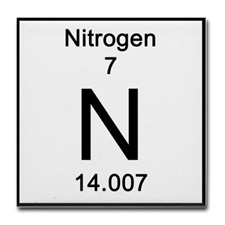
What is the number of protons that the element in this image contain?
a)
14
b)
7
c)
15
d)
18
28.

What particles would you find in the nucleus of an atom?

a)

Protons only

b)

Protons and Neutrons

c)

Neutrons and Electrons

d)

Protons and Electrons

29.
What is the number of protons that the element in this image contain?
a)
14
b)
7
c)
15
d)
18
30.

How many protons does oxygen have?

a)

8

b)

16

c)

15.999

d)

24

31.
These particles orbit around the nucleus of an atom.  What are they called?
a)
electrons
b)
protons
c)
neutrons
d)
photons
32.
What is the atomic number of this nucleus?
a)
1
b)
3
c)
4
d)
7
33.
Which of these is a property of metals?
a)
It's malleable
b)
It can't conduct electricity
c)
They are used in food
d)
It's very brittle
34.
An element's identity is determined by the number of
a)
electrons.
b)
protons.
c)
neutrons.
d)
valence.
35.
Most of the mass of an atom is found it its _____.
a)
electron cloud
b)
nucleus
c)
atomic number
d)
empty space
36.
Rutherford's experiment showed that most of an atom is made up of _____.
a)
a nucleus
b)
an electron cloud
c)
empty space
d)
alpha particles
37.
Which item on this element square is the chemical symbol?
a)
Copper
b)
29
c)
Cu
d)
63.546
38.
What is the atomic mass of "F"
a)
9
b)
18
c)
17
d)
19
39.
What family is Sodium a part of?
a)
Transition Metals
b)
Halogens
c)
Alkali Metals
d)
Alkaline Earth Metals
40.
Which one of these is the symbol for lead?
a)
Rb
b)
Pb
c)
Li
d)
Au
41.

how many groups/families are on the table

a)

15

b)

16

c)

17

d)

18

42.

what is the big group of metals called found within the metals

a)

transition metals

b)

nonmetals

c)

noble gases

d)

halogens

43.

what group number are the halogens

a)

18

b)

1

c)

2

d)

17

44.
Which rule of electronic configuration states that lower energy levels must be filled first.
a)
Pauli Exclusion Principle
b)
Aufbau Principle
c)
Heisenberg uncertainty principle
d)
Hund's rule
45.
What is the Average atomic mass for lead Pb
a)
82
b)
125
c)
207.2
d)
120
46.
Which of the following is a Physical Property 
a)
Toxicity
b)
Flammability
c)
Malleability
d)
Reactivity
47.
How would you separate a mixture of two liquids that mix (miscible)  together perfectly. 
a)
Filtration
b)
Magnetism
c)
Chromatography
d)
Distillation
48.
A block of metal has a mass of 14.0 Kg and a volume of 2.0 Liters what is the density?
a)
14.0 kg/L 
b)
7.0 Kg/L
c)
2.0 Kg/L 
d)
0.5 Kg/l
49.
Which orbital would come next in the sequence using electronic configuration rules?
1s2s2p3s3p4s
a)
4p
b)
5s
c)
4d
d)
3d
50.
What is the electronic configuration for Calcium
a)
1s22s22p23s33p34s2
b)
1s22s22p103s23d8
c)
1s22s23s23p63d8
d)
1s22s22p63s23p64s2
51.
What is the chemical formula for Mn(IV) and Oxygen coming together?
a)
Mn4O2
b)
Mn2O4
c)
MnO2
d)
Omnomnomnom
52.
What is the chemical formula for Mn(IV) and Oxygen coming together?
a)
Mn4O2
b)
Mn2O4
c)
MnO2
d)
Omnomnomnom
53.
What is the Chemical formula for Sodium and Nitrogen coming together
a)
Na5N3
b)
Na1N3
c)
Na3N1
d)
Na3N
54.
Which of the following is likely to form a cation
a)
Selenium
b)
Neon
c)
Molybdenum
d)
Oxygen
55.

What is the term for Molar mass

a)

Mols

b)

gram/mols

c)

Molarity

d)

Grandma

56.

What is the name of this compound P2O5

a)

Phosphorous Oxide

b)

Phosphorous Pentaoxide

c)

Pentaphosphorous Dioxide

d)

Diphosphorous pentaoxide

57.

What is the molar mass for CoCl2

a)

130 g/mol

b)

283 g/mol

c)

15.63 g/mol

d)

98.6 g/mol

58.

Which of the following has the greatest amount of valence electrons.

a)

Bromine

b)

Sodium

c)

Francium

d)

Cobalt

59.

What is the name of the number in from of products and reactants in an equation called?

a)

Variable

b)

Coefficient

c)

Mole

d)

Molar mass

60.

Identify the reaction presented above

a)

Single replacement

b)

Double replacement

c)

Synthesis

d)

Combustion

61.
Calculate the molar mass of Mg(OH)2.
a)
33.2 g/mol
b)
41.3 g/mol
c)
86.9 g/mol
d)
58.3 g/mol
62.
N2 +  3H2 → 2NH3 
How many moles of hydrogen are needed to react with 2 moles of nitrogen?
a)
6
b)
2
c)
3
d)
1
63.

This speeds up a chemical reaction

a)

Catalyst

b)

Reaction

c)

Reactant

d)

Limiting Reagent.

64.

How many atoms are in the compound Cu(OH)2

a)

5

b)

6

c)

3

d)

7

65.

In the following equations equilibrium would be reached when?


ClNO2(g)+NO(g)↔NO2(g)+ClNO(g)

a)

All the ClNO2 and NO are used up.

b)

When the compounds on the right are being made at the same rate as those on the left.

c)

When the compounds on the left are being made at an accelerated rate.

d)

When the compounds on the right are all the way used up.

66.

How many molecules would be in 3.4 Moles of K2(SO4)

a)

2.1 x 1024

b)

3.4 x 10²³

c)

5.4 x 10 22

d)

3.4