wayground logo

Free Printable Worksheets

Font size

S
M
L
XL
Worksheets

Semester 2 Review

Total questions: 150

Worksheet time: 3hrs 41mins
Name
Class
Date
1.
Aa, DD, bB, yy are all examples of
a)
genotypes
b)
phenotypes
2.
AA and Aa always show up as
a)
dominant
b)
recessive
3.
Which of the following genotypes is homozygous dominant?
a)
A
b)
Aa
c)
AA
d)
aa
4.
Which of the following genotypes is heterozygous?
a)
Bb
b)
BB
c)
bb
d)
B
5.
In a flowering plant species, red flower color (R) is dominant over white flower color (r). What is the genotype of any red-flowering plant resulting from this species?
a)
rr
b)
R
c)
RR
d)
RR or Rr
6.
What you see, or the physical appearance.
a)
Genotype
b)
Phenotype
c)
Homozygous
d)
Heterozygous
7.
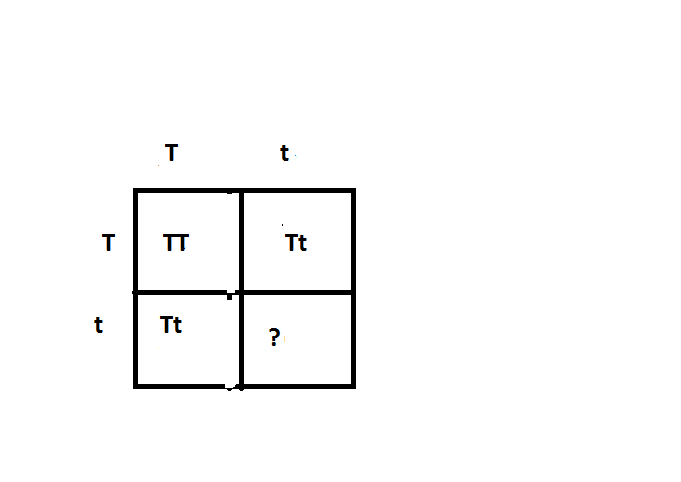
T - tall and t = short
In the punnett square below, what belongs in the missing square
a)
tt
b)
Tt
c)
Bb
d)
TT
8.
B = brown eyes
b = blue eyes
What is true about these two brothers that have brown eyes?
One has genotype BB the other Bb.
a)
they have same phenotype and genotype
b)
they have different genotypes and phenotypes
c)
they have same phenotype but different genotypes
d)
they have same genotype but different phenotypes
9.
Which of the following is homozygous recessive?
a)
Tt
b)
tt
c)
TT
d)
T
10.
What is the probability of heterozygous offspring?
a)
25%
b)
50%
c)
0%
d)
100%
11.

How many kids did I: I and 2 have?

a)

2

b)

4

c)

5

d)

6

12.

How are individuals I-2 and III-5 related?

a)

Grandpa and grandson

b)

Mom and son

c)

Uncle and nephew

d)

Grandma and grandson

13.
In a pedigree, what shape represents a male?
a)
circle
b)
square
c)
triangle
d)
diamond
14.
Hemophilia is a recessive sex-linked trait. If H = normal & h = has hemophilia, which genotype represents a male with hemophilia. 
a)
XHY
b)
XHXh
c)
XhXh
d)
Xh
15.

This is an autosomal recessive pedigree. Individual 5 must be:

a)

HH

b)

Hh

c)

hh

d)

HH or Hn

16.
In the second generation-how many people are carriers of the trait?
a)
2
b)
3
c)
5
d)
6
17.
The genotype of the affected son and daughter at the bottom of this pedigree...
a)
could be homozygous dominant
b)
could  be homozygous recessive
c)
could be heterozygous
d)
Can't tell
18.
If something is heterozygous, it is also...
a)
purebred
b)
hybrid
c)
dominant
d)
recessive
19.
What does a Punnett Square help you do?
a)
Determine the ratio of phenotypes
b)
Determine the ratio of genotypes
c)
Predict possible traits the offspring will have
d)
All of the above
20.
Another word for homozygous is...
a)
purebred
b)
hybrid
c)
heterozygous
d)
dominant
21.
Purple is dominant to white. A heterozygous purple flower is crossed with a white flower. What are the genotypes and phenotypes of the offspring?
a)
100% Pp (purple)
b)
50% Pp (purple); 50% pp (white)
c)
75% Pp (purple); 25% pp (white)
d)
25% PP, 50% Pp, 25% pp
75% purple, 25% white
22.
This is an example of ___________?
a)
Incomplete dominance
b)
Co-Dominance
23.
This type of inheritance pattern is a MIXTURE of both traits.
a)
incomplete dominance
b)
co-dominance
c)
complete dominance
24.
This is an example of ___________.
a)
 Incomplete Dominance
b)
 Codominance
25.
Which of Mendel's laws states that alleles are separated during meiosis?
a)
Law of Dominance
b)
Law of Segregation
c)
Law of Independent Assortment
d)
Law of Meiosis
26.
According to the Law of Segregation, alleles are separated during the process of _____________.
a)
Mitosis
b)
Meiosis
c)
Osmosis
d)
Translation
27.

alleles for different genes separate randomly from one another

a)

law of segregation

b)

law of independent assortment

c)

law of dominance

28.
If a trait shows up more commonly in men than women it is probably
a)
not inherited
b)
on the x chromosome and dominant
c)
on the x chromosome and recessive
d)
on a normal body chromosome
29.
In fruit flies, eye color is a sex linked trait. Red is dominant to white. What would be the percentages of offspring of a cross of a white eyed female with a red-eyed male?
a)
1 female white eyes, 1 female red-eyes, 1 male white eyes, 1 male red-eyes
b)
2 female red eyes, 2 males white eyes
c)
2 female white eyes, 2 males red eyes
d)
2 female red eyes, 1 male red eyes, 1 male white eyes
30.
Phenotypes which result as a combination of MANY genes, such as skin color and eye color, are known as ______________ traits.
a)
Monogenic
b)
Dihybrid
c)
Multiple Allele
d)
Polygenic
31.
Which of the following statements is true regarding blood types?
a)
A and O are codominant, B is recessive.
b)
B and O are codominant, A is recessive.
c)
A and B are codominant, O is recessive.
d)
A , B and O are all codominant with each other.
32.
According to _______, genes that are closer together on a chromosome, have a higher chance of being inherited together.  
a)
Gene Linkage
b)
Polygenic
c)
Pleiotropy
d)
Epistasis
33.

The forelimbs of vertebrates

a)

serve the same function

b)

contain the same kinds of bones

c)

have different kinds of bones

d)

evolved from wings

34.

There is clear evidence from fossils and other sources that the species now on Earth

a)

have evolved from ancestral species that are extinct

b)

have reached the ultimate in evolution

c)

will eventually evolve into the same species

d)

have always been the way they are now

35.

Which of the following is a factor in natural selection?

a)

Individuals of a population overproduce

b)

All populations are genetically diverse

c)

Individuals better abel to adapt to changes leave more offspring

d)

All of the above

36.

Fossils have been found that provide a link in the evolution of whales from

a)

two-legged mammals

b)

legless amphibians

c)

four-legged mammals

d)

flightless birds

37.

The evolution of beak shapes in Galapagos finches is a response to

a)

the bodies of water present

b)

the types of food available

c)

whether the populations interbreed

d)

the nutritional content of seeds

38.

According to Darwin, evolution occurs

a)

in response to use or disuse of a characteristic

b)

by punctuated equilibrium

c)

by natural selection

d)

within an individuals lifetime

39.

The hypothesis that evolution occurs suddenly, separated by periods of no change

a)

was supported by Darwin

b)

is known as punctuated equilibrium

c)

is supported by many transitional forms in the fossil record

d)

was proposed by Lyell

40.

The traits of individuals best adapted to survive and become more common in each new generation because

a)

offspring without those traits do not survive

b)

organisms with those traits are more likely to survive and reproduce

c)

those individuals do not breed

d)

natural selection does not affect well-adapted individuals

41.

Which is a process of microevolution?

a)

genetic drift

b)

coevolution

c)

macroevolution

d)

all of the above

42.

The final step of natural selection is

a)

adaptation

b)

divergence

c)

isolation

d)

variation

43.

Which of the following statements best reflects the evolutionary importance of the figures above?

a)

New genetic instructions have been disregarded in the evolution of vertebrates

b)

In parts of development, vertebrate embryos show evidence of common ancestry

c)

The evolutionary history of organisms is seen in transitional embryos

d)

All adult vertebrates retain tails

44.
In natural selection, the selective agent is the
a)
humans
b)
mutations
c)
breeders
d)
environment
45.
What is the process in which humans breed organisms for certain traits?
a)
natural selection
b)
inheritance
c)
artificial selection
d)
descent withOUT modification
46.
Some organisms that share a common ancestor have features that have different functions, but similar structures.  These are known as
a)
vestigial structures
b)
analogous structures
c)
homologous structures
d)
fossil structures
47.
What is the study of organisms at the early stages of development?
a)
DNA studies
b)
embryology 
c)
extinction
d)
fossil record
48.

What type of structures are shown?

a)

Homologous

b)

Analogous

c)

Vestigial

d)

Heterologous

49.

The "Best" form of evidence for evolutionary relationships is-

a)

Molecular- DNA

b)

Fossils

c)

Homologous Structures

d)

Analogous Structures

50.

According to fossil records, the horses that lived 50 million years ago were much smaller, weaker and slower than modern horses. Which process is most likely responsible for the changes that have led to the increased size, strength, and speed in horses?

a)

evolution by natural selection

b)

migration

c)

inbreeding

d)

commensalism

51.
Evolutionary Similarities that can be seen in organisms by comparing their DNA is called-
a)
Biochemical Similarities
b)
Embryology
c)
Vestigial Structures
d)
Homologous Structures
52.
The opossum and kangaroo both incubate their young in a pouch. This provides evidence that they---
a)
are descended from a common ancestor
b)
Have very similar skeletal structures
c)
belong to the same species
d)
must range great distances to eat
53.

What is a variation?

a)

a difference between individuals of the same species

b)

the same trait between individuals

54.
Where the better adapted organisms survive to pass traits along to offspring.
a)
Evolution
b)
Natural Selection
c)
Extinction
d)
Artifical Selection
55.

_________________ is the mechanism behind evolution where nature ____________ for advantageous traits

a)

Natural selection; selects

b)

Artificial Selection; adaptation

c)

Natural selection; adaptation

d)

Artificial Selection; selects

56.

What idea did Darwin take from Thomas Malthus for his theory of evolution?

a)

Overpopulation- species produce more offspring than can survive

b)

Selection- nature selects for advantageous traits

c)

Variation- there are differences within a species

d)

Adaptation- advantageous traits become more common within a population

57.

What are the four steps of Darwin's Theory in order?

a)

Selection; Overpopulation; Adaptation; Variation

b)

Variation; Selection; Adaptation; Overpopulation

c)

Overpopulation; Variation; Selection; Adaptation

d)

Adaptation; Variation; Selection; Overpopulation

58.

Why is Lamarckian inheritance incorrect?

a)

It relies on the fact that variation among a population is important

b)

It suggests that humans are descended from fish

c)

Traits passed down depend on use or disuse of the trait

d)

All of the above

59.

Which IS NOT used as evidence for evolution?

a)

Fossils

b)

Natural Selection

c)

Early Development/Embryos

d)

Body Structure/Anatomy

e)

DNA/Proteins

60.

Tiktaalik is an important ____________________because it shows how fish evolved into tetrapods.

a)

theory

b)

funny name

c)

transition fossil

d)

omnivore

61.
Structures that have the same function but different structures are...
a)
homologous structures
b)
analogous structures
c)
vestigial structures
d)
embryology 
62.
Whales are aquatic mammals that contain a pelvis bone.  Even though it does not aid in its movement, the function must have been used by a common ancestor of the whale.  Thus, the pelvis is referred to as a(n)
a)
vestigial structure
b)
analogous structure
c)
homologous structure
63.
In convergent evolution, organisms share physical similarities because they 
a)
have a common ancestor
b)
live in the same enviornment
c)
develop homologous structures
d)
are closely related 
64.
A population of chimpanzees was separated when the forest that they lived in had a section cut down and a town was built. After a long period of time, the chimpanzees came back into contact but were incapable of breeding. Which of the following best describes the process that occurred?
a)
adaptation
b)
speciation
c)
convergent selection
d)
stabilizing selection
65.

The wings of robins (a type of bird) and the wings of butterflies (a type of insect) are an

example of

a)

Divergent evolution

b)

Convergent evolution

c)

Punctuated evolution

d)

Adaptive radiation

66.
A bumble bee has just enough weight to open up the snapdragon flower and get the nectar/pollen inside.  Other insects cannot do this. This adaption is an example of........
a)
convergent evolution
b)
co-evolution
c)
divergent evolution
d)
speciation
67.

The rapid speciation of one ancestral species into many descendant species is called

a)

Adaptive radiation

b)

Punctuated equilibrium

c)

Coevolution

d)

Divergent evolution

68.
Gene flow involves
a)
Natural disasters killing most of the members of a population
b)
Individuals moving into and out of the population
c)
Selective mating
d)
Small changes because of the environment
69.
Yellow toucan birds seek out one another to make babies together and tend to avoid the green toucan birds.
a)
Genetic Drift
b)
Non-random mating
c)
Gene flow
d)
Mutation
70.

Which of the following is an example of natural selection?

a)

Bald Eagles are hunted until near extinction, population recovers.

b)

Small group of iguanas floats to an island, starts a new population.

c)

Red fox pups are more likely to survive in a snowy environment if they are born white.

d)

Farmer chooses seeds from largest apples to plant next year. This results in larger apples from year to year.

71.

What is an example of sexual selection?

a)

One sex of an organism is preferred over the other

b)

A small subgroup of a population leaves and forms a new population

c)

Female birds prefer male birds with red feathers

d)

Individuals move between two populations, exchanging genes

72.
Which statement is part of Darwin’s theory of evolution by natural selection? 
a)
More offspring are produced than can possibly survive.
b)
The organisms that are the fittest are always largest and strongest. 
c)
The number of offspring is not related to fitness.
d)
Acquired characteristics that are inherited are the cause of evolution.
73.
Charles Darwin’s theory of evolution by natural selection explains each of the following EXCEPT how 
a)
species can become extinct.
b)
inherited traits are passed from parent to offspring
c)
species descend from common ancestors. 
d)
evolution takes place in the natural world.
74.

Which type of evolution studies how genes change within a population?

a)

microevolution

b)

macroevolution

c)

speciation

d)

all of the above

75.

Which of the following studies how species change in relation with one another?

a)

microevolution

b)

macroevolution

c)

speciation

d)

all of the above

76.

How does migration affect a population?

a)

new individuals move in to the population bringing new genes

b)

new individuals move out of the population taking gene differences away

c)

genes neither leave nor enter the population

d)

both (a) and (b)

77.
Gradualism or Punctuated Equilibrium?
Species of bacteria showing resistance to antibiotics
a)
Gradualism
b)
Punctuated Equilibrium
78.
Gradualism or Punctuated Equilibrium?
Fossils show a sequence of difference between earliest camels and camels of today
a)
Gradualism
b)
Punctuated Equilibrium
79.

Which is not an example of coevolution?

a)

The speed of a cheetah and a gazelle.

b)

dogs and humans

c)

the tail of a fish and a tail of a dolphin

d)

all of these are coevolution

80.

Which of the following correctly sequences the flow of energy through an ecosystem?

a)

bacteria, water, algae fish

b)

sun, grass, rabbit, fox

c)

bacteria, sun, grass, deer

d)

algae, sun, small fish, shark

81.

What is the purpose of cellular respiration?

a)

to store carbohydrates

b)

to produce energy from carbohydrates

c)

to produce oxygen

d)

to store oxygen in water

82.

ATP synthase gets energy it needs to make ATP directly from

a)

hydrogen ions diffusing through the channel in the protein

b)

hydrogen ions it pumps out of the cell, across the membrane

c)

electrons in pigments that have absorbed light

d)

electrons that have bonded to carbohydrate molecules

83.

How do plants get energy from light?

a)

light excites hydrogen ions in the outer membrane of chloroplasts

b)

light excites electrons in a special chlorophyll molecule

c)

light excites ATP synthase in the membrane of plant cells

d)

light excites electron carriers in carotenoids

84.

What do plants need to complete making sugars via photosynthesis?

a)

glucose

b)

oxygen

c)

ethanol

d)

carbon dioxide

85.

In glycolysis

a)

glucose is produced

b)

aerobic processes produce energy-storing sugars

c)

one molecule of ATP and one molecule of NADPH are produced

d)

one molecule of pyruvate and two molecules of ATP are produced

86.

Which of these occurs during the Calvin Cycle?

a)

an animal cell produces a net total of two ATP molecules

b)

an animal cell produces up to a net total of 36 ATP molecules

c)

A plant cell produces one energy storing sugar molecule

d)

A plant cell produces up to 36 energy storing sugar molecules

87.

The most efficient form of cellular respiration requires

a)

carbon dioxide as a source for making energy storing molecules

b)

water as a source of excited electrons in electron transport chains

c)

oxygen as an electron acceptor so electron carriers can be recycled

d)

lactic acid as an electron acceptor so the electron carriers can be recycled

88.

Which substances are involved in two different types of fermentation?

a)

ethanol and lactic acid

b)

glucose and oxygen

c)

glucose and ethanol

d)

lactic acid and glucose

89.

Wha tis the maximum number of ATP molecules the can be produced through cellular respiration?

a)

41

b)

2

c)

18

d)

38

90.

_______________, NADPH and ___________ are reactants for the dark reaction. They are used to make __________

a)

glucose; ATP; C6H12O6

b)

water; oxygen; glucose

c)

ATP; oxygen; carbon dioxide

d)

ATP; carbon dioxide; glucose

91.

During the light reactions of photosynthesis, one ________________________________ uses energy from excited electrons to make _________________ and the other uses energy from excited electrons to make ____________

a)

ATP synthase; ATP; NADPH

b)

Electron Transport Chain; ATP; NADPH

c)

ATP synthase; FADH2; NADH

d)

Electron Transport Chain; FADH2; NADH

92.

Some organisms use the process of fermentation to recycle _____________ for ______________. This allows for the production of ATP in the absence of ___________________.

a)

NADPH; Kreb's cycle; oxygen

b)

glycolysis; Kreb's cycle; electron transport chain

c)

NAD+; glycolysis; oxygen

d)

NAD+; glycolysis; glucose

93.

What is the correct sequence of cellular respiration if oxygen is present?

a)

glycolysis, lactic acid fermentation, alcoholic fermentation

b)

glycolysis, Kreb's cycle, lactic acid fermenation

c)

Kreb's cycle, electron transport chain, glycolysis

d)

glycolysis, Kreb's cycle, electron transport chain

94.

Which of the following is true about the relationship between the light and the dark reaction?

a)

the light reaction depends on the dark reaction

b)

the dark reaction produces ATP and NADPH that are needed for the light reaction

c)

the dark reaction depends on the light reaction

d)

both reactions use light energy

95.
What is the name of the 1st step of cellular respiration?
a)
Glycolysis
b)
Kreb's Cycle
c)
ETC
d)
Anaerobic respiration
96.
Which type of respiration occurs in the presence of oxygen?
a)
Aerobic
b)
Anaerobic
97.
Which type of respiration occurs without the presence of oxygen?
a)
Aerobic 
b)
Anaerobic 
98.
___ produces the most ATP.
a)
Aerobic respiration
b)
Anaerobic respriation
c)
Glycolysis
d)
Photosynthesis
99.
The overall goal of cellular respiration is to make:
a)
Glucose
b)
ATP
c)
Oxygen
d)
Water
100.
Which type of fermentation occurs in muscles?
a)
Alcoholic 
b)
Lactic acid
101.
In which way are photosynthesis and cellular respiration different?
a)
Cellular respiration stores ATP, while photosynthesis releases ATP.
b)
Cellular respiration produces oxygen, while photosynthesis uses oxygen.
c)
Photosynthesis releases energy, while cellular respiration stores energy.
d)
Photosynthesis uses carbon dioxide, while cellular respiration produces carbon dioxide.
102.
What is the correct equation for cellular respiration?
a)
6O2 + C6H12O6 -> 6CO2 + 6H2O + Energy
b)
6O2 + C6H12O6 + Energy -> 6CO2 + 6H2O
c)
6CO2 + 6H2O -> 6O2 + C6H12O6 + Energy
d)
6CO2 + 6H2O + Energy -> 6O2 + C6H12O6
103.

Which of these is a product of cellular respiration?

a)

ATP

b)

Carbon dioxide

c)

Water

d)

All of these are a product of cellular respiration

104.
Which of the following removes carbon from the atmosphere?
a)
Combustion
b)
Respiration
c)
Photosynthesis
d)
Death
105.
Which process converts carbon in the form of sugar into carbon dioxide gas?
a)
Bioremediation
b)
Photosynthesis
c)
Respiration
d)
Transpiration
106.
What process occurs when coal (fossil fuel) is used for energy?
a)
Decomposition
b)
Combustion
c)
Pressurization 
d)
Respiration 
107.

What converts nitrogen gas into a usable form for plants and animals?

a)

bacteria

b)

rain

c)

fungi

d)

car exhaust

108.

The process in which nitrogen circulates and is recycled is called

a)

The nitrogen cycle

b)

The carbon cycle

c)

The water cycle

d)

The phosphorus cycle

109.

What is the process of combining nitrogen gas with other elements to make nitrogen into usable compounds?

a)

nitrogen composition

b)

nitrogen fixation

c)

ammonia

d)

denitrification

110.

What process occurs when dead plant and animal matter decomposes and nitrogen is released back into the atmosphere?

a)

Assimilation

b)

Fixation

c)

Ammonification

d)

Denitrification

111.

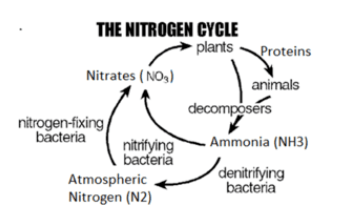
According to this diagram, plants use nitrogen to make _________________________

a)

bacteria

b)

animals

c)

proteins

d)

decomposers

112.
Example of a decomposer
a)
fungus
b)
mouse
c)
plants
d)
frogs
113.
A tree is a ....
a)
composer
b)
decomposer
c)
producer
114.
What is a producer?
a)
an organism that gets energy from eating other organisms
b)
an organisms that uses sunlight to make its own food
c)
an organism that gets energy from eating dead organisms, non-living material or waste
d)
an organism that uses chemical energy to make its own food
115.
What is a herbivore?
a)
an animal that gets energy from eating other animals
b)
an organism that gets energy from eating only plants
c)
an animal that gets energy by eating both plants and other animals
d)
an animal that eats only herbs
116.
What is a carnivore?
a)
an animal that gets energy by eating other animals
b)
An animal that gets energy by eating only plants
c)
an animal that gets energy by eating both plants and animals
d)
an animal that makes its own energy through photosynthesis
117.
An animal that gets energy from eating both plants and animals is a 
a)
herbivore
b)
carnivore
c)
omnivore
d)
autotroph
118.
The shrew provides energy for the _______?
a)
cricket
b)
grasshopper
c)
frog
d)
snake
119.
Which of the following is a herbivore?
a)
cricket
b)
frog
c)
hawk
d)
shrew
120.
The rabbit in this food web would be considered a:
a)
Decomposer
b)
Producer
c)
Secondary Consumer
d)
Primary Consumer
121.
The nonliving aspects of an ecosystem.
a)
Abiotic factors
b)
Biotic factors
122.
The living portions of the ecosystem.
a)
Biotic factors
b)
Abiotic factors
123.
As you move upward, from level to level, in an energy pyramid, energy _____.
a)
increases
b)
decreases
c)
stays the same
d)
increases exponentially
124.
A feeding relationship where one organism hunts and one is hunted.
a)
Commensalism
b)
Decomposistion
c)
Mutualism
d)
Predator-Prey
125.
An organism that helps to recycle nutrients within an ecosystem by eating dead or decaying organisms is a:
a)
Predator
b)
Autotroph
c)
Producer
d)
Decomposer
126.
This is known as a relationship in which one organism benefits, while the other is unaffected.
a)
Parasitism
b)
Mutualism
c)
Immigration
d)
Commensalism
127.
A clownfish uses a sea anenome as a safe place to live. While living there, the clownfish lures in food for the anenome. This is an example of what type of relationship?
a)
Predator-Prey
b)
Commensalism
c)
Mutualism
d)
Parasitism
128.
A mosquito feeds off of the blood of different organisms. This usually causes discomfort to the organism and sometimes disease and death. This is an example of:
a)
Parasitism
b)
Decomposition
c)
Commensalism
d)
Mutualism
129.
This is known as a relationship in which both organisms involved benefit. 
a)
Predator-Prey
b)
Commensalism
c)
Mutualism
d)
Decomposition
130.
A feeder fish usually follows behind sharks to pick up food scraps that they leave behind. The fish gets food and the shark is unaffected. This is an example of:
a)
Mutualism
b)
Commensalism
c)
Parasitism
d)
Decomposition
131.
This term refers to the total number of organisms that a particular habitat can support.
a)
Population
b)
Carrying capacity
c)
Ecosystem
d)
Niche
132.
In the energy pyramid here, which organisms have the most energy available?
a)
Producers
b)
Carnivores
c)
Herbivores
d)
Top Predator
133.
In the energy pyramid below, which organism has the least amount of energy available?
a)
Producers
b)
Herbivores
c)
Carnivores
d)
Top Predator
134.
If there is 1000 Kcal available in the producers in trophic level 1, how much energy is available in the herbivores in trophic level 2?
a)
10 Kcal
b)
1 Kcal
c)
100 Kcal
d)
1000 Kcal
135.
This diagram shows the amount of energy that moves from one feeding level to another in a food web.
a)
Energy Pyramid
b)
Food Web
c)
Ecosystem
d)
Food Chain
136.
In the energy pyramid here, how much of the energy in the producers gets passed to the herbivores?
a)
10%
b)
20%
c)
80%
d)
90%
137.
The Esophagus is an organ that connects?
a)
The mouth to the stomach
b)
mouth to the small intestine
c)
stomach to the large intestine
138.
A long folded tube inside the body attached to the stomach where nutrients in the food are absorbed.
a)
large intestine
b)
small intestine
c)
esophagus
d)
rectum
139.
An organ of the digestive system that makes chemicals to help the body break down fats and rid itself of harmful substances.
a)
esophagus
b)
mouth
c)
liver
d)
stomach
140.
What does stomach acid do?
a)
Chemically digests food in the mouth.
b)
Chemically digests food in the stomach
c)
Protects the stomach from digesting iteself
d)
Absorbs nutrients from food so the body has energy.
141.

The function of sneezing is to expel mucus containing foreign particles from the nasal cavity. A person sneezes when foreign particles pass through the nasal hair which triggers the release of chemical that activates body system causing sneezing. What body part is activated?

a)

circulatory system

b)

digestive system

c)

nervous system

d)

excretory system

142.
The _____ controls all the other organs, and processes all the information. 
a)
Nerves
b)
Spinal Cord
c)
Brain
143.

Which is not a function of the skeletal system?

a)

shape and support

b)

movement

c)

protection

d)

gas exchange

144.

A tough band of tissue that holds bones together at the joint are called a __________________________.

a)

tendon

b)

cartilage

c)

periosteum

d)

ligament

145.
What are the 3 types of muscle tissue?
a)
Thigh, Calf, & Shoulder
b)
Traps, Forearm, & Abs
c)
Hamstring, Biceps, & Triceps
d)
Smooth Muscle, Cardiac Muscle, & Skeletal Muscle
146.

Inhalation is the process that draws air into the lungs. How does the muscular system work with thre respiratory system to make inhalation possible?

a)

the chest muscle relaxes to let air flow into the respiratory system

b)

the smooth muscles of the esophagus relax to let air flow into the respiratory system

c)

the diaphragm muscle contacts to expand the chest and draw air into the respiratory system

d)

the skeletal muscles of the neck contract to pull on the pharynx and draw air into the respiratory system

147.

During a race, a person's breathing rate and heart rate increase. These changes most directly help the person do which of the following?

a)

increase the rate of digestion

b)

decrease the rate of gamete production

c)

decrease the rate of protein synthesis in neurons

d)

increase the rate of cellular respiration in mitochondria

148.

Information is detected by the eye and sent to the brain by which of the following structures?

a)

blood vessels

b)

sensory neurons

c)

smooth muscle

d)

cardiac muscle

149.

In the human heart, a group of cells in the wall of the right atrium produces nerve impulses that stimulate cardiac muscle. What do these nerve impulses directly control?

a)

the amount of oxygen in the blood

b)

the release of platelets into the blood

c)

the speed at which the heart pumps blood

d)

the path blood takes when it leaves the heart

150.

Which of the following is the best example of homeostasis in the human body?

a)

the secretions from oil glands in the skin decrease asa person ages

b)

the opposite muscles are used to bend and extend a person's arm at the elbow joint

c)

the villi of the small intestine increase the absorption of nutrients from the small intestine into the blood

d)

more growth hormone is released from the pituitary gland when the level of growth hormone in the body drops