wayground logo

Free Printable Worksheets

NEW

Font size

S
M
L
XL
Worksheets

Honors Exam #4

Total questions: 70

Worksheet time: 2hrs 42mins

Name
Class
Date
1.

During an endothermic reaction in a beaker if we are part of the surroundings and touched the beaker, it would feel _______.

a)

Warm

b)

Cold

c)

Bubbly

d)

Damp

2.
H2 + Cl2 --> 2 HCl + 1845 kJ
Is this reaction endothermic or exothermic?
a)
Endothermic 
b)
Exothermic
3.
H2 + 2 C + N+ 270.3 kJ --> 2 HCN
Is this reaction endothermic or exothermic?
a)
Endothermic 
b)
Exothermic
4.

The potential energy diagram of a reaction is shown. Which statement below is correct relating to this reaction?

a)

#1 represents the enthalpy change for this exothermic reaction.

b)

#2 represents the enthalpy change for this endothermic reaction.

c)

#3 represents the enthalpy change for this endothermic reaction.

d)

#4 represents the enthalpy change for this exothermic reaction.

5.

The diagram represents two solids and the temperature of each. What occurs when the two solids are placed in contact with each other?

a)

Heat energy flows from solid A to solid B. Solid A decreases in temperature

b)

Heat energy flows from solid A to solid B. Solid A increases in temperature

c)

Heat energy flows from solid B to solid A. Solid B decreases in temperature.

d)

Heat energy flows from solid B to solid A. Solid B increases in temperature.

6.

The amount of heat energy required to change the temperature of 12 g of gold from 45°C to 15°C is -47 J. What is the specific heat capacity of gold?

a)

0.13 J/(g°C)

b)

17,000 J/(g°C)

c)

1600 J/(g°C)

d)

0.065 J/(g°C)

7.

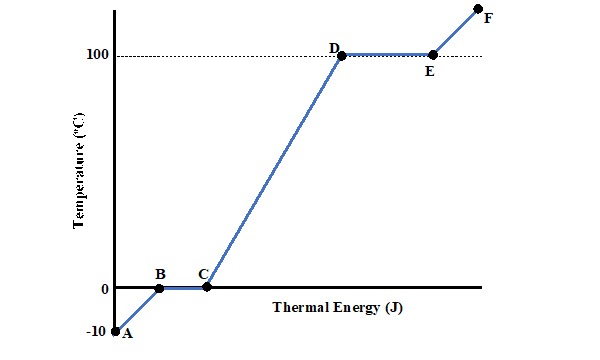
The graph represents the uniform heating of a substance, starting with the substance as a solid below its melting point. Which line segment listed below represents an increase in potential energy and no change in average kinetic energy?

a)

Line segment AB

b)

Line segment BC

c)

Line segment CD

d)

Line segment EF

8.
Heat flows from _______ to ______ objects
a)
cooler to warmer
b)
warmer to warmer
c)
warmer to cooler
d)
cooler to cooler
9.
The specific heat(c) of copper is 0.39 J/g °C. What is the temperature change(∆t) when 100 Joules of heat(Q) is added to 20 grams?
a)
12.82 °C
b)
24.12°C
c)
351 °C
10.
A chemical reaction that absorbs heat from the surroundings is said to be __________ and has a __________ ΔH at constant pressure.
a)
endothermic; positive
b)
endothermic; negative
c)
exothermic; negative
d)
exothermic; positive
11.
If the enthalpy ter (ΔH) is negative the reaction is ____.
a)
Endothermic
b)
Exothermic
c)
Neutral
12.
How much heat does an aluminum block absorb if 10.00 grams ae heated from 25.0oC to 50.0oC? the specific heat of aluminum is .900J/goC
a)
450
b)
-450
c)
225
d)
-225
13.
Durning a phase change the temperature of a substance_________.
a)
always increases
b)
always decreases
c)
always stays the same
d)
varies
14.
A 24.0 gram sample of copper was heated from 25.0oC to 500.0oC, 4378J of heat were absorbed, what is the specific heat of copper?
a)
.384
b)
49909200
c)
2.60
d)
8.77
15.
The amount of energy released or absorbed when one mole of a compound is formed from its elements
a)
heat of reaction
b)
heat of combustion
c)
 heat of completion
d)
heat of formation
16.
Which of the following is an endothermic process?
a)
solid to gas
b)
liquid to solid
c)
solid to liquid
d)
gas to liquid
17.
Which of the letters (A-D) represents activation energy?
a)
A
b)
B
c)
C
d)
D
18.

Between which two points is Heat of Fusion?

a)

A <----> B

b)

B <----> C

c)

C <----> D

d)

D <----> E

e)

E <----> F

19.
In which segment is the kinetic energy remaining constant?
a)
A-B
b)
B-C
c)
C-D
d)
E-F
20.
The graph shows a cooling curve for an unknown substance.  What is happening during segment DE?
a)
boiling
b)
condensation
c)
freezing
d)
melting
21.

How energy does it take to heat 60g of ice at -20C to a temperature of 75C?

a)

-19980 J

b)

2460 J

c)

19980 J

d)

41250 J

22.

What is the purpose of a catalyst?

a)

Helps to slow down a reaction

b)

Raises the activation energy

c)

Lowers the activation energy

d)

Is consumed by the reaction

23.

What factors effect rate of reaction?

a)

Temperature, Concentration, Pressure and Energy

b)

Surface Area, Concentration, Energy and Pressure

c)

Temperature, Pressure, Concentration and Surface area

d)

Pressure, Surface area, Density and Energy

24.

What criteria must be met for reactant collisions to result in a successful product?

a)

The reactants must collide with each other

b)

The reactants must collide with enough energy and be in the right positions

c)

The reactants must have enough energy to form the activated complex

25.
What two factors govern whether a collision between reacting particles will be effective?
a)
orientation and potential energy 
b)
kinetic energy and temperature 
c)
kinetic energy and orientation 
d)
potential energy and kinetic energy 
26.

Why does a higher temperature increase the rate of a reaction?

a)

it increases both the frequency and energy of particle collisions

b)

it only increases the frequency of particle collisions

c)

it only increases the energy of particle collisions

d)

it reduces the activation energy of the reaction

27.
The symbol for entropy is
a)
H
b)
S
c)
G
28.
The symbol for enthalpy is
a)
S
b)
H
c)
G
29.
A measure of the disorder of a system
a)
enthalpy
b)
entropy
c)
energy
d)
free energy
30.
When ammonium nitrate dissolves in water, the solution gets cold. Which is true?
a)
Reaction is ENDOTHERMIC with positive ΔH
b)
Reaction is ENDOTHERMIC with -ΔH
c)
Reaction is EXOTHERMIC with a -ΔH
d)
Reaction is EXOTHERMIC with +ΔH
31.

Which of the following would most likely lead to a spontaneous reaction.

a)

A high negative enthalpy.

b)

A low negative enthalpy.

c)

A high positive enthalpy.

d)

A low positive enthalpy.

32.
Which type of radiation has the greatest penetrating power?
a)
Alpha
b)
Beta
c)
Gamma 
d)
Microwaves
33.
What happens to the atomic number during alpha decay?
a)
The atomic number decreases by 4
b)
The atomic number increases by 1
c)
The atomic number decreases by 2.
d)
The atomic number stays the same.
34.
Arrange in order of increasing ability to penetrate matter.
a)
Beta, gamma, alpha
b)
Alpha, gamma, beta
c)
Gamma, beta, alpha
d)
Alpha, beta, gamma
35.
Balance the following equation:
146C --> 0-1e + ________
a)
145B
b)
146C
c)
147N
d)
42He
36.
Barium-122 has a half-life of 2 minutes. A fresh sample weighing 80 g was obtained. If it takes 10 minutes to set up an experiment using barium-122, how much barium-122 will be left when the experiment begins?
a)
0.25g
b)
2.5g
c)
25g
d)
80g
37.
If Thorium-234 undergoes a beta decay, What element will be left in its place?
a)
Actinium-234
b)
Thorium-233
c)
Protactinium-234
d)
Radium-230
38.
Which of the following is an example of nuclear fusion? 
a)
A plutonium atom is used to start a chain reaction that detonates a nuclear weapon 
b)
A uranium atom is split apart into lighter elements
c)
 Two hydrogen atoms are combined to form a helium atom
d)
Two hydrogen atoms bond with an oxygen atom to form a water molecule 
39.
This is an example of...
a)
Fission  reaction
b)
Fusion reaction
c)
Decomposition reaction
d)
Combustion
40.
If we start off with element 5024X after an gamma decay we get another element that looks like
a)
5224X
b)
5023X
c)
5024X
d)
5025X
41.
If we start off with element 5024X after an beta decay we get another element Y that looks like
a)
5023Y
b)
4622Y
c)
5025Y
d)
5024Y
42.
If we start off with element 5024X after an alpha decay we get another element Y that looks like
a)
5022Y
b)
 4622Y
c)
4820Y
d)
5426Y
43.
What are the two factors to look for when determining if the reaction is at equilibrium?
a)
Forward reaction rate is faster than the reverse and concentrations are equal
b)
Forward and reverse reaction rates are equal and concentration is conctant
c)
Forward and revers reaction rates are equal and concentration is equal
d)
Forward reaction rate is faster than the reverse and concentration is equal
44.

2SO2(g)+1O2(g) ⇌ 2SO3(g) + Heat


Increasing the pressure on the system will...

a)

shift equilibrium right

b)

shift equilibrium left

c)

slow rate of reaction

d)

have no change

45.

CoCI42- +6H2O →Co(H2O)62+ + 4CI-


What will happen when CI- ions are added?

a)

Position of equilibrium will shift to left and become more pink

b)

Color of system will turn to all pink

c)

Concentration of reactants and products remain unchanged

d)

Position of equilibrium will shift to left to reduce the added CI- ions

46.

1N2 + 3H2 →2NH3


When the pressure on the system is increased, the equilibrium position shifts to the right. Why?

a)

To increase the amount of products

b)

To reduce the pressure, as the right side has fewer molecules of gas

c)

Keq will increase when it is shifted to the right

d)

To increase the pressure, as the right side has more molecules of gas

47.

2SO2(g)+1O2(g) ⇌ 2SO3(g) + Heat


Increasing the pressure on the system will...

a)

shift equilibrium right

b)

shift equilibrium left

c)

slow rate of reaction

d)

have no change

48.

2SO2(g) + O2(g) ⇌ 2SO3(g) + Heat


Adding a catalyst will

a)

shift equilibrium right

b)

shift equilibrium left

c)

decrease percent yield

d)

not affect equilibrium

49.

CoCI42- +6H2O →Co(H2O)62+ + 4CI- + Heat


What will happen when the temperature is increased?

a)

Position of equilibrium will shift to left and become more blue

b)

Position of equilibrium will shift to right and become more pink

c)

No change in position of equilibrium

d)

Position of equilibrium will shift to left and become more pink

50.
For the reaction...
N2 (g) +  3 H2 (g) <=> 2 NH3 (g)

If the pressure in the system is increased,  which substance(s) will increase in concentration?
a)
N (as 2 mol gas  → 4 mol gas)
b)
H2 (as 2 mol gas  → 4 mol gas)
c)
N2 and H(as 2 mol gas  → 4 mol gas)
d)
NH3 (as 4 mol gas  → 2 mol gas)
51.
An equilibrium constant with a large value, e.g. Kc = 1000, indicates…
a)
A very fast reaction
b)
Mostly products at equilibrium
c)
Mostly reactants at equilibrium
d)
Nothing useful at all
52.
What are [A] and [B]?
a)
concentration of reactants
b)
concentration of products
c)
energy of reactants
d)
energy of products
53.
At 10 atm, dry ice is heated from -100 °C to 30 °C.  What changes occur?
a)
freezing, then condensation
b)
melting only
c)
sublimation only
d)
melting, then boiling
54.
What is the normal melting point of CO2?
a)
-78.5 °C
b)
-56.7 °C
c)
31 °C
d)
It doesn't have a normal melting point.
55.
Which statement is true for carbon dioxide at -60 °C?
a)
All three phases are possible.
b)
It can exist as a solid or a gas, depending on pressure.
c)
It is a solid.
d)
With enough pressure it can be melted.
56.
What is true regarding CO2 for temperatures above 31 °C?
a)
It can never be liquified.
b)
It decomposes.
c)
It has a high pressure.
d)
It is a plasma.
57.

_____________ is a dynamic condition in which two opposing changes occur at equal rates in a closed system.

a)

equilibrium vapor pressure

b)

sublimation

c)

equilibrium

d)

volitile liquid

58.

________ is the change of state from a gas directly to a solid.

a)

sublimation

b)

deposition

c)

condensation

d)

evaporation

59.
The change of state from a solid to a gas is called _________.
a)
sublimation 
b)
depositoin
c)
condensation
d)
evaporation
60.
The temperature and pressure conditions at which the solid, liquid, and vapor of a substance can coexist  at equilibrium is ______
a)
critical point
b)
triple point
c)
double point
d)
critical pressure point
61.
Name this compound
a)
2,2-dimethyl-4-ethylhexane
b)
4-ethyl-2,2-dimethylhexane
c)
3-ethyl-5,5-dimethylhexane
d)
4-ethyl-2-methylhexane
62.
Name the compound.
a)
nonene
b)
2,2-dimethyl-3-heptene
c)
1,1,5-trimethyl-2-hexene
d)
2,6-dimethyl-3-heptene
63.
Name the compound
a)
3,4-dipropylhexane
b)
3,4-diethyl-3,4-dimethylhexane
c)
Twelvane
d)
3,3,3,4,4,4-hexamethylhexane
64.
what kind of molecule is this?
a)
alkane
b)
alkene
c)
alkyne
d)
cycloalkane
65.

How many kilojoules are given off when 120 grams of water are cooled from 25o C to -25o C?

a)

51.2 kJ

b)

47.6 kJ

c)

58.7 kJ

d)

66.9 kJ

66.

How many apples grow on an apple tree?

a)

This is a dumb question that has nothing to do with chemistry...

b)

Apples grow in the produce section at Trader Joe's.

c)

83

d)

All apples grow on trees, silly.

67.

What is brown and sticky?

a)

I have no idea...

b)

strawberry ice cream

c)

a sardine and onion sandwich

d)

a stick

68.

How many kilojoules are required to heat 75 grams of water from -85 oC to 185 oC?

a)

1093 kJ

b)

251.8 kJ

c)

333 kJ

d)

528.1 kJ

69.
Name the following
a)
4-ethyl-6-methyl nonane
b)
3-propyl-5-methyl octane
c)
2,4-dipropyl hexane
d)
4-ethyl-2-propyl heptane
70.

What is the correct structure for 2 - butene?

a)
b)
c)
d)